A finance agent pulls transaction records from an expense API to explain a flagged charge, and one of the returned line items still carries a colleague’s full bank account number, sitting in an old memo field nobody scrubbed. The agent has no reason to treat that field any differently from the merchant name next to it, so both end up quoted in its summary back to the requester. Nobody wrote a rule that let this through. Nobody wrote one that caught it either, because the check everyone remembers to build watches what the user types, not what comes back from a tool call.
Key takeaways
- PII enters an LLM pipeline at four places: user input, retrieved context, tool results, and model output.
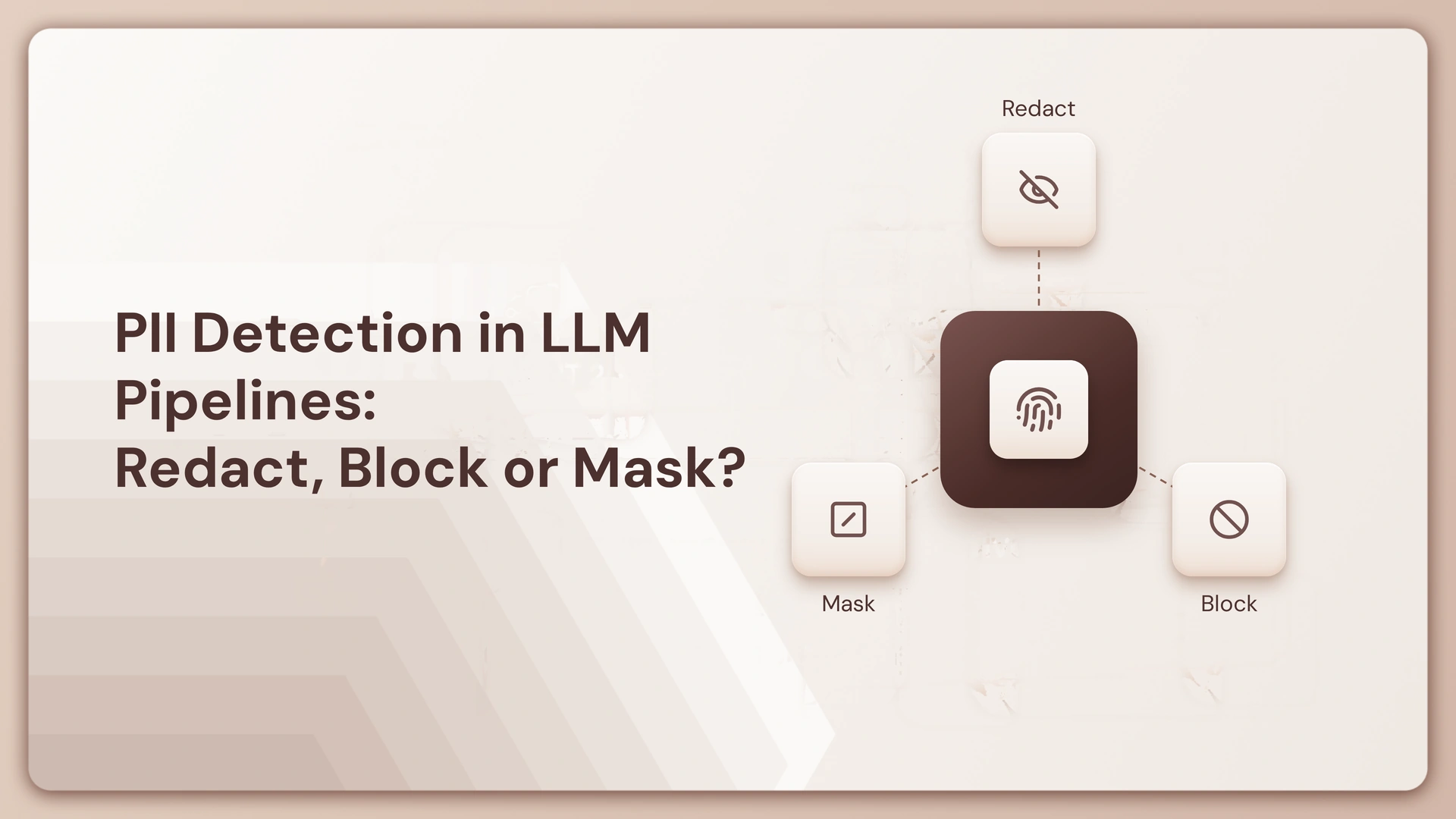
- Once flagged, there are exactly three ways to handle it: redact, mask, or block the request outright.
- The right one depends on where you are in the pipeline and whether the step downstream needs the entity’s real content.
- Production systems layer detection rather than relying on one method: pattern matching for structured PII, NER, and contextual models for the rest.
- IBM’s 2025 Cost of a Data Breach Report found 53% of breaches involved compromised customer PII, rising to 65% in breaches involving shadow AI.
- Redact, mask, and block only work if enforced the same way at every entry point, not configured once and forgotten elsewhere.
What is PII detection in LLM pipelines?
PII detection in LLM pipelines is the practice of automatically identifying personal data anywhere it appears inside an LLM application, not just what a user types, but what gets retrieved, what a tool returns, and what the model writes back, so it can be handled before it causes any harm.
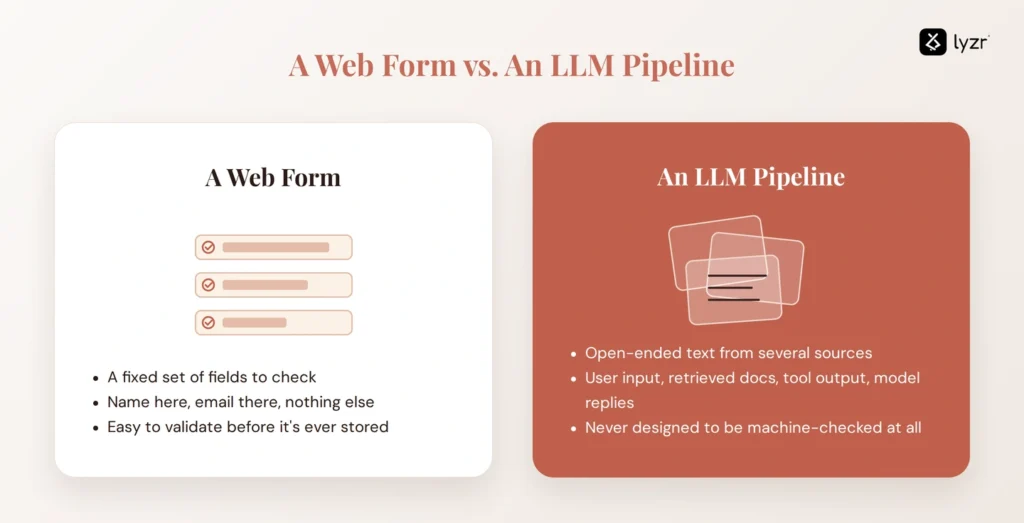
NIST defines PII as anything that can trace an individual’s identity: a name, Social Security number, date and place of birth, plus any other information linked or linkable to that person, including medical, financial, or employment records. That definition predates large language models by more than a decade, which is why detecting PII inside one is harder than it sounds: a web form has a fixed set of fields to check, while an LLM pipeline has open-ended text arriving from several places, most of it never designed to be machine-checked at all.
OWASP’s LLM02:2025 Sensitive Information Disclosure category names PII specifically among the data an LLM can expose, alongside financial details, health records, and credentials, and lists tokenization and redaction among its recommended mitigations. Detection is the first half of the job. Choosing what to do with what you find is the second.
Where PII actually enters an LLM pipeline, and how it gets caught
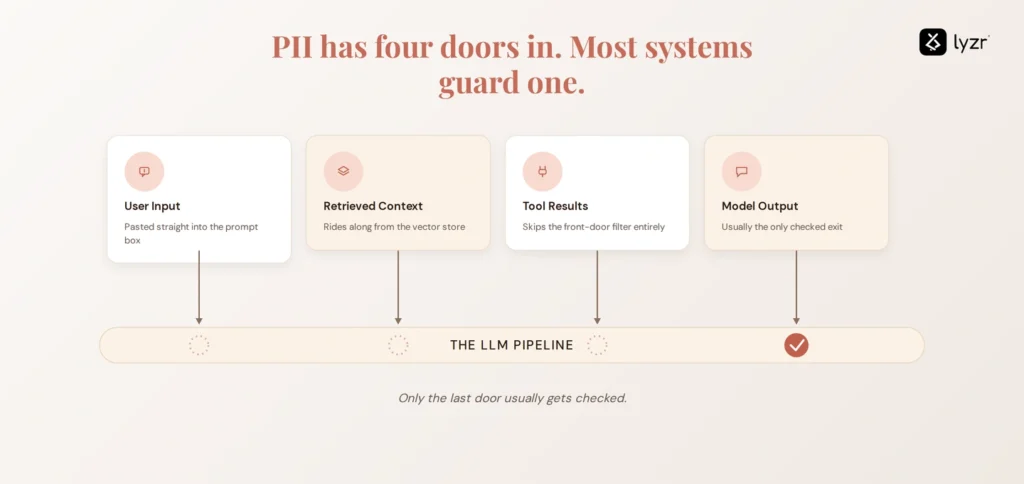
PII doesn’t have one door into an LLM pipeline. It has at least four, and most teams only build a check for one of them.
User input is the obvious one: personal details pasted into a prompt without a second thought, because the box in front of the user looks like a search bar, not a form.
Retrieved context is less obvious and often bigger. A retrieval-augmented generation system pulls chunks out of a vector store to ground an answer, and if the source documents contain PII, which in a support or HR knowledge base they usually do, it rides along into the context window unreviewed.
Tool results are the entry point most setups miss. When an agent calls an external API, the response enters the conversation the same way a user’s own message would, but it never passes through the filter at the front door.
Model output is the last stop, and the one most tools focus on, since it’s the easiest to intercept. By the time PII shows up here, though, it’s often just repeating something that entered earlier, undetected, at one of the other three points.
These points differ in structure and speed needs, so production systems layer detection rather than lean on one method. Pattern matching and checksums catch structured PII, things like emails, card numbers, and government IDs, in a millisecond. Named entity recognition catches names and addresses that don’t follow a fixed pattern. Contextual, LLM-based detectors catch what the first two miss: PII that’s implied rather than stated outright.
Redact, mask, or block: three ways to handle PII once it’s found
Detecting PII is only half of the job. Once something is flagged, a pipeline has exactly three moves available, and reaching for the wrong one is how a privacy control ends up breaking the product it was built to protect.
Redact
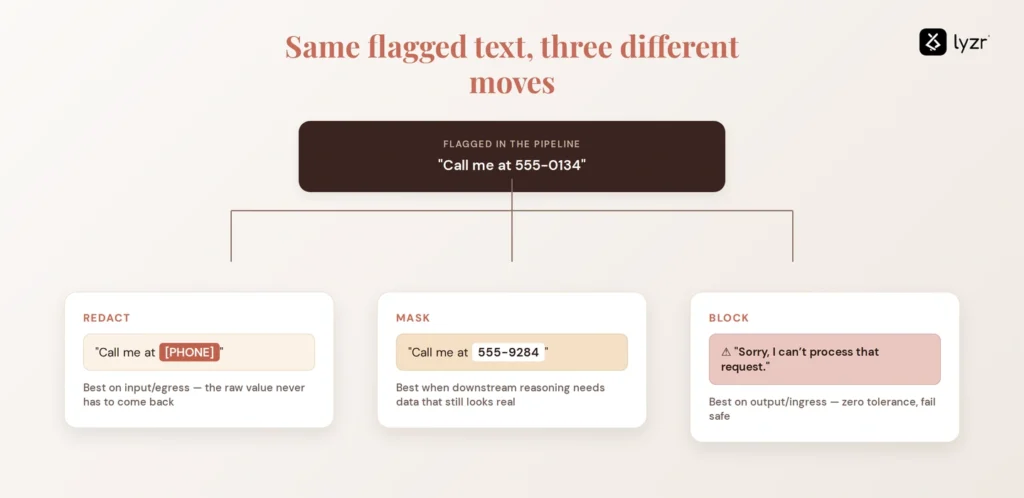
Redaction replaces the real value with a generic tag, so “call me at 555-0134” becomes “call me at [PHONE].” It’s the simplest control to build, since the raw value is gone with no path back to it, and the easiest to explain to an auditor.
That permanence is the limit too. Redaction works well on the input or egress path, stripping personal data out before it leaves your trust boundary. It works badly when the model needs to keep tracking that entity across a conversation: ask it to follow up on “that phone number” three turns later, and there’s nothing left.
Mask
Masking swaps the real value for a synthetic one that still looks and behaves like real data: a fake name, a dummy phone number in a valid format, optionally reversible on the way back so the legitimate owner still sees their own information.
This is the right move whenever the downstream task depends on the text making sense as a whole: summarizing a case file or letting an agent reason over a customer record. The mapping table behind a reversible mask now becomes an asset that has to be secured. Lose it, and you’ve never really masked anything.
Block
Blocking skips rewriting entirely: if a request or response trips the policy, the pipeline halts it and returns an error instead.
This belongs on the output or ingress side, where policy has zero tolerance for a category of data, and any version of it reaching a user counts as a hard compliance failure no matter how carefully it was rewritten. Failing safe is the point. The cost shows up elsewhere: a detector tuned too aggressively turns “sorry, I can’t process that” into the most common response a user sees.
Redact vs. mask vs. block: which one fits where
None of these three is a general-purpose answer. The difference comes down to where in the pipeline you’re standing and what the next step needs from the text.
| Mode | Best pipeline stage | Use it when | Watch out for |
| Redact | Input/egress, before data leaves your trust boundary | The raw value never needs to be seen again | Breaks multi-turn tracking of the same entity |
| Mask | Anywhere semantic flow matters | The downstream task needs the text to still make sense | The mapping table becomes a new asset to secure |
| Block | Output/ingress, zero-tolerance categories | Any leak is a hard compliance failure | False positives cost real user experience |
Two questions settle it. First, does the next step actually need this entity’s real content to do its job, or would something else in its place work just as well? Second, are you catching the data on the way in, before it reaches a model, or on the way out, before it reaches a user? Answer both, and the right mode is usually obvious.
Getting started: setting a PII policy across your LLM pipeline
Most teams that believe they’ve handled PII have only built one of the four checks. Usually it’s on the model’s output, because scanning what comes out at the end is simpler to set up than adding a separate check at every point PII can get in. Closing the gap starts with mapping where PII actually enters your pipeline, instead of assuming it’s just the prompt.
From there, decide per entry point, not globally, whether redaction or masking is tolerable, or whether the data needs a hard block, and pilot on the highest-risk path first, typically wherever customer data leaves through a third-party model API.
For a structured read on where your organization stands before building any of this, Lyzr’s agent governance maturity assessment is a reasonable place to start.
How Lyzr OpenController brings policy enforcement to your PII decisions
Deciding whether to redact, mask, or block at a given point is a policy question, and the framework above answers it. Making sure that decision holds on every prompt, every retrieved chunk, every tool result, and every response, without someone quietly turning it off under deadline pressure, is an infrastructure question, and that’s where most PII programs fail.
OpenController’s four connected capabilities, Find, Ship, Run, and Improve, apply to any policy an agent or workflow needs to follow, and a redact, mask, or block decision is one instance of that. Find discovers agents, tools, data, and workflows across an organization’s AI estate, a starting point for knowing which pipelines touch personal data at all. Ship is where an agent or workflow gets evaluated and validated against policy, whatever that policy says, before it reaches production. Run enforces that policy live, in the request path, on every call, rather than auditing it after the fact. As OpenController’s own team puts it, a dashboard can’t stop an agent: control has to happen in the path. Improve turns what Run observes back into policy updates.
If you’d rather see it than read about it, book a demo.
FAQ
Automatically identifying personal data anywhere it moves through an LLM application, user input, retrieved context, tool results, and model output, so it can be redacted, masked, or blocked before it causes harm.
Redaction replaces a real value with a generic tag, like [SSN] or [PHONE], with no way back to the original. Masking replaces it with a synthetic, format-valid stand-in, optionally reversible for the legitimate owner.
When the data involved makes any leak a hard compliance violation regardless of how it’s rewritten, typically on the output or ingress side. Blocking trades some user experience for a guarantee that nothing gets through.
PII can enter an LLM at four points: user input, retrieved context, tool or API results, and model output. Most detection setups only cover the last one.
Book A Demo: Click Here
Join our Slack: Click Here
Link to our GitHub: Click Here