For two decades, SEO has been a discipline of manual diligence: researching keywords by hand, auditing pages one by one, and waiting weeks to see whether a change moved the needle. That era is ending. AI agents — software systems that can plan, execute, and adapt across multi-step tasks with minimal human input — are now taking over large chunks of the SEO workflow. Unlike traditional automation, which follows fixed rules, these agents can reason about a goal, choose their own steps, and adjust course based on what they find along the way. For marketers, this shift isn’t just about saving time. It’s changing what SEO work even looks like.
What Makes an “Agent” Different From a Tool
Most SEO software to date has been reactive: you ask a question, it gives you an answer. Rank trackers report positions. Audit tools flag broken links. Keyword tools return search volume. A human still has to interpret the output and decide what to do next. As part of that process, SEO audits help uncover the technical and structural issues that still require someone to evaluate the findings and decide on the right course of action.
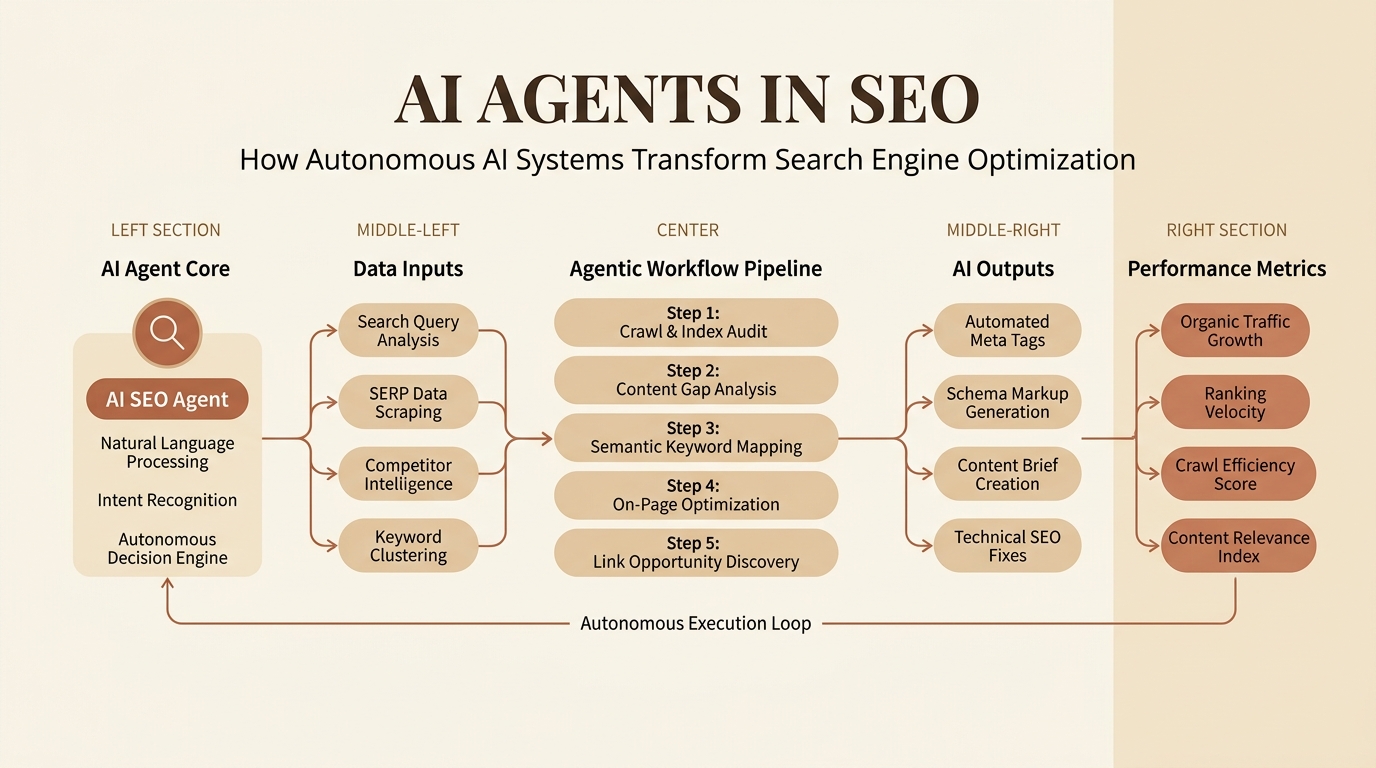
AI agents flip this model. Instead of answering a single query, you give an agent an objective — “improve organic traffic to our product pages” or “identify and fix technical issues suppressing crawl efficiency” — and it breaks that objective into subtasks, executes them using available tools (site crawlers, APIs, content generators, analytics platforms), evaluates the results, and iterates. Some agents can even trigger actions directly, like updating a meta description or submitting a sitemap, without waiting for a person to click “approve.”
This distinction matters because it changes the unit of labor in SEO from “task” to “outcome.” A marketer no longer has to specify every step; they specify the destination and let the agent figure out a path.
Where AI Agents Are Already Being Used
Technical audits. Agents can crawl a site, identify structural issues — orphaned pages, duplicate content, slow load times, broken internal links — and in many cases draft or apply fixes automatically. Instead of a monthly manual audit, some teams now run continuous, agent-driven monitoring that surfaces issues within hours of them appearing. As a result, enterprise SEO services can use this continuous oversight to catch technical issues much earlier and keep websites performing consistently. This approach enhances a comprehensive SEO audit service by providing ongoing visibility into technical issues and enabling faster resolution before they impact search performance.
Content research and briefs. Agents can analyze the AI visibility of and top-ranking pages for a target query, extract common subtopics and entities, compare against a client’s existing content, and generate a structured brief — or a full draft — tailored to close identified gaps. This doesn’t replace a skilled writer, but it collapses the research phase from hours to minutes. The same process also gives an AI video agent a stronger foundation for creating videos that stay aligned with the key topics, entities, and search intent identified during research.
Internal linking and site architecture. Agents can map a site’s link graph, detect where authority isn’t flowing to priority pages, and propose (or implement) new internal links to correct it. This kind of structural work used to require spreadsheets and manual cross-referencing; agents can do it at a scale no person could match. For off-page authority building, incorporating specialized comparison databases like FatGrid allows teams to instantly audit competitor backlink profiles and verify fair market pricing across major guest-posting marketplaces.
Rank and SERP monitoring with reasoning. Rather than just reporting that a google ranking suddenly dropped, an agent can investigate why — checking for algorithm updates, competitor changes, technical regressions, or content decay — and summarize a likely cause along with a recommended response. This kind of analysis also helps shape generative engine optimization services by showing what content needs to be improved to stay visible in AI generated results.
Answer-engine and AI-search optimization. As more search happens inside AI chat interfaces and AI-generated overviews rather than traditional blue links, agents are being used to monitor how brands are represented in those AI answers and to adjust content so it’s more likely to be cited as a source. Utilizing a targeted AI brand mentions service further ensures that your company is proactively recommended and accurately cited when LLMs answer user queries within your niche.
The Upside
The most obvious benefit is speed. Tasks that used to take a specialist a full day — a comprehensive technical audit, a competitive content gap analysis — can now run in the background and return a summarized report before lunch. For SEO teams operating inside enterprises with large websites, complex workflows, and growing optimization demands, this makes it possible to scale research, monitoring, and execution without requiring significantly more headcount. This lets SEO teams operate at a scale that used to require significantly more headcount. Along the same lines, SIXGUN focuses on scalable SEO strategies that help businesses manage growing websites without sacrificing quality or long-term performance.
There’s also a consistency benefit. Human auditors get tired, skip steps, or apply inconsistent standards across pages. An agent applies the same criteria every time, across every page, without fatigue. For large sites with thousands of URLs, this uniformity can surface issues a manual process would simply never reach.
Finally, agents shift human attention toward judgment calls rather than data gathering. Instead of spending hours pulling reports, an SEO strategist can spend that time deciding which of the agent’s recommendations actually align with brand voice, business priorities, or user experience — the parts of the job that still require a human perspective. To bring these disparate data streams together, managers can create a custom SEO dashboard that visualizes machine-driven performance shifts and agent actions in one unified interface.
The Risks and Limitations
Agents are only as good as the goals and guardrails they’re given. An agent optimizing purely for “more organic traffic” might generate large volumes of thin, formulaic content, or make changes that technically satisfy a metric while degrading the actual user experience. Search engines have gotten better at detecting and penalizing exactly this kind of low-value, mass-produced content, so an unsupervised agent can do real damage to a site’s reputation if left unchecked. To reduce this risk, many teams include an AI Humanize step, using a tool to humanize AI text, in their editorial workflow to refine AI-generated drafts, improve readability, ensure the content feels natural before it is published, and verify originality with an AI detector before publishing.
There’s also a transparency problem. When an agent chains together multiple tool calls and decisions, it’s not always easy to reconstruct why it made a particular change — which becomes a real liability if that change turns out to hurt rankings. Teams adopting agentic SEO tools need clear logging and rollback capability, not just automation. This becomes especially important as agents move from suggesting changes to making them directly updating meta descriptions, editing code, or restructuring internal links without a human clicking approve first. Every autonomous write action is a new entry point into your systems, and it’s worth treating agent-driven changes with the same security scrutiny as any other automated deployment. Tools like Aikido scan the code and infrastructure agents touch for vulnerabilities and misconfigurations before those changes reach production, giving teams a check on a process that otherwise runs with minimal oversight.
Finally, agents still struggle with judgment calls that require deep brand or business context: what tone is appropriate, which product should be prioritized, what claims are legally defensible. These are not tasks to hand off without a human checkpoint.
How to Adopt AI Agents Responsibly
Most teams succeed by starting narrow: pick one well-defined workflow — technical audits or content briefs are common starting points — and run the agent alongside existing human review before removing that review entirely. Set explicit boundaries on what the agent can do autonomously versus what requires sign-off, especially for anything that touches published content or site structure directly. And keep measuring outcomes, not just activity; an agent that produces a lot of output isn’t valuable unless that output moves rankings, traffic, or conversions in the right direction. The same outcome-focused mindset also applies when expanding agentic AI into other marketing functions, such as building an email marketing strategy, where AI agents can automate audience segmentation, personalization, and campaign optimization while still requiring human oversight.
Looking Ahead
AI agents aren’t going to replace SEO strategists, but they are rapidly absorbing the repetitive, data-heavy parts of the job that used to consume most of an SEO professional’s week. The practitioners who benefit most will be the ones who learn to direct agents effectively — setting the right goals, building in the right checks, and reserving their own judgment for the decisions that actually require it. In a field that has always rewarded early adopters of new tools, agentic AI looks like the next line worth getting ahead of.
Book A Demo: Click Here
Join our Slack: Click Here
Link to our GitHub: Click Here