TL;DR
- A framework agnostic platform runs AI agents built on any framework – LangChain, CrewAI, AutoGen, custom – without rewrites.
- True agnosticism requires independence across three axes: agent framework, LLM, and cloud infrastructure.
- 81% of enterprise leaders express concern about dependency on specific AI vendors, with 29% saying they’re very concerned.
- Only one in five companies surveyed report currently having a mature model for governance of autonomous agents.
- Standardize on the governance layer – the Control Plane – not the framework layer.
Your team is being asked to pick a framework. LangChain. CrewAI. AutoGen. Maybe Agentforce. The pressure is real – your CIO wants a standard, your board wants a roadmap, and your engineers want to ship. The problem is that picking a framework is the wrong question. Frameworks are execution engines. They tell agents how to reason, call tools, and pass messages. They do not tell you how to govern those agents, audit their decisions, deploy them across clouds, or swap the model underneath when a cheaper or better one ships next quarter. The platform that answers those questions is not a framework. It is what runs above the frameworks.
What is a framework agnostic platform?
A framework agnostic platform is an enterprise system designed to build, deploy, and govern AI agents regardless of their underlying framework. It allows your teams to run LangChain, CrewAI, AutoGen, LangGraph, Agentforce, or custom-built agents on a single platform – without rewriting any of them. The focus shifts from standardizing on a single, restrictive framework to standardizing on a unified governance layer that runs above them. True agnosticism operates across three axes: the agent framework, the large language model, and the cloud infrastructure. Fail on any one axis and you have traded one form of lock-in for another. The mechanism that enforces this independence is the Control Plane – the layer that manages policy, identity, audit, and observability for every agent in your fleet, regardless of how it was built.
Why “framework agnostic” matters more in 2026
Your teams are already building on multiple frameworks. One squad chose LangChain for its ecosystem. Another picked CrewAI for role-based agents. A third is running AutoGen for multi-agent conversations, and someone in the corner has a custom Python stack they are quietly proud of. This is agent sprawl – and it is not a failure of discipline. It is the natural result of a market where frameworks evolve faster than any single team can track.
The pressure to standardize is understandable. But standardizing on the wrong layer creates a problem that is genuinely hard to reverse. As teams build multi-step AI agents that call tools, query databases, and coordinate with other agents, the orchestration logic becomes tightly coupled to a single vendor’s framework. Rebuilding those workflows on a different platform is not a configuration change. It is a development project. Unlike model lock-in – where swapping an API call takes hours – framework lock-in compounds with every agent you ship.
The business risk is quantified. According to a 2026 Zapier survey, 81% of enterprise leaders express concern about dependency on specific AI vendors, with 29% saying they’re very concerned. More concretely, nearly three-quarters (74%) of enterprise executives say losing their AI vendor would disrupt day-to-day operations or leave them unable to function.
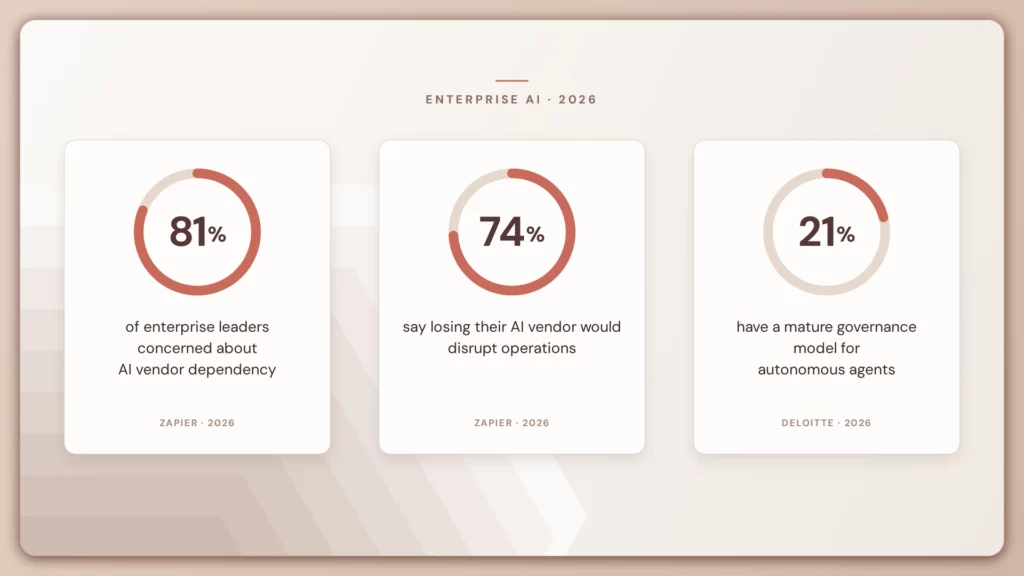
The governance gap makes this worse. Agentic AI usage is poised to rise sharply in the next two years, but oversight is lagging: only one in five companies has a mature model for governance of autonomous AI agents, according to Deloitte’s State of AI in the Enterprise 2026 report. That means most organizations are accumulating framework lock-in without the governance infrastructure to manage it. A framework agnostic platform solves both problems at once.
The three axes of agnosticism
Every vendor at RSA, re:Invent, and Google Cloud Next this year claimed to be “agnostic.” Most are not. Use this three-axis test before you sign anything.
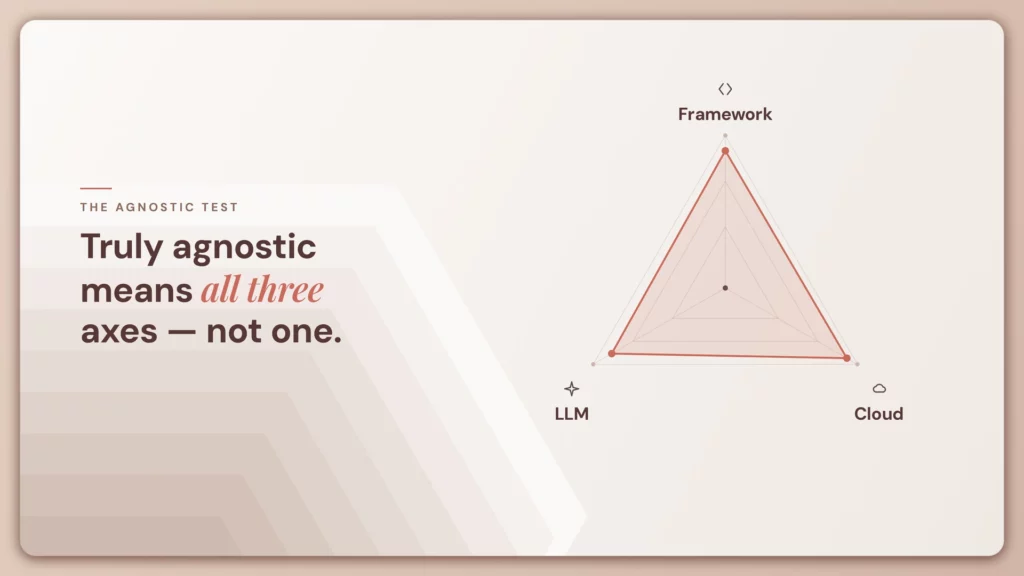
Framework agnostic means the platform runs agents built on any framework – LangChain chains, CrewAI crews, AutoGen agent groups, LangGraph graphs, custom Python – without requiring rewrites. Your existing agents run as first-class citizens, not as imports to a proprietary converter.
LLM agnostic means swapping models is a configuration change, not a code change. The control plane sits above your LLM choice. You should be able to swap GPT-4o for Claude, or Gemini for Llama, without touching your agent logic. This matters for cost, performance, and compliance – particularly as regulations in the EU and Asia specify where AI processing can occur.
Cloud agnostic means the same agent application deploys on AWS, Azure, GCP, in a VPC, on-premise, or in a hybrid environment without modification. Teams should be able to deploy the same agent to different clouds by switching the target runtime – the pipeline adapts automatically.
The test is binary. If a vendor scores on one axis but requires rewriting agents (framework lock-in), hard-codes a model provider (LLM lock-in), or ties deployment to a single cloud (cloud lock-in), they are not truly agnostic. They are a lock-in strategy with better marketing.
What “framework agnostic” actually means (five evaluation criteria)
Here is where vendor claims collapse under scrutiny. Five criteria separate real framework agnosticism from the three patterns that masquerade as it: a proprietary framework with a few competitor SDKs bolted on, a thin wrapper around one framework’s core, or genuine multi-framework support at the runtime layer. Only the third is real. Test for it.
Criterion 1: Import existing agents without rewrite. A LangChain chain, a CrewAI crew, an AutoGen agent group – each should run as a native component on the platform. You should be able to drop in agent code from any framework – LangGraph, CrewAI, Strands, or custom – and the platform handles everything from there. If the first step is exporting your agents into a proprietary YAML format, stop the evaluation.
Criterion 2: Unified observability across frameworks. You need one audit trail and one management console for all agents, regardless of framework. Fragmented observability – one dashboard for LangChain agents, another for CrewAI, a third for AutoGen – is operationally unmanageable and a compliance failure waiting to happen.
Criterion 3: Consistent governance regardless of underlying framework. Role-based access control (RBAC), data handling policies, and hallucination controls must be enforced by the platform – not left to individual developers to implement in prompts. Role-based access, audit logging, and compliance controls should be built in, not bolted on. Governance that lives in the prompt is not governance.
Criterion 4: Deployment portability. Build once, deploy anywhere. Full data privacy and sovereignty should be maintained – agents run within your cloud environment, not on shared infrastructure. The platform must handle cloud-specific infrastructure details without requiring separate deployment pipelines for each environment.
Criterion 5: Model portability at runtime. You must be able to swap the LLM an agent uses with a configuration change – not a redeployment. This enables cost routing, performance optimization, and compliance with data residency requirements, all without touching agent logic.
Best framework agnostic AI agent platforms in 2026
Six platforms lead the AI agent category in 2026. Each takes a different approach to the framework-agnostic problem, and each fits a different buyer state.

Lyzr takes the Control Plane approach. It runs LangChain, CrewAI, AutoGen, and custom agents as first-class nodes inside one governance layer, with model routing across OpenAI, Anthropic, Google, and open-source LLMs, and deployment across AWS, Azure, Google Cloud, VPC, or on-premise. Enterprise controls (SOC 2, ISO 27001, RBAC, audit logging, hallucination monitoring) ship built-in. Named customers include Accenture, JPMorgan Chase, Pepsi, and Crown Castle. Best fit: Fortune 2000 enterprises with agent sprawl across multiple frameworks and a mandate to consolidate governance.
LangSmith is the observability platform from the LangChain team. It markets as framework-agnostic through its Python and TypeScript SDKs, offering tracing and evaluation regardless of the underlying agent framework. Best fit: teams that want observability but do not need a full deployment or governance layer. Note: LangSmith is framework-agnostic; the LangChain framework itself is not.
RunAgent is an open-source multi-framework deployment platform. It ships REST and WebSocket endpoints for agents built on LangChain, LlamaIndex, CrewAI, LangGraph, Letta, or Agno via configuration files. Best fit: developer teams that want lightweight framework-agnostic deployment without an opinionated platform layer.
ZBrain Builder positions as an “agnostic agentic AI platform” for enterprise orchestration. Full-stack platform with a proprietary orchestration layer that integrates multiple frameworks. Best fit: enterprises that prefer a single-vendor platform over assembling a stack.
LiteLLM and Portkey are AI gateway platforms. Both route requests across 100+ language models with a unified OpenAI-compatible API. LiteLLM is open-source; Portkey adds enterprise governance features (caching, retries, guardrails). Best fit: teams that need model portability but do not yet have the agent-layer complexity that requires a full control plane.
Two others worth naming for adjacent needs. TrueFoundry and Kong AI Gateway solve the model gateway problem at the API layer. Braintrust and Arize solve the evaluation and observability problem. None is a full framework-agnostic platform, but each occupies a specific layer of the stack.
For platform-to-platform comparisons against specific alternatives, see Lyzr vs CrewAI, Lyzr vs LangGraph, Lyzr vs Agentforce, and Lyzr vs Microsoft Copilot.
The Control Plane pattern: what runs above the frameworks
The framework question is a distraction. The question that matters is what runs above the framework layer to govern, deploy, and audit. That is the Control Plane.
A Control Plane is the central enforcement layer for your entire AI agent fleet. Frameworks are the execution layer – they handle reasoning, tool calls, and agent-to-agent communication. The Control Plane is everything above that: identity, policy, audit, orchestration, memory, and observability. What is needed is a robust control plane that governs, observes, and secures how AI agents, their tools, and their models operate across the enterprise.
Lyzr’s Agent Control Plane is a platform designed to help enterprise engineering teams deploy, govern, and manage AI agents across cloud environments through a standardized production workflow. It is framework-agnostic by design. Agents built on AWS, Azure, GCP, LangChain, and custom stacks all connect to one control plane – no migration, no rewrite, just connect and govern.
Lyzr has attracted more than 400 enterprise customers, including organizations such as Accenture, AWS, Hitachi Energy, Publicis, and AirAsia. The consistent pattern across these deployments: teams that previously managed separate governance processes for each framework consolidated to a single control layer, cutting time-to-production from months to weeks.
Framework agnostic platforms compared (four architectural patterns)
Four architectural patterns have emerged. Understanding them clarifies why most vendor claims do not survive a technical conversation.
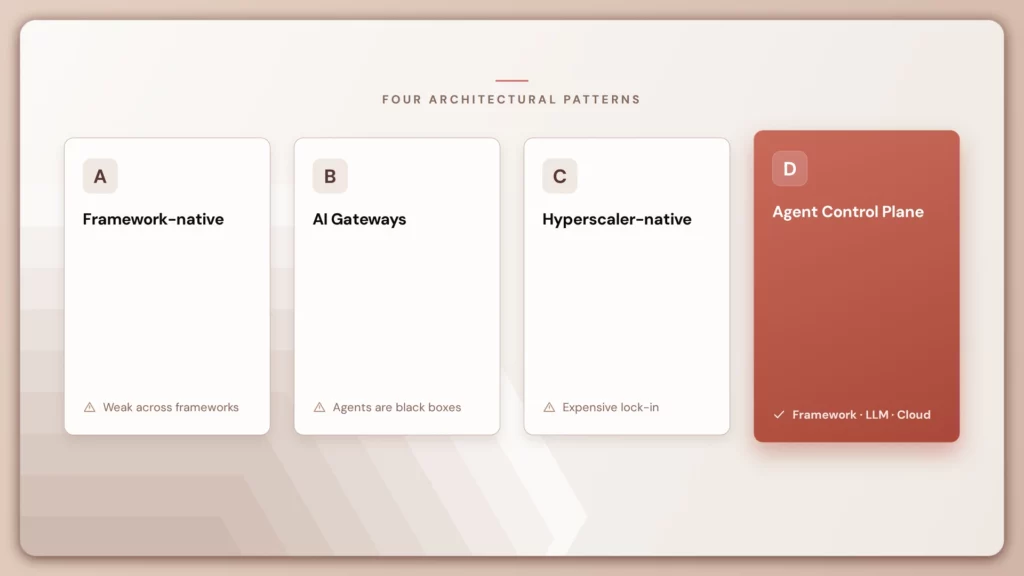
Pattern A: Framework-native platforms. LangChain with LangSmith, CrewAI Enterprise, AutoGen Studio. LangSmith markets as framework-agnostic at the observability layer, though LangChain itself is not. These tools offer deep integration within one framework ecosystem. Across frameworks, they are weak. If your organization standardizes here, every new framework your teams adopt creates a governance blind spot.
Pattern B: AI gateways. Kong, TrueFoundry, and similar API gateway approaches offer strong model routing and cost management. But gateways treat agents as black boxes. They see API calls, not agent decisions, tool invocations, or hallucination events. Agent-layer governance is absent.
Pattern C: Hyperscaler-native platforms. Google Vertex AI, AWS Bedrock, Azure AI Foundry. Powerful within their respective clouds. By the time a company considers switching vendors, AI has already been woven into internal processes, connected to other systems, and tuned to specific workflows. Swapping the vendor means untangling those dependencies, not just changing a billing plan. Hyperscaler platforms make that optionality expensive to maintain.
Pattern D: Agent Control Plane. Framework-agnostic, LLM-agnostic, and cloud-agnostic by design. This pattern supports organizations deploying agents developed using different frameworks while enabling governance across cloud environments from a single operational interface. The Lyzr Control Plane is the enterprise implementation of this pattern.
Four architectural patterns compared
| Capability | Framework-native | AI gateways | Hyperscaler-native | Agent Control Plane (Lyzr) |
|---|---|---|---|---|
| Multi-framework support (LangChain + CrewAI + AutoGen + custom) | No – single framework only | No – model layer only | Limited | Yes |
| Multi-model support (OpenAI + Anthropic + Google + open-source) | Yes | Yes | Yes | Yes |
| Multi-cloud support (AWS + Azure + GCP + on-premise + VPC) | Varies | Varies | No – single cloud | Yes |
| Unified audit trail across frameworks | No | No | No | Yes |
| Deployment portability | No | No | No | Yes |
| Agent-layer governance (RBAC, policy, hallucination controls) | No | No | Limited | Yes |
| Requires rewrite of existing agents | Yes – to their format | N/A | Yes – to their format | No |
Reference architecture for a framework agnostic platform
A production-grade framework agnostic system requires a layered architecture where concerns are cleanly separated. The key principle: governance is enforced at the infrastructure level, not in individual prompts or agent code.
- Layer 1: Auth and identity gateway integrates with corporate SSO for centralized RBAC.
- Layer 2: Orchestration manages workflows spanning agents from multiple frameworks.
- Layer 3: Framework adapters allow LangChain, CrewAI, AutoGen, and custom agents to run as native components.
- Layer 4: Model routing dynamically selects the best LLM for a given task based on cost, performance, or compliance requirements.
- Layer 5: Governed connectors provide secure access to data sources and APIs, with MCP – the Model Context Protocol – as a first-class citizen.
- Layer 6: Policy, audit, and observability form the core of Responsible AI as a Service, capturing a unified, immutable audit trail.
- Layer 7: The Control Plane – accessible through Lyzr Studio – provides a single management interface for the entire stack.
Lyzr Architect builds this full agent stack from a plain-language description of your workflow, handling integrations and compliance controls without requiring custom development. An agent that can be instructed to bypass its own guardrails via a prompt injection is not governed – it is supervised. The difference matters when your compliance team asks for evidence.
How to evaluate a framework agnostic platform (5-question test)
Take these five questions into every vendor conversation. The answers will separate genuinely agnostic platforms from the pretenders faster than any demo.
Question 1: Can I import my existing LangChain, CrewAI, and Agentforce agents without rewriting them? The answer must be an unqualified yes. Any mention of a “migration tool,” “conversion step,” or “we support most features” is a no. Your existing agents are not a liability to be converted – they are assets to be governed.
Question 2: Can I deploy the same agent in AWS, Azure, VPC, and on-premise with one binary? True cloud agnosticism means build once, deploy anywhere. The platform should abstract away infrastructure differences. If the answer involves maintaining separate deployment pipelines per cloud, you are looking at Pattern C – hyperscaler-native with extra steps.
Question 3: Can I swap OpenAI for Anthropic in an agent with only a configuration change? Model flexibility is critical for managing cost, performance, and regulatory compliance. This change should be possible at runtime without redeploying the agent. A model-agnostic core turns model choice into a config decision instead of an architectural commitment.
Question 4: Do I get one audit trail across all frameworks and clouds? For compliance, security, and incident response, you need a single, immutable record of every agent action regardless of how or where it ran. The platform should incorporate deployment versioning, rollback capabilities, and integrated security validation – all within a single operational workflow that maintains visibility across teams and environments.
Question 5: Does the platform support MCP as a first-class citizen? MCP (Model Context Protocol) standardizes how agents connect to tools and data sources. Native support demonstrates a commitment to open standards over proprietary connector lock-in. A vendor that has built their own closed connector ecosystem is building their next lock-in vector.
Frequently asked questions
What is a framework agnostic platform?
A framework agnostic platform runs AI agents built on any framework – LangChain, CrewAI, AutoGen, or custom – without rewrites. It also provides independence from any single LLM or cloud provider, enabling centralized governance across your entire agent fleet from one control plane.
What does framework agnostic mean in AI?
In AI, framework agnostic means the ability to build, deploy, and govern AI agent systems without being tied to a single vendor’s framework or technology stack. It prioritizes interoperability so your architecture can adopt the best tool for each job without accumulating migration debt.
What is the difference between framework agnostic and platform agnostic?
Framework agnostic refers specifically to which agent framework – LangChain versus CrewAI, for example – can run on a system. Platform agnostic refers to the broader hardware, operating system, and infrastructure layer. Enterprise AI buyers typically need both, which is why the three-axis test (framework + LLM + cloud) is the complete evaluation.
Is LangChain framework agnostic?
LangChain is a framework, not a platform – it cannot be agnostic to itself. LangSmith, its observability layer, markets as framework-agnostic at the monitoring layer. A truly agnostic platform is independent of any single framework vendor, including LangChain.
What is the best framework agnostic AI agent platform?
Run the 5-question test in this article against every vendor. The architecture that passes all five is the Agent Control Plane pattern. For enterprises that need framework-agnostic, LLM-agnostic, and cloud-agnostic governance in one platform, the Lyzr Control Plane is the production implementation.
How do I avoid AI vendor lock-in?
By the time a company considers switching vendors, AI has already been woven into internal processes, connected to other systems, and tuned to specific workflows – swapping the vendor means untangling those dependencies, not just changing a billing plan. Lock-in accumulates across five layers: model, orchestration, data, governance evidence, and organizational knowledge. Framework agnostic platforms directly address the orchestration and governance layers, which are the hardest and most expensive to reverse.
Can I run LangChain and CrewAI agents on the same platform?
Yes – this is the core capability of a genuinely framework agnostic platform. One control plane should connect to every framework you are already running: LangChain, CrewAI, AutoGen, Agentforce, Bedrock, Vertex, and MCP-native agents. If a vendor requires you to pick one, they are not framework agnostic.
What is an AI agent control plane?
An AI agent control plane is the governance and orchestration layer that sits above your agent frameworks. It enforces identity, policy, audit, and observability across all agents regardless of how they were built. It establishes a consistent production workflow for enterprise AI agents, allowing organizations to manage deployments through a centralized control layer designed for governance, operational visibility, and lifecycle management.
What is the difference between framework agnostic and open source?
Open source describes a software licensing model – it defines who can access and modify the code. Framework agnostic describes architectural compatibility – it defines which agent frameworks the platform can run. A platform can be open source but not framework agnostic, proprietary and framework agnostic, or any other combination. The two properties are independent.
Does MCP make platforms framework agnostic?
MCP standardizes how agents connect to tools and external data sources, which reduces tool-layer lock-in. It does not address agent-layer governance, multi-framework orchestration, or cross-cloud deployment. A framework agnostic platform supports MCP as a first-class citizen but adds the governance, audit, and orchestration layers above it. MCP is a necessary component – it is not sufficient on its own.
Where to go from here
The framework debate will continue. New frameworks will ship, existing ones will consolidate, and at least two vendors will announce “the last framework you’ll ever need” before the year ends. None of that changes the underlying architecture question: you need a governance layer that runs above all of them.
The enterprises that will have the most negotiating leverage with AI vendors in 2027 and 2028 are the ones building that abstraction layer now. While 89% of leaders believe they could switch AI vendors within a month, the majority of those who have attempted it (58%) say the process either failed or required far more effort than expected. The ones that standardized on a single framework’s tooling are on a different trajectory – one that gets harder to exit with every agent they ship.
Take the next step with Lyzr:
- To build your first governed agent today, start with Lyzr Architect – describe your workflow in plain language and get a working, governed agent stack without custom development.
- To see the Control Plane in production, deploy and manage your agent fleet through Lyzr Studio.
- To explore Responsible AI controls for your existing agent portfolio, review Lyzr’s Responsible AI as a Service capabilities.
- To explore agent memory and context management, see how Cognis gives your agents persistent, governed memory across frameworks.
The question is not which framework to pick. It is what governance layer you build above all of them.
Book A Demo: Click Here
Join our Slack: Click Here
Link to our GitHub: Click Here