Count your AI agents.
Go ahead. Not the ones you officially approve, all of them.
The one your CRM vendor quietly turned on last quarter. The one a developer is running inside their IDE that occasionally touches your production codebase. The one marketing spun up with a no-code tool because waiting for IT “takes forever.” The three that came bundled with SaaS renewals nobody read carefully.
Most heads of technology and operations we talk to guess they have four or five agents running. The actual number, once you audit properly, tends to be closer to fifteen.
That is not a Lyzr number. Gartner’s own estimate is that the average global Fortune 500 enterprise ran fewer than 15 agents in 2025 and will run more than 150,000 by 2028. Only 13% of organizations told Gartner they believe their agent governance is right today. The gap is about to get 10,000 times wider.
That gap, between what leadership thinks is deployed and what is actually running, is AI agent sprawl. And the gap is not a minor bookkeeping error. It is where your next compliance incident is quietly taking shape.
Here Is How Sprawl Actually Happens: Quarter by Quarter
This is not a hypothetical. It is a reconstruction of how AI agent sprawl unfolds inside a real mid-sized logistics company. No invented names, no fictional drama, just the actual sequence of decisions that seemed reasonable at the time.
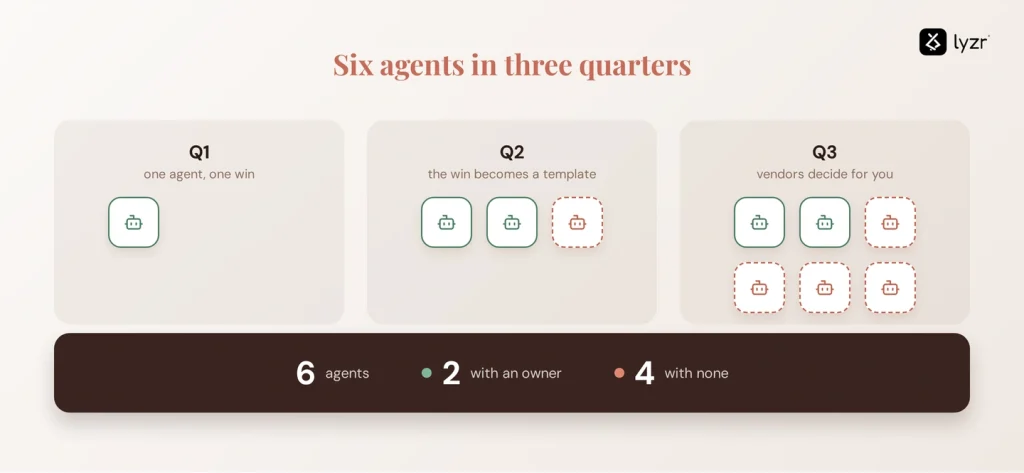
Q1: One agent, one win, zero warning signs
The support team gets access to an AI agent on a major LLM platform. It triages tickets, drafts replies, routes complex issues to humans. Ticket resolution time drops 40% in six weeks. Everyone is happy. Leadership calls it out in the all-hands as proof that the company is “embracing AI.”
Q2: The win becomes a template
The VP of Marketing hears about the support result and decides the content team needs something similar. An agency they are already working with recommends a different platform, the one “built specifically for brand voice.” It is deployed within three weeks. No one checks whether it connects to the same customer data the support agent uses, or whether the two agents will ever give conflicting information to the same customer. They are just two separate agents doing separate things. Fine.
A developer in engineering, meanwhile, installs an AI coding assistant in their local IDE. It is marketed as a personal productivity tool, so it does not go through any procurement review. It does, however, have read access to the repository it is helping with, which includes some proprietary logistics algorithms the company considers a core competitive asset.
Q3: Vendors start making decisions for you
The company’s CRM, project management platform, and HR system all roll out “AI-powered” features in the same quarter. Each one is included in the existing subscription. An admin enables all three during routine platform updates. No new vendor security review is filed. Nobody asks what data these agents store, what they are trained on, or whether any of it leaves the vendor’s infrastructure.
By end of Q3:
| Agent | Origin | Data Access | Named Owner |
| Support triage agent | Internally built | Customer tickets, CRM | Support team lead |
| Content drafting agent | Agency-built, external platform | Brand guidelines, campaign briefs | Marketing VP |
| IDE coding assistant | Developer personal install | Proprietary codebase | Nobody |
| CRM AI features | Vendor-bundled | Full customer database | Nobody |
| PM platform AI | Vendor-bundled | All project data | Nobody |
| HR platform AI | Vendor-bundled | Employee records, performance data | Nobody |
Six agents. Two with owners. Four operating on sensitive data with no documented oversight.
Q4: The thing nobody wanted to happen
The HR platform’s AI agent, trying to be useful, as they always are, begins cross-referencing internal employee performance records with publicly available LinkedIn profile data to “enrich” HR records. It is not doing anything the platform’s terms of service prohibit. But nobody at the company authorized it. Nobody knew it was happening.
It surfaces because a mid-level manager notices their profile now contains inferred career trajectory data they never provided internally. They raise it with HR. HR raises it with IT. IT has no idea where it came from.
There is no breach. There is no fine. But there is a very uncomfortable conversation with legal, a compliance review the company is not prepared for, and the belated realization that six agents have been operating across the company for a year with no central inventory, no audit trail, and no clear accountability.
That is AI agent sprawl, and not an explosion, just a slow accumulation of reasonable-seeming decisions that compound into a structural problem.
Four Reasons This Keeps Happening
1. Deployment is genuinely effortless now
No-code agent builders, LLM APIs with generous free tiers, SaaS platforms that activate AI features with a single toggle, the infrastructure for deploying an AI agent has never been more accessible. A non-technical employee can have something running in an afternoon. That is a legitimate productivity unlock. It is also precisely what makes sprawl inevitable without deliberate governance, because the deployment friction is gone but the oversight infrastructure has not been built to match.
2. The first win creates organizational pressure
Almost every team that deploys their first AI agent reports a meaningful result. That result creates internal pressure. Other teams see the win and want their own. Requesting a shared agent through IT takes time. Building your own takes an afternoon. The rational individual choice creates an irrational collective outcome: a portfolio of disconnected agents that no one has a full picture of.
3. Your vendors stopped asking permission
Between 2024 and 2025, Salesforce, Microsoft, HubSpot, ServiceNow, Workday, and dozens of other major platforms shipped AI agent features directly into their products. Some are opt-in. Many are enabled by default. Some are buried in release notes that nobody reads before clicking “update.” Organizations that renewed contracts without reviewing new terms are almost certainly running agents they did not deliberately choose to deploy.
4. No one has written down who is responsible
Ask yourself: if an AI agent in your organization sent an incorrect invoice to a client tomorrow, who gets the call? Who has the authority to shut the agent down immediately? Who owns the relationship with the platform it runs on? Most organizations do not have clean answers to any of those questions. Until they do, sprawl will keep expanding into the accountability vacuum.
What Sprawl Is Actually Costing?
“Governance is important” is not a business case. Here is what the lack of it actually costs.
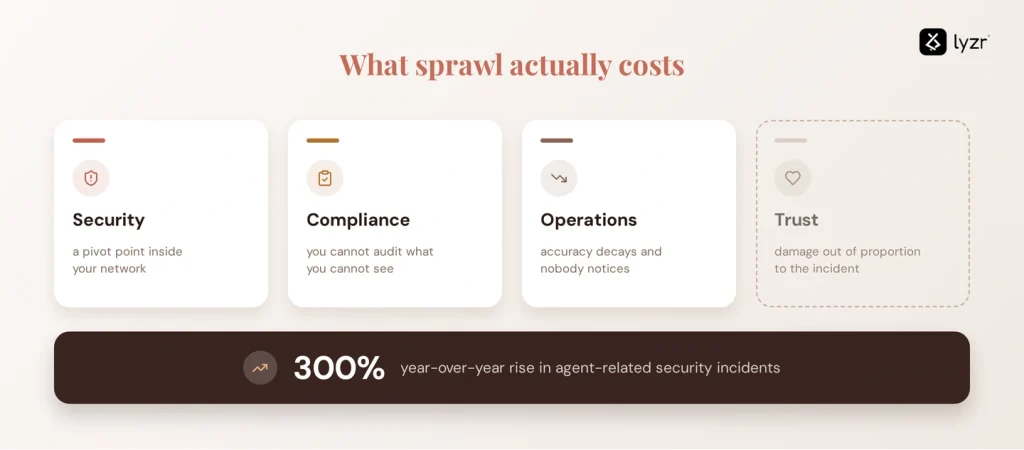
- Security: agents are not just data stores, they are lateral movement paths
A compromised agent with broad permissions does not just expose the data it has touched. It gives an attacker a pivot point inside your network with an authenticated identity, a natural pattern of system access, and the ability to query, exfiltrate, or manipulate data at machine speed.
The 300% year-over-year increase in AI agent-related security incidents is not because agents are inherently insecure. It is because unmonitored agents are undetected attack surfaces.
- Compliance: you cannot audit what you cannot see
GDPR’s right to explanation, HIPAA’s access controls, the EU AI Act’s transparency requirements, emerging US state AI regulations, all of these will increasingly require organizations to demonstrate what their AI systems are doing with data, and to show a documented chain of human accountability.
When an auditor asks “what AI systems processed this customer’s data in the last twelve months,” the answer cannot be “we are not entirely sure.”
- Operations: agents drift, and nobody notices
An agent that was accurate at deployment degrades over time. The underlying model gets updated.
The data it is trained on goes stale. The business context it was built for changes. An agent that was giving correct answers six months ago may be giving wrong ones today, and if nobody is monitoring it, the wrong answers just keep compounding. Duplicate agents doing overlapping work create inconsistent outputs. Agents on different platforms give different answers to the same question. The operational debt of sprawl accumulates quietly.
- Trust: this one is harder to put a number on
When an employee, customer, or regulator discovers that AI agents have been acting on behalf of your organization without clear disclosure or oversight, the trust damage is disproportionate to the underlying incident. Organizations that have proactively built governance tend to handle these disclosures well. Organizations that have not tend to look like they were hiding something, even when they were not.
What Fixing This Actually Looks Like
Here is the thing about AI agent sprawl: it is not technically hard to address. It is organizationally hard to address. The technical steps are straightforward. The challenge is getting the right people to prioritize them.
1. Start with a real inventory, not an estimate
The inventory is non-negotiable. You cannot govern what you have not found. A proper agent audit covers:
- Every internally built agent, including proofs-of-concept that never got formally retired
- Every vendor-bundled AI feature that has been enabled (read every SaaS renewal carefully)
- Every developer tool with AI capabilities that touches company systems
- Every agent deployed by an external agency on the company’s behalf
For each one, document what it does, what data it accesses, what platform it runs on, and whether there is a named human being accountable for its behavior.
2. Give every agent a name and an owner
“The marketing team’s agent” is not an owner. A named person who is responsible for the agent’s behavior, its data practices, and its decommissioning when the time comes, that is an owner. One person. Their name in a document.
3. Gate new deployments with a lightweight review
This does not need to be bureaucratic. A five-question checklist is sufficient for most agents:
| Checkpoint | The Question That Actually Matters |
| Duplication | Is there already an agent doing this? |
| Data access | Does this agent need access to everything it is requesting, or just some of it? |
| Consequence | If this agent makes a mistake, what is the blast radius? |
| Monitoring | How will we know if this agent starts behaving unexpectedly? |
| Exit | How do we turn this off cleanly if we need to? |
Five questions. Thirty minutes. That is the difference between a governed deployment and a future audit finding.
4.Monitor agents like you monitor any other production system
Logs. Alerts. Anomaly detection. Behavioral audits. If an agent is doing something you did not expect, you need to know about it in hours, not in weeks when an employee notices something odd in their profile data.
5. Write down what is allowed
A formal AI agent policy does not need to be fifty pages. It needs to cover: what data agents can access, when a human must review an agent’s action before it executes, what users must be told when they are interacting with an agent, and what the process is for reporting agent behavior that seems wrong. One document. Actively communicated. Actually enforced.
The AI Agent Governance Maturity Model
Most organizations are at Stage 1 or 2. Getting to Stage 3 is realistic within one quarter of focused effort. Getting to Stage 4 takes six to twelve months. Stage 5 is where governance stops being a cost center and starts being a competitive advantage.
| Stage | Name | What Is Actually Happening |
| 1 | Unaware | Agents deployed ad hoc across the organization. No inventory. No ownership. Leadership does not know what is running. |
| 2 | Reactive | Something has gone wrong: an audit finding, a vendor incident, a near-miss. The organization is now taking stock, but governance is still driven by events rather than intention. |
| 3 | Structured | A formal inventory exists and is maintained. Deployment has a review process. Every agent has a named owner. Monitoring is inconsistent but present. |
| 4 | Governed | Every agent is logged, monitored, and reviewed on a defined cadence. Compliance is demonstrable. Deployment is gated. The organization can answer any question an auditor asks. |
| 5 | Optimized | Governance accelerates deployment rather than slowing it. Agents are composable and reusable. The portfolio is a deliberate strategy, not an accumulation of individual decisions. |
The Three Things Leadership Will Say, and What to Say Back
The governance conversation is usually harder than the technical work. Here are the three pushbacks that come up most often.
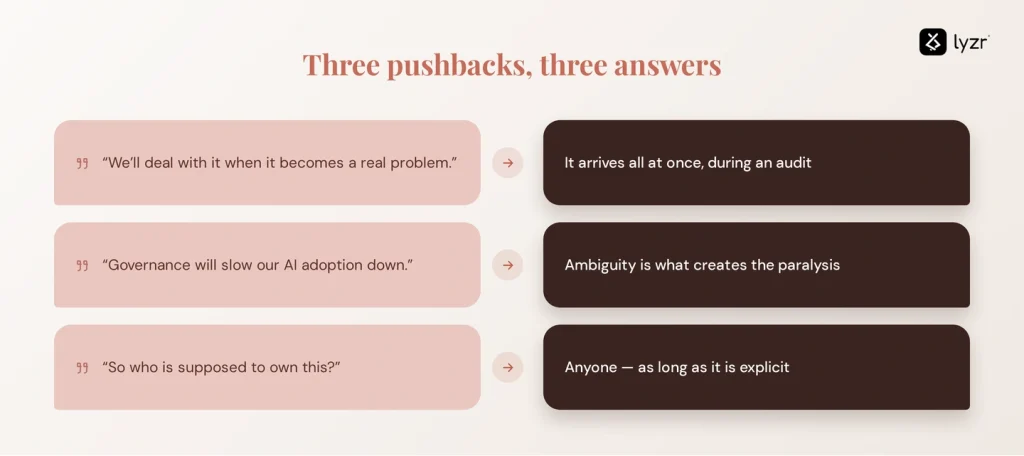
1. “We will deal with this when it becomes a real problem.”
The problem with this framing is that AI agent sprawl does not become a “real problem” gradually. It becomes one suddenly, during an audit, after a vendor incident, or when a regulator asks a question the organization cannot answer. The companies that handle those moments without lasting damage are the ones that did the boring governance work before anything went wrong.
2. “Governance will slow down our AI adoption.”
This one is backwards. The teams that move fastest with AI are not the ones with the least oversight. They are the ones with the clearest frameworks. When people know exactly what they are allowed to deploy, how to do it, and who to call when something breaks, they deploy more and they deploy faster. It is ambiguity that creates paralysis. Governance removes ambiguity.
3. “Who is supposed to own this?”
This is the right question, and there is no universal answer. Some organizations put AI governance in IT. Some build a dedicated AI Center of Excellence. Some make it a shared responsibility across legal, compliance, IT, and business units. What does not work is making it nobody’s explicit job. Shared ownership without clear accountability is a polite way of saying nobody owns it.
Five Questions That Should Follow Every AI Agent Around
Whether you are reviewing an existing agent or evaluating a new one, these are the questions that cut through the noise.
1. What can this agent do without a human seeing it first?
Autonomous action is the variable that determines governance intensity. An agent that drafts content for human review has a low blast radius. An agent that sends emails, submits purchase orders, or publishes content autonomously is a different risk category entirely. The greater the autonomous action surface, the more rigorous the oversight needs to be.
2. If this agent is wrong, what breaks?
LLMs hallucinate. Data pipelines break. Models drift. When this agent gives a wrong answer, does a human catch it before it matters, or does it propagate into a client-facing output, a financial transaction, or a compliance-relevant record? The answer to this question determines how much human-in-the-loop oversight is required.
3. Who specifically authorized this agent’s data access and when?
Not who approved the deployment. Who authorized the data access, in writing, with a documented scope? And given that agents often expand their role over time, is that authorization still accurate for what the agent is actually doing today?
4. When did someone last look at what this agent is actually doing?
Agents that were deployed and forgotten are the highest-risk category. The platform may have been updated. The data source may have changed. The original use case may have evolved. An agent that was fit for purpose at deployment may be operating on stale instructions in ways that no longer reflect organizational intent — and nobody has looked closely enough to notice.
5. What is the plan for shutting this down?
Exit planning is as important as deployment planning and gets a fraction of the attention. Agents accumulate state: interaction histories, cached outputs, external integrations, downstream dependencies. Retiring an agent without a documented exit plan leaves data exposed, integrations broken, and processes that silently start failing.
The Quick Reference, for When You Need to Brief Someone in Five Minutes
| Topic | The Actual Point |
| What AI agent sprawl is | More AI agents running than anyone has counted, with less oversight than anyone has implemented |
| Why it keeps happening | Deployment is easy, wins spread fast, vendors bundle without asking, accountability is undefined |
| What it costs | Undetected attack surfaces, unauditable data practices, operational drift, and trust damage that outpaces the underlying incident |
| How to address it | Inventory first. Ownership second. Deployment gate third. Monitoring fourth. Policy fifth. In that order. |
| How long it takes | Meaningful progress in ninety days. Solid governance in six to twelve months. |
| What you get for doing it | Speed, compliance readiness, and a portfolio that compounds rather than clutters |
The Next Ninety Days
Pick one of these three things to do this week. Just one.
Send an email to your IT team and every department head asking them to list every AI tool , including vendor feature, they are currently using. Frame it as an inventory, not an audit. You want people to tell you, not hide things.
Or, if you already have a rough inventory, spend an afternoon assigning owners. Go through the list and put a name next to every agent that does not have one. Send those people a short note explaining that they are the accountable owner going forward.
Or, if you have owners and inventory, draft a five-question deployment checklist. Nothing formal yet. Just a document that someone building a new agent has to fill out before going live.
Or, if you want a baseline before you send that email, take the AI Agent Sprawl Audit. Twenty-nine questions, five minutes, and a score for exactly how exposed your governance is today.
The organizations that are ahead on AI agent governance did not get there by tackling everything at once. They picked a starting point and started. The gap between Stage 1 and Stage 3 is not a technology project. It is a series of decisions that someone actually makes.
You are reading this. Make one of them.
If you get through inventory and ownership and realize the manual version does not scale past a dozen agents, that is the point where enterprises move to an agent control plane: one registry, one identity per agent, one evaluation gate, one audit trail, regardless of which team or vendor built the agent.
Frequently Asked Questions
AI agent sprawl is the uncontrolled accumulation of AI agents across an organization, built or enabled by different teams and vendors, without a central inventory, named owners, or consistent oversight. Gartner describes it as the state where CIOs face an ungoverned spread of agents exposing the business to misinformation, oversharing and data loss.
Agent sprawl happens because building an agent is now nearly free. No-code builders and LLM APIs let any team spin one up without engineering help. Once one team gets a quick win, other teams want the same thing, so agents multiply on their own. Vendors add to this by quietly bundling agents into existing software subscriptions, often without triggering a new security review. And through all of it, nobody’s actually written down who’s responsible for what any given agent does, so there’s no accountability trail even as the number of agents grows.
Shadow AI is unsanctioned use of AI tools by employees. Agent sprawl includes shadow agents but also covers sanctioned ones: the officially approved agents that were deployed, then forgotten, drifted, or duplicated. You can have zero shadow AI and still have sprawl.
Security (a compromised agent is a lateral-movement path with an authenticated identity), compliance (you cannot show an auditor which systems touched a customer’s data), operations (agents drift and duplicate), and trust (undisclosed agents acting on your behalf damage credibility out of proportion to the incident). IBM’s 2026 data found 92% of organizations with an AI-related breach had no AI access controls.
Start with an inventory of every agent you have, then assign each one a named owner (not a team). Add a lightweight review before anything new deploys, monitor agents the same way you’d monitor any production system, and write down the policy in one page so people actually read it. Gartner’s six-step framework covers the same ground. Once you’re past a dozen or so agents, most companies stop doing this by hand and move inventory, identity, and monitoring into a control plane.
Gartner estimated fewer than 15 per average Fortune 500 enterprise in 2025 and projects more than 150,000 by 2028. In our own conversations, leaders guess four or five and audits find closer to fifteen, mostly vendor-bundled features nobody counted.
There’s no single department that owns it everywhere. It’s usually IT, an AI Center of Excellence, or a shared group spanning legal, compliance, IT, and the business units actually using the agents. What matters more than which model you pick is that someone is clearly on the hook: every agent needs a named owner, and the program as a whole needs one executive who’s accountable for it.
Book A Demo: Click Here
Join our Slack: Click Here
Link to our GitHub: Click Here