Table of Contents
ToggleTable of Contents
- The Number That Should Make You Uncomfortable
- The Problem No One Is Naming
- What Is an Agentic OS, Really?
- The Four Pillars of a True Agentic OS
- Agentic OS vs. Your Current Stack
- What This Looks Like in the Real World
- The Strategic “So What” for the C-Suite
- Where to Start – Without Buying Anything Yet
- TL;DR and Action Checklist
- Frequently Asked Questions
The Number That Should Make You Uncomfortable
According to the 2026 Gartner CIO and Technology Executive Survey, only 17% of organizations have deployed AI agents to date, yet more than 60% expect to do so within the next two years – the most aggressive adoption curve among all emerging technologies measured in the survey.
Seventeen percent deployed.
Sixty percent racing to catch up.
That gap isn’t a technology problem.
It’s a coordination problem.
And the answer to it has a name: the Agentic OS.
An agentic OS – short for agentic operating system – is the coordination layer that gives multiple AI agents memory, tool access, decision logic, and oversight so they can complete multi-step work across real enterprise systems.
Not another chatbot.
Not another dashboard.
A new organizational capability.
The question isn’t whether your enterprise will have one.
Agentic AI sits at the Peak of Inflated Expectations, reflecting extraordinary market attention and aggressive adoption intent.
You’re either building this deliberately – with a blueprint and governance from day one – or you’re building it accidentally, one disconnected pilot at a time.
This guide is for the executive who wants to understand what an agentic OS actually is, why it’s different from everything already in the stack, and what the path forward looks like without the vendor spin.
The Problem No One Is Naming
You’ve approved AI budgets.
You’ve seen the demos.
You’ve probably sat through at least one deck that used the phrase “AI-powered transformation” four times before slide three.
And yet, here’s what most enterprises actually look like in June 2026.
Dozens of copilots and chatbots work in silos, each tied to a single platform, vendor, or department.
HR has one.
Sales has another.
Customer Support runs a third.
The result is fragmented intelligence.
Each tool works.
None of them talk to each other.
None of them remember what happened last quarter.
None of them coordinate when a customer complaint in support connects to a supply issue in operations.
That’s not enterprise intelligence.
That’s a pile of very expensive calculators.
The data confirms it isn’t just your organization.
Over 40% of agentic AI projects will be canceled by the end of 2027, due to escalating costs, unclear business value or inadequate risk controls.
Read that again.
Not “underperform.”
Canceled.
Only 21% of organizations have a mature governance model for autonomous AI agents, and 52% cite data quality as the biggest blocker to deployment.
This isn’t pessimism.
It’s the cost of building without a foundation.
The organizations that avoid this outcome aren’t the ones with bigger AI budgets.
They’re the ones that stopped thinking about AI as a collection of tools and started thinking about it as an operating layer.
[IMAGE: Side-by-side comparison graphic showing “AI Tool Sprawl” on the left with disconnected icons (chatbot, RPA bot, standalone LLM, dashboard) versus “Agentic OS” on the right showing interconnected agents with shared memory, governed tool access, and human-in-the-loop routing. Clean enterprise infographic style with dark navy and purple palette.]What Is an Agentic OS, Really?
Strip away the hype and the definition is straightforward.
An agentic OS is the coordination layer that gives multiple AI agents shared memory, tool access, decision logic, and governance – so they can complete multi-step work across real enterprise systems without requiring human intervention at every step.
That last clause matters.
Not “no human involvement.”
Not “fully autonomous.”
The distinction is between a human approving every micro-task versus a human setting goals, reviewing outcomes, and stepping in when judgment is required.
Think about what your laptop’s operating system actually does.
It doesn’t ask you to manually allocate memory when you open a new browser tab.
It doesn’t require you to tell the processor which core should handle your email.
It manages resources, arbitrates between competing processes, and keeps everything running without you having to orchestrate each action.
An agentic OS does the same thing for AI agents inside your enterprise.
It manages which agent handles which task.
It maintains context across interactions.
It connects agents to your data, your systems, and your people.
And critically – it knows when to stop and ask.
What it is not:
- A chatbot (reactive, single-session, no persistent memory or cross-system action)
- An RPA platform (rule-based, brittle, breaks when anything changes)
- A standalone LLM (responds to prompts, can’t initiate workflows or act across systems)
- LangChain or AutoGen (frameworks for building agents – not an enterprise-grade operating layer with governance, security, and deployment infrastructure)
As Gartner Senior Director Analyst Anushree Verma put it: “AI agents will evolve rapidly, progressing from task and application specific agents to agentic ecosystems.” She added that “this shift will transform enterprise applications from tools supporting individual productivity into platforms enabling seamless autonomous collaboration and dynamic workflow orchestration.”
The vendors who relabel their chatbots as “agents” aren’t lying, exactly.
They’re just not telling you the whole story.
Agentic AI’s defining risk in 2026 is not capability – it’s control, with both TechRT’s 2026 AI agent productivity report and enterprise research flagging governance as the make-or-break issue of the year.
The Four Pillars of a True Agentic Operating System
Most definitions of an agentic OS stop at “it coordinates AI agents.”
That’s like defining a car as “something with wheels.”
Here’s what actually separates a genuine agentic OS from a rebranded workflow tool.
Pillar 1: The Orchestration Engine
This is the conductor.
It receives a goal – not a task – and figures out which agents to deploy, in what sequence, with what data.
The orchestrator doesn’t just assign work.
It monitors progress, handles failures, reroutes when an agent hits a wall, and surfaces exceptions to humans when the situation requires judgment that hasn’t been pre-programmed.
Practices such as the agent development life cycle (ADLC), context graphs and agent experience (AX) highlight the growing need for structured approaches to building, deploying and managing agentic systems – reflecting early recognition that agentic AI requires new development, operational and governance models beyond those used for traditional AI or automation.
Pillar 2: Shared Memory and Persistent Context
Agents with amnesia are useless at scale.
If your customer service agent doesn’t know what your sales agent negotiated last month, you’re not running an intelligent enterprise – you’re running an expensive impersonation of one.
A true agentic OS provides a persistent, shared memory layer – often powered by RAG (Retrieval-Augmented Generation, the technique of pulling live enterprise data into an AI model’s working context).
This lets agents reference past decisions, understand organizational history, and avoid the kind of contradictions that erode customer and employee trust fast.
Unlike traditional data warehouses that store static information, the OGI layer evolves with each completed task, creating a collective, self-improving intelligence that enhances decision-making and automates complex processes across an entire organization.
Pillar 3: Tool and API Integration – The Execution Layer
Intelligence without action is just a very sophisticated opinion.
Agents become useful when they can actually do things: query your ERP, update your CRM, trigger a procurement workflow, send a notification through your communication platform.
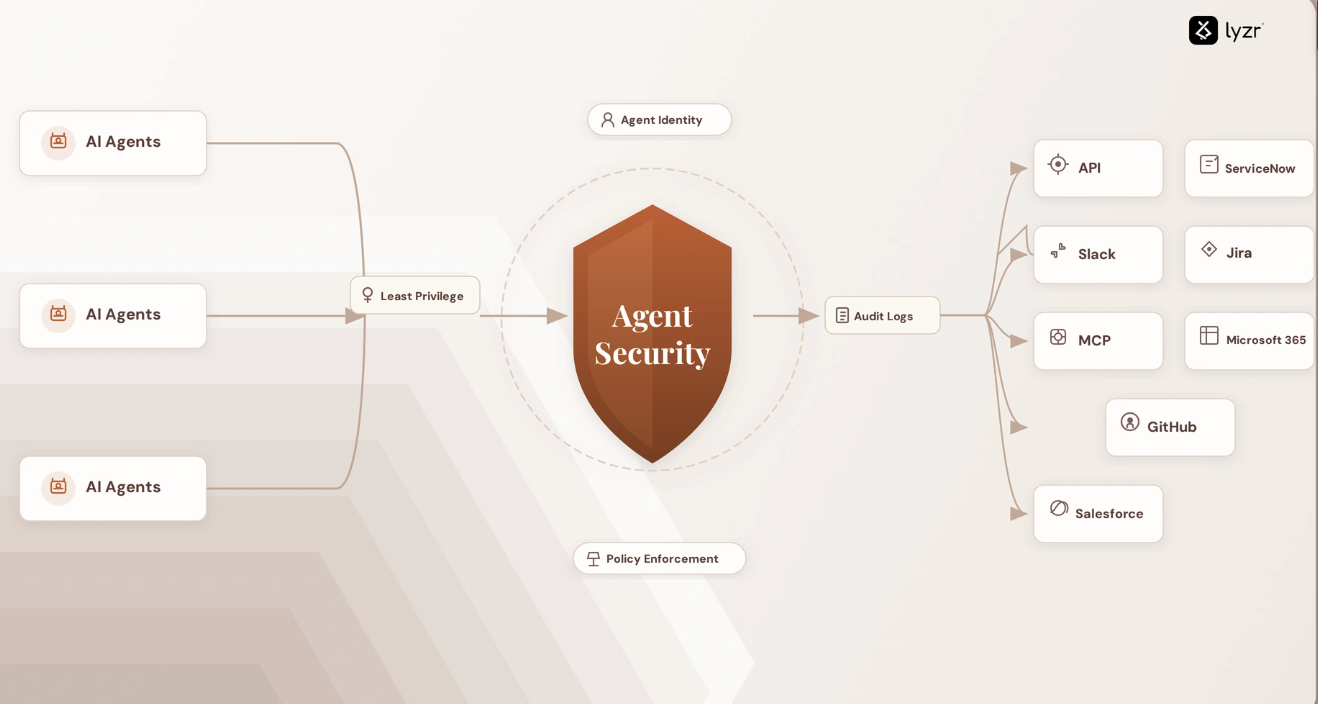
Think of it as a new operational layer above systems like Workday, Salesforce, and NetSuite, where AI agents can reason, act, and collaborate with both data and humans.
Without this layer, you have a thinker.
With it, you have a doer.
Pillar 4: Governance and Human-in-the-Loop – The Non-Negotiable
This is the pillar most vendors underemphasize.
It’s also the one that determines whether your agentic OS becomes a strategic asset or a liability.
Human-in-the-loop – the practice of designing AI systems to route specific decisions and exceptions to human reviewers – isn’t a limitation on what agents can do.
It’s the mechanism that makes autonomous action safe at enterprise scale.
Technologies such as agentic AI governance, agentic AI security and FinOps for agentic AI indicate rising enterprise concern about accountability, control and economic sustainability as agentic systems become more autonomous and interconnected – and the need for oversight is becoming evident early in the adoption cycle, not only after large-scale deployment.
A mature governance layer defines what agents can do without approval, what requires human sign-off, what gets logged for audit, and what triggers an automatic stop.
This is what separates a production-grade system from a pilot that looks impressive in a demo and fails in week three.
For a practical breakdown of how to build your governance layer before deployment, Lyzr’s guide on how to take agents to production is one of the most operationally specific resources available today.
Agentic OS vs. Your Current Stack
The question executives ask most often: “Don’t we already have this?”
The honest answer is no – and here’s exactly why.
Capability Comparison: RPA vs. Standalone LLM vs. Agentic OS
| Capability | RPA | Standalone LLM | Agentic OS |
|---|---|---|---|
| Core Function | Automates rule-based, repetitive tasks | Generates text, answers prompts | Orchestrates complex, multi-step goals |
| Adaptability | Brittle – breaks when UI or process changes | Can’t initiate action on its own | Reasons, adapts, self-corrects |
| Memory | None – each run starts fresh | Single session only | Persistent, shared across agents |
| Cross-System Reach | Limited to pre-mapped integrations | None without tools | Governed access across your full stack |
| Human Involvement | Defined at setup; no dynamic routing | Required for every interaction | Routed dynamically based on decision type |
RPA is precise and fast on stable, structured workflows.
It will never be obsolete.
But it can’t handle the complexity of a process that involves unstructured data, variable inputs, or a judgment call.
Teams should not throw out their existing automation to go agentic – instead, the right approach is to layer agents on top of the scenarios already running, starting at the steps where reasoning or exception handling adds the most value.
Before you evaluate any platform, ask the vendor one direct question: can your system complete a multi-step workflow across more than one enterprise system, without a human triggering each step, while maintaining an auditable log of every action?
If the answer hedges, you have your answer.
To understand what to look for when evaluating platforms specifically built for this category, this overview of the top AI agent builder platforms in 2026 provides a useful starting benchmark.
What This Looks Like in the Real World
Here’s a concrete scenario.
Not a whitepaper abstraction – a real workflow.
A global investment firm’s corporate venture capital team needs to evaluate 400 startups a quarter.
The old process: analysts manually pull data from Crunchbase and PitchBook, cross-reference LinkedIn, build a scoring model in a spreadsheet, write a memo, schedule a review meeting.
Time per startup: four to six hours.
With an agentic OS, a sourcing agent aggregates data from multiple databases.
An evaluation agent applies a consistent scoring framework across financials, traction, and team quality.
A memo-generation agent drafts the investment brief.
A routing agent flags the top candidates for human analyst review – with full context, sourced data, and a confidence score.
The analysts don’t disappear.
They spend their time on the 20 startups that actually deserve their judgment, not the 380 that don’t make the cut.
A Fortune 100 technology company has deployed an Agentic OS for its global corporate venture capital division, using over 200 interconnected agents to reduce time spent on investment sourcing and evaluation.
That’s not a pilot.
That’s a production system, running at scale, inside one of the largest technology companies in the world.
The pattern holds at the enterprise level too.
EY.ai EYQ was deployed to more than 300,000 professionals, powering secure enterprise chat, domain assistants, governed prompt tooling and safe generative AI experimentation across all service lines.
The answer began with the realization that employees didn’t need another tool, model or assistant – but rather a comprehensive operating system for agentic work across the enterprise.
Without a unified strategy and platform, EY risked creating isolated AI efforts, duplicated investment, inconsistent governance and lost opportunity – mirroring the challenges faced by CEOs externally.
EY didn’t buy a product.
They built an operating layer.
There’s a meaningful difference.
[IMAGE: Realistic enterprise workflow diagram showing three interconnected AI agents (sourcing agent, evaluation agent, memo agent) passing data through a central orchestration layer, with a human analyst reviewing the final output on a clean dashboard. Illustrative style, dark background with glowing node connections.]The Strategic “So What” for the C-Suite
Efficiency is table stakes.
Every technology pitch promises efficiency.
The real strategic argument for an agentic OS is something different: compounding organizational intelligence.
When agents share context through a central knowledge layer – when every workflow contributes to a growing body of institutional memory – the system gets smarter over time.
Every decision improves future decisions.
Every exception handled correctly becomes a template for the next one.
This architecture is designed for something bigger – Organizational General Intelligence (OGI) – when all these specialized agents share context through a central knowledge graph, allowing the organization itself to develop collective intelligence. The final step, OGI, isn’t about artificial general intelligence. It’s about emergent intelligence within an enterprise, when specialized agents across departments share context and decisions through a central knowledge graph.
“Just as operating systems defined the computer era, Agentic Operating Systems will define the enterprise AI era. Lyzr’s vision for Organizational General Intelligence is not theoretical – it’s being built function by function inside some of the world’s largest enterprises.”
– Madhu Shalini Iyer, Managing Partner, Rocketship.vc
The compound advantage here is significant.
In a best-case scenario, agentic AI could drive approximately 30% of enterprise application software revenue by 2035, surpassing $450 billion, up from 2% in 2025.
The organizations capturing that value won’t be the ones who ran the most pilots.
They’ll be the ones who built the foundation earliest.
Successfully deployed agents deliver an average 171% ROI globally – rising to 192% in the United States, where labor cost differentials amplify savings – with a median payback period from go-live to cost recovery of just 8.3 months.
That window is not theoretical.
It’s closing.
For teams ready to map out a structured path from pilot to production, Lyzr’s Agentic AI Roadmap playbook provides a function-by-function blueprint used by enterprise teams today.
Where to Start – Without Buying Anything Yet
This is where most guides fail.
They build the case for why you need an agentic OS, then hand you a vendor comparison matrix.
That’s the wrong starting point.
The right starting point is a single diagnostic question: Where is the highest cost of coordination in your business?
Not “where can we apply AI?” – that question produces a list of 40 use cases and no prioritization.
The cost-of-coordination question points you to the workflows where humans spend the most time translating between systems, chasing approvals, and manually synthesizing information that three different tools already have.
That’s your proving ground.
Start with one function.
Build one coordinated agent workflow.
Measure it.
Then expand.
A key component of any serious platform is simulation capability. Lyzr’s Agent Simulation Engine uses over 20,000 pre-deployment simulations per agent to test performance, logic, and compliance – built on Joint Embedding Predictive Architecture (JEPA) principles to ensure predictable behavior and reduce risk before agents enter production.
That matters because Gartner’s prediction that 40% of agentic AI projects will be canceled by the end of 2027 aligns closely with abandonment patterns observed across enterprise deployments.
The organizations that avoid that fate aren’t the most aggressive adopters.
They’re the most deliberate ones.
When evaluating any Agentic OS platform, look for four things:
- Governance architecture – not as an add-on, but as a foundational layer. Human-in-the-loop must be designed in, not bolted on.
- A full Agent Development Life Cycle (ADLC) – from design and simulation through monitoring and iteration. Agents that can’t be observed can’t be trusted.
- Private cloud or on-premise deployment – particularly for regulated industries. Enterprises can deploy the platform within their private cloud or on-premise infrastructure, maintaining data control while enabling agent collaboration.
- Pre-built simulation testing – before any agent touches production, it should have been stress-tested against thousands of scenarios, not just the happy path.
Lyzr’s Agentic OS platform provides a full agent development life cycle that includes creation, testing, simulation, deployment, and monitoring – with a unified operational layer above existing enterprise systems such as Workday, Salesforce, and NetSuite.
The organizations that will look back on 2026 as the year they got ahead aren’t the ones who bought the most software.
They’re the ones who asked the right question first.
For teams specifically exploring AI deployment in revenue functions, Lyzr’s Sales Playbook shows what a production-grade agentic workflow looks like inside a modern sales organization.
[IMAGE: Three-phase enterprise deployment roadmap graphic showing Phase 1 “Single Agent in Production” (Days), Phase 2 “Multi-Agent Orchestration by Function” (Weeks), and Phase 3 “Full Agentic OS with OGI Knowledge Graph” (Months). Clean horizontal flow diagram with milestone markers in Lyzr brand colors (deep navy, purple, warm earth tones).]Ready to move from disconnected AI projects to a coordinated enterprise intelligence layer?
Explore Lyzr’s Agentic OS →TL;DR
- Only 17% of organizations have deployed AI agents, yet more than 60% expect to within two years (Gartner, 2026) – the gap between ambition and execution is the defining enterprise AI challenge right now.
- An agentic OS is the coordination layer that connects AI agents with shared memory, tool access, decision logic, and governance – enabling multi-step work across real enterprise systems.
- Over 40% of agentic AI projects will be canceled by the end of 2027, due to escalating costs, unclear business value or inadequate risk controls (Gartner).
- The four pillars of a true agentic OS: orchestration engine, shared memory, tool integration, and human-in-the-loop governance. Miss any one and you don’t have an OS – you have a fancier chatbot.
- The long-term strategic destination is Organizational General Intelligence (OGI) – when agents across functions share context through a central knowledge graph and the organization develops compounding institutional intelligence.
- Start with the cost-of-coordination question, not a vendor comparison. One function, one workflow, measurable outcomes. Then expand.
Your Action Checklist
- Map your current AI stack and identify every tool operating in isolation
- Ask the cost-of-coordination question: where do humans spend the most time translating between systems?
- Identify one high-value, cross-functional workflow as your proving ground
- Evaluate platforms on governance architecture first – not features
- Require pre-deployment simulation testing before any agent touches production
- Define your human-in-the-loop decision framework before deployment, not after
- Set a 90-day outcome metric for your first agentic workflow – not “deployed,” but measurable business impact
- Brief your board on the difference between AI tools and an agentic OS capability
- Explore Lyzr’s Agentic OS platform to understand what deliberate deployment looks like
Frequently Asked Questions
What is the difference between an AI agent and an LLM?
An LLM (Large Language Model) is the reasoning engine inside an agent – it generates text, interprets instructions, and produces outputs.
But an LLM on its own is reactive.
It responds when asked.
An AI agent is the full entity built around that engine: it has a goal, persistent memory, access to tools and APIs, and the ability to take actions across systems.
The LLM is the brain.
The agent is the employee.
To go deeper on the distinction, this 2026 definition of AI agents covers types, failure modes, and why 95% never reach production.
Is an agentic OS the same as LangChain or AutoGen?
No.
LangChain and AutoGen are open-source frameworks for building agents and multi-agent applications – they’re construction tools.
An agentic OS is the complete enterprise-grade operating layer that includes those frameworks as components, but adds the governance, security, observability, simulation testing, and deployment infrastructure that production enterprise environments require.
Building with LangChain is like laying your own pipes.
An agentic OS is the plumbing system, already certified and running.
Is this just another name for hyperautomation?
Related, but a meaningful step beyond.
Hyperautomation focuses on automating as many tasks as possible – typically linear, structured workflows using RPA, AI, and integration tools.
An agentic OS focuses on orchestrating complex, dynamic, non-linear workflows that require reasoning, adaptation, and judgment.
Hyperautomation asks “how do we automate this task?”
An agentic OS asks “how do we achieve this goal?”
The distinction matters when the workflow involves unstructured data, variable inputs, or decisions that can’t be pre-programmed.
What’s the biggest risk of implementing an agentic OS?
Treating it as a technology project rather than an organizational capability.
Despite broad momentum, governance gaps, unclear ROI, and runaway costs are leading to high failure rates – over 40% of agentic AI projects are at risk of cancellation by 2027 per Gartner, while only 21% of organizations have a mature governance model for autonomous AI agents.
The failure modes are consistent: scope creep, missing guardrails, and unmanaged agent sprawl.
The fix is governance-first architecture and a deliberate, function-by-function rollout – not a big-bang deployment.
What is Organizational General Intelligence (OGI)?
OGI is the long-term strategic destination of a mature agentic OS.
Lyzr describes the long-term goal as Organizational General Intelligence (OGI), a model in which specialized agents across an enterprise share context and insights through a central knowledge graph, allowing organizations to develop collective intelligence across functions.
Unlike traditional AI deployments that optimize individual tasks, OGI creates a system where intelligence compounds across functions.
Every workflow makes the next one smarter.
Lyzr reports strong usage across enterprise and developer communities, with more than one billion agent simulations executed to date and over one million agents operating in production environments.
How long does it take to deploy an agentic OS?
It depends on scope, but the pattern is consistent.
A single production-ready AI agent can be deployed in days.
A coordinated multi-agent workflow for one business function typically takes weeks.
A full enterprise agentic OS – spanning multiple departments with a shared knowledge layer – is a months-long build, not a years-long transformation.
The key is starting with one high-value workflow rather than trying to boil the ocean.
Lyzr ensures customers are successful through a platform-plus-people approach, embedding Agentic Transformation Consultants and Forward Deployed Engineers with enterprise customers to understand specific business requirements, configure governance rules, and integrate with existing enterprise systems including ERP, CRM, and document management platforms.
What does “human-in-the-loop” mean in the context of an agentic OS?
Human-in-the-loop (HITL) is the governance design principle that defines when AI agents act autonomously and when they route to a human for approval or judgment.
In a well-designed agentic OS, HITL isn’t a manual override – it’s a structured escalation framework.
Low-stakes, high-confidence decisions execute automatically.
High-stakes, low-confidence decisions surface to the right human with full context and a recommended action.
The goal isn’t to make humans approve everything.
It’s to make sure humans are involved in exactly the decisions that require them – and freed from the ones that don’t.
To explore what best-in-class platform options look like across the agentic AI landscape, this review of the 20 best AI agent platforms for enterprise teams in 2026 is a useful comparative reference.
[IMAGE: Minimalist graphic of a “human-in-the-loop” decision framework: a central AI orchestration node routing low-confidence decisions upward to a human reviewer icon (shown in warm amber), while high-confidence decisions flow automatically to execution. Clean infographic style, Lyzr brand palette, suitable for enterprise boardroom presentations.]The thesis, restated plainly: an agentic OS is not a product you install on a Tuesday and present to the board on a Thursday. It’s an organizational capability you build deliberately – the digital nervous system that transforms a fragmented collection of AI tools into coordinated enterprise intelligence. The organizations building it now, function by function, with governance from day one, are the ones that will look back on 2026 as the year the gap opened. The ones waiting for the technology to mature are already behind.
Book A Demo: Click Here
Join our Slack: Click Here
Link to our GitHub: Click Here