A travel company’s booking assistant gets a cheeky request: “Write a savage roast of my boss, use his real name.” It obliges, with gusto. By morning the screenshot is doing laps on LinkedIn, tagged with the company’s logo.
Nothing in that exchange would score as severe on a toxicity scale. The failure sat between “is this harmful?” and “should our brand ever say this?”, which is where most buying mistakes in this category happen.
The best tools for AI content filtering and moderation now judge what comes in, what goes out, and what an agent tries to do with a tool. Here are ten, and where each one runs out.
Pick fast
- Lyzr Opencontroller: one enforced policy across many agents and clouds.
- Azure AI Content Safety: Azure OpenAI and Foundry builds.
- Amazon Bedrock Guardrails: one guardrail for several model providers on AWS.
- Google Cloud Model Armor: prompt and response screening, on Google Cloud or off it.
- OpenAI Moderation API and gpt-oss-safeguard: a free baseline, plus open weights that follow your written policy.
- Llama Guard 4 or NVIDIA Nemotron: classifiers that stay in your network.
- Lakera Guard (Check Point AI Guardrails): security teams on Check Point.
- Hive: image, video and audio uploads at scale.
Three checkpoints, one blind spot
Moderation used to stop at user posts. Agents add two more places to fail:
- Input: prompts, uploads and retrieved documents. A hidden instruction in a PDF counts, and it overlaps with prompt injection defense.
- Output: responses checked for toxicity, personal data, unsupported claims and topics your brand avoids.
- Action: tool calls and tool responses. Drafting a refund email is fine. Sending it unapproved is a failure no toxicity score notices, and most products stop before this checkpoint.

Incidents keep climbing. Stanford’s 2026 AI Index counted 362 documented AI incidents in 2025, up from 233 in 2024. In the same report’s survey data, 62% of organizations named security and risk as the main obstacle to scaling agentic AI, well ahead of technical limits and regulatory uncertainty, at 38% each.
What we looked at
| Criterion | What we checked | Why it matters |
| Coverage | Harm categories, PII, jailbreaks, groundedness | Gaps mean a second tool |
| Modalities | Text, image, audio, video | Unscreened channels leak first |
| Policy control | Thresholds, custom categories, written policies | Your brand rules are not a vendor’s taxonomy |
| Deployment | Managed API, your cloud, self-hosted weights | Decides where customer data travels |
| Agent coverage | Tool calls, tool responses, multi-turn context | Agents fail through actions |
| Enforcement | Flag, redact, block or hold | A score alone still needs someone watching |
Based on public documentation as of October 2026. Lyzr makes one product here, and we say when another fits better.
Best Tools for AI Content Filtering and Moderation
1. Lyzr Opencontroller: a verdict is only useful if something acts on it
Our view, after watching teams wire up three or four classifiers: detection is the easy half. The hard half is deciding what a verdict means for this agent and this tool, then proving it happened.
Opencontroller sits in the request path between agents and the models and tools they call. Its guardrails check inputs, outputs and tool calls in both directions for prompt injection, PII, secrets and groundedness, then allow, redact, block, or hold the action for a named owner. It is model- and framework-agnostic, so your existing classifier keeps scoring while Opencontroller applies one policy, agent identity and an audit trail. It runs in your VPC, on-prem or air-gapped. Agents built on Lyzr also get toxicity control from the Responsible AI module.
Pick it if many agents across teams or clouds face customers or touch money and records.
Skip it if you run one chatbot and only need a toxicity score.
How to take agents to production: The guardrail, evaluation and rollout checklist Lyzr uses before an agent meets real customers. Access the playbook here:
2. Azure AI Content Safety
Severity-graded classifiers for hate, sexual, self-harm and violence across text and images, plus Prompt Shields for direct and indirect injection. In March 2026, Task Adherence, which flags agents drifting from their job, became a native Foundry guardrail. It, tool-call screening and self-run containers are all in preview. The free tier covers 5,000 text records and 5,000 images a month.
- Best for: Azure OpenAI and Foundry builds.
- Watch out for: loosening default filters requires a Limited Access application.
3. Amazon Bedrock Guardrails
One guardrail bundles content filters, denied topics, word filters, PII filters, grounding checks and Automated Reasoning. The Standard tier (June 2025) catches typos and rephrasings in 60 languages; ApplyGuardrail covers models outside Bedrock. Content filters cost $0.15 per 1,000 text units; word filters are free.
- Best for: AWS teams wanting a single policy across providers.
- Watch out for: the Standard tier requires opting in to cross-region inference.
4. Google Cloud Model Armor
Screens prompts and responses, including text inside PDFs, for injection, jailbreaks, sensitive data, malicious URLs and harmful content. Google advises starting filters at “High” or “Medium and above” confidence to limit false positives. June 2026 brought image screening (preview) and generally available screening of agent traffic through Agent Gateway. It also covers AI hosted elsewhere.
- Best for: Google Cloud and multi-cloud screening.
- Watch out for: it screens traffic but doesn’t route risky actions to an owner for approval.
5. OpenAI Moderation API and gpt-oss-safeguard
The Moderation API is free and can score images as well as text for several categories, but its categories are fixed, so “never roast a named person” needs something else. gpt-oss-safeguard fills that gap: open-weight 20B and 120B models (Apache 2.0) that read your written policy at inference time and explain each verdict.
- Best for: a free baseline, plus nuanced brand and safety policies.
- Watch out for: reasoning adds latency and compute cost.
6. Meta Llama Guard 4
A 12B multimodal classifier released April 2025, pruned from Llama 4 Scout. It labels prompts and responses against the MLCommons hazard taxonomy, several images per prompt included. Self-host, or pay about $0.18 per million tokens through hosted providers.
- Best for: teams keeping weights inside their own network.
- Watch out for: a fixed taxonomy, with threshold tuning left to you.
7. NVIDIA NeMo Guardrails with Nemotron safety models
NeMo Guardrails is an open-source rails framework that NVIDIA’s safety models plug into. Nemotron 3.5 Content Safety (June 2026) is a 4B model for text and images in 12 languages, with an optional reasoning trace. Safety Guard 8B v3 covers 20+ languages and 23 categories.
- Best for: multilingual products and teams already on NVIDIA NIM.
- Watch out for: rail configuration has a learning curve, and there is no agent identity or approval layer.
8. Lakera Guard (now Check Point AI Guardrails)
Check Point closed the Lakera deal in October 2025, and Lakera Guard now ships as AI Guardrails. It flags prompt attacks (including in documents and tool responses), data leakage, harmful content and unapproved links, and a tool allow/deny list limits what an agent may call. It runs as SaaS or self-hosted, in 100+ languages. Check Point cited 98% detection and sub-50ms latency at the acquisition. A free Community tier offered 10,000 requests a month as of August 2026.
- Best for: security teams consolidating on Check Point.
- Watch out for: text only for now; image defense is listed as coming soon.
9. Hive
Moderates images, video, text and audio, with CSAM detection, AI-generated content detection and a review dashboard. A January 2025 Internet Watch Foundation partnership strengthens CSAM coverage, useful now that TAKE IT DOWN Act requirements apply (since May 19, 2026).
- Best for: social apps, marketplaces, dating, gaming and image generators.
- Watch out for: built for user uploads, not agent tool calls.
All nine AI content filtering and moderation tools in one table
✓ built in · ! partial, in preview or needs extra setup · ✗ not offered or not a focus. Editorial assessment based on public documentation, October 2026.
| Tool | Harm categories | Prompt injection | Image, video, audio | Tool-call control and approvals | Per-agent identity, policy and audit | Self-host or your VPC |
| Lyzr Opencontroller | ✓ | ✓ | ! | ✓ | ✓ | ✓ |
| Azure AI Content Safety | ✓ | ✓ | ! | ! | ! | ! |
| Amazon Bedrock Guardrails | ✓ | ✓ | ! | ! | ! | ✗ |
| Google Cloud Model Armor | ✓ | ✓ | ! | ! | ! | ✗ |
| OpenAI Moderation / gpt-oss-safeguard | ✓ | ! | ! | ✗ | ✗ | ! |
| Llama Guard 4 | ✓ | ✗ | ! | ✗ | ✗ | ✓ |
| NeMo + Nemotron | ✓ | ✓ | ! | ! | ✗ | ✓ |
| Lakera Guard (Check Point) | ✓ | ✓ | ✗ | ! | ! | ✓ |
| Hive | ✓ | ✗ | ✓ | ✗ | ✗ | ! |
Every tool here scores content. They split on two columns: few can stop or hold an agent’s action, and fewer tie each decision to a named agent and owner.
Stack them the way production teams do
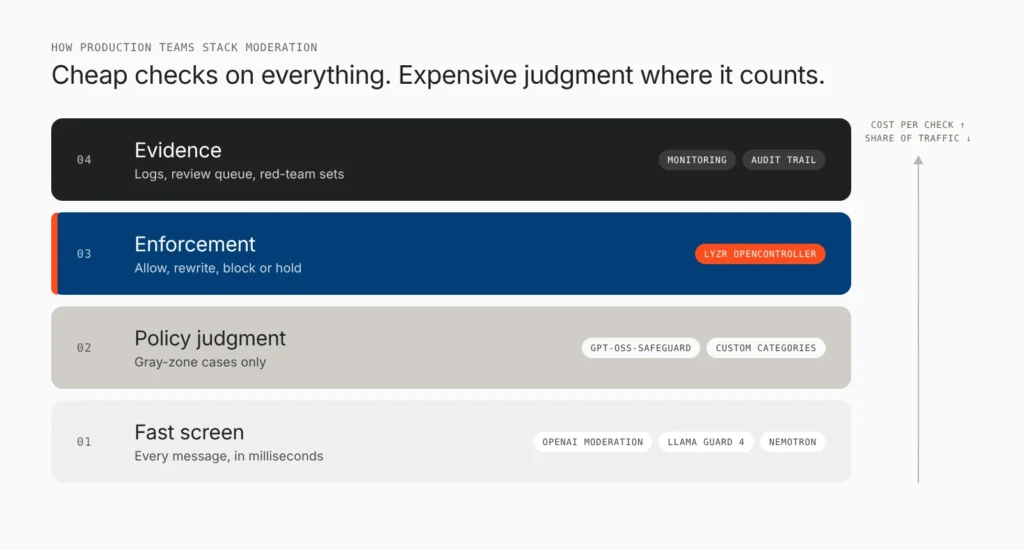
Few teams run one filter. OpenAI itself recommends a cheap, fast classifier on every message and a reasoning model only for gray-zone cases. Add a control plane that turns each verdict into allow, rewrite, block or hold per agent, and feed every layer’s logs into real-time agent monitoring. Sandboxing and access controls sit outside content filtering; see AI agent safety in production.
Before signing anything, run a two-week bake-off on your own traffic:
- Use 300 to 500 real prompts, slang and other languages included.
- Count false positives like misses. Engineers disable filters that block “kill the stuck process.”
- Attack the action path with a hidden instruction and an over-limit tool request.
- Price at real volume. Azure bills per 1,000 characters, so long documents cost several records.
The travel company’s classifier wasn’t wrong. The roast was mild, and the score said so. What was missing was a rule that this assistant never writes about a named private person, enforced on every reply, with a log proving it fired.
So choose the classifier that fits your stack, then decide who owns the rules when the fifth team ships an agent. Book a demo to see Opencontroller enforce moderation policy across your own agents.
FAQ
Managed: Azure AI Content Safety, Bedrock Guardrails and Model Armor. Self-hosted: Llama Guard 4 and Nemotron. For enforcement across many agents: Lyzr Opencontroller.
Yes. OpenAI’s Moderation API is free, Azure and Lakera have free tiers, and Llama Guard 4 and gpt-oss-safeguard cost only compute.
Some do. Azure Prompt Shields, Model Armor, Bedrock’s prompt-attack filter, NVIDIA’s jailbreak detection model and Lakera Guard detect injection attempts. Pure toxicity classifiers such as Llama Guard 4 do not.
Book A Demo: Click Here
Join our Slack: Click Here
Link to our GitHub: Click Here