Your next best employee isn’t human. Enterprise AI agents are specialized autonomous systems designed to execute specific business processes, make data-driven decisions, and integrate seamlessly with your existing technology infrastructure. Unlike consumer chatbots that respond to prompts, these agents proactively manage workflows, optimize operations, and deliver measurable business outcomes without constant supervision.
Think of an enterprise AI agent as a digital specialist on your team. A marketing manager analyzes campaign performance and adjusts strategies. A marketing AI agent performs the same analysis, optimizes ad spend, and generates strategic recommendations with machine-level precision and speed. These aren’t simple automation scripts. They are intelligent systems built to understand context, learn from patterns, and execute complex business logic.
What defines an enterprise AI agent?
An enterprise AI agent is defined by four core characteristics that distinguish it from general-purpose AI tools and basic automation software.
First, enterprise AI agents are function-specific. Each agent is designed with a clear job description and domain expertise. A finance agent understands invoice processing, compliance requirements, and financial reporting standards. An HR agent knows how to screen resumes, schedule interviews, and manage onboarding workflows. This specialization allows agents to perform at expert levels within their designated business domains.
Second, they operate with deep system integration. Enterprise AI agents don’t function as standalone applications. They connect directly to your core business systems like Salesforce for CRM, SAP for ERP, Workday for HRM, and countless other tools in your technology stack. This integration enables agents to access real-time data, execute actions across multiple platforms, and maintain consistency throughout your operational ecosystem.

Third, enterprise AI agents exhibit genuine autonomy. They execute multi-step workflows, make decisions based on business rules and learned patterns, and adapt to changing conditions without requiring human intervention for every action. An agent monitoring inventory can automatically reorder supplies when stock falls below thresholds, select optimal suppliers based on current pricing and delivery times, and adjust order quantities based on seasonal demand forecasts.
Fourth, they maintain business context awareness. These agents understand your company’s specific policies, compliance requirements, workflow standards, and strategic objectives. This contextual understanding ensures that every action aligns with organizational goals and regulatory frameworks. Platforms like Lyzr’s enterprise AI agents platform enable organizations to embed this business-specific knowledge directly into agent architectures.
How do enterprise AI agents differ from consumer AI applications?
The distinction between enterprise AI agents and consumer AI tools centers on purpose, architecture, and operational models.
Consumer AI applications are generalists designed for broad accessibility. They answer questions, generate content, and provide assistance across diverse topics. ChatGPT, Claude, and similar tools excel at responding to user prompts but operate in a reactive mode. You ask, they respond. They don’t initiate actions or manage ongoing processes independently.
Enterprise AI agents are specialists built for proactive execution. They don’t wait for prompts. They actively monitor business conditions, detect triggers, and execute appropriate workflows autonomously. When a customer submits a support ticket, an enterprise customer service agent automatically categorizes the issue, checks knowledge bases for solutions, escalates complex problems to human specialists, and tracks resolution progress across your ticketing system.
The integration depth represents another fundamental difference. Consumer tools operate as standalone applications with limited connections to other software. Enterprise AI agents require deep, bidirectional integration with your technology infrastructure. They read from and write to multiple systems, maintaining data consistency and executing coordinated actions across your entire digital ecosystem.
Security and compliance requirements also differentiate these categories. Consumer AI tools process data on external servers with standard privacy policies. Enterprise AI agents must comply with industry-specific regulations, maintain audit trails, enforce role-based access controls, and often operate within private AI infrastructure to protect sensitive business information.
Finally, success metrics differ fundamentally. Consumer AI is measured by user satisfaction and engagement. Enterprise AI agents are evaluated against specific business KPIs like cost reduction percentages, processing time improvements, error rate decreases, and revenue impact. This accountability to measurable business outcomes shapes how enterprise agents are designed, deployed, and optimized.

What business transformations do enterprise AI agents enable?
Enterprise AI agents transform business operations by shifting organizations from manual, reactive processes to automated, predictive workflows that operate at machine speed and scale.
In finance and accounting departments, AI agents automate invoice processing, expense report validation, and accounts payable workflows. UiPath’s digital workforce agents process thousands of invoices daily, extracting data, validating against purchase orders, flagging discrepancies, and routing approvals through proper channels. Finance teams that previously spent 60% of their time on data entry now allocate those hours to strategic financial analysis and planning.
Sales organizations deploy AI agents to optimize every stage of the customer journey. Salesforce Einstein analyzes historical deal data to score leads based on conversion probability, recommends next-best actions for sales representatives, and automates personalized follow-up communications. These agents don’t just assist salespeople; they actively manage pipeline health and revenue forecasting with accuracy that improves continuously as they learn from outcomes.
Research and analysis functions benefit tremendously from specialized agents. Organizations like HFS Research have implemented agentic systems for enterprise research that automatically gather data from multiple sources, synthesize insights, and generate analytical reports that would require weeks of manual effort. These agents transform research from a bottleneck into a competitive advantage.
Healthcare providers use IBM Watson agents to analyze clinical data, medical literature, and patient histories to support diagnostic decisions. These agents don’t replace physicians but augment their expertise by highlighting relevant research, identifying potential diagnoses based on symptom patterns, and flagging drug interaction risks that might be missed in complex cases.
Supply chain and operations teams deploy agents that monitor inventory levels, predict demand fluctuations, optimize routing logistics, and automatically adjust procurement schedules. These agents reduce stockouts, minimize excess inventory carrying costs, and improve delivery reliability by making thousands of micro-optimizations that would be impossible for human teams to manage manually.
The cumulative impact across these functions includes efficiency gains of 40-60% for routine processes, error rate reductions of 70-90% in data-intensive tasks, and the liberation of human talent to focus on strategic, creative, and relationship-oriented work that AI cannot replicate.
What technical architecture powers enterprise AI agents?
Enterprise AI agents operate through a sophisticated technical architecture that combines multiple AI technologies with enterprise integration capabilities.
At the foundation, API integration frameworks enable agents to communicate with your existing software ecosystem. Application Programming Interfaces serve as bridges that allow agents to authenticate with systems, read data from databases, execute actions through business applications, and maintain synchronization across platforms. Modern enterprise agent architectures support hundreds of pre-built connectors plus custom integration capabilities for proprietary systems.
Machine learning algorithms form the intelligence layer. These models analyze historical business data to identify patterns, generate predictions, and optimize decisions. Supervised learning models predict outcomes like customer churn probability or equipment failure risk. Reinforcement learning models optimize sequential decisions like workflow routing or resource allocation. The specific algorithms deployed depend on the business function and available training data.
Natural Language Processing capabilities enable agents to understand and generate human language. NLP models parse customer emails, extract intent from support tickets, analyze contract documents, and generate human-readable reports. Advanced NLP allows agents to participate in conversational interfaces, clarify ambiguous requests, and explain their reasoning in accessible terms.
Knowledge graphs and business rules engines provide the context layer. Knowledge graphs encode relationships between business entities, processes, and policies. Rules engines enforce compliance requirements, approval workflows, and decision logic. Together, these components ensure agents operate within defined business constraints and organizational knowledge.
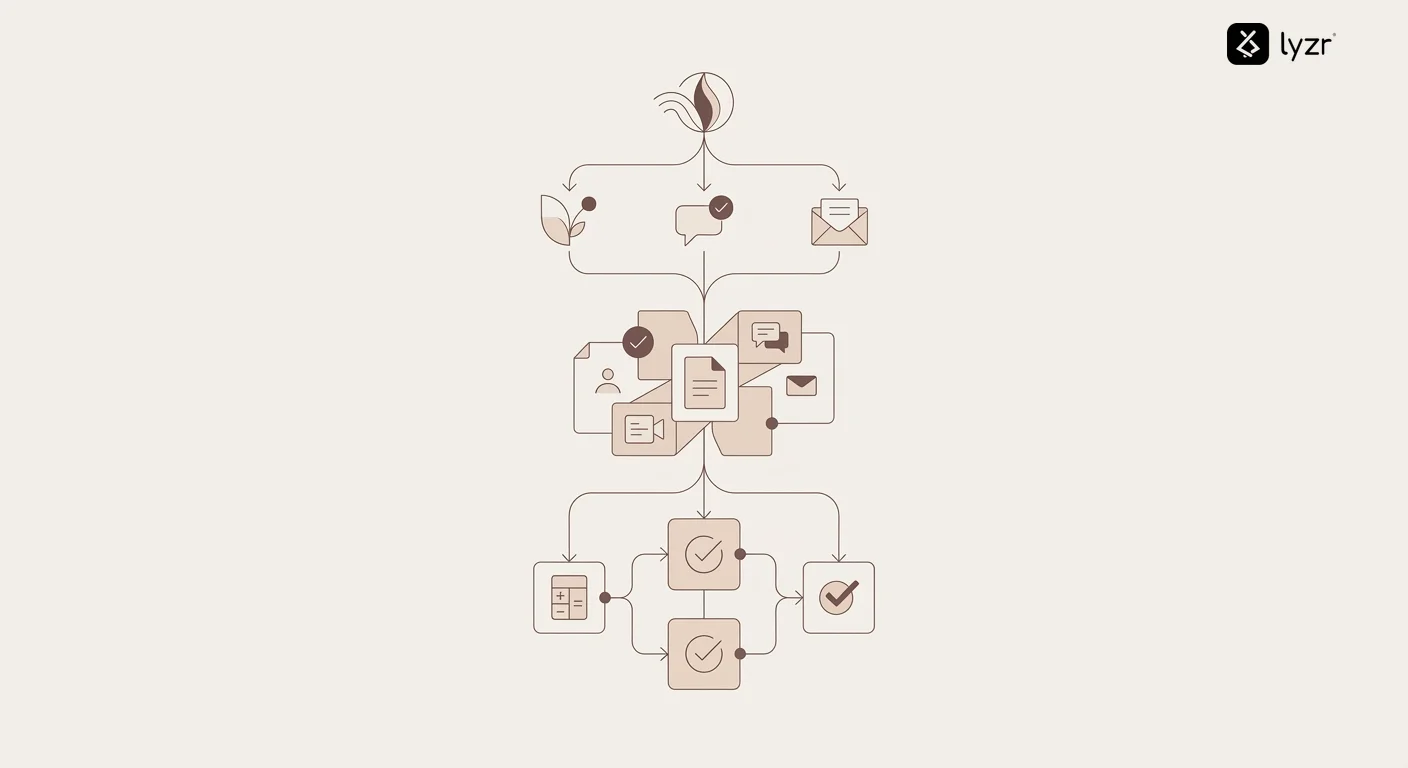
Orchestration and workflow engines coordinate multi-step processes. Enterprise operations rarely involve single actions. An order fulfillment agent must verify inventory, check customer credit, coordinate shipping, update multiple systems, and trigger billing processes. Workflow engines manage these complex sequences, handle exceptions, and maintain state across distributed systems.
Security and governance layers wrap around all components. Authentication mechanisms control agent access to systems and data. Audit logging tracks every agent action for compliance and troubleshooting. Monitoring systems detect anomalies and performance degradation. Organizations implementing secure AI agents prioritize these governance capabilities to maintain control as automation scales.
What challenges do organizations face deploying enterprise AI agents?
Successful enterprise AI agent deployment requires navigating several interconnected challenges that span technical, organizational, and strategic dimensions.
System integration complexity represents the most immediate technical hurdle. Large enterprises operate dozens or hundreds of software applications, many with limited API capabilities or outdated integration standards. Connecting agents to this heterogeneous environment requires significant engineering effort, custom connector development, and ongoing maintenance as systems evolve. Legacy mainframe systems pose particular challenges, often requiring intermediate translation layers.
Data quality and accessibility issues undermine agent performance. AI agents depend on high-quality training data and real-time operational data. Many organizations discover their data is siloed across systems, inconsistent in format and definitions, incomplete in critical fields, or inaccessible due to security restrictions. Addressing these data challenges often requires substantial data engineering work before agents can deliver value.
Process standardization gaps emerge when organizations attempt to automate workflows. Many business processes rely on tribal knowledge, undocumented exceptions, and human judgment calls. Automating these processes requires formally defining steps, decision criteria, and exception handling. This process mining and documentation effort reveals inefficiencies worth addressing independently of AI implementation.
Change management and workforce adaptation challenges extend beyond technology. Employees accustomed to manual processes must learn to work alongside AI agents, shifting from executing tasks to supervising agent performance and handling exceptions. This transition creates anxiety about job security, requires new skills, and demands cultural shifts in how work is conceptualized and valued. Successful AI agent implementations invest heavily in communication, training, and role redefinition.
Governance and compliance frameworks must evolve to accommodate autonomous agents. Organizations need clear policies defining agent authority levels, approval requirements, audit procedures, and accountability structures. Regulated industries face additional complexity ensuring agents comply with industry-specific requirements while maintaining the flexibility to adapt and improve.
Performance evaluation and continuous improvement present ongoing challenges. Unlike traditional software with predictable behavior, AI agents learn and adapt, making their performance dynamic. Organizations must implement robust evaluation frameworks that monitor agent accuracy, detect performance degradation, identify biases, and trigger retraining when necessary.
Cost-benefit analysis and ROI measurement require sophisticated approaches. Initial deployment costs are substantial, including software licenses, integration development, data preparation, and change management. Benefits accrue gradually as agents scale and optimize. Organizations need realistic timelines, phased deployment strategies, and metrics frameworks that capture both direct cost savings and strategic value creation.

How should organizations approach enterprise AI agent adoption?
Strategic enterprise AI agent adoption follows a deliberate progression from high-value use cases through organizational scaling.
Begin with use case prioritization based on business impact and feasibility. Ideal initial deployments target processes that are high-volume, rule-based, data-rich, and currently labor-intensive. Customer service ticket routing, invoice processing, and lead qualification typically meet these criteria. Avoid starting with highly complex, exception-heavy, or strategically sensitive processes until organizational capabilities mature.
Establish clear success metrics before deployment. Define specific KPIs like processing time reduction, error rate improvement, cost per transaction decrease, or customer satisfaction score increase. Baseline current performance and set realistic improvement targets. These metrics guide development priorities and provide objective evaluation of agent performance.
Invest in data infrastructure and quality. Audit data availability, consistency, and accessibility for target use cases. Address critical gaps through data integration projects, quality improvement initiatives, and governance policy implementation. Strong data foundations accelerate agent development and improve long-term performance.
Adopt a platform approach rather than point solutions. Evaluate comprehensive agentic AI platforms that support multiple use cases, provide reusable components, and offer governance capabilities that scale across the organization. Platform approaches reduce integration effort, standardize best practices, and lower the marginal cost of additional agent deployments.
Plan for human-agent collaboration from the start. Design workflows that leverage agent strengths in data processing, pattern recognition, and consistent execution while preserving human judgment for complex decisions, relationship management, and creative problem-solving. This collaboration model maximizes value while maintaining quality and building employee confidence.
Implement robust governance and monitoring. Establish agent oversight committees, define escalation procedures, implement comprehensive logging, and create dashboards that surface performance metrics and anomalies. Governance isn’t bureaucracy; it’s the foundation for safely scaling automation across critical business functions.
Iterate and expand systematically. Deploy initial agents, measure results, gather user feedback, and refine implementations before scaling. Use learnings from early deployments to improve development processes, integration patterns, and change management approaches. Systematic expansion builds organizational capability and confidence.
Deep Dive FAQs
What security considerations are critical for enterprise AI agents?
Enterprise AI agents require multi-layered security approaches addressing authentication, authorization, data protection, and audit capabilities. Agents must authenticate to systems using service accounts with appropriate credential management, often leveraging secrets management platforms and certificate-based authentication. Authorization frameworks enforce least-privilege access, ensuring agents only access data and functions necessary for their designated tasks. Data protection includes encryption in transit and at rest, with particular attention to sensitive information like personally identifiable information or financial data. Comprehensive audit logging captures every agent action, enabling security investigations and compliance verification. Organizations in regulated industries should prioritize platforms that accelerate agent deployment with built-in security rather than building security controls from scratch.
How do enterprise AI agents handle exceptions and edge cases?
Robust enterprise AI agents incorporate sophisticated exception handling through multiple mechanisms. Confidence scoring allows agents to assess their certainty in decisions, automatically escalating low-confidence situations to human review. Rule-based guardrails define explicit boundaries beyond which agents cannot operate independently, ensuring critical decisions receive human oversight. Fallback workflows provide alternative processing paths when primary approaches fail, maintaining operational continuity. Exception queues route unusual cases to specialized human experts while allowing routine processing to continue. Learning systems analyze exceptions to identify patterns, enabling agents to expand their autonomous capabilities over time as edge cases become better understood and codified. Well-designed enterprise operation agents balance automation efficiency with appropriate human oversight of complex situations.
Can enterprise AI agents work across multiple departments?
Cross-functional enterprise AI agents represent an advanced deployment pattern with significant coordination benefits. A customer onboarding agent might interact with CRM systems in sales, provisioning systems in operations, billing systems in finance, and communication platforms in customer success. These multi-departmental agents require careful governance defining responsibilities, escalation paths, and coordination protocols across organizational boundaries. Technical architecture must support access to diverse systems while maintaining appropriate security boundaries. Change management becomes more complex as multiple departments must align on process definitions and success metrics. Despite these challenges, cross-functional agents deliver disproportionate value by eliminating handoff delays, reducing coordination overhead, and providing end-to-end process visibility. Organizations exploring diverse enterprise use cases often discover that cross-departmental applications generate the highest ROI.
What role do large language models play in enterprise AI agents?
Large language models have expanded enterprise AI agent capabilities significantly, particularly for unstructured data processing and natural communication. LLMs enable agents to extract information from contracts, emails, and documents with unprecedented accuracy. They power conversational interfaces that allow employees to interact with agents using natural language rather than structured commands. LLMs generate human-readable summaries of agent actions and recommendations, improving transparency and trust. They also enhance agent flexibility, allowing adaptation to new situations through prompt engineering rather than extensive retraining. However, enterprise deployments must address LLM-specific challenges including hallucination risks, consistency requirements, and latency constraints. Organizations increasingly deploy custom enterprise agents that combine LLM capabilities with traditional ML models and business rules to balance flexibility with reliability and performance.
How do organizations measure enterprise AI agent ROI?
Comprehensive ROI measurement for enterprise AI agents encompasses direct cost savings, efficiency gains, quality improvements, and strategic value creation. Direct cost metrics include labor hours saved, transaction processing cost reduction, and software license consolidation. Efficiency metrics track processing time improvements, throughput increases, and cycle time reductions. Quality metrics measure error rate decreases, compliance violation reductions, and consistency improvements. Strategic value includes revenue impact from improved customer experience, competitive advantages from faster time-to-market, and innovation capacity freed by automating routine work. Effective ROI frameworks establish baseline measurements before deployment, track metrics continuously, and account for implementation costs including development, integration, training, and ongoing maintenance. Organizations should calculate both immediate returns and long-term value as agents scale and capabilities expand through continuous learning.
What distinguishes enterprise AI agent platforms from building custom solutions?
Platform versus custom development decisions hinge on speed, scalability, governance, and total cost of ownership. Enterprise AI agent platforms provide pre-built components including integration connectors, workflow orchestration, monitoring dashboards, and governance frameworks that accelerate deployment by months. Platforms offer reusable patterns and templates that reduce the marginal cost of each additional agent deployment. They include built-in governance, security, and compliance capabilities that would require substantial custom development. Platforms provide vendor support, regular updates, and community best practices. Custom development offers maximum flexibility for unique requirements and avoids platform licensing costs but requires significant ongoing engineering investment. Most organizations adopt hybrid approaches, using platforms for standard deployments while building custom solutions for highly differentiated competitive processes. When evaluating options, consider not just initial development effort but long-term maintenance, scaling economics, and organizational AI maturity.