TL;DR
- Article 26 deployer obligations apply to any organization using a high-risk AI system professionally, including non-EU companies whose AI output is used in the EU.
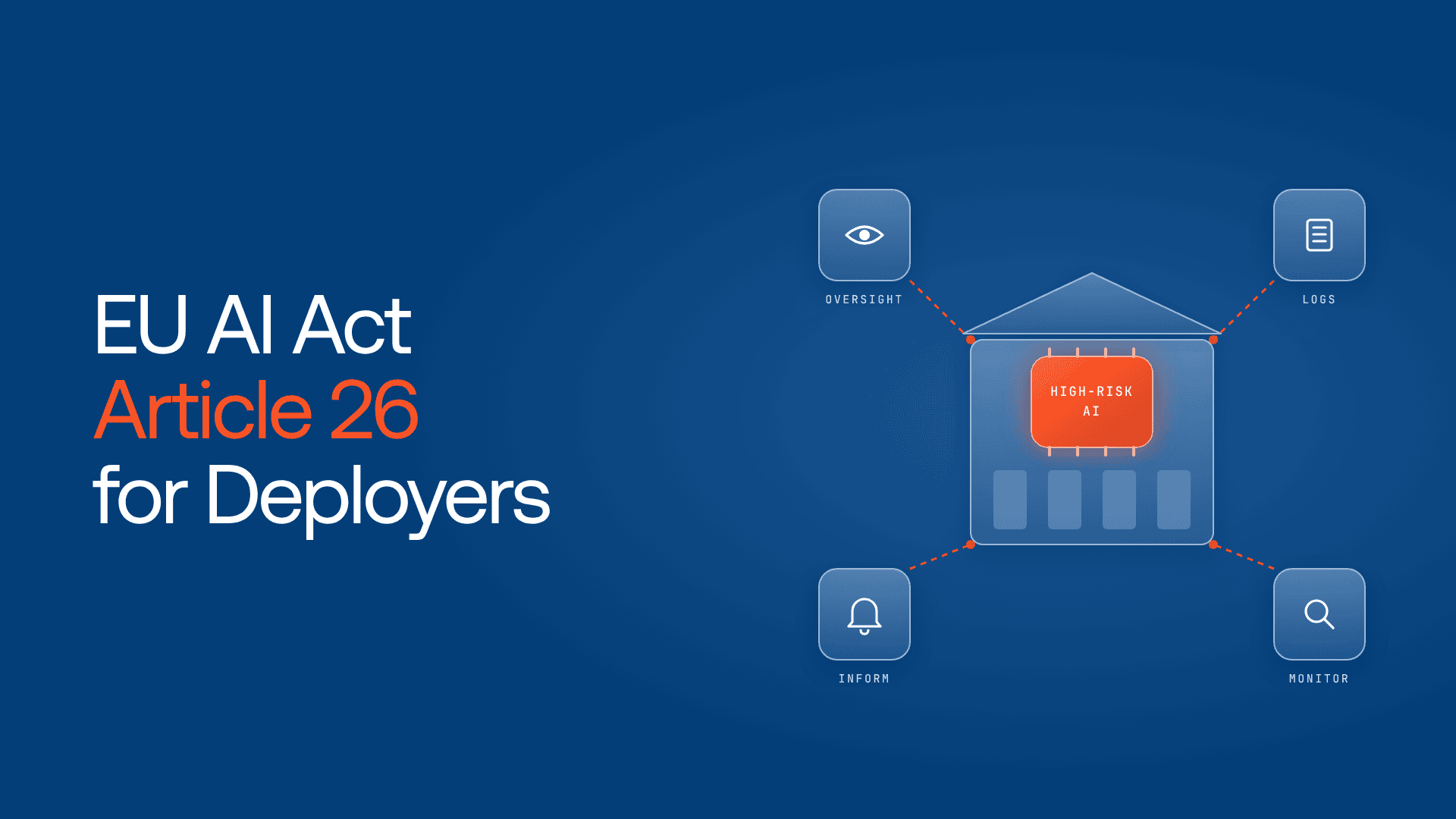
- The article has 12 paragraphs. Core duties: follow the provider’s instructions, assign trained human oversight, control input data, monitor and report risks, keep logs for at least six months, and inform workers and affected people.
- After the Digital Omnibus, they apply from December 2, 2027 for Annex III systems and August 2, 2028 for AI in Annex I products.
- Rebrand, substantially modify or repurpose a system into a high-risk use, and you become the provider.
- Fines reach EUR 15 million or 3% of worldwide turnover.
- Agents make oversight, monitoring and logging runtime problems.
An HR team rolls out a vendor’s CV-screening agent across its EU offices (a composite scenario). Procurement signed the contract and assumed the vendor carries the compliance load. Then the works council asks who reviews the agent’s rejections, and legal asks where its decision logs are kept.
That’s where Article 26 deployer obligations come in. The EU AI Act splits duties between the provider that builds a high-risk system and the deployer that uses it. Buying the system doesn’t transfer your share.
What are Article 26 deployer obligations?
Article 26 deployer obligations are the duties the EU AI Act places on organizations that use high-risk AI systems: use the system per the provider’s instructions, assign trained human oversight, keep input data relevant, monitor and report risks and incidents, retain logs for at least six months, and inform workers and affected people.
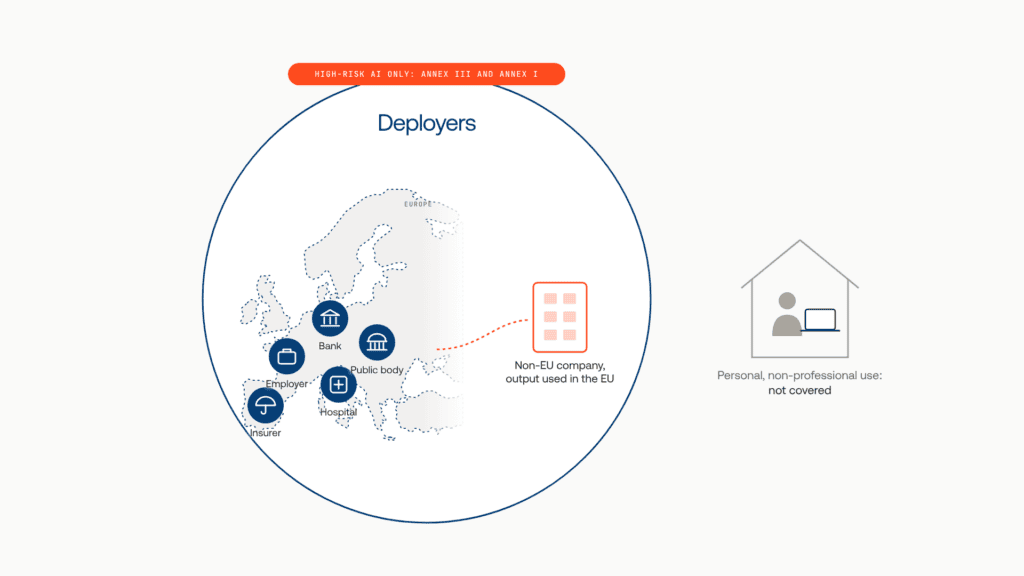
They apply only to high-risk systems: the use cases in Annex III, such as employment, credit scoring, education and biometrics, and AI in products covered by Annex I. The CV-screening agent falls under Annex III’s employment category.
Who counts as a deployer?
Under Article 3(4), a deployer is any person, company or public body using an AI system under its authority, except for personal, non-professional use. Location doesn’t get you out: under Article 2(1)(c), deployers outside the EU are in scope when the system’s output is used in the EU.
When does Article 26 apply?
The Digital Omnibus on AI, Regulation (EU) 2026/1744, was published on July 24, 2026 and entered into force on July 27, 2026. It moved the dates, not the duties. Under the amended Article 113, Article 26 applies from:
- December 2, 2027 for high-risk systems listed in Annex III
- August 2, 2028 for high-risk AI covered by Annex I
Article 26’s own text wasn’t amended.
Are you a deployer or a provider?
Check your role before you plan anything. Under Article 25, a deployer takes on the provider’s much heavier duties in three cases:
- You put your name or trademark on a high-risk system already on the market.
- You make a substantial modification to a high-risk system and it stays high-risk.
- You change the intended purpose of an AI system that wasn’t high-risk, including a general-purpose one, so it becomes high-risk.
The third case catches teams building agents. Wrap a general-purpose model in an agent, point it at screening candidates or scoring loan applicants, and you’ve likely created a high-risk system. You’re its provider, not just its deployer.
| Provider | Deployer | |
| Who | Develops the system and places it on the market under its name | Uses the system under its authority |
| Core duties | Meet the high-risk requirements, run the conformity assessment, register the system, monitor it after release | Article 26: use per instructions, human oversight, input data, monitoring, logs, notices |
| Instructions for use | Writes them | Follows them |
| Fine ceiling for these duties | EUR 15M or 3% of turnover (Article 99) | EUR 15M or 3% of turnover |
The 12 Article 26 deployer obligations, paragraph by paragraph
| Paragraph | What it requires | Evidence to keep |
| 26(1) Instructions for use | Technical and organizational measures to use the system as the provider’s instructions say | Instructions on file; configuration matches them |
| 26(2) Human oversight | Assign oversight to people with the competence, training, authority and support to do it | Named overseers, training records, escalation rights |
| 26(3) Other law | Paragraphs 1 and 2 don’t override other EU or national duties, or your freedom to organize oversight | Map of overlapping obligations |
| 26(4) Input data | Where you control input data, keep it relevant and sufficiently representative for the intended purpose | Data source list and review notes |
| 26(5) Monitoring and incidents | Monitor operation; on a risk, inform the provider or distributor and the authority, and suspend use; report serious incidents | Monitoring records, incident log, notifications |
| 26(6) Logs | Keep automatically generated logs under your control for at least six months, unless other law says otherwise | Retention policy, retrievable logs |
| 26(7) Workers | Employers inform workers’ representatives and affected workers before workplace use | Dated notices, works council records |
| 26(8) Registration | Public authorities and EU bodies meet Article 49 registration duties and don’t use unregistered systems | Registration confirmation |
| 26(9) DPIA | Use the provider’s Article 13 information for a GDPR data protection impact assessment where required | DPIA referencing the system |
| 26(10) Post-remote biometric ID | Law enforcement needs judicial or administrative authorization, with strict limits | Authorizations, annual reports |
| 26(11) Affected people | Annex III deployers making or assisting decisions about people tell them a high-risk system is used | Notices in letters or interfaces |
| 26(12) Cooperation | Cooperate with competent authorities on any action relating to the system | Contact owner, response records |
Three of these create most of the work.
Human oversight is a staffing decision. A reviewer who can’t overrule the system, or doesn’t understand its limits, doesn’t meet paragraph 2.
Monitoring has a set order. Under paragraph 5, if you have reason to think the system presents a risk, you inform the provider or distributor and the market surveillance authority without undue delay, and suspend use. For a serious incident, you immediately inform the provider first, then the importer or distributor and the authorities.
Logs depend on your contract. Paragraph 6 covers logs only to the extent they’re under your control. If the vendor holds every log, your retention duty is only as good as your access to them.
Extra rules for public bodies, banks and law enforcement
Public authorities register their use under 26(8). They also face Article 27: a fundamental rights impact assessment before first use.
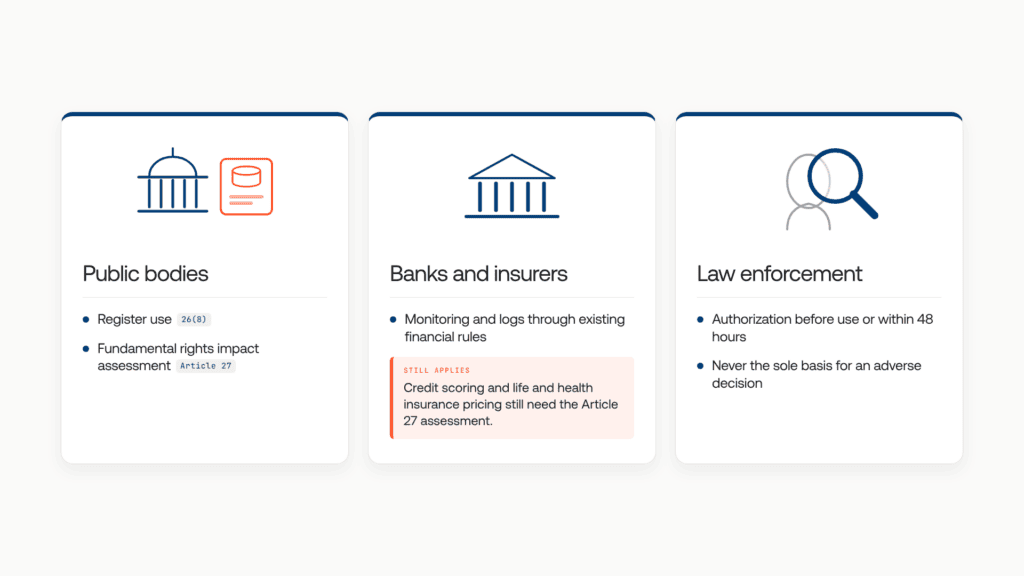
That assessment reaches further than many expect. It covers bodies governed by public law, private entities providing public services, and deployers of Annex III points 5(b) and (c): creditworthiness and credit scoring, and risk assessment and pricing for life and health insurance. Critical infrastructure systems are excluded. Results go to the market surveillance authority.
Banks and other financial institutions meet the 26(5) monitoring duty through their internal governance rules under financial services law, and keep 26(6) logs as part of the documentation that law already requires. Neither carve-out removes the Article 27 assessment for credit scoring, so their compliance monitoring still has to cover it.
Law enforcement using post-remote biometric identification needs authorization from a judicial or binding administrative authority, beforehand or within 48 hours. Use must be targeted, reported annually, and never the sole basis for a decision with adverse legal effects.
What Article 26 means for AI agents
Article 26 was written for systems that score or classify. Agents act: they call tools, update records and send messages. That stretches four duties.
Instructions for use: An agent’s behavior depends on its prompt, model, tools and permissions. Change one and you may drift outside the provider’s instructions, or, under Article 25, become the provider yourself.
Human oversight: For an agent, oversight means a person can approve or stop a specific action before it lands, not review a weekly report after the fact.
Input data: What you control now includes retrieval sources, connected systems and the access the agent runs with. Each shapes what the agent sees and does.
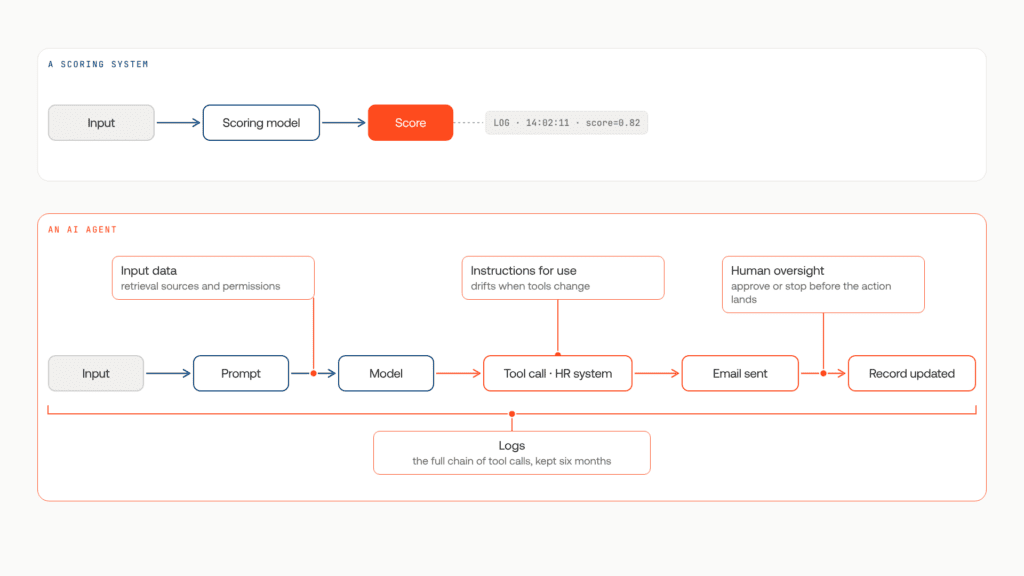
Monitoring and logs: The meaningful record is the chain of tool calls behind each outcome, not just the final output. Six months of it must be retrievable on request.
One caveat: the Omnibus softened the general AI literacy duty in Article 4. Providers and deployers now take measures to support literacy, without guaranteeing any specific level. Paragraph 2 didn’t change, so whoever oversees a high-risk agent still needs real competence and authority.
An Article 26 readiness checklist for deployers
December 2027 is about a year away. Work through these in order:
- Inventory your AI systems and flag which fall under Annex III.
- Confirm your role for each: deployer, or provider under Article 25.
- Collect each provider’s instructions for use and agree log access in the contract.
- Name oversight owners with the training and authority to intervene or stop the system.
- Set log retention to at least six months, longer where sector law requires.
- Draft notices for workers and representatives, and for people subject to decisions.
- Check whether you need a DPIA under 26(9) and a fundamental rights impact assessment under Article 27.
- Write the incident path: who tells the provider and the authority, and who can suspend use.
Steps 1 to 3, 6 and 7 are paperwork you write once and update. Steps 4, 5 and 8 depend on what happens while the system runs. For agents, that’s the hard part.
Turning the checklist into controls? The free CIO guide to AI agent governance covers the control points that put an owner, a policy and an audit trail on every agent, across any framework and cloud. Get the playbook →
Where Article 26 compliance breaks for agents
Policies, notices and assessments sit in documents. Oversight, monitoring and logs happen at runtime, one action at a time.
When every team wires its agents straight to models and tools, there’s no single place to see what an agent did, hold a risky action for review, or pull six months of records. The overseer named in step 4 has nothing to oversee in real time.
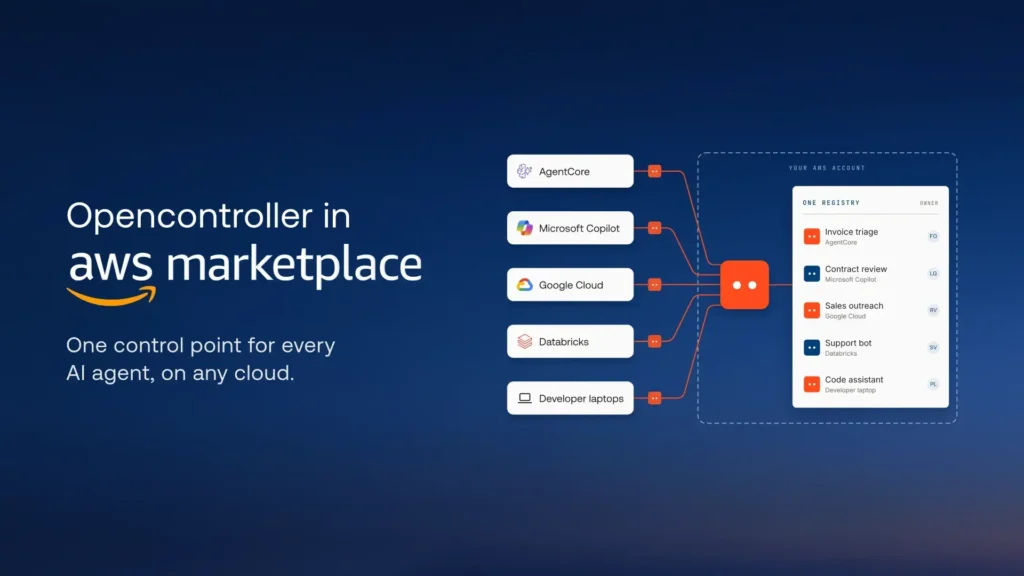
What closes that gap is one control point in the path between agents and everything they call: every agent identified, every call checked against policy, every action recorded the same way. That’s the job Lyzr Opencontroller was built for.
How Lyzr Opencontroller supports Article 26 for AI agents
Opencontroller is a control plane that finds every AI agent across your clouds, gives each one an owner, and controls what it can call, spend and touch. Per Lyzr’s architecture overview, every governed action can be authenticated, authorized, budgeted and checked before it reaches a model, tool or enterprise system. Existing frameworks and runtimes stay as they are, and it can run in your cloud account, on-premises or fully air-gapped.
| Article 26 duty | What it needs at runtime | How Opencontroller helps |
| 26(1) Instructions for use | Agents used only for their intended tools and actions | Applies identity and policy to every call; model and tool calls go only to destinations you authorize |
| 26(2) Human oversight | A named owner and a way to act before an action lands | Gives each agent an owner; risky actions, such as a refund over a set amount, can be held until the owner approves |
| 26(5) Monitoring | Visibility into what each agent does | Records every run as an OpenTelemetry trace with cost, owner and guardrail decisions, exported to the tools you already run |
| 26(6) Logs | Retrievable records under your control | In customer-managed deployments, telemetry stays in your environment and the retention model stays under your control |
| Checklist step 1 | A complete list of agents in use | Finds every AI agent across your clouds |
Opencontroller doesn’t classify systems, write notices or file assessments, and it doesn’t make you compliant. It gives you the runtime control and evidence Article 26 assumes you have.
Back to the HR team. With the screening agent routed through Opencontroller, it has a named owner, its high-impact actions can wait for a reviewer, and every step is traced. When the works council or a regulator asks what the agent did, the answer is already on record.
Book a demo to see how Opencontroller gives every agent an owner, a policy and an audit trail before December 2027.
Frequently asked questions
They’re the EU AI Act duties for organizations using high-risk AI systems: follow the provider’s instructions, assign competent human oversight, keep input data relevant, monitor and report risks and serious incidents, retain logs for at least six months, inform workers and affected people, and cooperate with authorities.
A deployer is any person, company or public body using an AI system under its authority, except for personal, non-professional use. Companies outside the EU are covered when the system’s output is used in the EU.
After the Digital Omnibus on AI, Regulation (EU) 2026/1744, Article 26 applies from December 2, 2027 for high-risk systems listed in Annex III and from August 2, 2028 for high-risk AI covered by Annex I.
At least six months, under Article 26(6), unless other EU or national law sets a different period. The duty covers logs the system generates automatically, to the extent they’re under the deployer’s control, so log access belongs in vendor contracts.
Some do, under Article 27. Bodies governed by public law, private entities providing public services, and deployers using AI for credit scoring or life and health insurance pricing must assess fundamental rights impacts before first use and notify the market surveillance authority of the results.
Under Article 99(4), breaching Article 26 can bring fines of up to EUR 15 million or 3% of total worldwide annual turnover, whichever is higher. For SMEs, start-ups and small mid-cap enterprises, the lower of the two applies.
This article is for general information and isn’t legal advice.
Book A Demo: Click Here
Join our Slack: Click Here
Link to our GitHub: Click Here
Got a use case in mind?
8 weeks from use case to agents running in production.
Platform, people and FDEs, all in. Bring your environment. We'll co-build and stay until it's live.
Talk to UsFree resource
101 AI Agents Use Cases
100+ production-ready AI agent use cases across Marketing, Sales, HR, Banking, Insurance, Operations and a lot more
Download now