TL;DR
- A compliance monitoring and testing plan for banks is a risk-based schedule of which requirements get checked, by whom, how often, and what happens to findings.
- Monitoring is ongoing first-line self-review. Testing is periodic, independent second-line review. Keep the two separate.
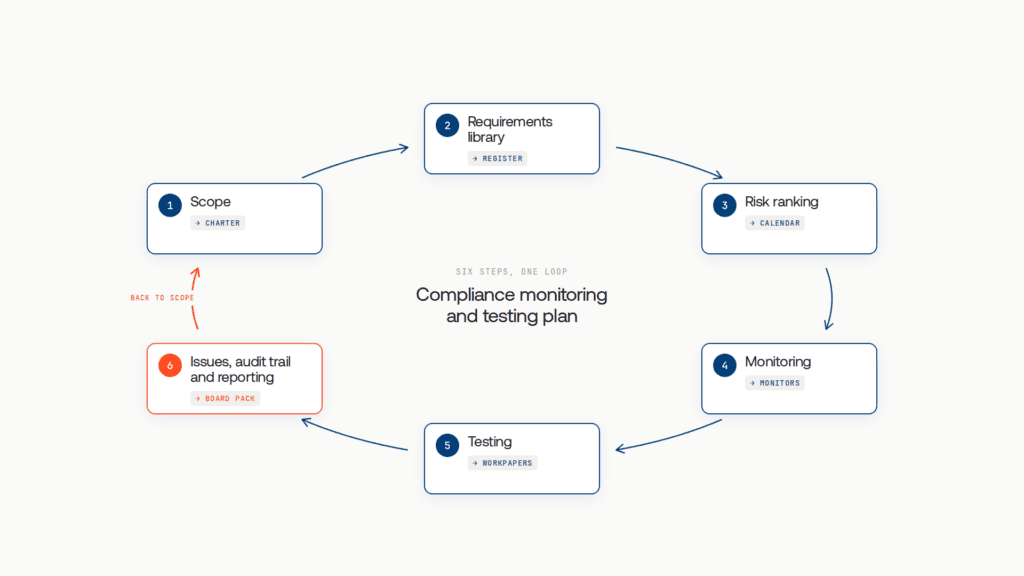
- Build it in six steps: scope, requirements library, risk ranking, monitoring, testing, and issue management backed by an audit trail.
- Most failed plans ran on schedule. They failed because of what they never looked at.
- Nearly every failure is a broken link between an obligation, its control and its evidence. Keep those links current all year.
Last year’s plan finished on time. Every test closed, the committee signed off, and the findings log was almost empty. That is supposed to be good news.
Bank of America had a program too. On October 13, 2026, the OCC fined it $750 million, the agency’s largest penalty ever, finding its monitoring system failed to properly monitor trillions of dollars in transactions and its BSA audit function missed long-standing concerns examiners later uncovered. FinCEN assessed $1.2 billion the same day, crediting the OCC’s amount.
A compliance monitoring and testing plan for banks rarely fails in execution. It fails in what it never looked at, or never looked at hard enough. This guide builds one around that problem, as part of the compliance program your examiners already assess.
What is a compliance monitoring and testing plan?
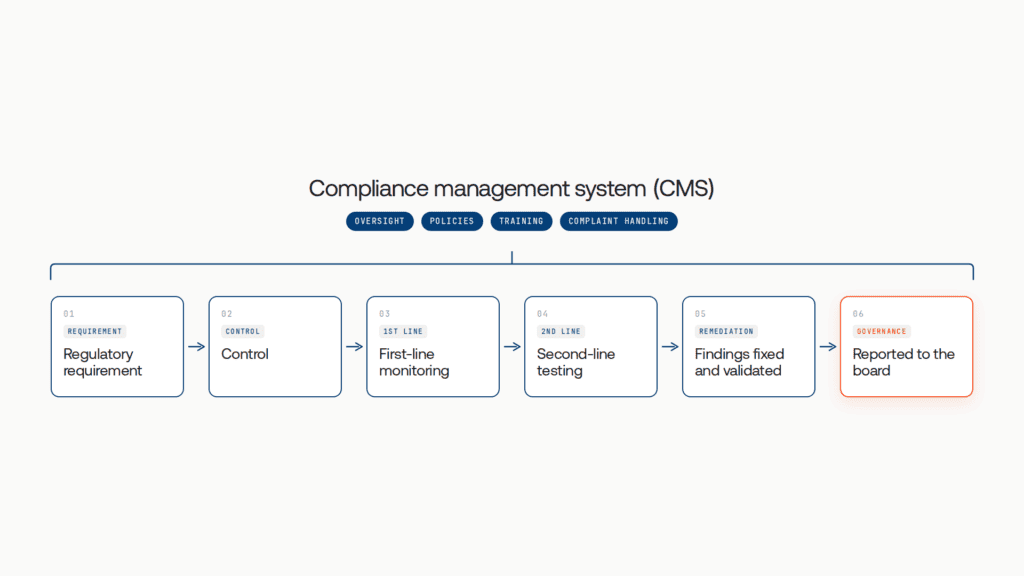
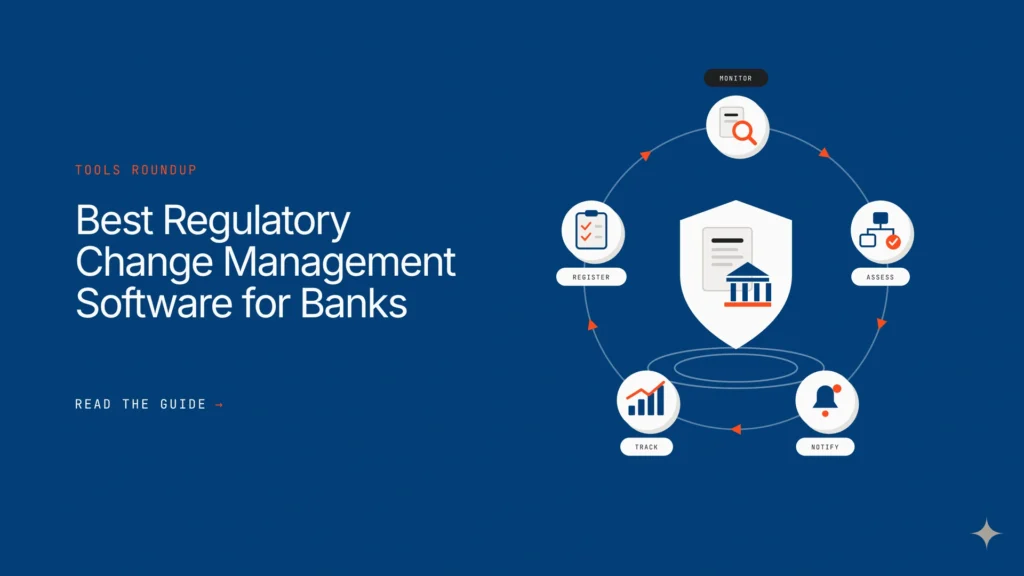
A compliance monitoring and testing plan for banks is a board-approved, risk-based schedule that maps each applicable regulatory requirement to the controls that meet it. It then sets how the first line monitors those controls, how the second line tests them independently, how often, and how findings are fixed, validated and reported.
It’s one piece of the bank’s compliance management system (CMS), alongside oversight, policies, training and complaint handling.
Compliance monitoring vs compliance testing: what’s the difference?
Monitoring is the ongoing review a business line runs on its own activity to catch problems early. Testing is a periodic, independent, sample-based check by compliance that the controls actually work.
| Monitoring | Testing | Audit | |
| Who | First line (business), supported by compliance | Second line (compliance testing) | Third line (internal audit) |
| When | Continuous or frequent | Periodic, scheduled by risk | Cyclical |
| How | Reports, KRIs, quality control, surveillance | Samples, walkthroughs, re-performance | Independent assurance over both lines |
| Question it answers | Is anything going wrong right now? | Do the controls work as designed? | Can the board rely on both? |
The first two columns get blurred most. When the business monitors and closes its own findings, nobody independent has checked the controls.
What examiners expect your plan to show
No regulator publishes a template, but recent guidance points one way.
- OCC: in Bulletin 2025-24 (October 2025), the OCC said examiners will leverage a community bank’s audit and risk functions when appropriate, once they judge them reliable. Reliable testing means less duplicated exam work.
- FDIC: its updated exam schedule (November 2025) puts well-rated institutions with $350 million or less in assets on 66 to 78 month cycles. Your own monitoring carries the load between exams.
- FinCEN: an April 2026 proposed rule says independent AML/CFT testing should focus on effectiveness, use objective criteria, and be run by people truly independent of the AML/CFT function. It’s still a proposal.
The plan is the evidence your CMS works.
How to build a compliance monitoring and testing plan for banks in six steps
Fix the scope, build the library, rank by risk, design monitoring and testing separately, then close the loop.
Step 1. Set scope, objectives and governance
Cover the period, entities, business lines, products, channels and regulations. Write testable objectives (“confirm Reg E error-resolution deadlines were met in sampled claims”), not “ensure compliance.” Add the line most plans miss: any process that makes or prepares a compliance decision is in scope, whoever or whatever performs it. The CCO drafts, the Compliance Committee approves.
Step 2. Build the requirements library and link it to controls
List every applicable obligation: BSA/AML, OFAC, Reg E, Reg Z, ECOA, UDAAP, fair lending, privacy, flood. Then link each one through the chain that makes it testable: obligation, policy, procedure, control, owner, evidence. An obligation with no control can’t be tested. This step decides whether the rest of the plan is honest.
Step 3. Rank by risk and set frequency
Score inherent risk on volume, complexity, consumer harm and regulatory focus, then adjust for control strength. Feed in the risk assessment, RCSA, exam and audit findings, complaints, new products and system changes. A common pattern: high residual risk twice a year, moderate annually, low every two to three years.
Step 4. Design first-line monitoring
Decide what runs continuously: alert aging, CTR timeliness, KYC refresh dates, complaint themes, third-party performance, exception reports. Give each monitor a threshold, an owner and an escalation path. AI agents can run many of these checks. Monitoring tells you something changed. It doesn’t prove a control works.
Step 5. Design second-line tests
Choose the method by control: transaction testing (sample and re-perform), walkthroughs (procedure versus practice), observation, or analytics over a full population. Write criteria before opening a file. Confirm the population is complete before sampling, because a clean sample from an incomplete population proves nothing. Keep workpapers an examiner could reperform.
Step 6. Manage issues, keep an audit trail and report
Log every exception with severity, root cause, owner, due date and required evidence. Compliance re-tests before anything closes. Keep an audit trail of every test, finding, fix and sign-off, so an examiner can follow any result from obligation to evidence. Report monthly to management and quarterly to the board. A plan that escalates nothing for a year isn’t looking hard enough.
See how banks run dispute resolution with AI agents, with a full audit trail and decision replay built in. Read the BFSI dispute guide:
Sample compliance monitoring and testing plan
A few rows of a finished plan look like this. Yours carries one row per material requirement.
| Area | Requirement | Residual risk | First-line monitoring | Second-line test | Frequency | Owner |
| BSA/AML | SARs filed within regulatory deadlines | High | Alert aging and backlog dashboard | Sample closed alerts, re-perform the decision, check filing dates | Semiannual | BSA officer |
| BSA/AML | Monitoring covers all transaction types | High | Monthly coverage reconciliation by channel | Reconcile monitored vs total volume by product and channel | Annual and on system change | Head of financial crimes |
| KYC/CDD | Risk-based customer due diligence refresh | High | Overdue refresh report | Sample high-risk files for completeness and timeliness | Semiannual | KYC operations lead |
| Reg E | Error resolution and provisional credit deadlines | Moderate | Claim aging report | Sample claims, test notice and credit timing | Annual | Deposit operations |
| Fair lending | Pricing exceptions applied consistently | Moderate | Exception volume by branch | Statistical review plus file sample | Annual | Lending compliance |
| Complaints | UDAAP signals captured and escalated | Moderate | Theme and volume trends | Sample classification accuracy | Annual | Complaints lead |
| AI-assisted process | Alert-triage agent follows AML policy | High | Agent decision and override rates | Sample agent decisions, confirm approved version and policy in force | Quarterly | BSA officer and agent owner |
The second row is the coverage check most plans skip. The last row is the one most plans still don’t have.
Where compliance monitoring and testing plans quietly fail
Plans rarely fail because tests weren’t run. They fail because the plan stopped matching the bank.
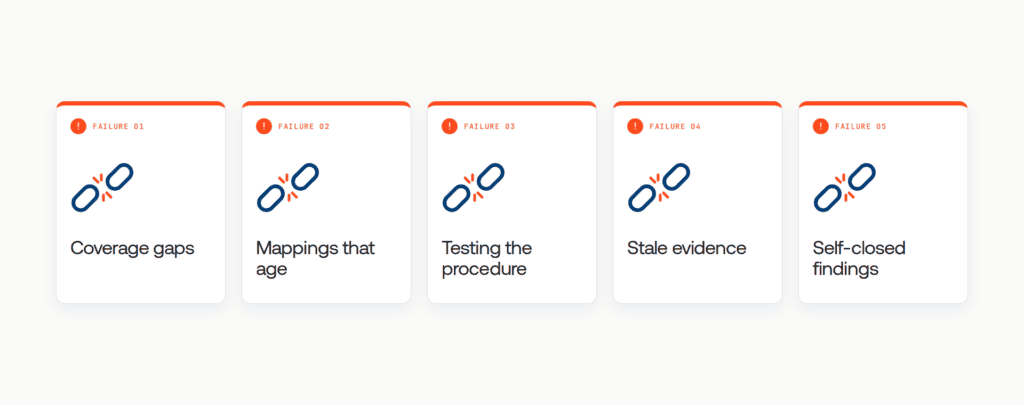
Coverage gaps
Products, channels or transaction types that never made it into scope. A new lending partnership can drop out as easily as a payment channel.
Mappings that age
The library gets built once and then drifts, though FinCEN’s proposal would require programs to stay current as risk evolves. Today the likeliest missing process is one an AI agent runs, often a shadow AI agent a vendor embedded. Since April 2026, SR 26-2 places agentic AI outside model risk guidance and under the bank’s broader risk management, so it belongs in this plan.
Testing the procedure, not the outcome
A walkthrough without a sample proves a document exists, not that anyone follows it. Soft testing ends where Bank of America’s audit function did: missing what examiners later find.
Stale evidence
A control passed once and its evidence was never refreshed. Nobody can say what still proves the duty today.
Self-closed findings
The business marks remediation complete and nobody re-tests. The OCC said Bank of America’s program “continues to have significant breakdowns” even after the bank committed to fixing its deficiencies.
The pattern behind every failure: broken links
These five failures are one problem. The obligation, its policy and procedure, its control and its evidence sit in different places: a regulatory tracker, a GRC inventory, a shared drive, an inbox. Someone links them during plan season, then they drift.
That’s why testing one control takes weeks. The test is quick; finding which procedure the control belongs to, and whether its evidence is current, is slow. A plan is only as good as the links behind it.
How Madison keeps your monitoring and testing plan connected
Madison is Lyzr’s agentic governance, risk and compliance system for banks and credit unions. It holds obligations, policies, procedures, controls and evidence as one connected model, so your plan’s links stay current.
| Plan step | Where it usually breaks | What Madison does |
| Step 1, scope | Obligations nobody has confirmed apply to the bank | Maps which obligations apply, and flags the ones no policy carries at all |
| Step 2, library | Mappings set up once, then left to age | Agents maintain the links continuously. A rule feed monitor diffs new and amended text from the Federal Register and agency sites, and Madison traces each change to every object it touches |
| Step 3, risk ranking | Little view of where enforcement is heading | An enforcement scanner reads public consent orders and tags the regulations they cite |
| Step 5, testing | Weeks spent finding which procedure a control belongs to | Each control is linked to the obligation it satisfies and the evidence that proves it |
| Step 6, reporting | Evidence that passed once and was never re-checked | An evidence readout shows what’s verified, stale or missing |
| The exam | Requests tracked as a task list | Each request is traced back to the obligation, control and evidence behind it |
Agents propose, your people decide. A named reviewer checks each proposed change, and a person attests to it against a specific object version. Madison never remediates on its own and doesn’t determine compliance. Your team does.
It runs where your data lives. Madison deploys into your own cloud tenancy and reads from core, origination and document systems without writing back to core.
It covers the processes your plan is adding. Third-party and AI governance is one of Madison’s domains, built on the same objects, so an agent-run process gets the same chain as any other.
Next November, you don’t rebuild the library. You check three readouts: Are we covered? What are we exposed to? Can we prove it?
Book a demo to see Madison trace one of your obligations from rule to evidence.
Before the plan goes to committee
Reconcile monitored activity against total activity by product and channel; a mismatch is your first finding. Add the scope line for every process that makes a compliance decision. Then trace your five highest-risk obligations to current evidence. Where the chain breaks, your plan is failing.
Rules will keep moving. A compliance monitoring and testing plan for banks that keeps its links current won’t need rebuilding when they do.
FAQ
It’s a board-approved, risk-based schedule mapping each regulatory requirement to its controls. It sets how the first line monitors them, how the second line tests them, how often, and how findings are fixed and reported.
Monitoring is ongoing review the business runs on its own activity to catch issues early. Testing is periodic, independent and sample-based, run by second-line compliance to confirm controls work as designed.
Base it on risk, since no single frequency is required. Many banks test high-risk areas twice a year, moderate risk annually and low risk every two to three years, adding tests after major changes.
Second-line compliance runs testing and the chief compliance officer owns the plan. A compliance committee approves it, the board oversees it, and internal audit assures both monitoring and testing.
It means pulling a sample of real transactions or files and re-performing them against the requirement. It confirms the outcome was correct, not just that a procedure exists, which process reviews alone can’t show.
Include scope, sample, criteria, results and exceptions by severity, plus root cause, owners and due dates for each issue. Keep an audit trail detailed enough for an examiner to re-perform the test.
Book A Demo: Click Here
Join our Slack: Click Here
Link to our GitHub: Click Here
Got a use case in mind?
8 weeks from use case to agents running in production.
Platform, people and FDEs, all in. Bring your environment. We'll co-build and stay until it's live.
Talk to UsFree resource
101 AI Agents Use Cases
100+ production-ready AI agent use cases across Marketing, Sales, HR, Banking, Insurance, Operations and a lot more
Download now