TL;DR
- The real difference: in LiteLLM vs Opencontroller, the split is no longer models vs agents. LiteLLM now routes model, MCP and agent traffic for whatever is registered with it.
- What Opencontroller adds: Lyzr Opencontroller governs your whole agent estate, including agents that never touch a gateway.
- Choose LiteLLM to unify model APIs, team keys, budgets and fallback across a handful of apps. The core is free and open source.
- Choose Opencontroller when you need discovery of unregistered agents, an identity and owner for every agent, gated releases and policy checked before each call.
- You don’t have to switch on day one. Start by finding every agent you run, then decide about the gateway.
A year ago, a platform team put LiteLLM in front of its apps. It was a good call. Thirty-odd services got one OpenAI-style endpoint, team keys, budgets and fallback through a single LLM gateway. Since then, the team has added two MCP servers and registered four agents with the gateway.
Then, before an audit, the CISO asks one question: “Show me every agent that can read customer data, who owns it, and what stops it.”
The LiteLLM dashboard answers for every agent that calls through it. It can’t show the agent a data science team runs from a notebook with its own provider key, or the vendor agent another business unit deployed last quarter.
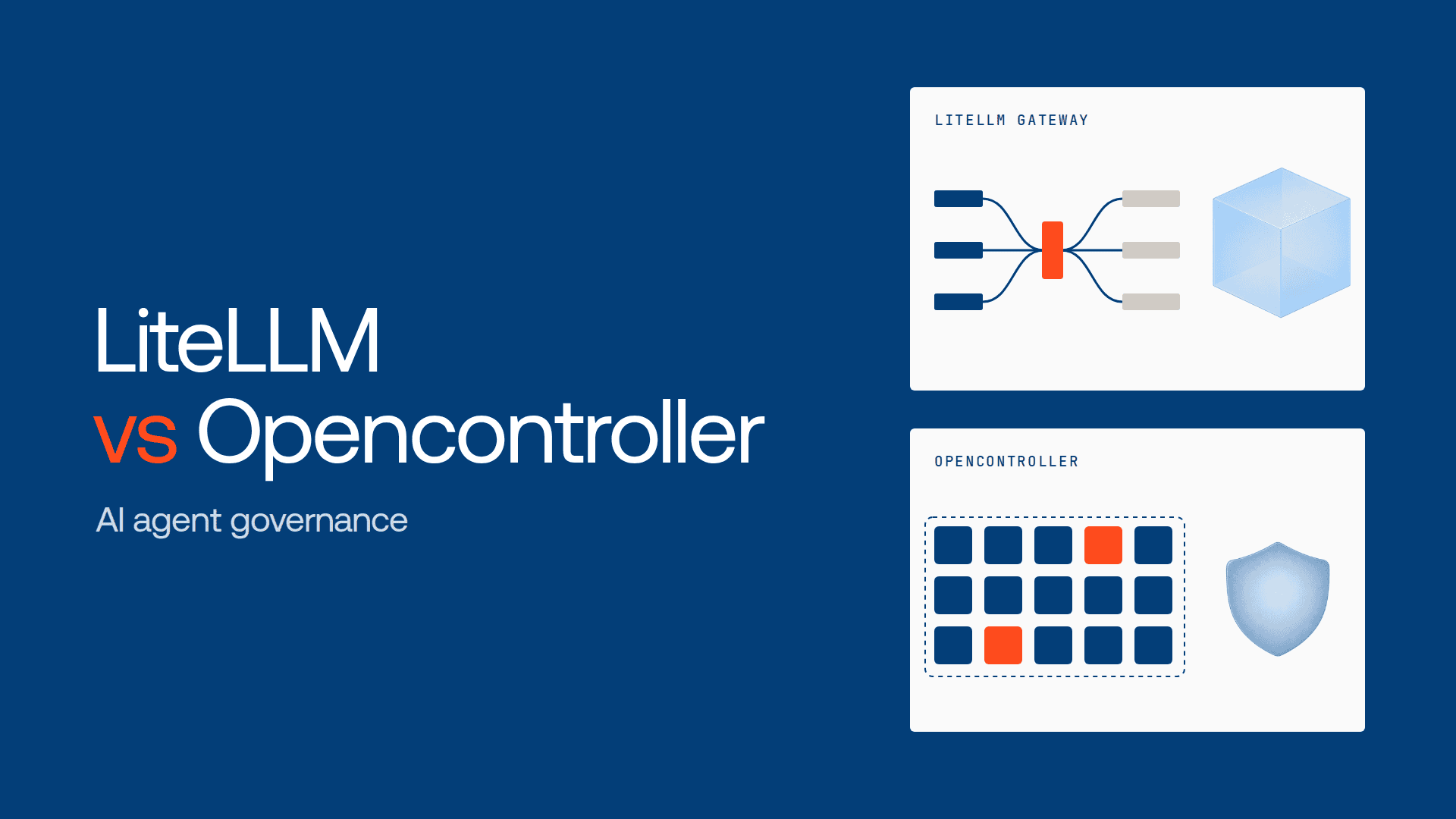
That gap is the whole LiteLLM vs Opencontroller comparison. LiteLLM is an open-source SDK and gateway that gives apps one OpenAI-style API across 100+ model providers, with keys, budgets and routing for the traffic sent through it. Lyzr Opencontroller is an enterprise control plane that finds, governs and enforces policy on every AI agent an organization runs, whether or not anyone registered it.
What LiteLLM does, and does well
LiteLLM gives developers one OpenAI-format API for many model providers. You can use it as a Python library inside your code, or deploy it as a self-hosted AI gateway that every app calls. That gateway, widely known as the LiteLLM proxy, is what most platform teams run.

Here’s what the open-source gateway gives you:
- One API for 100+ providers. Write OpenAI-style calls once and switch providers without rewriting code.
- Virtual keys and budgets. Issue keys per team, app or developer, each with its own rate limits and spend cap.
- Routing and fallback. Balance load and retry across deployments when one fails.
- Guardrails and logging. Custom guardrails, PII masking and spend tracking for every request.
- An open core. The code outside its enterprise folder is MIT-licensed. A paid Enterprise license on the same image adds SSO beyond five users, SCIM, audit logs, org and team admins, JWT authentication and secret-manager integrations.
For a team that wants one front door to its model providers, it’s a strong choice, which is why it shows up in so many stacks. Still deciding whether you need a gateway at all? Start with gateways vs direct SDKs.
LiteLLM has moved into agents too
Most comparisons still describe LiteLLM as a model router. That’s out of date. LiteLLM now routes MCP tool calls and agent-to-agent (A2A) calls alongside model calls, and its deployment guide describes it as “a single control plane for three resource types.”
Models, MCP servers and agents are each registered with the gateway, and per the guide, “All three share the same auth (LiteLLM API key), rate limiting, and usage dashboard.” Through the A2A agent gateway, you add an agent by name and URL, decide which teams and keys may call it, and track its spend. By default, any authenticated caller can use every MCP tool until you restrict access by key or team.
Our team’s four registered agents show up in the dashboard with spend against them. But notice the shape of the model: LiteLLM governs what someone registered, for whoever holds a key. So the honest comparison is about two things. How much of your AI estate can each tool see? And what can each one say no to?
What is Lyzr Opencontroller?
Lyzr Opencontroller is a control plane for AI agents, built for agent sprawl. It sits in the request path in front of agents, models and tools, and before a call lands it checks identity, policy and budget. It runs inside your own environment and governs agents across clouds and frameworks, including agents nobody chose to route through it.
It works in four stages, in the product page’s own words:
- Find: “Know every agent you have.”
- Ship: “Put an owner and a gate on every release.”
- Run: “Enforce your rules on every call.”
- Improve: “Turn production failures into fixes.”
It includes an LLM gateway and an agent gateway, so the job LiteLLM does is one part of a bigger system.
Why does this category exist? Gartner predicts that by 2028 an average global Fortune 500 enterprise will have over 150,000 agents in use, up from fewer than 15 in 2025. Only 13% of organizations think they have the right AI agent governance in place.
LiteLLM vs Opencontroller: side-by-side comparison
Both route traffic and can run in your cloud. They differ in what they govern and how far they see.
| LiteLLM | Lyzr Opencontroller | |
| What it is | Open-source SDK and AI gateway | Enterprise control plane for AI agents |
| Built to answer | Which provider gets this request, under which key and budget? | Which agents exist, who owns them, and is this call allowed? |
| Traffic it governs | Models, MCP tools and A2A agents routed through it | Models, tools and agents in the request path, plus discovery of agents outside it |
| Who the caller is | A key holder (virtual key or team), or a JWT from your identity provider with Enterprise | Each agent’s own identity, signed in through your identity provider, with a named owner |
| Agent inventory | Agents someone registered as A2A routes | Registered and unregistered agents across clouds, clusters and developer laptops |
| Policy | Budgets, rate limits, guardrails, access per key or team | Identity, policy and budget checked before each call, plus per-tool limits and guardrails |
| Release control | Not a LiteLLM feature; handled in your CI/CD | Evals, approvals, canary releases and quarantine at the production handoff |
| Provider credentials | Gateway config and database; secret managers with an Enterprise license | Your existing secrets manager stays in place; credentials never need to reach Lyzr |
| Deployment | Self-hosted: Docker image, Helm chart or pip package | Your VPC, on-prem or air-gapped |
| Licensing | MIT open core, paid Enterprise license | Commercial; governance starts at $100K a year |
| Best fit | Developers and platform teams unifying model APIs | Enterprises governing many agents across teams, frameworks and clouds |
A few rows in that table matter more than the rest. They show up as five questions.
Five questions a gateway can’t answer for you
The difference shows up when someone asks about agents rather than traffic. Our CISO’s request breaks into five such questions.
Which agents exist, not just which ones are registered?
LiteLLM’s inventory is whatever someone added as a route or MCP server. Opencontroller’s Find stage runs “read-only scans across your clouds, clusters and developer laptops” to surface shadow agents, including agents that call providers directly. On the team’s list, the four registered agents are there. The notebook agent and the vendor agent aren’t, because they never touched the gateway.
Who is acting, and for whom?
LiteLLM authenticates a key, or a JWT with Enterprise, so the caller is a key or a token. Opencontroller registers each agent with an owner, and “each agent gets its own identity and signs in through the identity provider you already run,” replacing shared API keys. Its product page puts the contrast plainly. Ask what an agent can do, and the answer is either “Whatever its API key allows” or “Only what its identity and policy allow.” On our team, two agents share one team key, so the audit log can’t say which one called the payments tool.
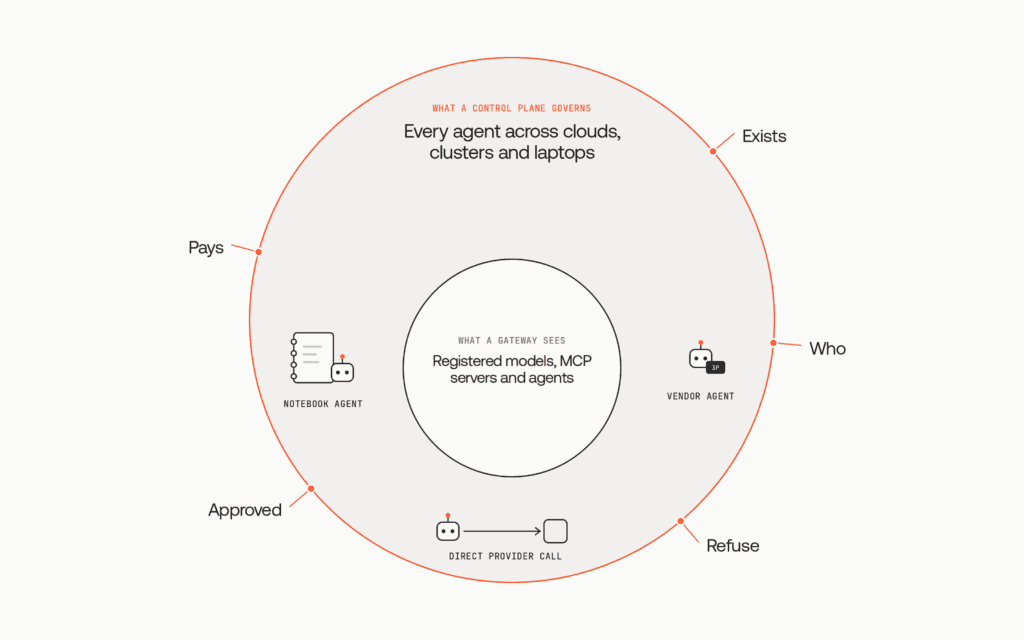
Can it refuse the call, or only record it?
Both can block on budgets, rate limits and guardrails. Opencontroller adds per-agent authorization: it checks identity, policy and budget before a call reaches a model, tool or API, and limits which models and tools each agent can use. The product page’s example scopes an agent to refunds of $2,500 or less, with read access to cases. Its guardrails cover “prompt injection, personal data, secrets and per-tool limits, checked both ways,” and the page shows a refund over $2,500 held for human review.
Is this the version you approved?
LiteLLM routes to whatever version is running; release control lives in your own pipeline. In Opencontroller’s Ship stage, “Multi-turn, red-team and regression evals decide what ships.” A release that misses a threshold is blocked, so an unapproved version doesn’t end up taking traffic.
Who pays, and where do the keys live?
LiteLLM tracks spend by key, team and tag. Opencontroller tracks “every dollar, by agent, version and team.” Keys matter more than they look: a gateway that holds every provider key is a prime target. NVD’s record for CVE-2026-42208, a 2026 LiteLLM flaw rated 9.8, says it could expose the gateway’s database and “the credentials it manages.” LiteLLM’s answer is secret-manager integration, an Enterprise feature. With Opencontroller, your secrets manager stays in place, and credentials never need to reach Lyzr.
A gateway answers questions about requests. A control plane answers questions about agents, and those are the questions auditors ask.
How many of your agents never touch LiteLLM?
Take the AI Agent Sprawl Audit to see how many agents are running across your teams and clouds without an owner or central control, and which gaps to fix first. Take the audit below
LiteLLM or Opencontroller: which should you choose?
Choose by the question you need answered, not by feature count.
| If this is you | Choose | Why |
| A developer or small team unifying a few model APIs | LiteLLM | Free, quick to stand up, and does the job well |
| A platform team with one gateway for a handful of apps and registered agents | LiteLLM, with Enterprise for SSO, audit logs and secret managers | Your traffic already goes through one gateway |
| Agents spread across teams, frameworks or clouds, and you can’t list them all | Opencontroller | You need discovery and ownership before routing |
| Agents that move money, change records or touch regulated data | Opencontroller | You need per-agent policy checked before the call, plus an owner for every action |
| Nothing can leave your network, including control-plane data | Opencontroller | VPC, on-prem or air-gapped, and credentials, telemetry and control-plane data never need to reach Lyzr |
| You run LiteLLM today and aren’t ready to change | Start with Opencontroller discovery | Discovery is read-only, so you can see the whole estate first, then decide about the gateway |
If you’ve decided to leave LiteLLM and want a wider shortlist, see our best LiteLLM alternatives.
How Lyzr Opencontroller answers the CISO’s question
Remember the CISO’s question before the audit: every agent that can read customer data, who owns it, and what stops it? Here’s how Opencontroller answers each part:
| The CISO’s question | How Opencontroller answers it |
| Which agents exist? | Find: read-only scans across clouds, clusters and developer laptops build one live inventory, including unregistered agents |
| Who owns each one? | Each agent gets a registry record with an owner, and its own identity through your identity provider |
| What stops it? | Identity, policy and budget checked before each call, with per-tool limits and guardrails in both directions |
| Was this version approved? | Ship: multi-turn, red-team and regression evals decide what ships |
| Where’s the evidence? | Traces tied to an owner and cost, exported to the tools you already use |
It still does the gateway job. Its LLM gateway covers “virtual keys, team budgets, routing and fallback across model providers.” Its agent gateway makes each agent “public, internal or private, with every caller authenticated and rate-limited.” You keep what LiteLLM gave you.
It runs where your agents run. “Deploy it in your VPC, on-prem or air-gapped.” Per the page, “Credentials, telemetry and control-plane data never need to reach Lyzr.” It uses open standards: OpenAI-compatible APIs, MCP, A2A, OpenTelemetry, OIDC, SAML and SCIM. You can pause an agent or quarantine a release when something goes wrong.
Adoption is gradual. “Keep your clouds, models and tools. Change one endpoint.” Agents stay where they run, and Lyzr says a first environment takes under a week, starting with read-only discovery.
Our team starts with discovery. The notebook agent and the vendor agent appear in one inventory, each with an owner. Then they point their agents at an Opencontroller endpoint inside their VPC. Each agent has its own identity, so the payments tool accepts calls only from the agent allowed to make them. The CISO’s list now comes from one place.
Book a demo to see Opencontroller on your own agents.
Frequently asked questions
LiteLLM is an open-source SDK and gateway that unifies model APIs and governs the traffic routed through it with keys and budgets. Lyzr Opencontroller is an enterprise control plane that discovers and governs every AI agent, with per-agent identity, release gates and policy checked before each call.
Yes. LiteLLM’s gateway routes A2A agent calls and calls to MCP tools alongside model calls, with shared key-based auth, rate limits and spend tracking. Agents must be registered with it; it doesn’t discover agents that never call through it.
It can cover the gateway job. Its LLM gateway includes virtual keys, team budgets, routing and fallback across model providers. Teams can also start with read-only discovery and decide about their gateway later.
The SDK and gateway are open source under the MIT license and free to self-host. A paid Enterprise license adds SSO beyond five users, SCIM, audit logs, admin roles, secret-manager integrations and support SLAs.
Inside your own environment: your VPC, on-premises or fully air-gapped. Customer-managed deployments don’t require credentials, telemetry or control-plane data to reach Lyzr.
Not necessarily. A small team with a few apps may only need LiteLLM. An organization with many agents across teams and clouds needs a control plane, and Opencontroller’s own gateway can then handle model routing.
Book A Demo: Click Here
Join our Slack: Click Here
Link to our GitHub: Click Here
Got a use case in mind?
8 weeks from use case to agents running in production.
Platform, people and FDEs, all in. Bring your environment. We'll co-build and stay until it's live.
Talk to UsFree resource
101 AI Agents Use Cases
100+ production-ready AI agent use cases across Marketing, Sales, HR, Banking, Insurance, Operations and a lot more
Download now