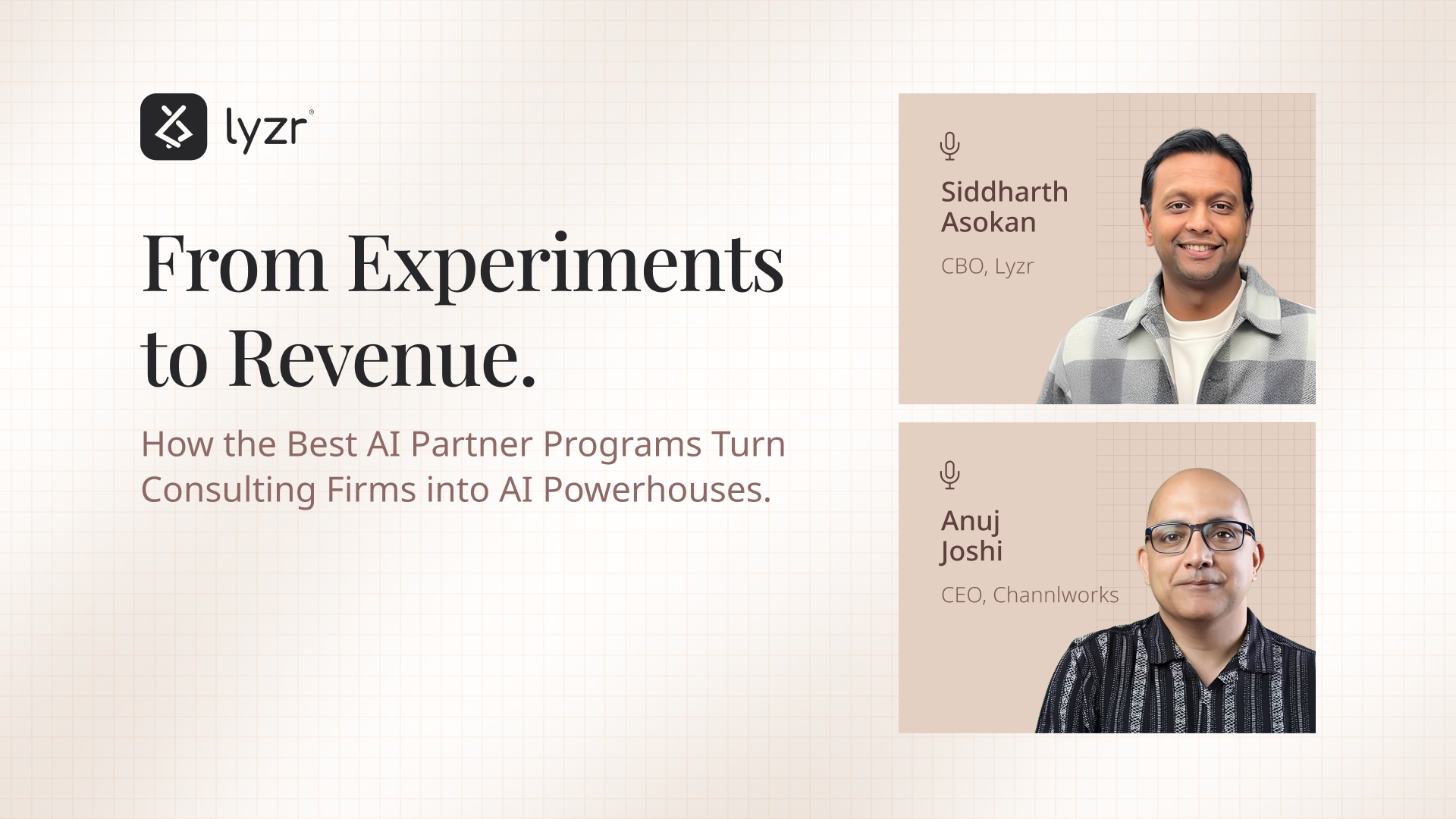
Speaker Details:
- Siddharth Asokan, Chief Business Officer at Lyzr, leading partnerships across the ecosystem of GSIs, consulting firms, and system integrators. He brings close to 20 years in B2B tech, with experience building and scaling teams across the UK, Nordics, and India. At Lyzr, he runs the partner motion taking agentic AI to enterprise customers worldwide.
- Anuj Joshi, Founder and CEO of Channlworks, an AI-led alliance intelligence platform that helps SaaS companies discover and manage global partner ecosystems. He brings 25 years across IBM, Sun Microsystems, Autodesk, and Amazon Web Services, where he was one of the early team members building the AWS partner network in India. He’s also the Bangalore Chapter Host for Partnership Leaders, the global community for alliance and ecosystem professionals.
Summary And Key Takeaways:
TL;DR
The window for consulting firms to go AI-native is closer to 18 months than three years. Most can’t build their own platform, so partner programs aren’t optional anymore. Sid Asokan (CBO, Lyzr) and Anuj Joshi (CEO, Channlworks) talked through what AI partner programs need to look like now: competency over pipeline, co-create before co-sell, and surround revenue as the economics that matter for consulting firms.
Siddharth Asokan, CBO at Lyzr, sat down with Anuj Joshi, CEO of Channlworks, for a 45-minute conversation on what’s shifting in AI partner programs and what consulting firms need to do about it. The framing was direct. Most consulting firms can’t realistically build their own AI platform. The next 18 to 24 months will decide who becomes an AI powerhouse. And the mechanics of partnering have to change with the technology.
Sid opened with the HFS Research data: a $1.5T services-as-software market, 44% of enterprises now preferring AI specialists over legacy consultancies, and 71% of leaders ready to switch providers. Anuj brought 25 years of ecosystem-building from IBM, Sun, Autodesk and AWS into the conversation.
Key Takeaways
- The window is closer to 18 months than three years. Sid’s read on the data is that mid-size and niche consulting firms have a real shot at competing with global players in AI, but only if they move quickly and partner early. The “born in the cloud vs traditional” moment from a decade ago is happening again, with three layers this time: traditional, cloud-native, AI-native.
- Distribution is the choke point, not the build. Anuj’s sharpest line of the session. If a vendor ships product daily and the partner can’t absorb at the same pace, the build doesn’t matter. Static onboarding playbooks go stale in six weeks. Activation speed has to match release speed.
- Knowledge is democratized. The sales rep at the partner organization often has equal or more product and customer knowledge than the vendor. Activation playbooks have to assume that, not pretend the vendor still holds the keys.
- The first 30 days are about clarity, not pipeline. Both leadership teams need a documented view of how each side’s business grows together, who’s sponsoring it, and what the joint commitment looks like. Without that, the press release fades and momentum dies. Partners that pick a single focus build pipeline. Partners that chase “anyone with an AI problem” stall.
- Co-create before you co-sell. Most programs fail because of missing competency, not missing pipeline. POCs don’t fail because the product is bad. They fail because skills are missing on both sides. Anuj’s framing: AI is a competency story more than anything else. The sequence is to co-create first (programs, delivery models, internal use), then co-sell once the partner can confidently pitch without the vendor in the room.
- Sell-to runs in parallel with sell-with. Most of Lyzr’s GSI partners are adopting the platform internally for their own agent transformation before taking it to clients. Partner programs have to cater to both motions, not just the outbound one.
- Surround revenue is where the economics actually live. License revenue isn’t the glue for consulting firms. The drag revenue is. In the cloud era, every $1 of product spend pulled $7 to $8 of services. For AI, Anuj’s read is closer to $15 to $16 of services for every $1 of platform spend. Pricing the practice, not the license, is what changes the math for a partner.
- Pre-built industry agents change the sales conversation. Walking into a BFSI prospect with a loan origination agent where governance, risk and security are already handled replaces “we have AI capability” with “we’ve solved this specific problem in your sector.” Sharper GTM, faster traction, easier customer qualification.
- Competency is the leading indicator of program health. Anuj’s top metric for the first two or three quarters isn’t revenue. It’s how many people across the partner’s sales, presales and delivery teams can talk about the product with authority. POC win-rate is the second metric. Revenue and leads come after as a corollary of those two.
- Heavy lifting sits with the vendor early. Live customer meetings can’t be outsourced. The partner team learns the product by being in the room with you. Once competency is built, the rest can shift to the partner.
- A partner success story is a customer success story. The closing example was a customer who prevented millions in DDoS damage with around $2,500 of infrastructure. The success was the outcome for the customer, not the deal size. What made it possible was that the partner’s first-responder team was fully enabled and knew exactly which buttons to press without hesitation. Anuj’s closing line: the moment a partner stops feeling like they’re carrying a Lyzr product and starts feeling like it’s their product, your job is done.
Date : April 22, 2026
Time : 8:30 PM – 9:30 PM (IST)
Location : Online