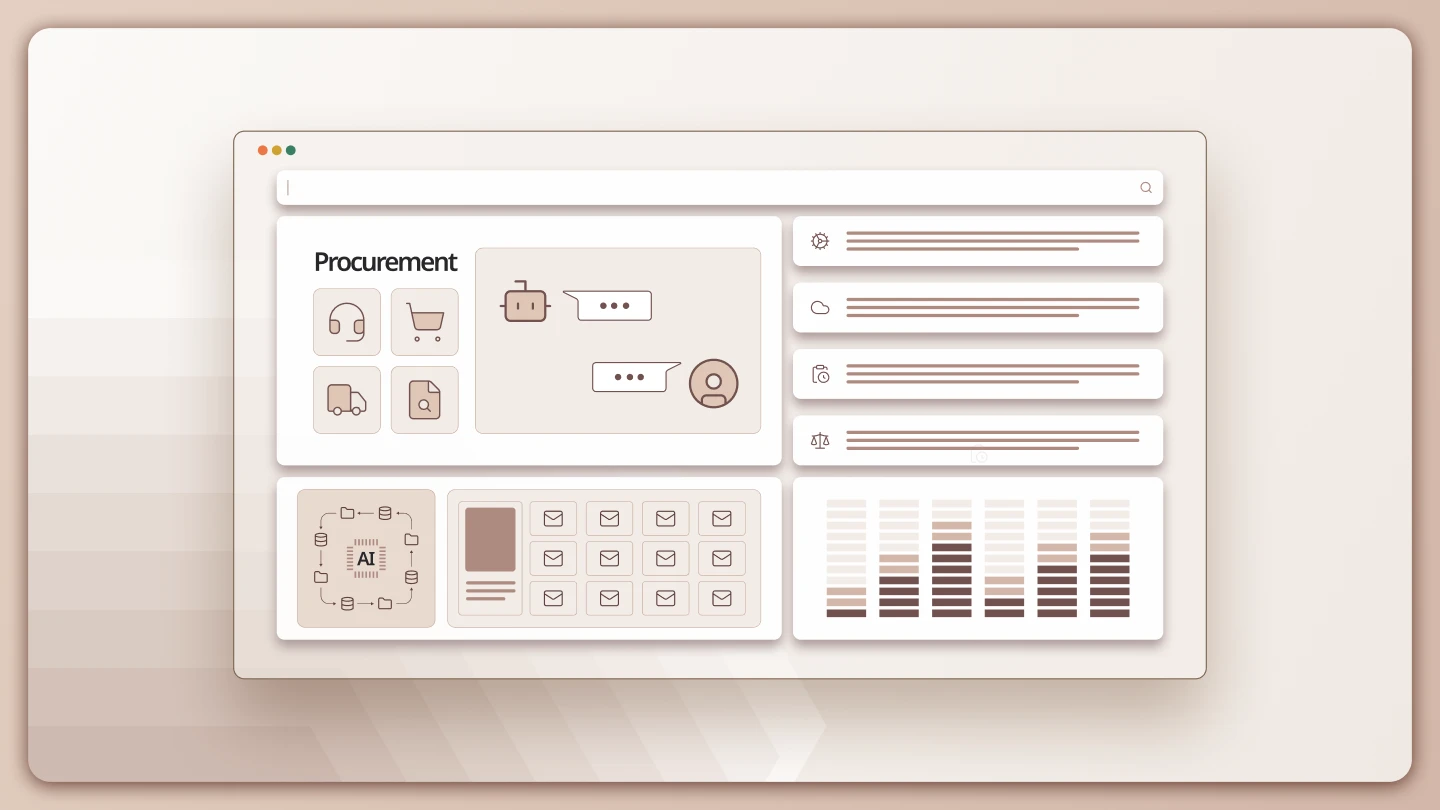
Procurement is no longer defined by individual tasks like issuing purchase orders or running sourcing events. In large enterprises, procurement now operates as a continuous decision system, balancing cost, risk, compliance, supplier performance, and speed at scale. This shift has given rise to the procurement agent.
A procurement agent is not a chatbot or a workflow shortcut.
It is a goal-driven execution layer that observes procurement data, applies context and rules, makes decisions, and acts across systems.
This article explains what procurement agents are, how they work in practice, where they deliver value, and how enterprises are deploying them today, using a balanced mix of explanation, bullets, and tables for clarity.
What a Procurement Agent Is (and What It Is Not)
A procurement agent is an entity, human or digital, that owns procurement outcomes rather than isolated steps. Modern usage increasingly refers to AI procurement agents that can reason and execute with limited human intervention.
A procurement agent is:
- Goal-oriented (cost control, compliance, speed, risk reduction)
- Context-aware (understands policy, contracts, suppliers, and demand)
- Action-capable (can execute in ERP and procurement systems)
- Governed (operates within approval and audit boundaries)
A procurement agent is not:
- A static rule engine
- A reporting dashboard
- A conversational interface without execution rights
Types of Procurement Agents
| Agent Type | Decision Capability | Typical Responsibility |
|---|---|---|
| Human procurement agent | Judgment-based | Negotiation, category strategy, supplier governance |
| Digital task agent | None | PO creation, invoice matching |
| Intelligent procurement agent | Contextual | Supplier selection, sourcing decisions |
| Autonomous procurement agent | Adaptive | End-to-end execution for defined categories |
Why Procurement Agents Are Becoming Necessary
Procurement agents are emerging because traditional operating models no longer scale.
Key pressures driving adoption:
- Spend volume increasing faster than headcount
- Supplier networks expanding across regions and regulations
- Rising compliance and audit requirements
- Continuous supply-chain risk and disruption
Where Traditional Procurement Breaks
| Challenge | Manual / Workflow-Based Approach | Agent-Based Approach |
|---|---|---|
| High request volume | Backlogs and delays | Autonomous triage and execution |
| Supplier risk | Periodic reviews | Continuous monitoring |
| Compliance | Post-facto checks | Real-time enforcement |
| Exceptions | Manual investigation | Automatic detection and escalation |
Procurement agents allow enterprises to increase control without adding friction.
How Procurement Agents Work in Practice
Procurement agents operate through a continuous execution loop.
Core execution cycle:
- Observe relevant internal and external data
- Evaluate options using policy, contracts, and risk context
- Decide on the optimal action
- Execute actions across procurement systems
- Record outcomes for audit and learning
Data Consumed by Procurement Agents
| Data Category | Examples |
|---|---|
| Internal procurement data | Spend, POs, invoices, contracts |
| Supplier data | Performance scores, certifications |
| Financial signals | Pricing trends, FX rates |
| Risk indicators | News, weather, geopolitical events |
| Policy constraints | Approval limits, sourcing rules |
This allows agents to act continuously rather than waiting for manual triggers.
Core Capabilities of a Procurement Agent
Procurement agents combine multiple capabilities into a single operational layer.
Primary capabilities include:
- Intake interpretation and request validation
- Supplier discovery and qualification
- Sourcing and bid evaluation
- Contract-aware purchasing
- Purchase order execution
- Exception and risk handling
- Audit logging and traceability
Capability-to-Outcome Mapping
| Capability | What the Agent Does | Business Outcome |
|---|---|---|
| Intake management | Validates requests | Faster, compliant buying |
| Supplier evaluation | Scores suppliers | Better sourcing decisions |
| Contract awareness | Matches terms | Reduced off-contract spend |
| PO automation | Executes orders | Shorter cycle times |
| Exception handling | Flags anomalies | Lower operational risk |
High-Impact Procurement Agent Use Cases
1. Autonomous Indirect Spend Execution
Problem: High-volume, low-value purchases overwhelm teams.
Agent actions:
- Interprets purchase intent
- Selects preferred suppliers
- Enforces pricing and policy
- Issues purchase orders automatically
Impact:
- 60–80% reduction in manual effort
- Consistent policy compliance
2. Supplier Discovery and Evaluation
Procurement agents analyze large supplier datasets to identify best-fit vendors.
Evaluation criteria include:
- Cost competitiveness
- Delivery performance
- Compliance status
- Financial stability
- ESG indicators
Result: Faster, more objective supplier shortlisting at scale.
3. Strategic Sourcing and RFx Management
Agents assist with sourcing by:
- Drafting RFQs/RFPs using historical patterns like with AI RFP software
- Distributing events to approved suppliers
- Scoring responses across multiple dimensions
- Integrating rfq software further enhances this process by automating request management and improving supplier collaboration.
Outcome: Sourcing cycles compressed from weeks to days.
4. Contract-Aware Procurement
Agents continuously reference contract data.
Key functions:
- Prevent off-contract purchases
- Track renewals and expirations
- Flag pricing or clause deviations
Outcome: Higher realized savings and fewer compliance gaps.
5. Risk Monitoring and Mitigation
Procurement agents continuously scan for risk signals.
Monitored signals:
- Supplier delivery performance
- Financial stress indicators
- External disruptions
Response: Automated alerts and alternative sourcing recommendations.
Governance and Control in Agent-Based Procurement
Procurement agents operate within strict guardrails.
Governance Mechanisms
| Control | Purpose |
|---|---|
| Policy encoding | Prevent unauthorized actions |
| Approval thresholds | Define human intervention |
| Audit logs | Enable traceability |
| Role-based access | Limit agent permissions |
| Explainability | Build trust and adoption |
Well-governed agents improve control rather than reduce it.
Implementation Considerations
Recommended starting points:
- Indirect spend categories
- Purchase order execution
- Supplier onboarding
Common pitfalls to avoid:
- Treating agents as chatbots
- Ignoring data quality
- Skipping governance design
- Expecting full autonomy immediately
The Evolving Role of Procurement Teams
As agents handle execution, human roles shift.
Human focus areas:
- Supplier strategy and negotiations
- Category planning
- Risk oversight
- Exception resolution
This is role elevation—not replacement.
What the Future of Procurement Agents Looks Like
Procurement agents will increasingly operate as coordinated networks.
Expected advancements:
- Autonomous sourcing events
- Continuous supplier optimization
- ESG-aware decisioning
- Predictive spend commitments
Procurement will move from process execution to continuous orchestration.
Final Thoughts
Procurement agents represent a structural shift in how procurement operates. By combining intelligence, execution, and governance into a single layer, they allow enterprises to scale procurement without scaling complexity.
Organizations that adopt procurement agents gain:
- Faster execution without loss of control
- Better risk visibility
- Higher compliance and audit readiness
- More strategic impact from procurement teams
The procurement agent is becoming the operational backbone of modern, enterprise-grade procurement.
Book A Demo: Click Here
Join our Slack: Click Here
Link to our GitHub: Click Here