

A Practical Guide to Agent-Led Source-to-Pay Transformation
Executive Summary
Most procurement playbooks explain why change is needed and what good looks like. Very few show how to actually implement AI at scale.
This playbook fills that gap.
Today, up to 70% of procurement team time is consumed by operational work. Agent-led automation can remove 50–60% of repetitive tasks, allowing teams to focus on strategic sourcing, negotiations, and risk management.
What this playbook delivers:
- A practical breakdown of where procurement loses time and money today
- Production-ready agent blueprints tied to real workflows
- A 90-day pilot model that proves value quickly and safely
- A phased roadmap to enterprise-scale deployment
- Clear metrics, guardrails, and adoption guidance
Expected Outcome: $8-15M value over 3 years for a typical $1B spend organization with 6-9 month payback.
Who should read this:
- Chief Procurement Officers seeking operational transformation
- C-Suite evaluating procurement AI investments
- Procurement and digital leaders responsible for execution
The Agent-led Procurement Revolution
Traditional procurement is a burning platform.
Despite decades of ERP, P2P, and RPA investments, McKinsey research indicates that close to half of all procurement activities remain manual and could be automated using existing technologies.
Deloitte’s 2023 Global CPO Survey reveals that even high-performing procurement organizations spend 24% of their time on transactional tasks, with average performers spending significantly more, limiting strategic value creation.
To understand why this persists, we need to look at the specific failure modes of modern procurement, not at a strategic level, but at the level where time, money, and trust are lost every day.
Three Critical Pain Points
Pain Point 1: Intake Chaos
30-40% of team capacity lost to fragmented request management.
“Monday starts with 30-50 emails, 10-15 tickets, a spreadsheet with 20 ‘urgent’ items, and 5-8 Slack messages asking ‘quick questions’ that are never quick.” – Category Managers, Fortune 500 manufacturer
Observed patterns from enterprise deployments:
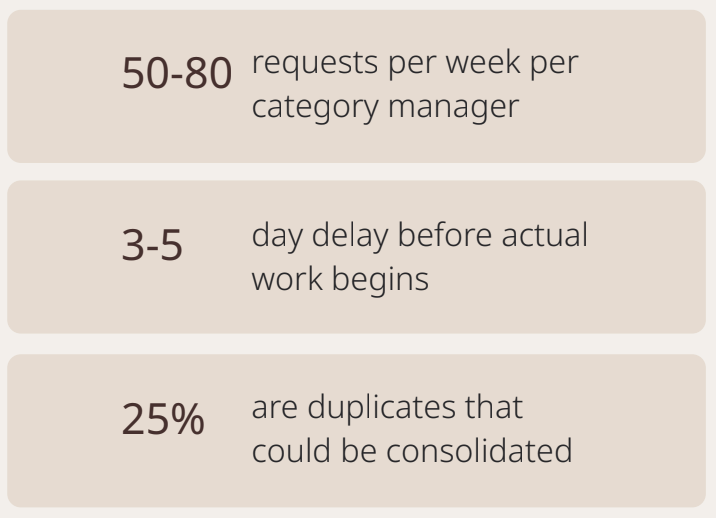
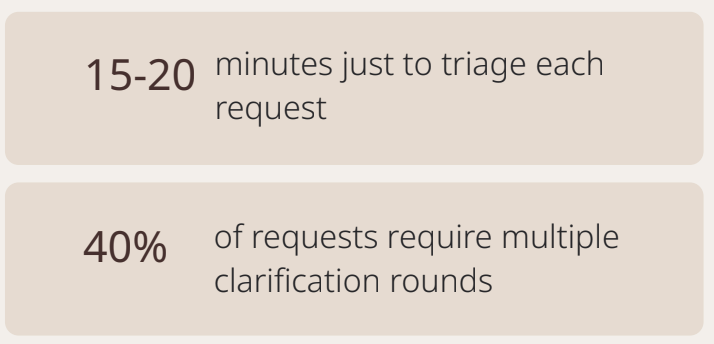
Business stakeholder frustration: “I submitted a request three weeks ago and never heard back. When I followed up, they asked questions I thought I’d already answered.”
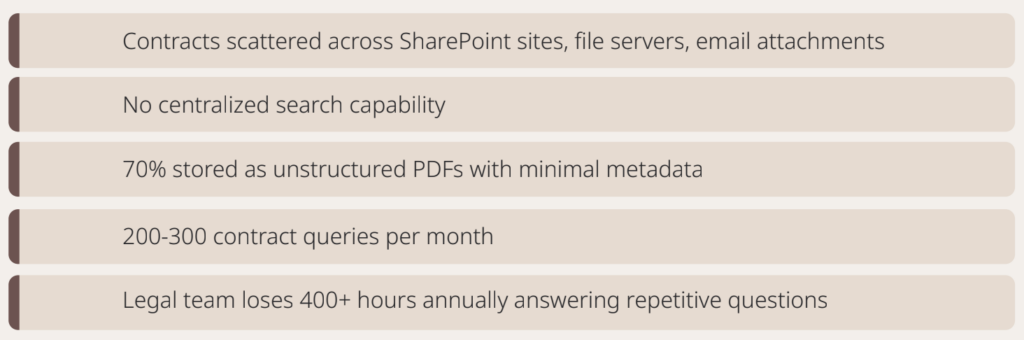
Pain Point 2: Contract Intelligence Locked in PDFs
2-4 hours per query: Manual PDF archaeology across 15+ repositories
Simple question: “What are the payment terms for Supplier X?” Current reality observed in enterprise deployments: 2-4 hours of manual PDF archaeology across 15+ repositories.
Case study data from a global enterprise with 5,000+ contracts:
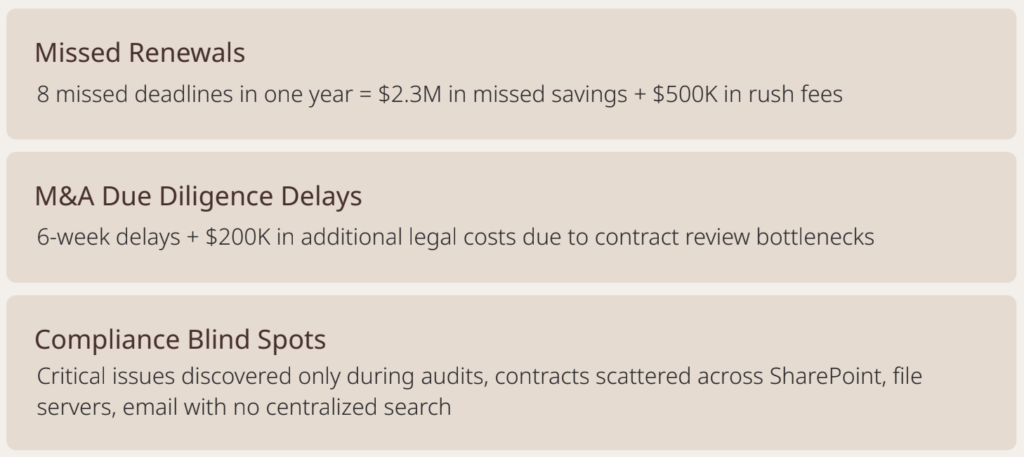
Business Consequences:
Pain Point 3: Procurement Viewed as Bottleneck
Stakeholder perception limits strategic influence and value creation
Internal Stakeholder Perception
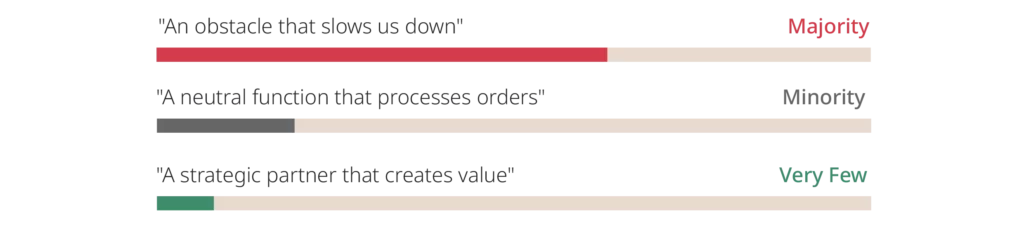
McKinsey research confirms procurement’s strategic challenge: two-thirds of procurement organizations now report directly to the CEO or CFO, yet many procurement functions remain primarily transactional with limited scope of influence.
The Strategic Capacity Challenge
Deloitte’s research shows that even high performers struggle to reduce time spent on transactional work, with average organizations spending 24% or more on operational tasks, limiting strategic capacity for category strategies, supplier innovation, and value-creating negotiations.
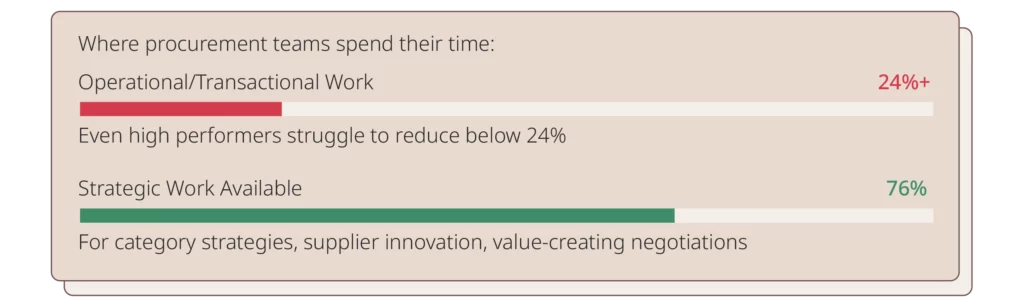
Limited Strategic Capacity Results In:
- Fewer proactive category strategies
- Less supplier partnership development
- Reactive “order-taking” reinforces bottleneck perception
The Cost of Inaction
Based on deployment observations and industry benchmarks, directional estimates for a typical $1B annual spend organization:
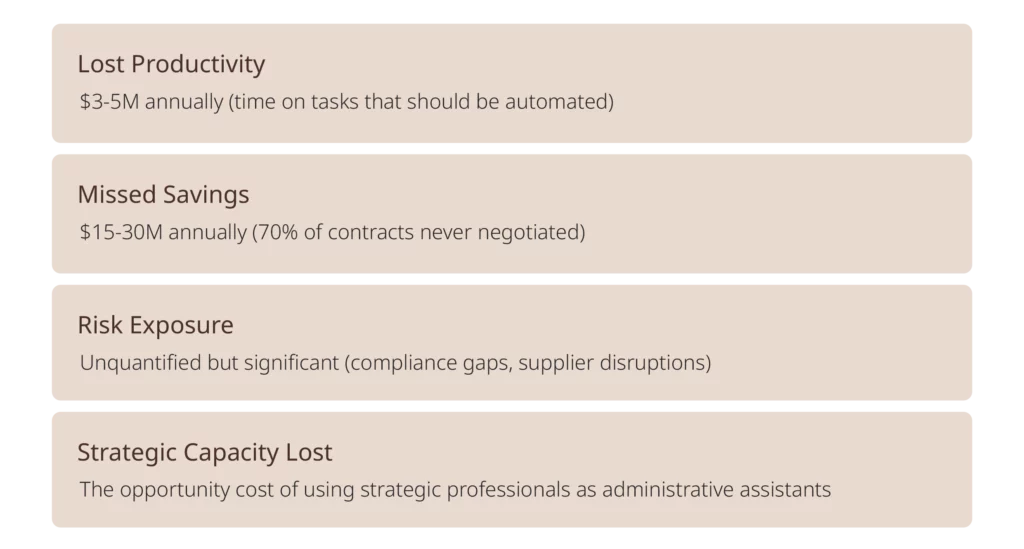
What’s often missed is this: inaction isn’t the only risk.
Most organizations respond with incremental fixes: more workflows, dashboards, and bots. Complexity increases, but the work stays the same.
What’s needed isn’t more automation, but a different model. That shift becomes clear when you look at how procurement automation has evolved. Implementing IT procurement strategy with a focus on spend analytics can help organizations identify cost-saving opportunities and improve overall sourcing strategies.
The Three Waves of Procurement Automation

Wave 1: Pre-AI Era (2000-2020) – ERP and RPA
Technologies: SAP/Oracle ERP, Ariba/Coupa P2P platforms, UiPath/Blue Prism RPA bots
What it solved: Digitized paper processes, created systems of record, standardized workflows
What it didn’t solve:
- RPA bots break when exceptions occur (60% automation rate deteriorates to 40% within 12 months)
- No intelligence or reasoning capability
- Limited to structured data only
- Poor user experience across disconnected systems
- Heavy manual configuration and maintenance burden
The RPA brittleness problem (observed deployment pattern): A manufacturer deployed 50 bots for invoice processing. First year: 70% automation. Second year: 40% of bots broken at any time, maintenance costs exceeded implementation costs.
Wave 2: The ChatGPT Moment (2020-2024) – Assisted Intelligence
Technologies: ChatGPT, Claude, GPT-4, AI-powered chatbots, NLP for contracts
What it enabled:
- Natural language interaction instead of complex interfaces
- Intelligent search across unstructured documents
- Automated summarization and insight generation
- Pattern recognition and predictions
What it still required:
- Manual workflow orchestration
- Copy-paste between systems
- Humans driving process with AI assisting
The “I Still Have To” problem: AI tells you which contracts renew Q3, but you still have to research pricing, create proposals, email suppliers, manage negotiations, route approvals, execute renewals. AI saved 2 minutes answering a question but 20+ hours of work remained.
Wave 3: Agent-Led Era (2024+) – Autonomous Orchestration
The paradigm shift: From AI that answers questions to AI that executes workflows.
Key characteristics:
- Multi-agent systems with specialized agents coordinating autonomously
- Continuous 24/7 monitoring and proactive action
- End-to-end process orchestration
- Self-healing exception handling
- Cross-system integration and action execution
- Memory and continuous learning
Example transformation:
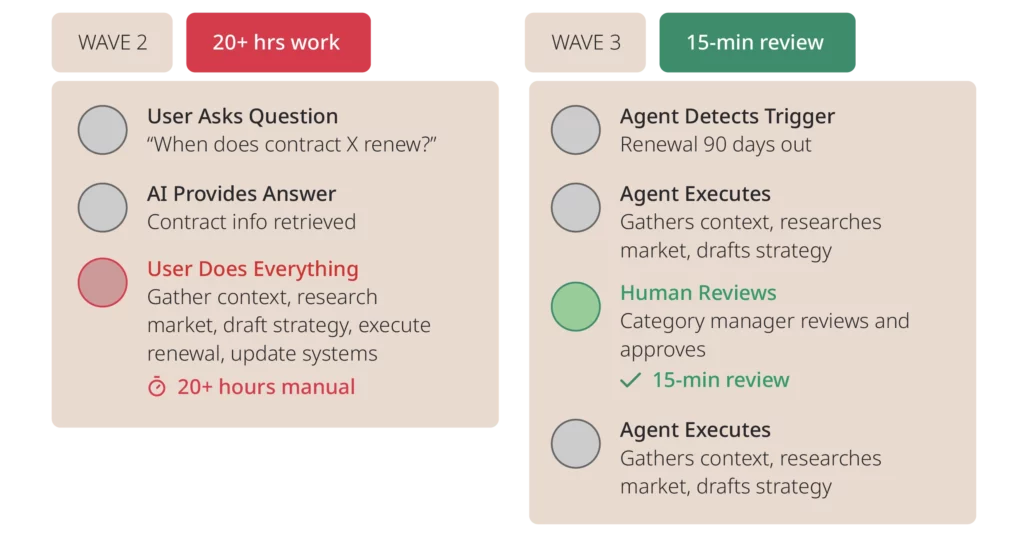
- Wave 2 approach: User asks “When does contract X renew?” → AI answers → User spends 20 hours executing renewal
- Wave 3 approach: Agent detects renewal 90 days out → Autonomously gathers context, researches market, drafts strategy → Routes to category manager for 15-minute review → Executes approved renewal workflow → Updates all systems
So what actually enables wave 3?
The Procurement Agentic Operating System
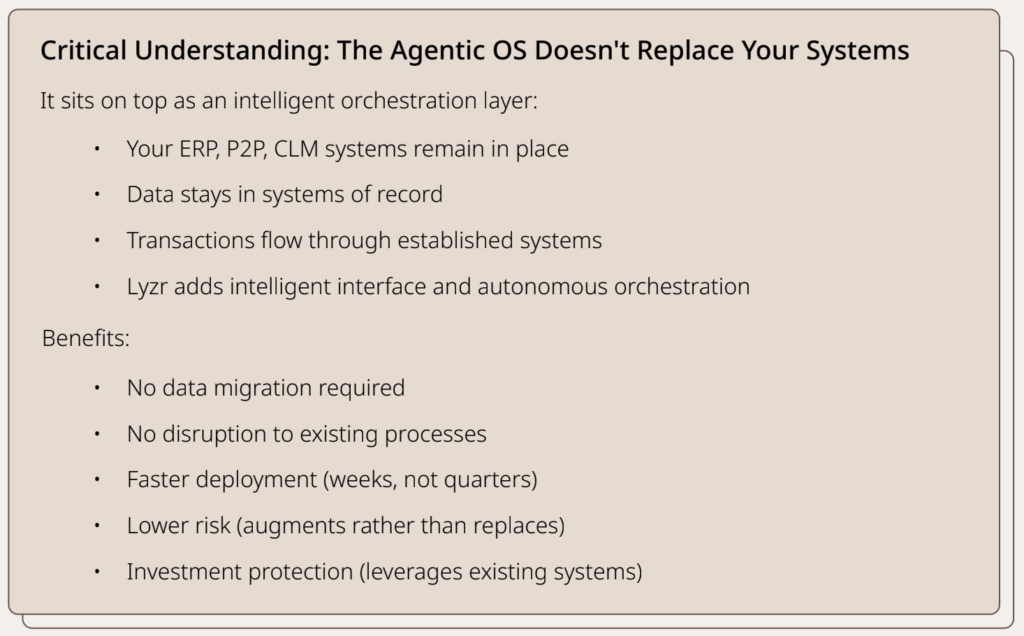
It’s the Intelligent orchestration layer on top of existing systems.
Imagine your most experienced procurement professional who:
- Never sleeps, never gets overwhelmed (24/7/365 availability)
- Has instant recall of every contract, policy, supplier interaction (perfect memory)
- Can analyze thousands of data points simultaneously (superhuman processing)
- Operates with perfect consistency and zero bias
- Continuously learns and improves
- Can be in multiple places at once
That’s the Procurement Agentic OS.
Instead of forcing users to navigate multiple disconnected systems, AI-powered multi-agent systems provide a single conversational interface: accessible via web app, Microsoft Teams, Slack, or email, backed by specialized AI agents that autonomously handle procurement workflows.
Why Lyzr’s Agentic OS?
Lyzr agents operate on a continuous observe-decide-act loop, managing entire end-to-end workflows with genuine autonomy:
- Contextual reasoning: Understand nuance beyond rigid rules
- Exception handling: Adapt to variations without breaking
- Goal-driven decisions: Optimize for business outcomes, not just task completion
- Continuous learning: Improve from every interaction and outcome
That’s the experience.The obvious next question is: how does this work without replacing everything you already run?
That’s where the architecture matters.
Technical Architecture & Integration for the Geeks
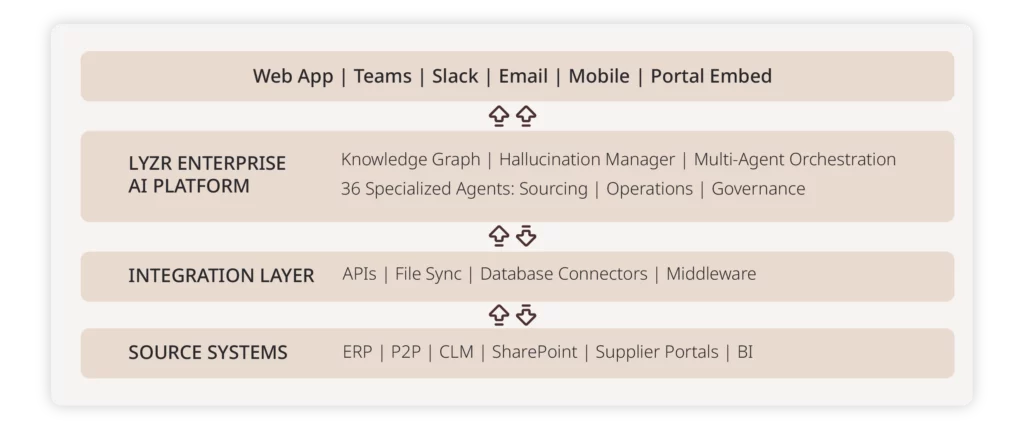
Data Integration Layer
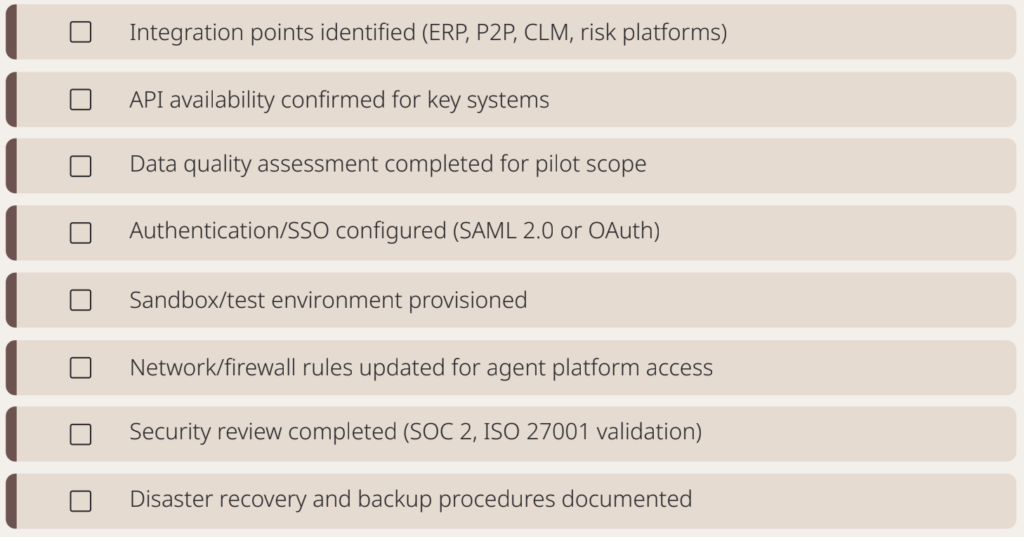
- Connects to existing systems via APIs, file sync, or database connectors
- Ingests contracts, policies, supplier data, and transaction records
- Maintains data in source systems (no migration required)
- Supports real-time and batch synchronization
AI Intelligence Layer (Lyzr Enterprise AI Platform)
- Knowledge Graph: Linked data model connecting contracts, suppliers, policies, and transactions
- Hallucination Manager: Grounds all responses in verified source documents with citations
- Multi-Agent Orchestration: Coordinates 36 specialized agents with autonomous decision-making
- Continuous Learning: Improves accuracy from user feedback and outcomes
Explore Agent Studio to see how agents are built and orchestrated Go to Agent Studio
User Interface Layer
- Web application (browser-based access)
- Microsoft Teams and Slack integrations
- Email interface for simple queries
- Embedded widgets for existing procurement portals
- Mobile app (iOS/Android)
Want to dive deeper into technical integration?
We’ll walk you through architecture, connectors, and deployment options tailored to your environment.
The Core Agent Pillars
Rather than a few monolithic “do-everything” agents, Lyzr’s Agentic OS deploys 36 specialized agents organised into three strategic pillars. Each agent is purpose-built for a specific workflow, ensuring deep expertise and high accuracy.
Pillar 1: Sourcing Agents
Strategic value creation through intelligent supplier discovery, RFx automation, and negotiation support
Key agents include:
- Supplier Discovery Agent (identifies vendors by category/geography/risk)
- RFP Creation Agent (drafts customized RFPs)
- Vendor Comparison Agent (analyzes pricing, SLAs, capabilities)
- RFP Response Analysis Agent (scores vendor submissions)
- Negotiation Preparation Agent (provides benchmarks and leverage points)
- Category Intelligence Agent (tracks market trends)
Value: 50% faster sourcing cycles, 2-3% better pricing outcomes, systematic tail spend coverage
Pillar 2: Operational Automation Agents
Touchless procure-to-pay workflows with intelligent exception handling
Key agents include:
- Purchase Requisition Agent (validates and routes requests)
- Approval Workflow Agent (manages multi-level approvals)
- PO Creation Agent (generates purchase orders automatically)
- Invoice Matching Agent (performs 2-way and 3-way matching)
- Exception Handling Agent (resolves discrepancies autonomously)
- Internal Procurement Helpdesk Agent (provides instant stakeholder support)
Value: 80-90% touchless processing, 70% cycle time reduction, 60% stakeholder self-service
Pillar 3: Governance & Compliance Agents
24/7 policy enforcement, proactive risk monitoring, audit-ready documentation
Key agents include:
- Procurement Policy Enforcement Agent (ensures policy compliance)
- Contract Compliance Agent (validates spend against contracts)
- Maverick Spend Detection Agent (flags unauthorized purchases)
- Fraud Detection Agent (identifies anomalies in real-time)
- Supplier Risk Assessment Agent (monitors financial/operational risks)
- Audit Readiness Agent (maintains complete documentation trail)
Value: 99%+ policy compliance, $6-10M contract leakage prevention, 90% faster audit preparation
Single Interface, Multi-Agent Orchestration
What user sees: One conversational interface (web, mobile, Teams, Slack) What happens behind the scenes: Lyzr’s Orchestration as a Service coordinates specialized agents seamlessly
Example: User asks “We need to renew our facilities contract. What should I know?”
Multiple agents coordinate automatically:
- Contract Lookup Agent: Retrieves current contract ($2.4M annually, renews April 30, 3% escalation clause, performance 4.2/5)
- Supplier Risk Assessment Agent: Evaluates vendor (B+ credit rating, improving performance, competitive pricing)
- Procurement Policy Enforcement Agent: Determines requirements (VP approval for $2.4M, legal review if terms change, 60-day notice)
- Category Intelligence Agent: Provides market context (facilities services 5% below market average, favorable renewal window)
- Orchestration Layer (Lyzr Platform): Synthesizes comprehensive response with recommendations and next steps
User gets: Complete, actionable guidance in one response. They don’t need to know five agents coordinated behind the scenes.
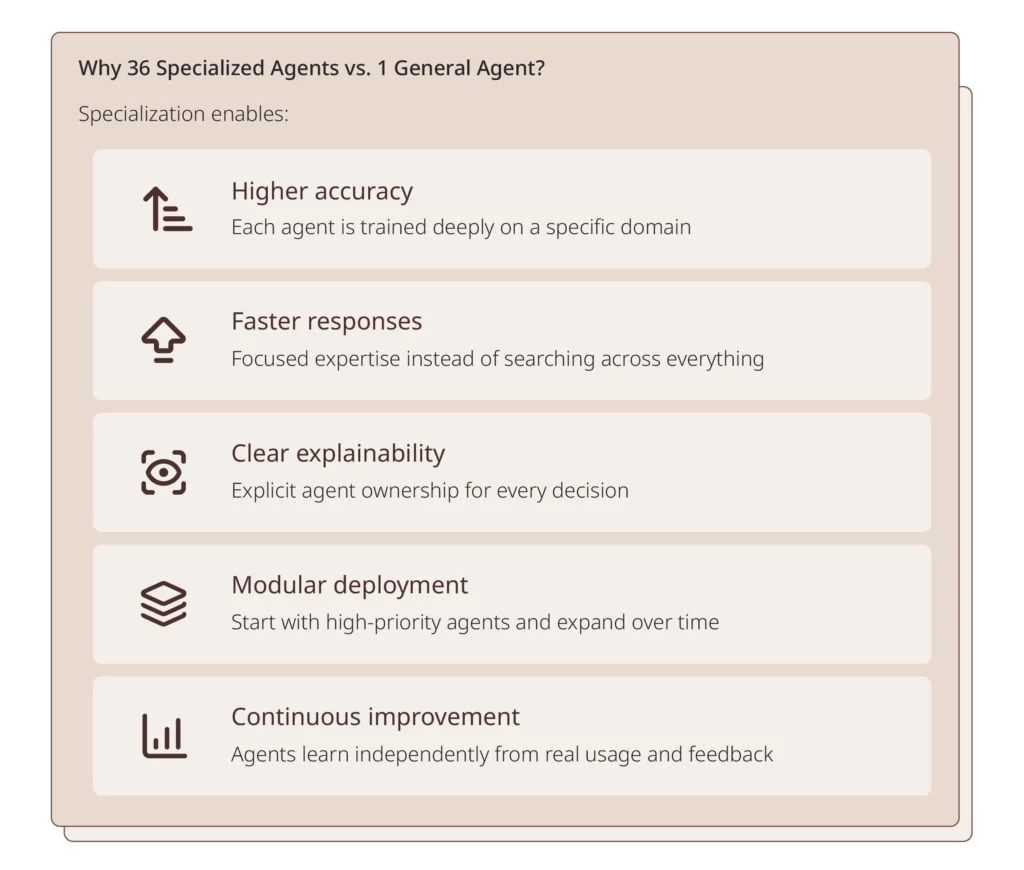
Procurement Agent Matrix
Pillar 1: Sourcing Agents (Strategic Value Creation)
Specialised agents that transform procurement from reactive purchasing to proactive value orchestration.
| Agent | Pain Point | Primary Function | Business Impact |
| Supplier Discovery Agent | Can’t find qualified vendors quickly enough | Identifies and shortlists vendors based on category, geography, and risk | 60% faster supplier identification |
| Vendor Comparison Agent | Subjective supplier selection without objective data | Analyzes pricing, SLAs, and capabilities across suppliers | Objective vendor evaluation at scale |
| RFP Creation Agent | RFx process too slow and manually intensive | Drafts and customizes RFPs based on sourcing needs | 75% reduction in RFx prep time |
| RFP Response Analysis Agent | Can’t evaluate vendor responses objectively at scale | Scores and ranks vendor responses automatically | Eliminate manual evaluation bias |
| Supplier Risk Assessment Agent | Blind to supplier risks until crisis hits | Evaluates financial, operational, and geopolitical risks | Proactive risk detection (30-90 days advance) |
| Vendor Due Diligence Agent | Manual compliance checks slow sourcing cycles | Checks compliance, certifications, and background data | Automated compliance verification |
| Alternative Supplier Agent | Single-source dependencies create business risk | Recommends backup suppliers to reduce dependency risk | 35% reduction in supply concentration |
| Category Intelligence Agent | No market visibility for informed negotiations | Tracks market trends and benchmarks by procurement category | Real-time market intelligence |
| Supplier Performance History Agent | Selecting vendors without performance data | Analyzes past delivery, quality, and SLA adherence | Data-driven supplier decisions |
| Diversity & ESG Supplier Agent | Can’t track diversity/ESG compliance systematically | Identifies vendors aligned with ESG and diversity goals | Automated ESG compliance tracking |
| Negotiation Preparation Agent | Lack leverage and benchmarks in supplier negotiations | Provides pricing benchmarks and negotiation levers | 2-3% better pricing outcomes |
| Vendor Consolidation Agent | Supplier proliferation drives complexity and cost | Identifies overlap and rationalization opportunities | $3-5M savings through consolidation |
Strategic Sourcing & RFx Workflow
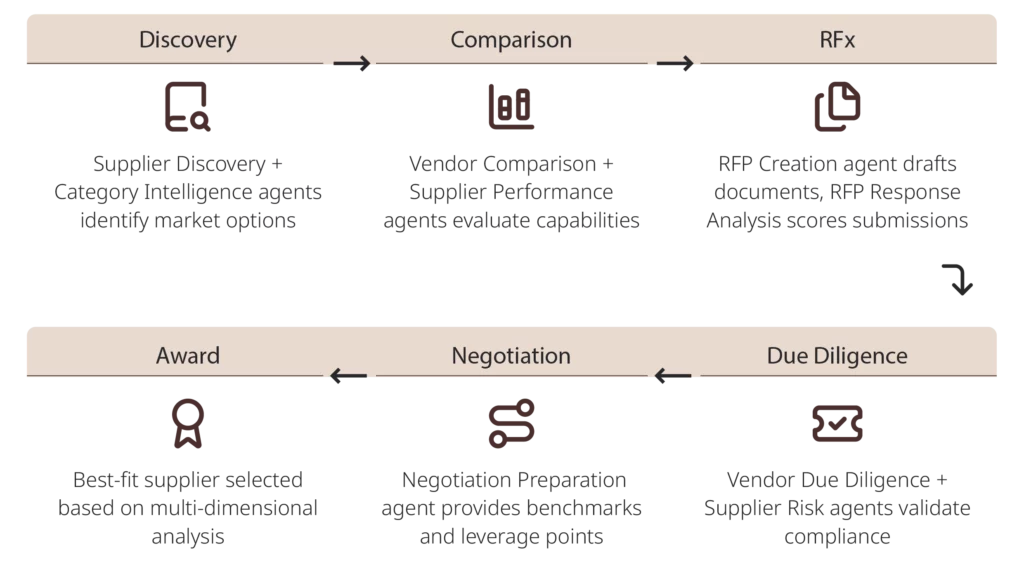
Expected Results
- RFx cycle time: 8-12 weeks → 4-6 weeks (50% reduction)
- Supplier pool: +40% qualified options through systematic discovery
- Negotiation outcomes: +2-3% better pricing through data-backed leverage
- Risk incidents: -80% through proactive monitoring
Pillar 2: Operational Automation Agents (Efficiency Engine)
Specialized agents that deliver touchless procure-to-pay with intelligent exception handling.
| Agent | Pain Point | Primary Function | Business Impact |
| Purchase Requisition Agent | Intake chaos – requests come from everywhere | Validates and routes requisitions for approval | 70% reduction in triage time |
| Approval Workflow Agent | Approval bottlenecks slow procurement cycles | Manages multi-level approvals based on policy | 60% faster approval cycles |
| PO Creation Agent | Manual PO generation wastes team capacity | Automatically generates purchase orders from approved requests | 90% touchless PO generation |
| Invoice Matching Agent | Invoice processing backlog consumes AP resources | Performs 2-way and 3-way invoice matching | 80-90% automated matching |
| Exception Handling Agent | Exceptions require manual intervention and delay payment | Flags discrepancies and resolves invoice errors | 85% autonomous resolution |
| Spend Categorization Agent | Poor spend visibility limits strategic decisions | Classifies spend automatically across categories | 95% accurate auto-categorization |
| Budget Compliance Agent | Budget overruns due to lack of real-time controls | Ensures purchases stay within allocated budgets | Zero budget overruns |
| Contract Lookup Agent | Can’t find contract terms quickly (2-4 hours lost) | Retrieves pricing and terms from existing contracts | Instant contract intelligence (<30 sec) |
| Supplier Communication Agent | Supplier follow-up consumes category manager capacity | Handles order updates, confirmations, and follow-ups | 60% reduction in manual comm |
| Delivery Tracking Agent | Reactive to delays and disruptions | Monitors shipment status and delays | Proactive delay mitigation |
| Renewal Reminder Agent | Missed renewals cost money and relationships | Tracks contract and subscription renewals | Zero missed renewals |
| Internal Procurement Helpdesk Agent | Stakeholders can’t self-serve, flood procurement with questions | Answers employee procurement queries instantly | 60% stakeholder self-service |
Touchless Procure-to-Pay Workflow
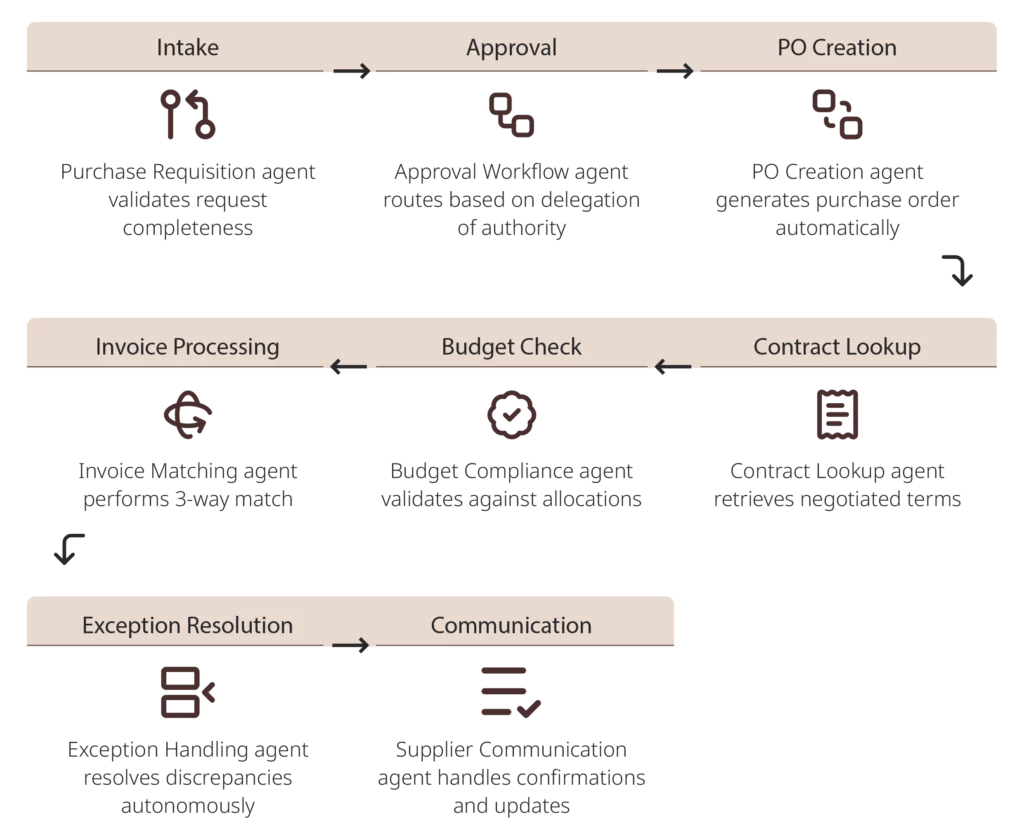
Expected Results
- Touchless processing rate: 40% → 85% (end-to-end without manual intervention)
- Cycle time: 7-10 days → 2-3 days (70% reduction)
- Processing cost: $50-100/transaction → $10-15/transaction
- Stakeholder satisfaction: 90%+ through instant helpdesk responses
Pillar 3: Governance & Compliance Agents (Risk Shield)
Specialized agents that provide 24/7 policy enforcement, risk monitoring, and audit readiness.
| Agent | Pain Point | Primary Function | Business Impact |
| Procurement Policy Enforcement Agent | Policy violations go undetected until audits | Ensures all purchases align with internal policies | 100% policy compliance |
| Contract Compliance Agent | Paying wrong prices, missing negotiated savings | Validates spend against negotiated contract terms | $6-10M contract leakage prevention |
| Maverick Spend Detection Agent | Off-contract spend drains negotiated value | Flags unauthorized, non-compliant purchases | -50% maverick spend |
| Cost Optimization Agent | No systematic approach to identifying savings | Identifies cost-saving opportunities across suppliers | Systematic savings identification |
| Spend Forecasting Agent | Inaccurate budget planning limits strategic agility | Predicts future procurement spend using historical data | 15-20% forecast accuracy improvement |
| Audit Readiness Agent | Audit prep consumes 4-6 weeks of manual work | Prepares procurement documentation for audits | 90% reduction in audit prep time |
| Regulatory Compliance Agent | Regulatory risk exposure (GDPR, SOX, industry regs) | Ensures adherence to local and global regulations | Zero compliance violations |
| Fraud Detection Agent | Fraud discovered too late (quarterly vs. real-time) | Identifies suspicious patterns and anomalies | Real-time fraud prevention |
| Supplier Dependency Risk Agent | Over-reliance on single suppliers creates vulnerability | Monitors over-reliance on single vendors | Supply chain resilience |
| Price Variance Analysis Agent | Paying incorrect prices without detection | Tracks deviations between invoiced and agreed pricing | Automatic pricing discrepancy detection |
| Executive Procurement Insights Agent | No real-time executive visibility into procurement performance | Generates C-level dashboards and strategic insights | Real-time executive visibility |
| Procurement Governance Agent | Fragmented governance controls across organization | Coordinates approvals, controls, and accountability | Enterprise-wide governance orchestration |
Proactive Risk & Compliance Workflow
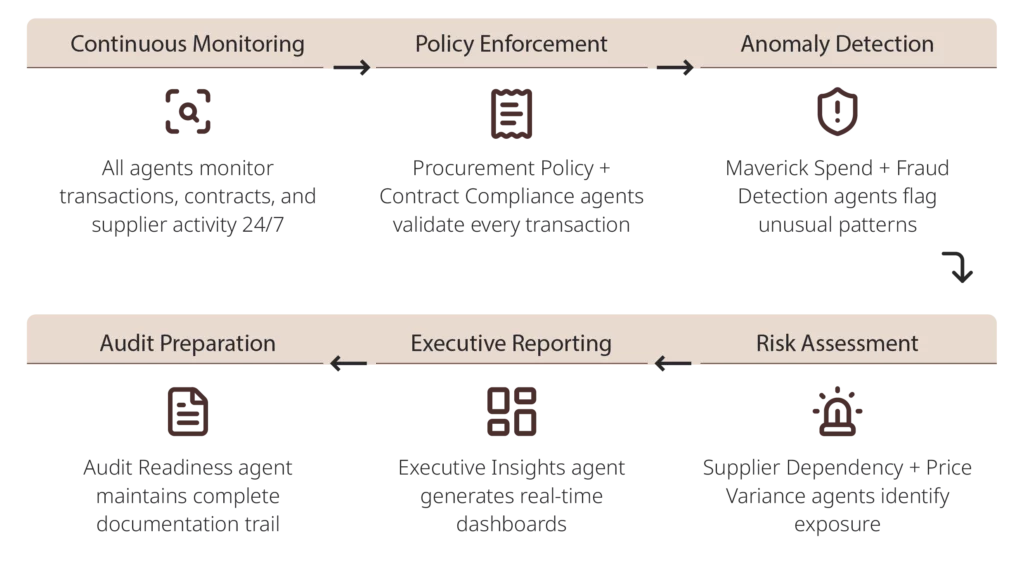
Expected Results
- Policy violations: Near-zero through proactive enforcement
- Contract savings capture: $6-10M annually through compliance monitoring
- Fraud prevention: Real-time detection vs. quarterly discovery
- Audit preparation: 4-6 weeks → 2-3 days (90% reduction)
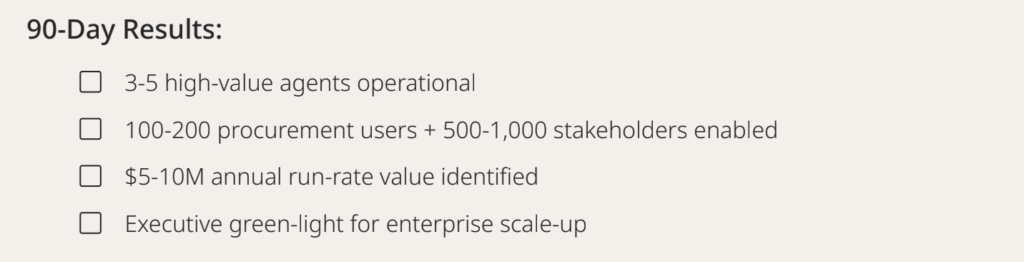
The 90-Day Pilot Approach
Based on validated Fortune 500 deployment patterns, this approach minimizes risk while demonstrating value quickly.
Note: Every organisation’s procurement challenges are different. Use this framework to build your customised pilot.

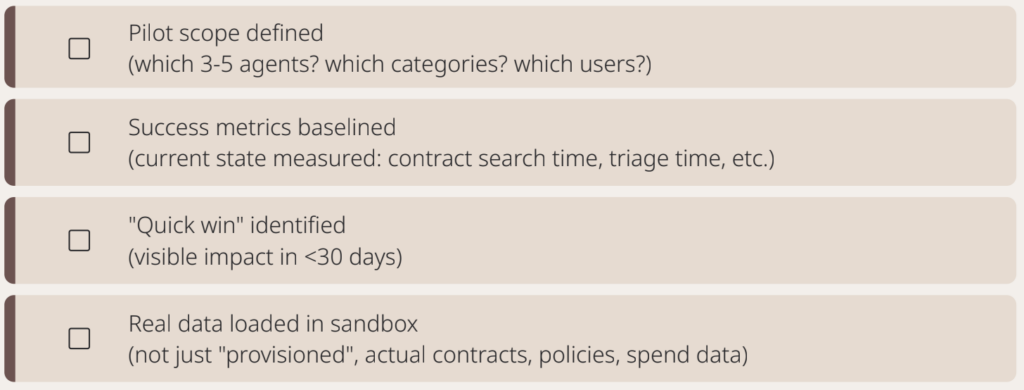
Step 1: Identify Your Top 3-5 Pain Points
Review the Agent Matrix and highlight the pain points that resonate most with your team. Common starting points:
- Intake/Stakeholder Pain → Start with Procurement Helpdesk + Purchase Requisition agents
- Contract Blindness → Start with Contract Lookup + Contract Compliance agents
- Compliance/Risk Exposure → Start with Policy Enforcement + Maverick Spend Detection agents
- Sourcing Inefficiency → Start with Supplier Discovery + RFP Creation agents
- Invoice Backlog → Start with Invoice Matching + Exception Handling agents
Step 2: Map Pain Points to Agents
Each pain point corresponds to 1-3 agents that directly address it. Your pilot should focus on the 3-5 agents that solve your highest-impact problems.
Step 3: Validate with Quick Wins
Choose at least one agent that delivers visible results in <30 days. Recommended quick wins:
- Contract Lookup Agent (immediate time savings)
- Procurement Helpdesk Agent (instant stakeholder satisfaction)
- Maverick Spend Detection (immediate savings identification)
Phase 1: Recommended First Agents (Highest Immediate ROI)
Foundational Intelligence (Weeks 1- 4)
- Contract Lookup Agent
- Spend Categorization Agent
- Internal Procurement Helpdesk Agent
Value: Instant contract intelligence, spend visibility, stakeholder self-service
Core Workflows (Weeks 5-8)
- Purchase Requisition Agent
- Approval Workflow Agent
- PO Creation Agent
Value: 70% reduction in intake/triage time, 60% faster approvals
Compliance Foundation (Weeks 9-12)
- Procurement Policy Enforcement Agent
- Contract Compliance Agent
- Maverick Spend Detection Agent
Value: Near-100% policy compliance, $2-3M contract savings capture
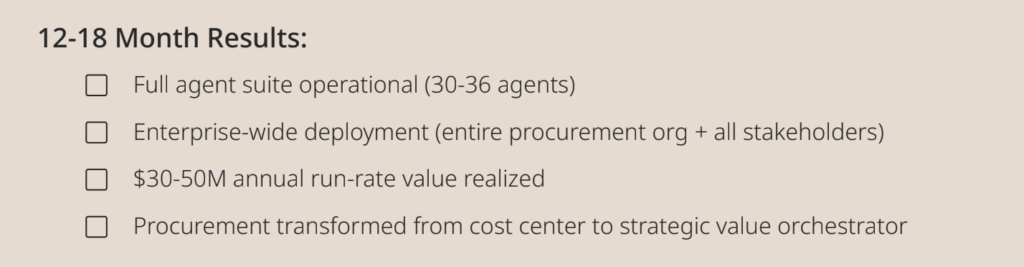
Phase 2: Comprehensive Deployment (12-18 Months to Full Capability)
Quarter 1: Foundation (6-8 agents)
- Quick Win agents from Phase 1
- Add: Supplier Risk Assessment, Budget Compliance, Cost Optimization
Quarter 2: Strategic Expansion (12-16 agents)
- Add sourcing suite: Supplier Discovery, Vendor Comparison, RFP Creation, Category Intelligence
- Add operational: Invoice Matching, Exception Handling, Delivery Tracking
Quarter 3: Advanced Workflows (20-24 agents)
- Add RFx automation: RFP Response Analysis, Negotiation Preparation
- Add compliance: Audit Readiness, Regulatory Compliance, Fraud Detection
- Add communication: Supplier Communication, Renewal Reminder
Quarter 4: Full Ecosystem (30-36 agents)
- Complete sourcing: Due Diligence, Alternative Supplier, ESG Supplier, Vendor Consolidation
- Complete analytics: Spend Forecasting, Price Variance, Supplier Dependency Risk
- Complete governance: Executive Insights, Procurement Governance
Phase 3: Industry-Specific Configurations
Manufacturing & Industrial:
- Emphasis: Supplier Risk Assessment, Alternative Supplier, Delivery Tracking (supply chain resilience)
- Priority agents: 18-20 focused on operational continuity and supplier diversity
Financial Services & Banking:
- Emphasis: Regulatory Compliance, Fraud Detection, Vendor Due Diligence (stringent governance)
- Priority agents: 15-18 focused on compliance, audit, risk management
Healthcare & Life Sciences:
- Emphasis: Regulatory Compliance, ESG Supplier, Contract Compliance (regulatory + ethics)
- Priority agents: 16-20 focused on compliance and ethical sourcing
Technology & Software:
- Emphasis: Spend Categorization, Budget Compliance, Renewal Reminder (SaaS/subscription management)
- Priority agents: 18-22 focused on tail spend and subscription optimization
The Human Side of Agent Deployment
Here’s the thing: it’s normal for your team to feel overwhelmed. Every major shift in how work gets done triggers the same questions.
| Concern | Solution |
| “Will agents replace my job?” | Position as augmentation: agents handle tedious work, humans focus on strategic value (supplier innovation, category strategy, negotiations) |
| “Can I trust agent decisions?” | Full transparency: Every decision includes rationale, data sources, confidence score. Humans retain override authority |
| “What if agents make mistakes?” | Built-in safety: Confidence thresholds trigger human review. Continuous learning improves accuracy. Full audit trail for review |
| “Too complex to learn?” | Conversational interface: Ask questions in plain English. No new systems to learn. Agents adapt to user style |
Ignoring those questions slows adoption more than any technical limitation ever could. Addressing them directly is what makes agentic systems actually usable, not just impressive on paper.
Want to go deeper on the leadership shift this requires?
Read the Unlearn Leadership black paper to understand how teams move from control to augmentation, and why trust, transparency, and human judgment are the real adoption levers in an agentic world.
Implementation Checklist
These are the critical items that determine success or failure, not the obvious ones.
Pre-Implementation (week 0)
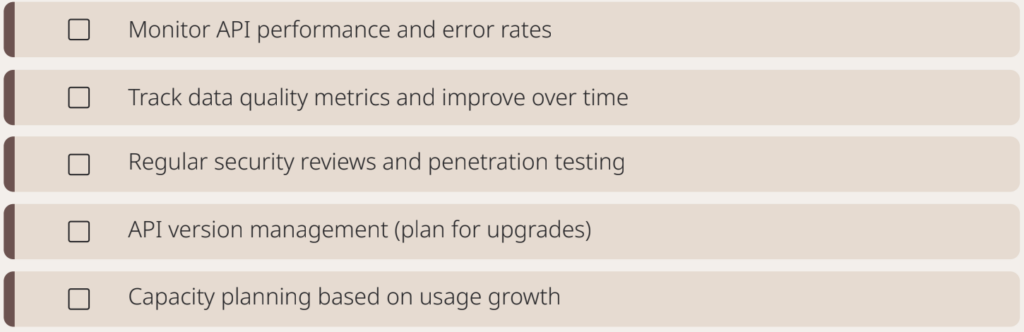
Technical Must-Haves
Pilot launch (week 1- 4)
Power User Strategy

Rapid Iteration

During Implementation (5-12 weeks)
Organic Growth
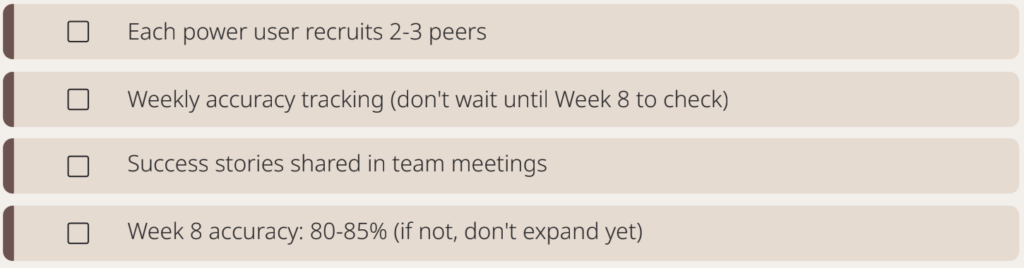
User Experience

Go/No-Go Criteria
- 80%+ adoption among trained users
- User satisfaction: 90%+ would recommend
- Measured time savings: 1-2 hrs/user/day
- Zero critical blockers remaining (P0 issues resolved)
- What if NO-GO? (pivot plan, iterate further, or kill pilot?)
- Who makes the final decision? (steering committee, CPO, executive sponsor?)
Scale Planning (if GO)
- Deployment roadmap: Quarters 1-4 (phased, not big bang)
- Support model defined (who handles questions when it scales?)
Post-Implementation (Ongoing)
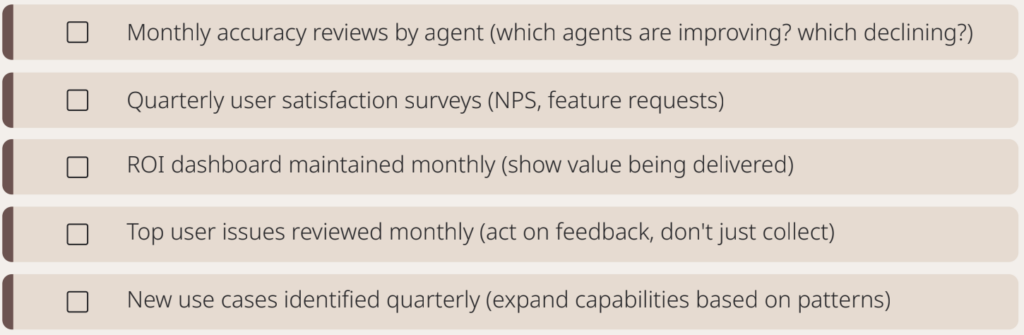
Technical Must-Haves
Common Implementation Pitfalls & Solutions
Focus on the 10 issues that actually kill deployments. Everything else is noise.
The Deployment Killers (Must Prevent)
| Pitfall | Impact | Solution |
| Agent hallucinations (fabricating data) | Wrong decisions, compliance violations, destroyed trust | Require citations for all responses, confidence thresholds (>90% auto, <90% human review), Hallucination Manager enabled |
| Scope creep in pilot (trying to do too much) | Never finish, no proof of value, wasted investment | Hard limit: 3-5 agents max, “parking lot” for future features, executive enforces boundaries |
| Users reverting to old methods | Pilot failure, signals agents don’t work | Weekly pulse check: Why? Fix root cause immediately (UX/speed/accuracy), don’t wait |
| Data quality worse than expected | Low accuracy, unusable agents | Start with high-quality subset (70%+ complete), narrow scope, parallel cleanup for later |
High-Risk Issues (Manage Proactively)
| Pitfall | Impact | Solution |
| Performance/latency >30 seconds | Users abandon agents | Response time SLA (<30 sec), async for complex queries, caching |
| Integrated system downtime (ERP/P2P unavailable) | Agents can’t function | Graceful degradation, clear error messages, queue requests |
| Unclear ownership (Procurement vs IT) | Finger-pointing, slow issue resolution | RACI matrix upfront, joint steering committee, documented escalation |
| Insufficient training examples | Poor accuracy from Day 1 | 50-100 quality examples per use case minimum before launch |
| Inadequate monitoring | Discover issues from users, not dashboards | Real-time tracking: accuracy %, response time, error rates, daily review |
| No fallback when agents fail | Dead-end UX, user frustration | Human escalation path clear, helpful error messages with next steps |
Red Flag Detection
Watch for these warning signs and act immediately:
| Week | Red Flag | Immediate Action |
| Week 1-4 | Accuracy stuck at 70% | Pause expansion, analyze errors, add training data |
| Week 1-4 | Power users not using daily | 1-on-1 interviews, identify blockers, fix UX |
| Week 5-8 | Users saying “faster to do myself” | Critical UX/performance problem, fix before scaling |
| Week 5-8 | Accuracy <80% | Don’t expand, iterate until fixed |
| Any week | Users reverting to old methods | Emergency: Find why, fix in 1 week, or pivot use case |
The Rule of Three
Every week, answer these 3 questions:
- Is accuracy improving? (70% → 75% → 80% → 85%)
- Are users using it daily? (track active users)
- Can you name 3 people who saved X hours? (real stories)
If “NO” to any → that’s your priority to fix this week.
The Road Ahead
You’ve seen the full picture. The pain points. The missed value. The limits of past automation waves. And the very real, very achievable path to agent-led procurement.
At this point, the question isn’t if procurement will move to autonomous orchestration. It’s who moves first and how deliberately they do it.
The organizations that win don’t start with a massive transformation program. They start with a focused pilot. Three to five agents. Real data. Real users. Real outcomes in 90 days. They prove value, earn trust, and scale with confidence.
If you’re a CPO, this is a leadership moment.
If you’re an executive sponsor, this is a leverage point.
If you’re a procurement leader, this is your chance to reclaim time for the work that actually matters.
Ready to explore this in your environment?
Book a 15-minute demo call to map your top procurement pain points to specific agents, review integration with your ERP/P2P/CLM stack, and pressure-test a 90-day pilot plan tailored to your organization.
Still exploring what’s possible?
Check out our Procurement Agent Blueprints to see concrete, enterprise-ready use cases, how agents work across sourcing, operations, and governance, with real workflows and outcomes.
Procurement is no longer about managing processes.
It’s about orchestrating value.
This playbook shows you how.