A brutally honest breakdown of every gap, risk, and limitation you’ll hit with ChatGPT Enterprise, and how LyzrGPT addresses each one.
01. Data Sovereignty & Privacy
Where does your data actually go? ChatGPT Enterprise promises isolation, but cloud-only means your most sensitive information still leaves your walls.
Reason 1: It’s Cloud-Only. Your Data Always Leaves Your Building.
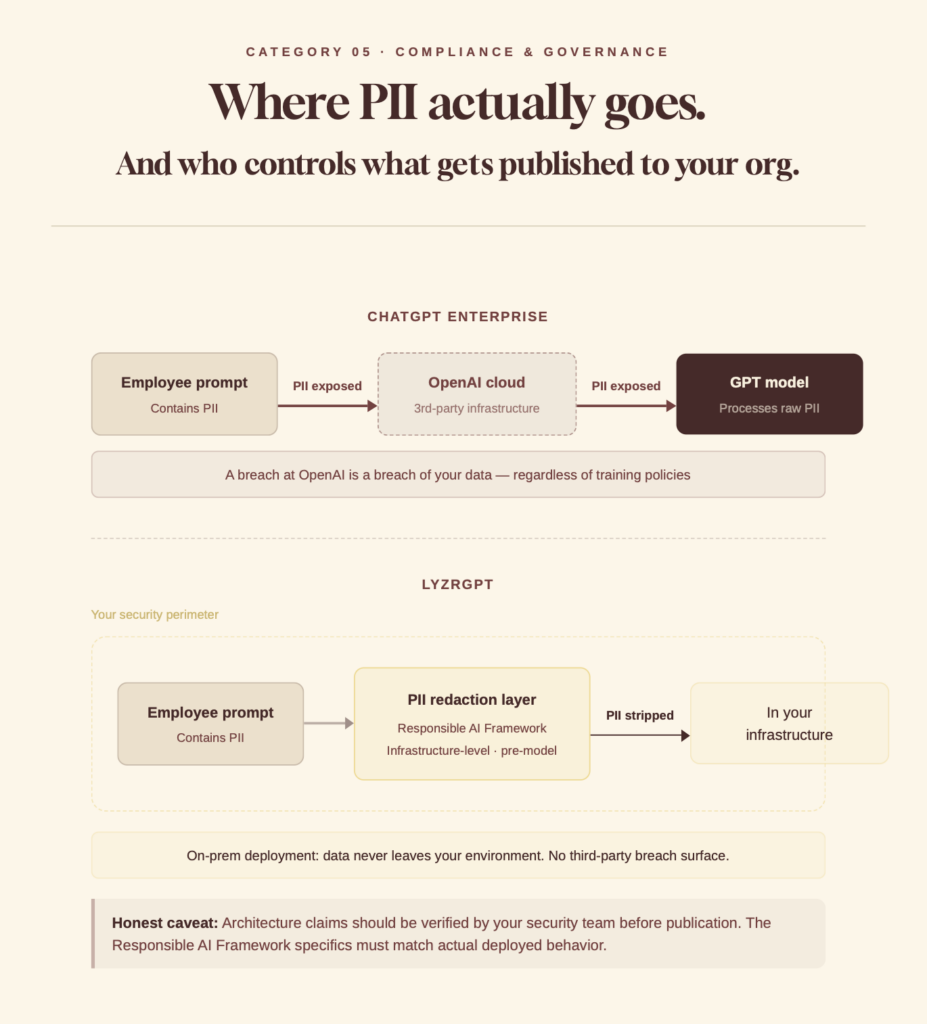
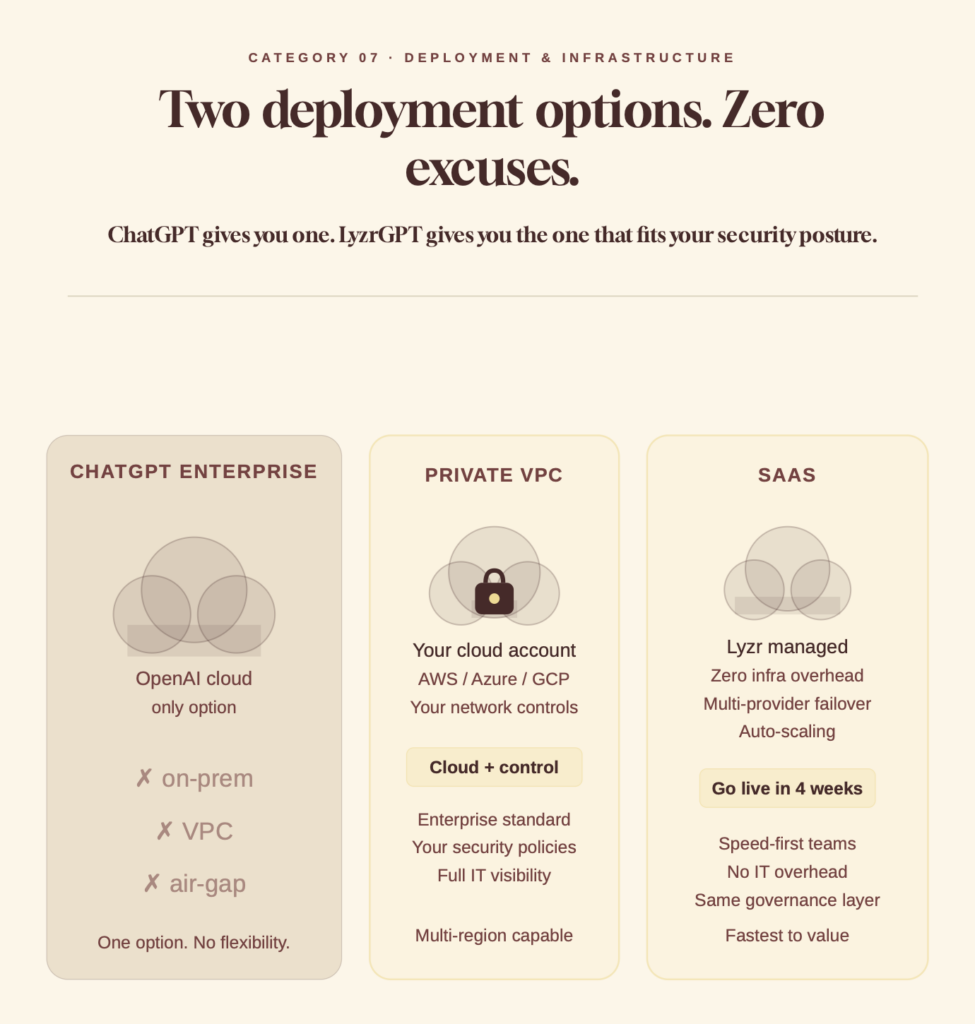
ChatGPT Enterprise runs exclusively on OpenAI’s cloud infrastructure. There is no on-premises deployment option. Every prompt, every document, every internal conversation gets processed on servers you don’t own, in data centers you can’t audit, under terms of service that can change at renewal.
✓ LyzrGPT: True on-premises, private VPC, or SaaS , your choice. Air-gapped deployment available. Your data never has to leave your infrastructure.
Reason 2: Data Residency Is Limited and Controlled by OpenAI
ChatGPT Enterprise offers data residency in select regions, but region availability is determined by OpenAI’s infrastructure roadmap , not your compliance requirements. If your data needs to stay in a specific jurisdiction, you’re dependent on OpenAI expanding there first.
✓ LyzrGPT: Full data residency control via on-prem or private VPC. You decide where data lives. No dependency on a vendor’s infrastructure expansion plans.
Reason 3: PII Redaction Is an Afterthought, Not Infrastructure
ChatGPT Enterprise relies on standard content moderation. PII detection is surface-level and user-dependent. It flags obvious patterns but doesn’t systematically strip sensitive information before it reaches the model. One careless prompt can expose a customer’s SSN, medical record, or financial data.
✓ LyzrGPT: Infrastructure-level PII redaction via the Responsible AI Framework. PII is stripped before it reaches any model , not after. System-wide, not user-dependent.
Reason 4: “No Training on Your Data” Doesn’t Mean No Risk
OpenAI claims they don’t train on Enterprise customer data. But data still passes through their infrastructure, gets processed by their systems, and is subject to their security posture. A breach at OpenAI is a breach of your data, regardless of training policies.
✓ LyzrGPT: On-prem deployment means your data never leaves your environment. Security is your own , not contingent on a third party’s breach record.
Reason 5: No Granular Data Access Controls Per User or Department
ChatGPT Enterprise offers workspace-level isolation but lacks fine-grained, per-user data controls. You can’t easily restrict what one department’s AI can access versus another’s without significant custom engineering on top of the platform.
✓ LyzrGPT: Per-user encrypted agents with configurable data access scopes. Finance sees finance data. Legal sees legal data. Enforced at the infrastructure level.
Reason 6: Incident Response Is Negotiated, Not Guaranteed
When something goes wrong, a data exposure, a model error with customer data, a breach, your recourse with ChatGPT Enterprise is a negotiated SLA. You’re in a queue with thousands of other enterprise customers. You don’t own the incident response process.
✓ LyzrGPT: On-prem means you own incident response entirely. Your security team, your protocols, your timeline, no vendor queue.
Reason 7: No Audit Logs You Fully Own and Control
ChatGPT Enterprise provides some logging and admin controls, but the underlying audit infrastructure is OpenAI’s. Regulators increasingly want complete audit trails that organizations fully own. Logs housed in a third party’s infrastructure create compliance gaps for regulated industries.
✓ LyzrGPT: Full audit trail ownership with on-prem deployment. Every interaction, every model call, every output, logged in your environment, accessible to your auditors.
Reason 8: Prompt Injection Attacks Are a Real Enterprise Risk
ChatGPT Enterprise offers standard safety guardrails but limited systematic protection against prompt injection at the infrastructure level. Malicious inputs embedded in documents or user queries can manipulate model behavior, exposing data or bypassing intended controls.
✓ LyzrGPT: Responsible AI Framework includes systematic prompt injection detection before inputs reach any model. Protection is architecture-level, not prompt-level.
Reason 9: Terms of Service Can Change at Renewal
OpenAI’s terms of service for how they handle enterprise data, what they can do with outputs, and what protections they provide are subject to change. You sign today’s terms. Renewal terms may be different, and the leverage to push back decreases after you’ve built workflows on the platform.
✓ LyzrGPT: Self-hosted deployments remove dependency on vendor ToS for data governance. Your data policy doesn’t have an expiry date.
Reason 10: Third-Party Integrations Multiply Your Data Exposure
Every connector ChatGPT Enterprise plugs into, Slack, Salesforce, Notion, your databases, creates another data pathway through OpenAI’s infrastructure. The more you integrate, the wider the exposure surface becomes. You lose visibility into every data hop.
✓ LyzrGPT: Integrations run through your controlled environment on on-prem deployments. Data flows stay inside your security perimeter regardless of how many systems you connect.
02. Pricing & Economics
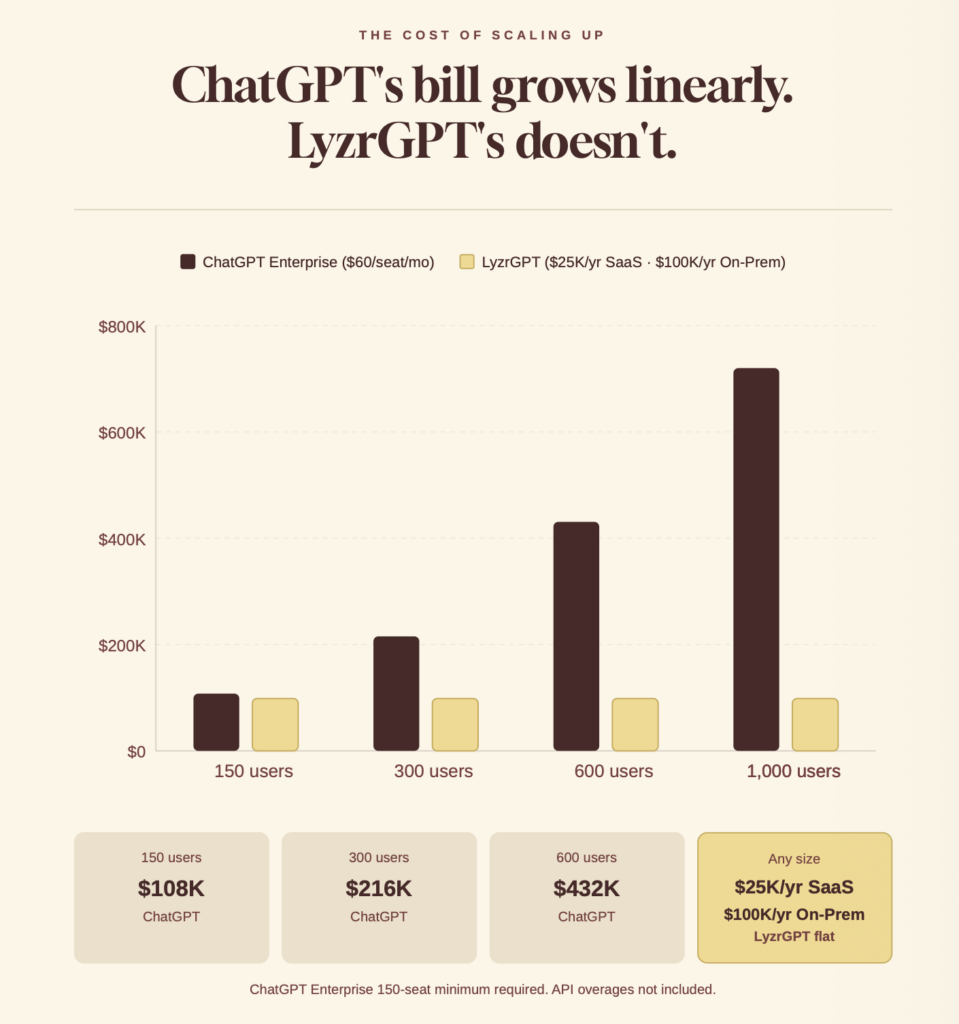
ChatGPT Enterprise starts at 150 seats minimum. At $60/user/month, that’s $108K/year before you’ve run a single workflow. Here’s how the economics get worse as you scale.
Reason 11: 150-Seat Minimum Before You Can Even Start
ChatGPT Enterprise requires a minimum of 150 seats to access the enterprise plan. If you have a 50-person legal team who needs AI, you’re still paying for 150 seats. You’re forced to over-buy from day one before you’ve proven any ROI.
✓ LyzrGPT: No seat minimums. Flexible POC terms. Start with the team that needs it, scale when you’re ready. Pay for usage, not phantom seats.
Reason 12: Seat-Based Pricing Punishes Success
The moment AI adoption works and more employees want access, your bill grows linearly. 300 users = 2x the cost. 600 users = 4x the cost. The better ChatGPT Enterprise performs, the more expensive it becomes, creating a perverse incentive to limit access.
✓ LyzrGPT: $25K/year (SaaS) or $100K/year (On-Prem), unlimited users. Your 1,000th user costs nothing extra. AI adoption becomes a goal, not a budget threat.
Reason 13: API Overages Create Unpredictable Bills
ChatGPT Enterprise includes API credits, but high-usage months, agentic workflows, or unexpected employee adoption can push you past those credits. API overage charges hit finance teams without warning and turn a fixed IT cost into a variable, hard-to-budget expense.
✓ LyzrGPT: Transparent consumption-based pricing: $0.08/agent run (SaaS) or $0.03/agent run (self-hosted) + LLM costs. Every line item visible. No surprise charges.
Reason 14: The Real Cost of 300 Employees Is $216K+/Year Just for Access
150 seats × $60/month × 12 = $108,000. For 300 people, that’s $216,000/year, and that’s before any API usage, custom integrations, or agent workflows. Most enterprises are paying for model access, not for actual AI capability or business outcomes.
✓ LyzrGPT: $25K/year (SaaS) or $100K/year (On-Prem) flat for the entire organization. 150 people or 1,500 people, same price. The math stops getting worse when you grow.
Reason 15: You’re Paying for Seats Whether They Use It or Not
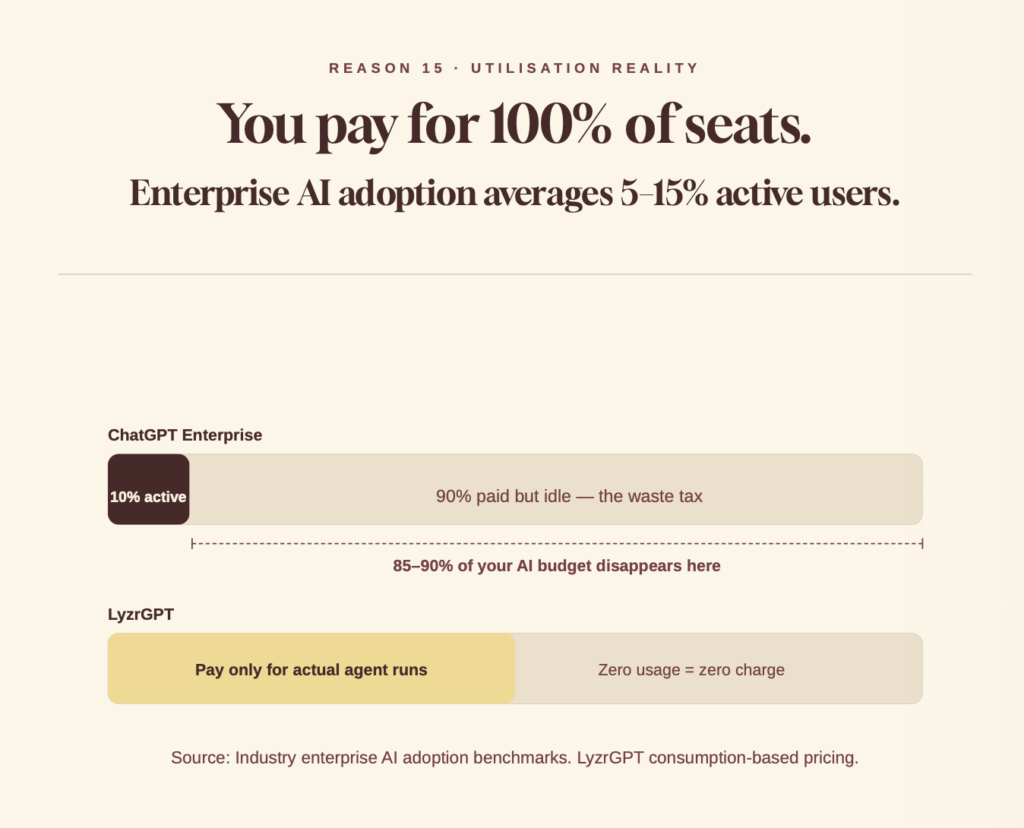
Enterprise AI adoption averages 5–15% of licensed users actively engaging. With seat-based pricing, you pay for 100% of seats to get 10% utilization. That’s an 85–90% waste rate on your AI investment, a number that’s very hard to defend in a budget review.
✓ LyzrGPT: Consumption-based means you only pay when the AI actually runs. Zero usage = zero charges beyond the base. No waste tax.
Reason 16: Renewal Negotiations Favor OpenAI, Not You
After year one, you’ve built workflows, trained employees, and embedded ChatGPT into operations. Your negotiating leverage at renewal is near zero. Price escalators in Year 2 and 3 contracts are common.
✓ LyzrGPT: No vendor lock-in means you retain negotiating leverage always. Your agents, your data, your workflows, portable. That’s real leverage at every renewal.
Reason 17: No Visibility into Cost-Per-Task or Cost-Per-Outcome
ChatGPT Enterprise charges per seat, not per task. You have no way to measure cost-per-document-processed, cost-per- analysis, or cost-per-agent-run. Without task-level visibility, AI ROI is nearly impossible to calculate.
✓ LyzrGPT: Per-agent-run pricing creates natural cost attribution. Finance can measure exactly what each workflow costs. ROI becomes a real number, not an estimate.
Reason 18: POC Costs Are Prohibitive for Smaller Enterprise Teams
To run a proof of concept on ChatGPT Enterprise, you need the 150-seat minimum contract. There’s no meaningful smaller-scale pilot option. That means committing budget before you’ve validated the business case, a significant risk for any procurement team doing their job properly.
✓ LyzrGPT: Flexible POC terms designed for enterprise evaluation. Test with a real team at real scale before committing. No 150-seat minimum to see if it works.
Reason 19: Model Upgrades Can Change Your Cost Structure Overnight
When OpenAI releases a new model tier, your existing workflows may need to move to a higher-cost model to maintain quality. A model upgrade that improves performance can simultaneously inflate your annual AI spend with zero warning.
✓ LyzrGPT: Multi-model architecture means you auto-route to the best model at the best price. You’re never hostage to one provider’s pricing.
Reason 20: There’s No “Bring Your Own Model” Option
ChatGPT Enterprise is OpenAI’s models, OpenAI’s pricing, OpenAI’s roadmap. If your team wants to use an open-source model like Llama for cost-sensitive tasks, you can’t do that within ChatGPT Enterprise.
✓ LyzrGPT: Bring your own models , open-source, proprietary, or specialized vertical models. Route tasks to the right model at the right cost.
03. Vendor Lock-in
Every Custom GPT you build, every workflow you create, every conversation context you accumulate, it all lives inside OpenAI’s ecosystem. Here’s what getting out actually costs.
Reason 21: Your Custom GPTs Don’t Port to Any Other Platform
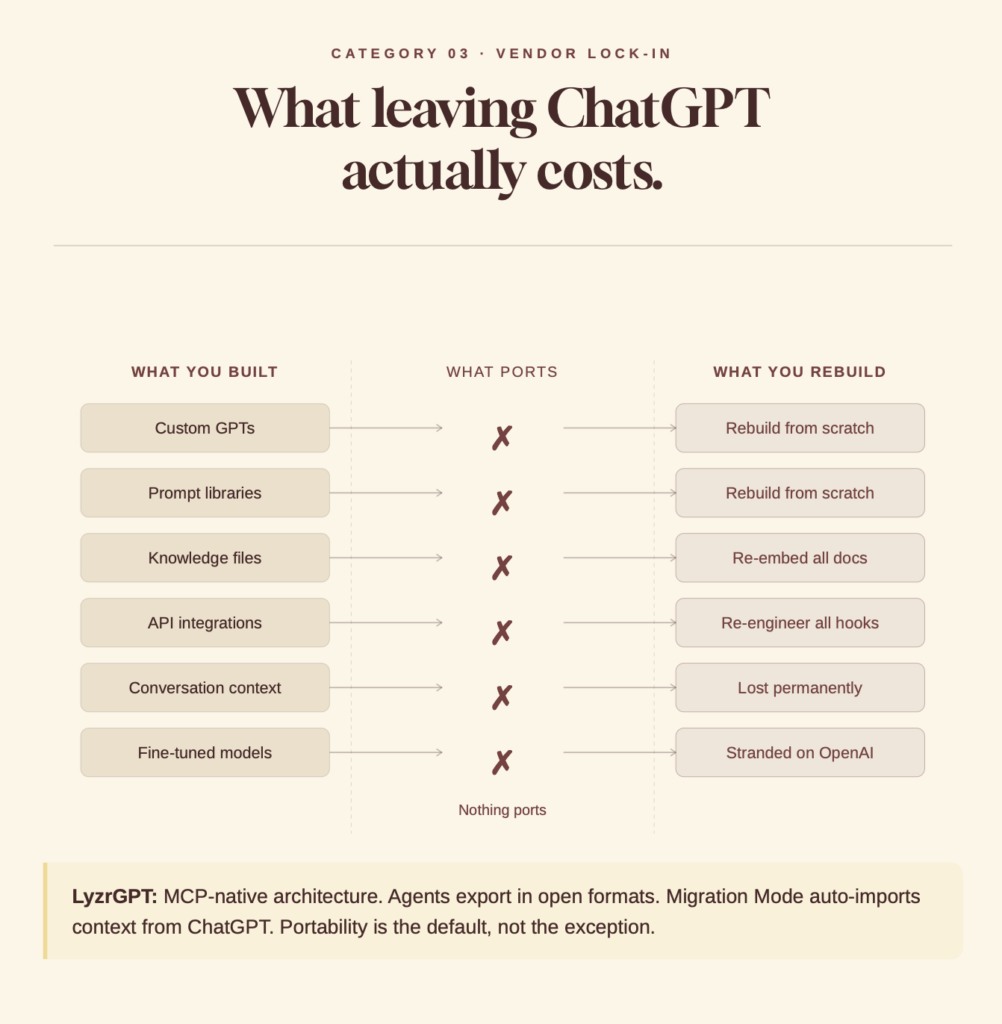
Every Custom GPT your team builds is OpenAI-proprietary. The instructions, the tool configurations, the knowledge files, none of it exports in a format usable on any other AI platform. When you leave ChatGPT Enterprise, you rebuild everything from scratch.
✓ LyzrGPT: MCP architecture means agents are built on open standards. Portable by design. No rebuild tax if you switch or add platforms.
Reason 22: Context and Conversation History Is Trapped
Months of institutional context, specialized prompt patterns, and conversation history accumulated in ChatGPT Enterprise can only be exported manually, and that export is raw data with no structured format for import elsewhere. Your team’s AI memory is effectively held hostage.
✓ LyzrGPT: Migration Mode auto-imports context from ChatGPT, Copilot, or Gemini. Your institutional memory travels with you , structured, searchable, and usable from day one.
Reason 23: OpenAI Is Now Competing With Its Own Enterprise Customers
OpenAI has moved into consumer AI, enterprise software, and agentic products that directly overlap with what customers build on their API. Industry observers have flagged that OpenAI monitors successful API use cases and may build competing products. Building your business on a vendor who might compete with you is a genuine strategic risk.
✓ LyzrGPT: Lyzr is a platform vendor, not a model competitor. We don’t compete with what you build on top of our platform.
Reason 24: GPT-Specific Prompt Engineering Doesn’t Transfer
Your team will spend months developing GPT-optimized prompts, system instructions, and workflow patterns. These are highly model-specific. If you need to move to Claude, Gemini, or Llama for any reason, that prompt engineering investment largely has to be rebuilt for each new model.
✓ LyzrGPT: Model-agnostic prompt layer abstracts away model specifics. Switch models without rewriting your entire prompt library.
Reason 25: Integration Workflows Are Built on OpenAI’s API Spec
All your Zapier connections, API integrations, and automation workflows are built around OpenAI’s API format. Switching vendors means re-engineering every integration, a substantial hidden cost that only becomes visible when you try to leave.
✓ LyzrGPT: Provider-agnostic API layer. Your integrations connect to LyzrGPT once. Swap the underlying model without touching your integration code.
Reason 26: Your AI Strategy Becomes Dependent on OpenAI’s Roadmap
If you need a capability OpenAI hasn’t built yet, you wait. If they deprioritize a feature your business needs, you’re stuck. Your AI roadmap is effectively outsourced to a single company’s product decisions, a company with very different priorities than your business.
✓ LyzrGPT: Multi-provider access means you access the best capability wherever it exists , OpenAI, Anthropic, Google, or open source. You’re never waiting on one vendor’s roadmap.
Reason 27: No Exit Strategy Built Into the Contract
ChatGPT Enterprise contracts don’t include structured offboarding, data migration assistance, or portability guarantees. If you need to exit, due to pricing, compliance, performance, or competitive risk, you’re on your own. Data export is manual and time-consuming.
✓ LyzrGPT: MCP architecture ensures no proprietary lock-in. Exiting is clean because everything was portable from the start.
Reason 28: Model Deprecation Breaks Your Workflows Without Warning
OpenAI has deprecated models before, GPT-3.5 Turbo variants, older embeddings models, with relatively short notice periods. Workflows built on a specific model version can break when that version is retired, forcing emergency re-engineering on someone else’s timeline.
✓ LyzrGPT: Automatic fallback routing means if one model is deprecated, traffic routes to the next best option automatically. Your workflows don’t break when vendors change their lineups.
Reason 29: OpenAI’s Business Model Instability Creates Platform Risk
OpenAI has undergone significant leadership turbulence, governance crises, and structural changes since its founding. An enterprise platform built on a company that’s undergone a near-collapse event and board-level chaos carries real continuity risk that procurement teams should assess honestly.
✓ LyzrGPT: Multi-model architecture means no single provider’s instability can take down your AI operations. Redundancy is built into the platform architecture itself.
Reason 30: Knowledge Files and Fine-Tuning Are OpenAI-Only Assets
Custom knowledge files, fine-tuned models, and embedding stores built within ChatGPT Enterprise are OpenAI-format assets. They don’t convert to formats usable in other AI systems without substantial re-work, months of data engineering to recreate what took months to build.
✓ LyzrGPT: Open vector store standards and model-agnostic knowledge architecture. Your knowledge assets work across any model the platform supports.
04. Model Flexibility
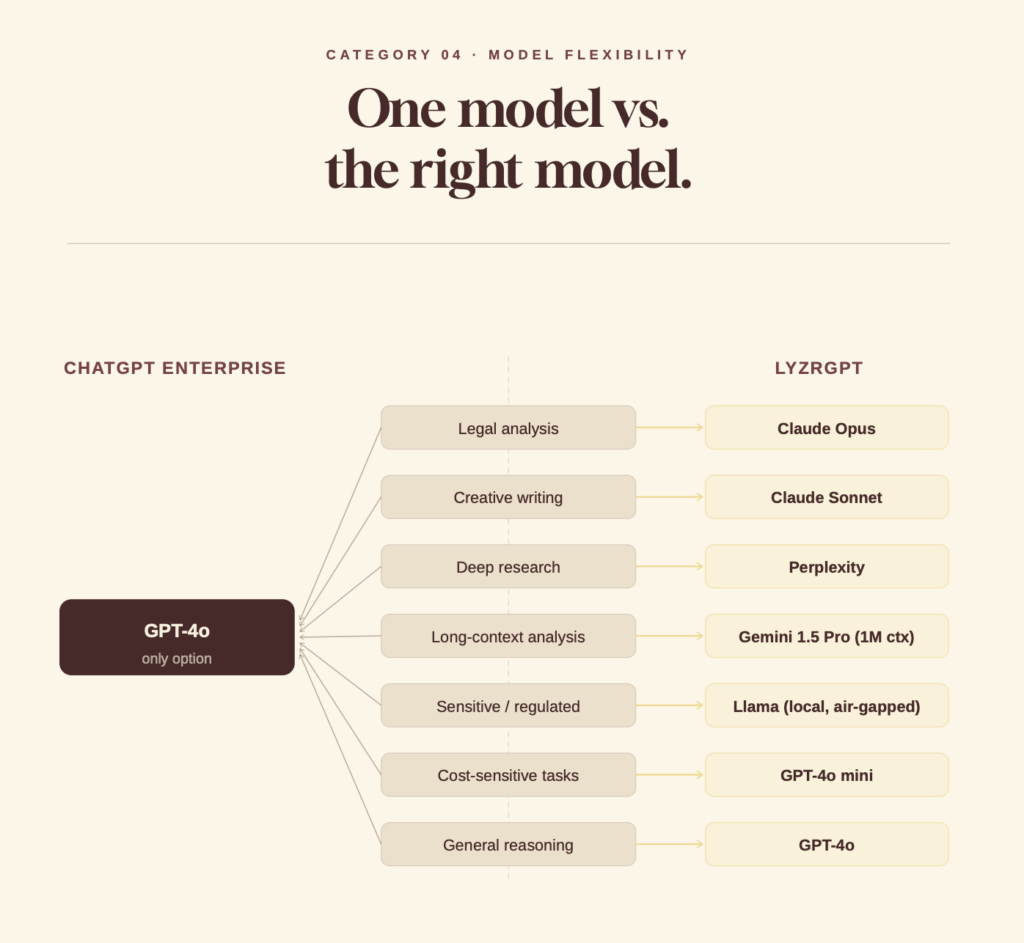
GPT-4o is a great model. It’s not the best model for every task. Legal reasoning, creative writing, code generation, data analysis, different tasks have different optimal models.
Reason 31: One Model Family for Every Task Is Suboptimal by Definition
GPT-4o excels at general reasoning. Claude 3 Opus is widely regarded as superior for complex legal and long-form analysis. Gemini handles multimodal tasks differently. Llama variants run cheaper for high-volume commodity tasks. Using only GPT for everything means accepting mediocre performance on the tasks where it isn’t the best.
✓ LyzrGPT: Auto-routes each prompt to the best model for that task type. Creative to Claude. Analysis to GPT-4o. Research to Perplexity. Best output, automatically.
Reason 32: Model Switching Mid-Conversation Isn’t Possible
Once a conversation starts in ChatGPT Enterprise, you’re locked into that model’s context window, capabilities, and limitations for the duration of that session. If you need a different model’s strength mid-task, you start a new conversation and lose all context.
✓ LyzrGPT: Switch models mid-conversation without losing context. No “start over” tax when you need a different capability.
Reason 33: No Intelligent Cost Arbitration Between Models
A simple summarization task costs the same as a complex analysis task on ChatGPT Enterprise, both run through the same premium model. There’s no intelligence routing simple tasks to cheaper models and complex tasks to expensive ones.
✓ LyzrGPT: Intelligent cost arbitration routes simple tasks to efficient models and complex tasks to premium ones. You get the right model at the right price automatically.
Reason 34: No Access to Open-Source Models for Sensitive Tasks
For certain highly sensitive operations, enterprises prefer open-source models (Llama, Mistral) that can run fully on-premises with no external API calls whatsoever. ChatGPT Enterprise cannot accommodate this, every inference call routes to OpenAI’s servers.
✓ LyzrGPT: Route sensitive tasks to open-source models running on your own hardware. Zero external API calls for your most sensitive workflows. True air-gapped inference.
Reason 35: New Frontier Models Don’t Automatically Benefit You
When Anthropic releases a breakthrough model that outperforms GPT on legal reasoning, you can’t just switch to it within ChatGPT Enterprise. You’d need a separate contract, separate integration, separate workflows.
✓ LyzrGPT: New model providers get added to the routing layer. Every frontier model release is automatically available to your workflows without new contracts or integrations.
Reason 36: No Specialized Vertical Models for Your Industry
Healthcare, legal, finance, and defense each have specialized AI models fine-tuned on domain-specific data. ChatGPT Enterprise offers GPT variants, not Med-PaLM equivalents, not Harvey AI for legal, not specialized financial reasoning models.
✓ LyzrGPT: Integrate specialized vertical models alongside general-purpose ones. Route legal tasks to legal-optimized models, medical tasks to clinical models , within the same platform.
Reason 37: Research Tasks Suffer Without Perplexity-Style Retrieval
ChatGPT Enterprise has Bing-powered web search, but it’s not optimized for deep research with cited sources and structured retrieval chains. Teams doing serious research work find the general-purpose search integration insufficient.
✓ LyzrGPT: Dedicated Research Mode powered by Perplexity-style retrieval with citation chains. Research tasks route to research-optimized infrastructure automatically.
Reason 38: Long-Context Tasks Hit GPT’s Limits
GPT-4o supports 128K context tokens, large, but not infinite. Tasks requiring analysis of full legal contracts, entire codebases, or lengthy research corpora can exceed this. There’s no fallback to a longer-context model within ChatGPT Enterprise.
✓ LyzrGPT: Route long-context tasks to Gemini 1.5 Pro (up to 1M tokens) automatically. Never hit a hard ceiling on analysis depth.
Reason 39: No A/B Testing of Models for Quality Optimization
On ChatGPT Enterprise, you can’t run the same prompt against multiple models to identify which produces better outputs for your specific use case. Single-model platforms make empirical quality improvement nearly impossible.
✓ LyzrGPT: Multi-model architecture enables systematic model comparison across GPT, Claude, and Gemini , then codify that as routing logic.
Reason 40: Embedding Model Lock-in Affects Your Search and Retrieval
Document search, semantic retrieval, and RAG pipelines built on OpenAI’s embedding models are locked to those embeddings. Switching embedding providers requires re-indexing your entire document corpus.
✓ LyzrGPT: Embedding model agnosticism means you can upgrade your retrieval layer without rebuilding your document index from scratch.
05. Compliance & Governance
Both platforms claim SOC 2 and GDPR compliance. But compliance certifications and true compliance posture are different things.
Reason 41: HIPAA BAA Exists, But Cloud Infrastructure Still Carries Risk
ChatGPT Enterprise offers a HIPAA BAA, which covers the contractual liability layer. But HIPAA risk with cloud AI isn’t just about contracts; it’s about data flow control, breach notification timelines, and your ability to demonstrate to auditors that PHI never leaves your control.
✓ LyzrGPT: On-prem deployment means PHI genuinely stays in your environment. The HIPAA audit conversation changes from “we have a BAA” to “data never leaves our walls.”
Reason 42: Financial Services Regulations Require Data Localization ChatGPT Can’t Provide
FINRA, SEC, and many international banking regulators have data localization requirements that cloud-only AI platforms struggle to satisfy. Banks and asset managers in regulated markets need to demonstrate full data control.
✓ LyzrGPT: Purpose-built for financial services compliance with on-prem deployment. Your infrastructure, your auditors, your regulator conversations , clean and defensible.
Reason 43: EU AI Act Compliance Is Harder Without Infrastructure Control
The EU AI Act imposes obligations on high-risk AI use, including documentation, audit rights, and human oversight requirements. Meeting these obligations is significantly harder when your AI infrastructure is a third-party cloud service.
✓ LyzrGPT: Full infrastructure access enables the documentation and audit trails EU AI Act compliance requires.
Reason 44: No Department-Level AI Governance Controls
ChatGPT Enterprise operates at the workspace level. Governance policies apply broadly, not per department, per role, or per data sensitivity level. A company with different AI governance needs for HR, Legal, and Engineering cannot enforce those distinct policies within the same workspace.
✓ LyzrGPT: The Enterprise Brain enforces a 4-tier RBAC model: Super Admin, Admin, Ecosystem Agent Managers, and Members, with department-level scoping at each tier. Every agent goes through a governed lifecycle: requested, built, reviewed, approved, then published to the org. Finance’s agents don’t cross into Legal.
Reason 45: Toxicity and Content Moderation Is One-Size-Fits-All
ChatGPT Enterprise applies OpenAI’s content policies uniformly. A cybersecurity firm discussing malware, a law firm discussing criminal cases, or a medical team discussing sensitive clinical topics all hit the same guardrails designed for consumer safety, not enterprise professional use.
✓ LyzrGPT: Configurable guardrails per use case and department. Set appropriate content boundaries for each professional context.
Reason 46: No Confidence Scoring or Hallucination Flags
ChatGPT Enterprise doesn’t provide systematic confidence scores or hallucination probability indicators for outputs. In regulated industries where AI outputs influence decisions, knowing how confident the model is in a given answer is fundamental, and completely absent.
✓ LyzrGPT: Confidence scoring and fact-checking layer surfaces uncertainty before it becomes a compliance event.
Reason 47: Human-in-the-Loop Approval Workflows Are Primitive
For high-stakes AI decisions, loan approvals, medical flagging, legal document generation, enterprises need configurable human approval checkpoints built into AI workflows. ChatGPT Enterprise’s Custom GPT workflows don’t offer systematic human-in-the-loop architecture.
✓ LyzrGPT: Govern & Approve stage is a mandatory checkpoint in every agent’s lifecycle. Flagged outputs require explicit approve/deny actions before reaching users. This isn’t a workaround bolted on after deployment, it’s step 3 of a 4-step operating model built into the platform architecture.
Reason 48: Shadow AI Risk Is Actively Enabled by the Consumer Product
ChatGPT Enterprise coexists with ChatGPT Free and ChatGPT Plus, which your employees are already using for work on personal accounts. The existence of free alternatives means shadow AI usage is hard to eliminate even after you buy Enterprise.
✓ LyzrGPT: Consumer UX combined with enterprise safety controls reduces the motivation for shadow AI. When the governed platform is as good as the shadow option, adoption becomes the default.
Reason 49: No Cross-System Data Lineage Tracking
When AI-generated content moves from ChatGPT into your CRM, your docs, your databases, there’s no built-in tracking of AI-originated data. Regulators increasingly want data lineage. Knowing which decisions or documents were AI-influenced is architecturally difficult with ChatGPT Enterprise.
✓ LyzrGPT: Agent execution logs create traceable AI lineage across systems. Every AI action is attributable, auditable, and traceable , compliance-grade data provenance by default.
Reason 50: Government and Defense Use Cases Are Simply Off-Limits
Government agencies, defense contractors, and national security organizations face cloud AI restrictions that make ChatGPT Enterprise largely unusable for sensitive workloads. The cloud-only architecture fails these buyers entirely.
✓ LyzrGPT: Air-gapped, fully on-premises deployment designed for government and defense use cases. Where ChatGPT can’t go, LyzrGPT can.
06. Agents & Automation
Custom GPTs are impressive demonstrations. Production agent orchestration, the kind that actually automates enterprise workflows, is a different beast entirely.
Reason 51: Custom GPTs Are Chatbots, Not Enterprise Agents
Custom GPTs are sophisticated chatbots with custom instructions and knowledge files. They can’t reliably execute multi-step workflows, call external APIs in production chains, or orchestrate across multiple systems without significant custom engineering.
✓ LyzrGPT: Production agents with native tool use, database querying, and multi-step workflow execution , not wrapped chatbots. Agents that actually do things, not just answer questions.
Reason 52: No Multi-Agent Orchestration Out of the Box
Real enterprise automation requires agents that coordinate. A research agent feeds a drafting agent feeds a review agent. ChatGPT Enterprise has no native multi-agent orchestration framework. Building it requires custom engineering on the OpenAI API, outside the enterprise product entirely.
✓ LyzrGPT: Native multi-agent workflow architecture. Chain agents, pass outputs between them, and build complex automation pipelines within the platform.
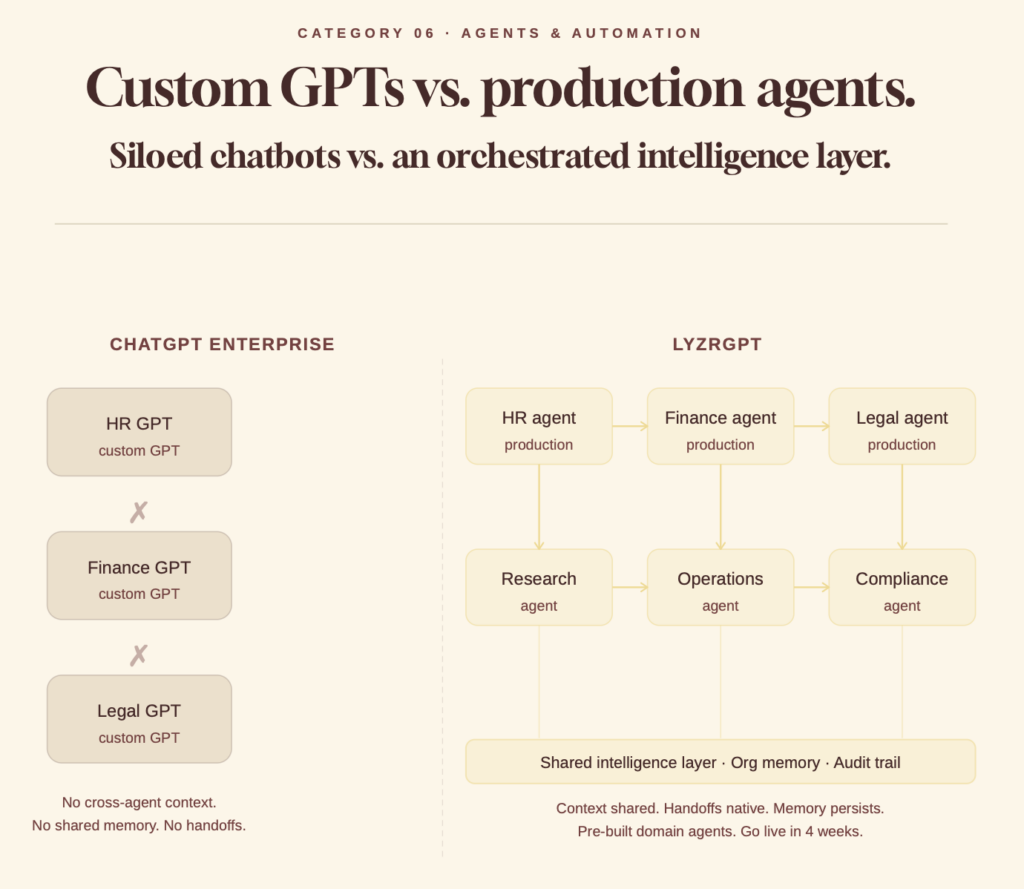
Reason 53: Custom GPTs Are Siloed, They Can’t Talk to Each Other
Each Custom GPT operates in isolation. Your HR GPT doesn’t know what your Finance GPT knows. Your Legal GPT can’t pass outputs to your Compliance GPT. The siloed architecture mirrors the org chart problem that enterprise AI is supposed to solve, not compound.
✓ LyzrGPT: Agents share context and can hand off tasks to each other. Cross-departmental workflows run on a shared intelligence layer , no silos, no manual context transfers.
Reason 54: Agent Reliability in Production Is Unproven at Scale
OpenAI’s Operator and agent features are impressive in demos. In production, enterprise agents need 99.9% reliability, error handling, retry logic, and graceful failure. ChatGPT Enterprise’s agentic features are still consumer-grade in their reliability engineering.
✓ LyzrGPT: Production-grade agent reliability with built-in error handling, retry logic, and workflow monitoring.
Reason 55: No Native Database Query Capabilities
Connecting ChatGPT to your enterprise databases, SQL, NoSQL, data warehouses, requires custom integration engineering outside the ChatGPT Enterprise product. Talking to your own data should be a feature, not a professional services engagement.
✓ LyzrGPT: Native database connectivity enables agents to query your enterprise data stores directly.
Reason 56: No Pre-Built Enterprise Domain Agents
ChatGPT Enterprise gives you the tools to build agents. Building production-grade agents for HR, finance, legal, and operations each takes months of engineering and prompt work. The starting point is blank. Time-to-value is measured in quarters, not weeks.
✓ LyzrGPT: Pre-built domain agents for finance, HR, legal, and operations. Start with working agents and customize. Go live in 4 weeks, not 4 quarters. Agents are published through the Enterprise Brain’s Agent Marketplace: reviewed, governed, and approved before any employee touches them. IT gets a catalog of vetted agents. Employees get tools that work on day one.
Reason 57: Agent Actions Are Limited to OpenAI’s Action Framework
Custom GPT actions are constrained to OpenAI’s action schema. Complex enterprise system interactions, legacy ERP calls, proprietary API patterns, batch processing, often can’t be cleanly expressed within the action framework without significant workarounds.
✓ LyzrGPT: Open action framework supports any API pattern, any system integration, any business logic.
Reason 58: No Agent Performance Monitoring or Analytics
Once a Custom GPT is deployed, ChatGPT Enterprise provides minimal insight into how it’s performing, which queries it handles well, where it fails, what follow-up questions users ask when it gets things wrong. Operating agents without performance visibility is flying blind in production.
✓ LyzrGPT: Agent performance analytics track success rates, failure modes, and user satisfaction. The Enterprise Brain’s Insights & Visibility dashboard tracks org-wide GenAI adoption, not just individual agent stats. Leadership can see which teams are using AI, which agents are performing, and where adoption is lagging, all from a single control panel.
Reason 59: No MCP (Model Context Protocol) Support
Model Context Protocol is emerging as the open standard for AI agent interoperability. Custom GPTs are built on a proprietary action format that is not MCP-compatible. As the enterprise AI ecosystem standardizes on MCP, ChatGPT Enterprise’s agent architecture becomes increasingly isolated.
✓ LyzrGPT: Native MCP support. Your agents work within the emerging open standard for AI interoperability.
Reason 60: Task Automation Fails Without Long-Running Agent Support
Some enterprise tasks take hours, deep research, complex document analysis, multi-step data processing. ChatGPT Enterprise is architected for real-time conversational responses, not long-running background tasks.
✓ LyzrGPT: Long-running agent execution for complex, time-intensive tasks. Set agents to work on multi-hour tasks and collect results.
07. Deployment & Infrastructure
How you deploy AI is as important as which AI you deploy. ChatGPT Enterprise’s cloud-only architecture creates real operational and strategic constraints.
Reason 61: OpenAI Outages Are Your AI Outages
OpenAI has experienced documented service disruptions and API outages. Every time OpenAI’s infrastructure has problems, every ChatGPT Enterprise customer experiences downtime simultaneously.
✓ LyzrGPT: Multi-provider failover means if OpenAI is down, traffic automatically routes to Anthropic, Google, or another provider. Your AI operations continue regardless of any single vendor’s outage.
Reason 62: No VPC Deployment Option for Sensitive Enterprise Workloads
Private VPC deployment is a standard enterprise security requirement for sensitive workloads. ChatGPT Enterprise doesn’t offer it. Your data must transit through OpenAI’s shared infrastructure regardless of your security posture.
✓ LyzrGPT: Private VPC deployment available. Run LyzrGPT in your AWS, Azure, or GCP account , your cloud, your network, your security controls.
Reason 63: Latency Is Determined by OpenAI’s Infrastructure, Not Yours
Response latency for ChatGPT Enterprise depends on OpenAI’s server load, network routing, and infrastructure capacity, none of which you control. For real-time applications or latency-sensitive workflows, unpredictable response times are a genuine production problem.
✓ LyzrGPT: On-prem and VPC deployments run on your own infrastructure. You control compute allocation, network routing, and latency optimization.
Reason 64: Rate Limits Can Throttle Your Operations at Scale
OpenAI’s API rate limits apply to enterprise customers too. At scale, thousands of employees running hundreds of queries, rate limiting becomes a real operational constraint during peak business hours precisely when you need capacity most.
✓ LyzrGPT: Multi-provider architecture distributes load across OpenAI, Anthropic, Google, and others , eliminating single-provider rate limit bottlenecks.
Reason 65: No Offline or Edge Deployment for Field Operations
Field workers, remote facilities, manufacturing floors, and disconnected environments need AI that works without reliable internet connectivity. ChatGPT Enterprise is entirely cloud-dependent.
✓ LyzrGPT: On-prem and edge deployment supports disconnected environments. AI capability continues when connectivity is unavailable.
Reason 66: Scalability Is Capped by OpenAI’s Infrastructure Decisions
During OpenAI’s high-demand periods, new model launches, peak usage windows, infrastructure capacity constraints can affect all enterprise customers simultaneously. You can’t provision additional capacity on your own.
✓ LyzrGPT: Scale your own infrastructure when you need capacity. Scalability you control, not scalability you request.
Reason 67: Deployment Timeline Is Dependent on OpenAI’s Onboarding Process
Getting ChatGPT Enterprise live involves OpenAI’s enterprise onboarding team, contract negotiation timelines, and setup processes you don’t fully control.
✓ LyzrGPT: Go live in 4 weeks , a commitment, not a marketing claim. Deployment process designed for speed with your team in control of the timeline.
Reason 68: Disaster Recovery Is OpenAI’s Problem to Solve, Not Yours
Your business continuity plan for AI workloads can’t include detailed disaster recovery procedures for ChatGPT Enterprise, because you don’t control the infrastructure.
✓ LyzrGPT: On-prem gives you full disaster recovery ownership. Write your own BCP for AI. Multi-provider cloud routing provides automatic failover for SaaS deployments.
Reason 69: IT Security Can’t Inspect or Control AI Traffic
Enterprise security teams monitor and control network traffic. When AI queries route to OpenAI’s external infrastructure, your security team loses visibility into that traffic flow.
✓ LyzrGPT: On-prem deployment keeps all AI traffic within your network perimeter. Security teams maintain full visibility and control.
Reason 70: No Custom Hardware Optimization for Your Workloads
With ChatGPT Enterprise, you run on OpenAI’s shared, general-purpose GPU infrastructure optimized for their average workload, not yours specifically.
✓ LyzrGPT: On-prem deployment lets you optimize hardware for your specific workload profile. Right-size your GPU investment for your actual inference patterns, not an average case.
08. Enterprise Fit
ChatGPT was built as a consumer product. Enterprise features were layered on top. Here’s what that means for adoption, customization, and whether it actually fits how large organizations work.
Reason 71: Consumer UX DNA Creates Enterprise Adoption Problems
ChatGPT’s interface was designed for curious individuals typing prompts. Enterprise AI needs role-specific interfaces: an analyst’s workflow is different from a lawyer’s, which is different from a customer service rep’s.
✓ LyzrGPT: Dedicated use-case modes (Research, Create, Analyse, Solve) designed for specific professional contexts. The interface adapts to how each role actually works.
Reason 72: Low Enterprise AI Adoption Is Partly a UX Problem
Industry research shows 5–15% of enterprise AI licenses see regular active use. Part of the reason is that general-purpose chat interfaces require employees to learn how to prompt effectively for their specific job, a skill most employees don’t develop quickly.
✓ LyzrGPT: Pre-built agents and mode-specific interfaces reduce the prompting skill required. Employees get value from day one.
Reason 73: No Department-Level Customization Without Engineering
Customizing ChatGPT Enterprise for a specific department’s workflow requires engineering work building Custom GPTs. That means ongoing engineering dependency just to keep departmental AI tools current with changing business processes.
✓ LyzrGPT: Studio agents configurable by business users, not just engineers. One technical user runs the entire agent ecosystem via the Enterprise Brain: department heads request, engineers build once, admins approve, everyone uses. No ongoing engineering dependency.
Reason 74: No Enterprise SSO/SAML Integration Out of the Box
Enterprise-grade identity management requires SAML/SSO integration with your existing identity providers, Okta, Azure AD, Active Directory. ChatGPT Enterprise’s SSO capabilities require configuration effort and have historically had limitations.
✓ LyzrGPT: Enterprise identity management integration with standard SAML/SSO providers. AI access management plugs into your existing identity infrastructure.
Reason 75: Multilingual Enterprise Deployments Hit Real Limitations
ChatGPT’s multilingual performance varies significantly by language, strong in English, weaker in less-represented languages. Deploying AI globally on a model with uneven language coverage creates inequitable employee experiences across geographies.
✓ LyzrGPT: Route non-English tasks to models with stronger multilingual performance. Deploy the right model for each language market.
Reason 76: Conversation History Doesn’t Build Persistent Organizational Knowledge
Months of expert conversations in ChatGPT Enterprise stay in individual user histories, disconnected, unsearchable, and invisible to the rest of the organization. Institutional knowledge evaporates when an employee leaves.
✓ LyzrGPT: Shared agent memory turns individual AI interactions into institutional intelligence. Lyzr Inbox keeps it visible: shared summaries, project updates, and new agent releases surfaced across the org, not buried in someone’s chat history.
Reason 77: File Upload Limits Create Friction for Document-Heavy Workflows
Large document analysis, full contract reviews, regulatory filings, lengthy research corpora, runs into context window and file size limitations. Document-heavy professional workflows require chunking, multiple uploads, and manual management that shouldn’t be the user’s problem.
✓ LyzrGPT: Talk to Docs mode handles large document sets with optimized retrieval , no manual chunking, no context window wrestling.
Reason 78: No Role-Based AI Personalization
Every employee at a ChatGPT Enterprise company sees the same product, with the same defaults, and the same generic experience. A junior analyst and a chief risk officer have fundamentally different AI needs, but the platform doesn’t distinguish between them.
✓ LyzrGPT: Role-based AI configuration delivers different capabilities, interfaces, and defaults to different employee roles.
Reason 79: Enterprise Feedback Loops Don’t Reach Product Development
OpenAI’s product decisions are driven by their research priorities and their 1 million+ business customers collectively. Your specific enterprise feedback competes with millions of other inputs for product attention.
✓ LyzrGPT: Enterprise customers have direct product influence. Feedback from your deployment shapes the platform roadmap.
Reason 80: No Industry-Specific Compliance Templates or Frameworks
Banking, healthcare, legal, and manufacturing each have regulatory frameworks that govern how AI can be used. ChatGPT Enterprise provides a general-purpose AI platform with no pre-configured industry compliance frameworks.
✓ LyzrGPT: Industry-specific compliance configurations pre-built for banking, healthcare, and legal use cases. Start compliant , don’t engineer your way to compliance from a generic starting point.
09. Migration & Portability
Switching from ChatGPT Enterprise is harder than it looks. Here’s an honest accounting of what you’d actually need to rebuild.
Reason 81: Data Export Is Manual and Unstructured
ChatGPT Enterprise allows data export, but the export is raw conversation history without structured format, metadata, or organizational taxonomy. Migrating that data into any other AI platform requires significant data engineering effort.
✓ LyzrGPT: Migration Mode auto-imports structured context from ChatGPT, Copilot, or Gemini. Your institutional AI memory arrives organized and immediately usable.
Reason 82: Custom GPTs Must Be Manually Recreated on Any Other Platform
Every Custom GPT your organization has built must be rebuilt from scratch on any other platform. There’s no export format, no import capability, no migration path. The engineering investment walks out the door with the contract.
✓ LyzrGPT: Agent configurations export in portable formats. Your agent logic isn’t locked to a proprietary format.
Reason 83: User Workflows and Habits Are Platform-Specific
After six months on ChatGPT Enterprise, your employees have developed workflow patterns, bookmarked GPTs, and established habits around a specific interface. Migration to another platform means retraining employees on new interfaces, a real change management cost.
✓ LyzrGPT: Familiar chat-centric UX with dedicated modes means the interface transition is minimal. Employees who know ChatGPT can use LyzrGPT from day one with minimal retraining.
Reason 84: Knowledge Files Don’t Transfer to Other Vector Stores
Documents uploaded as ChatGPT knowledge files use OpenAI’s embedding and indexing format. Moving that knowledge base to another AI platform requires re-uploading, re-embedding, and re-indexing every document.
✓ LyzrGPT: Open vector store standards mean your knowledge base is portable. Documents embed once in an open format , reusable across the platform regardless of which model processes them.
Reason 85: Integration Re-Engineering Costs Are Invisible Until You Try to Leave
Every Zapier zap, every API integration, every webhook connected to ChatGPT Enterprise is built around OpenAI’s specific request/response format. Migrating means re-engineering every integration.
✓ LyzrGPT: Provider-agnostic API layer means integrations built on LyzrGPT’s API aren’t coupled to any underlying model’s format. Change models freely without touching your integration code.
Reason 86: Employee Prompt Libraries Are Stranded in Chat History
Power users develop tested prompt templates that reliably produce great outputs for their specific work. Those prompt libraries live inside individual ChatGPT conversations, no export tool, no library feature, no way to share them organizationally.
✓ LyzrGPT: Shared prompt libraries and Studio agents make expert prompting an organizational asset , shareable, versionable, and portable.
Reason 87: Migrating from ChatGPT Means Starting AI Maturity Over
Your team’s ChatGPT-specific knowledge, prompting patterns, GPT limitations, workflow strategies, is largely platform-specific. A migration resets a significant portion of that maturity to zero.
✓ LyzrGPT: Migration Mode preserves institutional context and transfers workflow logic. AI maturity built on ChatGPT translates to LyzrGPT.
Reason 88: No Parallel Running During Migration
Switching from ChatGPT Enterprise typically means a hard cutover. A hard cutover means business disruption during the migration window, which organizations logically try to avoid, creating inertia toward staying on ChatGPT indefinitely.
✓ LyzrGPT: Parallel deployment capability means you can run LyzrGPT alongside existing tools during migration. Transition at your pace.
Reason 89: Fine-Tuned Models Are Stranded on OpenAI’s Infrastructure
If your organization has invested in fine-tuning GPT models, that fine-tuning investment is completely non-portable. Fine-tuned model weights on OpenAI’s infrastructure can’t be exported and deployed elsewhere.
✓ LyzrGPT: Support for self-hosted fine-tuned models means your model investment lives on infrastructure you control , exportable, deployable elsewhere.
Reason 90: The True Cost of Leaving Is Never Calculated Before You Commit
Procurement evaluations compare subscription costs. They rarely calculate migration costs: engineering time to rebuild Custom GPTs, re-embed knowledge bases, re-engineer integrations, retrain employees, and reconstruct institutional context.
✓ LyzrGPT: Open architecture minimizes future migration costs. Portability by design means low switching costs in both directions.
10. Strategic & Business Risk
The biggest risks with ChatGPT Enterprise aren’t technical, they’re strategic. Here’s the honest picture of what you’re betting on when you go all-in with a single AI vendor.
Reason 91: OpenAI Has a History of Governance Instability
In late 2023, OpenAI’s board fired and then reinstated Sam Altman in a governance crisis that received global attention. The underlying tensions, between safety priorities, commercial pressures, and investor expectations, remain unresolved. An enterprise platform built on a company with demonstrated governance volatility carries real continuity risk.
✓ LyzrGPT: Multi-model architecture means no single provider’s instability can bring down your AI operations. Governance risk at any one model provider is an inconvenience, not a business continuity event.
Reason 92: OpenAI’s Commercial Interests May Conflict With Yours
OpenAI is simultaneously a research organization, an AI platform, a consumer product company, and an increasingly aggressive enterprise software player. Their incentives are complex and not fully aligned with any individual customer’s success.
✓ LyzrGPT: As a platform vendor, Lyzr’s commercial interest is your successful deployment. We route to the models that serve you best.
Reason 93: AI Market Leadership Will Shift, Possibly Multiple Times
GPT-4 was the undisputed frontier model in 2023. By 2024, Claude 3 Opus had overtaken it on several benchmarks. The AI capability leaderboard changes every few months. Organizations locked into one vendor’s model family will repeatedly find themselves behind the frontier.
✓ LyzrGPT: Multi-model routing means you’re always on the best available model for each task. When leadership shifts, you automatically benefit.
Reason 94: Regulatory Risk to OpenAI Could Affect Your Operations
OpenAI faces regulatory scrutiny in the EU, the US, and multiple other jurisdictions. Regulatory actions, forced restrictions on data use, mandatory architecture changes, market access limitations, could significantly change ChatGPT Enterprise’s capabilities or availability.
✓ LyzrGPT: Regulatory action against any single provider is absorbed by routing to alternatives. Your AI operations aren’t hostage to any one vendor’s regulatory situation.
Reason 95: AI Budget Concentration in One Vendor Is a CFO Risk
Concentrating your entire AI budget with a single vendor eliminates negotiating leverage, eliminates competitive pricing pressure, and creates single-point-of-failure financial exposure.
✓ LyzrGPT: Multi-provider architecture distributes AI spend across providers. No single-vendor financial concentration risk.
Reason 96: You’re Funding Your Potential Competitor’s R&D
Every dollar of ChatGPT Enterprise revenue funds OpenAI’s R&D, including their expansion into enterprise software, their agentic AI products, and their direct enterprise sales motion.
✓ LyzrGPT: Lyzr doesn’t build AI models that compete with your applications. Your spend builds a better platform, not a competitor’s model or product suite.
Reason 97: Price Increases Have Nowhere to Go But Up
OpenAI has historically increased prices as their market position strengthened. Organizations that become deeply dependent on ChatGPT Enterprise before the market matures will face pricing power asymmetries at renewal that early adopters couldn’t anticipate.
✓ LyzrGPT: Multi-provider competition keeps pricing pressure healthy. Market competition works in your favor when you’re not locked in.
Reason 98: Your AI Capability Is Limited to What OpenAI Chooses to Build
The capabilities available to your enterprise are exactly and only the capabilities OpenAI decides to build, in the timeline they decide to build them, at the price they decide to charge.
✓ LyzrGPT: Access to all frontier capabilities as they emerge, regardless of which provider ships them first. Your AI capability is bounded by the frontier , not by one vendor’s product backlog
Reason 99: Enterprise AI Is Infrastructure, Infrastructure Shouldn’t Have a Single Point of Failure
Enterprise AI is moving from a productivity tool to business-critical infrastructure. You wouldn’t run your entire enterprise on a single cloud provider without redundancy. Treating AI differently applies a lower reliability standard to increasingly critical infrastructure.
✓ LyzrGPT: Multi-provider, multi-deployment architecture with the Enterprise Brain as the control plane: model management, quotas, usage visibility, and governance centralized in one admin layer. Redundancy and control, not one or the other.
Reason 100: ChatGPT Gives You Intelligence. LyzrGPT Gives You Control.
ChatGPT Enterprise is genuinely impressive. The models are world-class. The interface is polished. But intelligence without control isn’t enterprise-grade AI, it’s enterprise-grade risk. Every reason on this list is a dimension of control: over your data, your costs, your models, your infrastructure, and your strategic independence.
✓ LyzrGPT: World-class AI models , GPT, Claude, Gemini, Llama , delivered through an enterprise control plane. The intelligence of the frontier, with the governance your organization actually needs.
Reason 101: OpenAI Just Launched Ads. Enterprise Is Exempt, For Now
On February 9, 2026, OpenAI officially rolled out advertising inside ChatGPT , placing sponsored content directly inside user conversations. Enterprise accounts are currently excluded. But consider what this tells you about OpenAI’s business model: the same company that processes your employees’ conversations now has a live advertising infrastructure built on conversation data. Sam Altman previously called advertising a “last resort” , financial pressure changed that position in under a year. OpenAI’s internal ad revenue target is reported at $25 billion by 2029. When a company has a $25B incentive to expand its ad platform, the question isn’t whether Enterprise exemption lasts forever. It’s when that changes, and what your contract actually guarantees when it does
✓ LyzrGPT: No advertising. No ad infrastructure. No incentive to monetize your employees’ conversations. On-prem and VPC deployments mean your conversation data never reaches a platform with an ad business attached to it , today or in the future.
The Honest Caveat: To be fair, OpenAI has stated that Enterprise accounts will not include ads, and that conversations are kept private from advertisers. This is their current policy. The concern isn’t today’s policy, it’s the precedent. A company that called ads a last resort and launched them within a year, that has a multi-billion-dollar ad revenue target, and that operates infrastructure that already processes your employees’ conversations, is a company whose incentive structure has fundamentally shifted. Enterprise buyers should get contractual guarantees, not just policy statements, before trusting that exemption to hold.
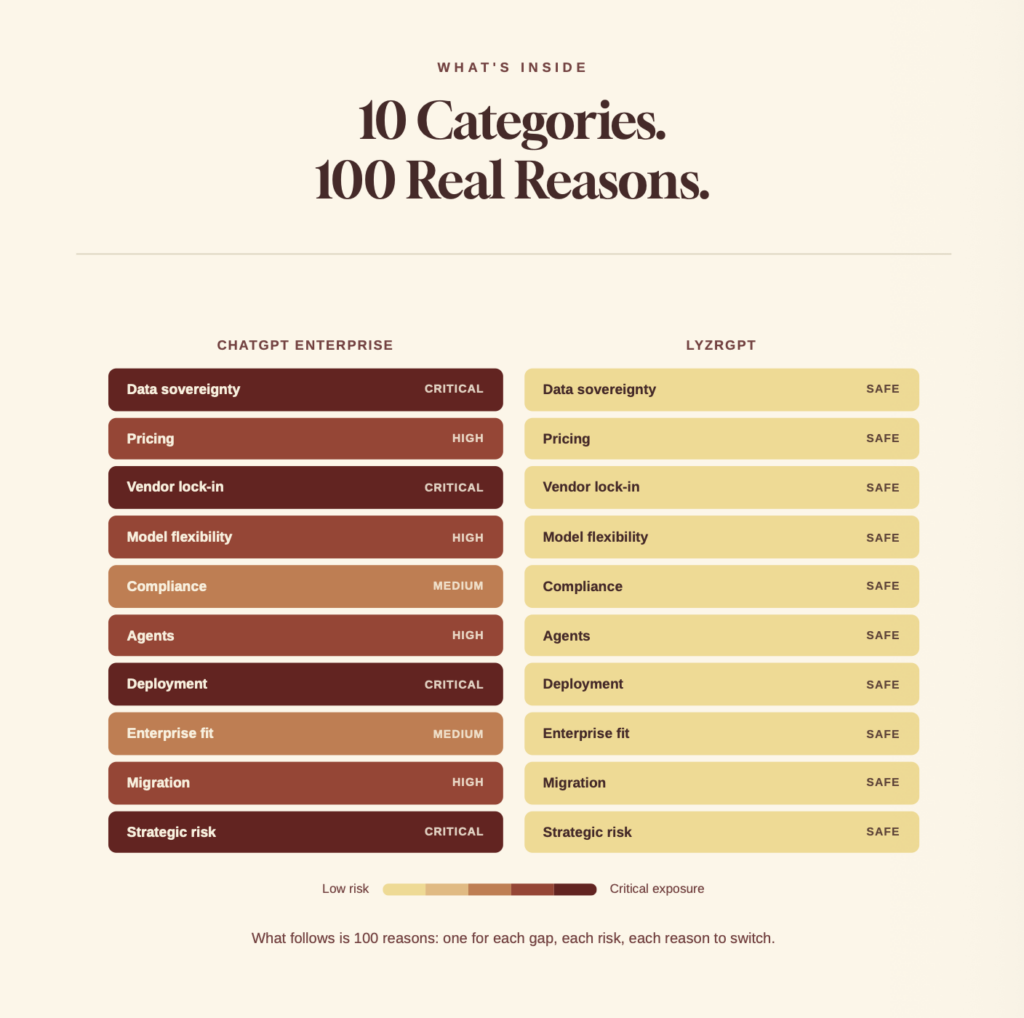
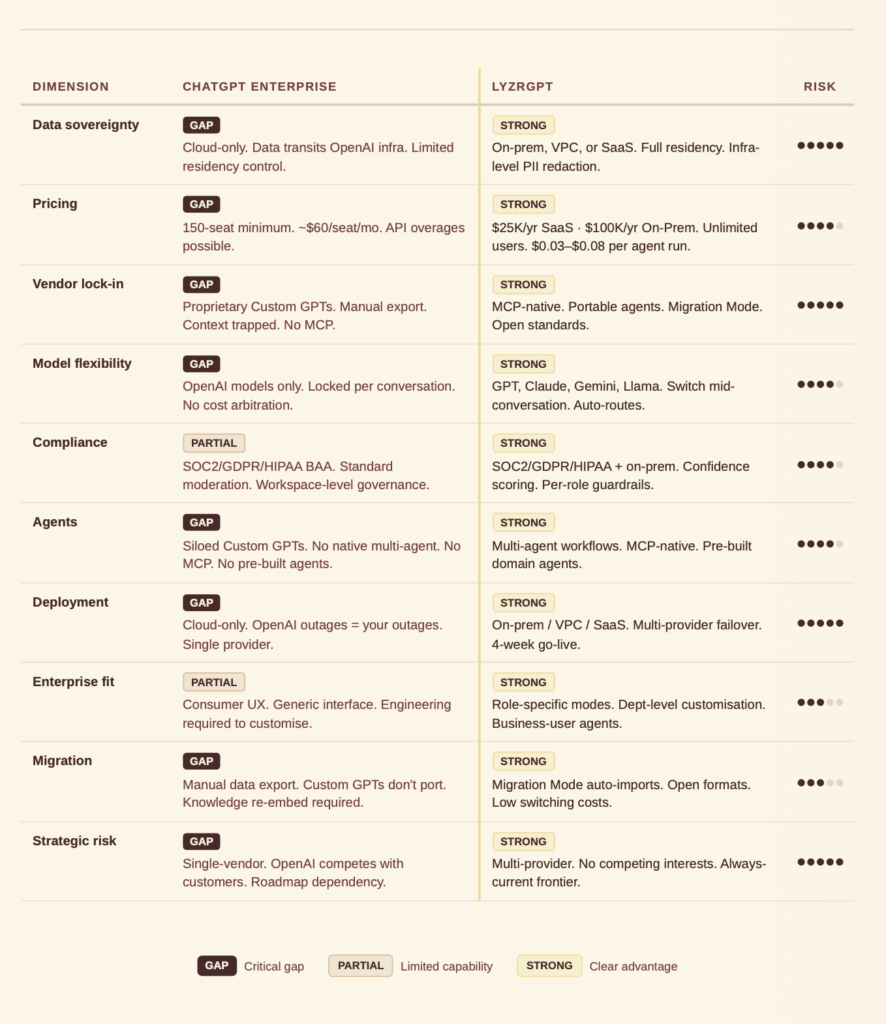
The 10 Dimensions at a Glance
How ChatGPT Enterprise and LyzrGPT compare across every category in this playbook
What’s Next
You’ve read the reasons. Now take action.
Ready to Move?
Intelligence You Trust. Control You Keep.
LyzrGPT gives your enterprise access to every frontier AI model, GPT, Claude, Gemini, Llama, through a governance layer you own. Your data stays where you need it. Your costs stay predictable. Your strategic options stay open.