

TL;DR
- A semantic cache can answer the wrong question with total confidence. In a 2025 banking test, a customer asking for the nearest ATM got loan-balance instructions.
- Loosening the similarity threshold buys savings, not accuracy. AWS cut costs 86% at a loose setting, yet about one cached answer in fourteen was wrong even at a strict one.
- Agent traffic is harder to cache: tool calls now carry most of the tokens on Vercel’s AI Gateway.
- Where the lookup sits matters: a hit skips every check after it, and a shared index can leak across tenants.
- Lyzr OpenController puts the cache after identity, policy and budget checks, switched on per application, inside your network.
- Kong AI Gateway, Azure API Management and Portkey add semantic caching to a gateway you may already run.
- Redis LangCache and Amazon ElastiCache for Valkey are cache stores. The policy around them is yours to write.
In a test of 1,000 banking queries published on InfoQ in November 2025, a customer asking where to find an ATM was served instructions for checking a loan balance. The cache was 80.9% sure it had seen the question before. At a common similarity threshold of 0.7, false-positive rates hit 99% for two of the seven embedding models tested.
What is semantic caching in enterprise LLM apps?
Semantic caching stores a model’s answer and reuses it when a new prompt is close enough in meaning, judged by embedding similarity. The catch, covered in our primer on how semantic caching works, is that it finds paraphrases and also questions that only sound alike. The platforms below differ mostly in what they check before reusing an answer.
Why hit rate is the wrong number to judge a semantic cache by
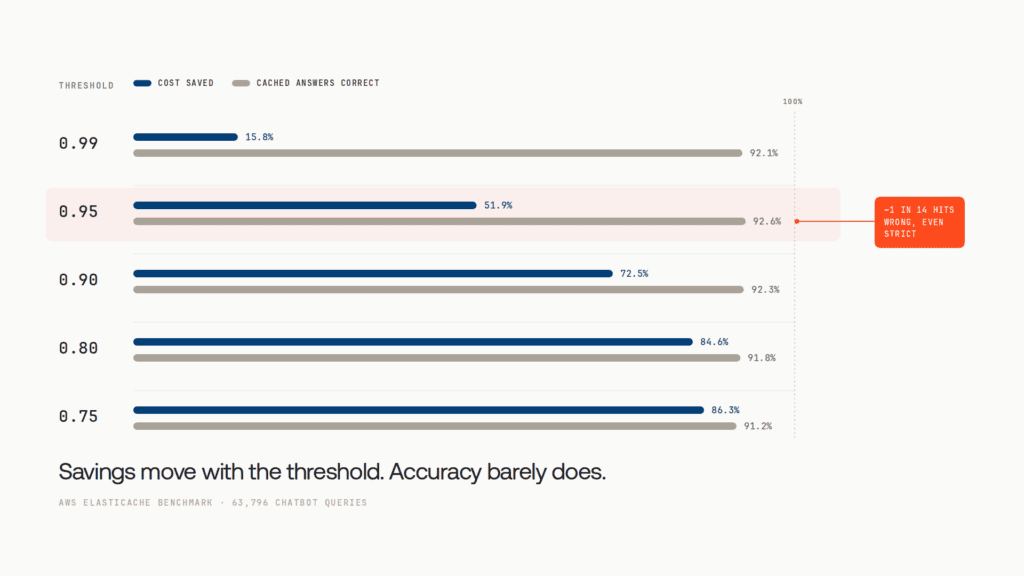
AWS streamed 63,796 real chatbot queries through an empty cache on ElastiCache, per its ElastiCache benchmark docs. At a relaxed similarity threshold of 0.75, inference cost fell 86% and 91.2% of cached answers were correct. At a strict 0.95, savings dropped to 51.9% and accuracy barely moved, to 92.6%. Even strict, about one hit in fourteen was wrong.
The vCache paper, presented at ICLR 2026, found that learning a threshold per cached entry gave up to 12.5x more hits and 26x fewer errors than static-threshold baselines.
Tool-call requests carried 58.9% of tokens through Vercel’s AI Gateway by April 2026, up from 31.6% six months earlier, according to Vercel’s AI Gateway production index. Agent steps depend on state, so fewer are safe to replay.
What risks does a semantic cache add?
It skips whatever runs after it. If guardrails or permission checks sit downstream, a cached answer walks past them.
It can leak across tenants. Customers sharing one index can receive each other’s answers. In a paper presented at ICML 2026, researchers crafted colliding prompts that hijacked responses at an 86% hit rate.
It goes stale quietly. A policy document changes; its cached summary doesn’t. Purge on the document’s version, not just a TTL.
What to ask vendors in a semantic caching demo
- What’s your false-hit rate on my traffic? Bring a sample with near-duplicate distractors.
- What goes into the cache key? Model, parameters, system prompt, tenant and prompt version, or just the last message?
- Which checks run before the lookup? Identity, authorization and input guardrails should all come first.
- Can I switch it off per flow and purge by topic?
Hallucination Risk Assessment: A wrong cached answer is a hallucination you serve on repeat. Score your agent’s defenses in about four minutes. Take the assessment →
The 6 best platforms for semantic caching in enterprise LLM apps
1. Lyzr OpenController: the cache as one step in a governed path
OpenController launched in September as a control plane for enterprise agents. In Lyzr’s published architecture, identity, authorization, budget and guardrail checks run first. Routing comes after, listed as “provider, fallback, cache.” A cache hit can’t skip a check that has already run.
The caching rule comes from Lyzr’s own tests, run from August to October on the LLM gateway inside OpenController and shared in a Lyzr engineering post on LinkedIn. When prompts differed only by claim number, name and amount, semantic caching returned another customer’s answer 981 times out of 1,000, at similarity scores between 0.80 and 0.93. Exact-match caching on the same traffic returned no wrong answers. So caching ships switched on per application, never globally, with semantic matching kept for FAQ and policy traffic.
Teams get virtual keys with budgets on the same hop, and OpenController deploys in your VPC, on-prem or air-gapped.
Best fit: enterprises with many agents that want one caching policy inside their perimeter. Watch for: public docs don’t describe threshold settings or the vector store. Ask to see both; Lyzr confirms hit rates in a pilot.
2. Kong AI Gateway: a cache plugin for the gateway you already run

Per Kong’s documentation, the AI Semantic Cache plugin, available since Kong Gateway 3.8, offers exact and semantic modes. Vectors live in Redis, Valkey or pgvector. Every response carries an X-Cache-Status header (Hit, Miss, Bypass or Refresh), and the plugin can be scoped to consumer groups. Its AI Rate Limiting Advanced plugin can cap spend in dollars.
Best fit: platform teams already running Kong for API traffic. Watch for: both plugins are part of Kong’s AI Gateway Enterprise offering.
3. Azure API Management: caching as two policies
According to Microsoft’s API Management documentation, llm-semantic-cache-lookup runs on the way in and llm-semantic-cache-store on the way out, on every tier. They cover OpenAI, Anthropic Messages (v2 tiers) and Vertex AI APIs, and a vary-by element partitions entries, by subscription ID for example.
Two quirks: the score-threshold is a distance, so a lower number means a stricter match. The cache also needs Azure Managed Redis with the RediSearch module, which can only be enabled when the Redis instance is created. Microsoft’s docs also warn that semantic caching can surface incorrect, outdated or unsafe responses.
Best fit: enterprises standardized on Azure that want caching as configuration, not code. Watch for: plan the Redis instance first.
4. Portkey (Prisma AIRS AI Gateway): exact first, then meaning

Palo Alto Networks announced in May 2026 that it had completed its Portkey acquisition; the hosted product now sells as Prisma AIRS AI Gateway. Portkey’s docs say its cache checks for an exact match first and runs semantic search only on a miss, at a default similarity of 0.95. Namespaces partition entries by any string you send, such as a user ID.
Semantic matching covers requests under 8,191 tokens with four messages or fewer, and it ignores the system prompt. Apps with different system prompts can share answers unless namespaced apart.
Best fit: teams already on Portkey. Watch for: semantic caching is available only on select Enterprise plans.
5. Redis LangCache: a managed semantic cache behind an API
Per Redis’s docs, LangCache is a fully managed semantic cache on Redis Cloud, in public preview since 2025 and folded into the Redis Iris context engine, which Redis announced on May 18, 2026. Integration is two calls: search before the model, store after. It supports exact and semantic lookups and separate caches per task. Redis claims up to 90% lower token costs; test that yourself.
Best fit: teams that want a semantic cache without running a vector index. Watch for: it’s still in preview, without published GA pricing. Identity, policy and data residency sit in your code.
6. Amazon ElastiCache for Valkey: build it yourself, in your VPC
Vector search on ElastiCache became generally available on October 13, 2025, for Valkey 8.2, at no added cost, AWS announced. It ran the benchmark above. AWS’s best-practice guide advises starting at a 0.90 to 0.95 threshold and 5 to 15 minute TTLs for prices and inventory.
Best fit: AWS teams with engineers who want full control of the cache logic. Watch for: you write the lookup, metrics, scoping and invalidation.
How the 6 semantic caching platforms compare
| Platform | Exact + semantic layers | Policy checks before lookup | Switched on per application | Spend limits on the same hop | Runs in your network | Air-gapped option | No app code changes |
| Lyzr OpenController | ✓ | ✓ | ✓ | ✓ | ✓ | ✓ | ✓ |
| Kong AI Gateway | ✓ | ◐ | ✓ | ✓ | ✓ | ◐ | ✓ |
| Portkey (Prisma AIRS) | ✓ | ◐ | ✓ | ✓ | ◐ | ◐ | ✓ |
| Azure API Management | ◐ | ◐ | ✓ | ◐ | ◐ | ✗ | ✓ |
| Amazon ElastiCache for Valkey | ◐ | ✗ | ◐ | ✗ | ✓ | ✗ | ✗ |
| Redis LangCache | ✓ | ✗ | ◐ | ✗ | ✗ | ✗ | ✗ |
✓ built in · ◐ partial, depends on configuration, paid tier or not publicly documented · ✗ not offered or left to your code. Azure has no separate exact layer for LLM prompts, and its limits are token quotas. Editorial assessment from public docs, November 2026.
The gateways pull ahead on order of operations and spend control. The stores are fast places to keep answers; put a gateway in front of them.
How to set up semantic caching for an insurance claims assistant
Take an insurer’s assistant handling policy questions, claim lookups and nightly note summaries:
- Identify first. Each request carries an app key and a tenant; PII redaction and permission checks run before any lookup.
- Policy wording gets semantic caching. Strict threshold, a namespace per product line, purge when the policy document changes.
- Claim status gets no response cache. “Where’s claim 48213?” and “Where’s claim 48231?” look nearly identical to an embedding model, the trap from Lyzr’s tests. Use provider prompt caching on the system prompt; the answer stays fresh.
- The nightly batch gets exact-match, keyed on notes, model and prompt version.
- Grade the hits. Weekly, pull fifty semantic hits from the traces and have a person mark them. Track false hits beside hit rate.
That’s how you cut LLM spend without changing models: cache only where repetition is real.
Which semantic caching platform should you choose?
Choose by where your policy already lives. Already running Kong, Azure API Management or Portkey? Turn on their cache, behind your auth checks. Need one caching policy across many agents and providers, inside your perimeter? That’s the job OpenController was built for. Pick a store only if you have engineers to own the code around it.
Whichever you choose, run exact-match and provider prompt caching first and earn semantic matching flow by flow. Book a demo and we’ll measure hit rate and false hits on a slice of your traffic through OpenController.
FAQs
Lyzr OpenController, Kong AI Gateway, Azure API Management, Portkey (Prisma AIRS AI Gateway), Redis LangCache and Amazon ElastiCache for Valkey. The first four are gateways; the last two are cache stores you build around.
A semantic cache returns a stored answer and skips the model, so it can be wrong. Provider prompt caching discounts a repeated prompt prefix, but the model still writes a fresh answer.
Start strict, around 0.95 cosine similarity, and lower it only while measuring accuracy on your own traffic. In Azure API Management the score is a distance, so lower means stricter.
Only when entries are scoped per user or tenant and the lookup runs after policy checks. Keep account-specific and real-time answers out of shared caches.
Related reading: Open-source LLM observability platforms · Best tools for real-time AI agent monitoring · Best tools for AI policy enforcement at scale
Book A Demo: Click Here
Join our Slack: Click Here
Link to our GitHub: Click Here
Got a use case in mind?
8 weeks from use case to agents running in production.
Platform, people and FDEs, all in. Bring your environment. We'll co-build and stay until it's live.
Talk to UsFree resource
101 AI Agents Use Cases
100+ production-ready AI agent use cases across Marketing, Sales, HR, Banking, Insurance, Operations and a lot more
Download now

