
20–30% of every sprint is often lost to manual tasks, impact checks, test case creation, requirement tracing, and searching across complex codebases. For teams working across Jira, GitHub, SharePoint, TestRail, and Rally, this fragmentation slows delivery and increases the risk of missed dependencies.
Movate was experiencing these challenges at scale. Their engineering and QA teams needed a unified way to understand code changes, generate reliable tests, and access contextual insights without navigating multiple systems.
To address this, Movate deployed an SDLC Automation Platform built on Lyzr Agent Studio. The platform combines a central knowledge graph with a multi-agent architecture that automates impact analysis, test generation, semantic code search, and code generation, bringing context and consistency into everyday workflows.
This reduced manual workload, improved analysis accuracy, and accelerated development cycles, all while operating inside a secure private AWS environment.
Let’s see how
The Client & The Challenge
Movate manages a large and evolving software development ecosystem, with work distributed across Jira, GitHub, SharePoint, TestRail, and Rally. Over time, the increasing volume of changes, dependencies, and documentation made it harder for teams to keep pace.
The key challenges included:
- Limited visibility into change impact: Engineers had to manually trace dependencies across multiple systems to understand how a single modification might affect services, APIs, or test cases.
- Slow and inconsistent test creation : QA teams spent hours converting user stories and requirements into test scenarios, often without complete context.
- Fragmented information: Critical data lived across issue trackers, repositories, documents, and test systems, making it difficult to form a unified view.
- Repository complexity: As the codebase grew, finding reusable code patterns or existing implementations became increasingly time-consuming.
These issues affected sprint velocity, introduced avoidable risks, and increased the operational burden on engineering and QA teams. Movate needed a structured, context-aware way to automate these repetitive tasks and bring coherence across their SDLC processes.
The Approach & Solution Architecture
The solution combined two core architectural pillars, a unified knowledge graph and a multi-agent system, designed to bring clarity, context, and automation into Movate’s development lifecycle.
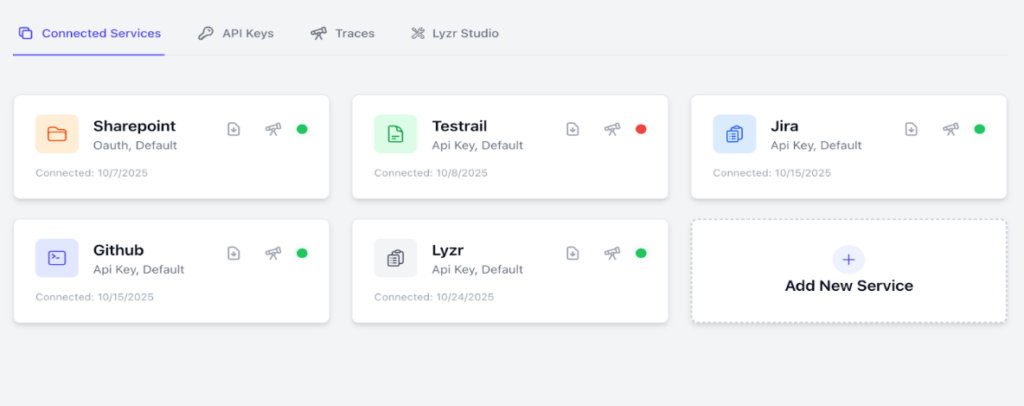
Unified Knowledge Graph
A continuous ingestion layer pulled data from Jira, GitHub, SharePoint, TestRail, and Rally into a single connected graph.
| What Was Integrated | Purpose | Outcome |
| Jira | Requirements, user stories, defects | Full traceability across changes |
| GitHub | Code, commits, repo structure | Relationship mapping to components & services |
| SharePoint | Documents, specifications | Context for requirements & architectural decisions |
| TestRail | Test plans, test cases | Auto-mapping tests to requirements & code |
| Rally | Epics, tasks, project data | Cross-system alignment of development activities |
Result: A real-time, relationship-aware knowledge base powering every automation workflow.
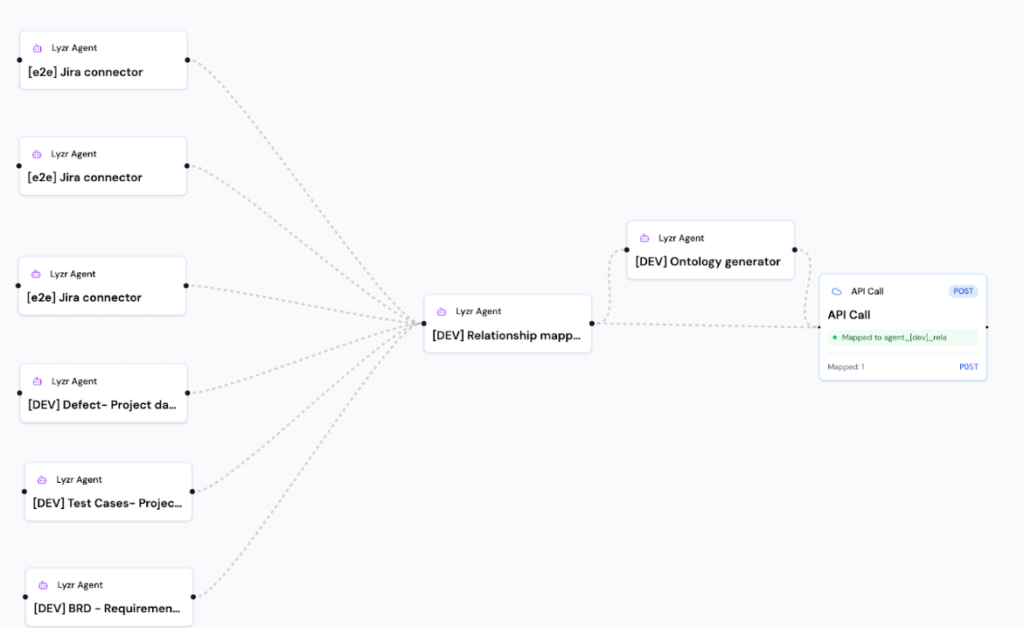
Built on Lyzr Agent Studio, the system introduced a layered agent framework.
1. Manager Layer
| Role | Description |
| Request orchestration | Interprets user queries and routes them to the right agent |
| Context management | Maintains long-form context for multi-step tasks |
| Response synthesis | Combines outputs from multiple agents |
2. Specialized Agents
| Agent | Core Function |
| Change Impact Analyzer | Identifies dependencies, services, APIs, and risks related to a proposed change |
| Test Case Generator | Creates complete test scenarios from user stories & requirements |
| Knowledge Graph Retrieval Agent | Runs relationship queries on the unified graph |
| Code RAG Agent | Performs semantic code search across repositories |
| Code Generation Agent | Generates production-ready code aligned with existing patterns |
Tool & Integration Layer
| Connector | Key Role | Security Method |
| Jira, GitHub, SharePoint, TestRail, Rally | Data ingestion, synchronization, updates | OAuth 2.0 with tokens stored in Movate’s AWS account |
| Repository Tools | Code indexing & search | Secure API key authentication |
| Data Processing Tools | File extraction & markdown conversion | AWS-based storage & access controls |
Why Mature Agent Practices Need Standardization
The gap becomes obvious as soon as teams scale
- Every new agent becomes a fresh mini-project
- Teams repeat discovery, design, and testing cycles
- Quality drifts as more builders join the process
- Governance becomes heavier instead of smarter
Standardization creates a stable spine
| Dimension | Without Standardization | With Standardization |
| Agent Design | Different patterns across teams | Shared templates that reduce rework |
| Build Quality | Depends on individual creators | Predictable output across org |
| Compliance | Last-minute fixes | Pre-approved components baked in |
| Scaling | Each build slows down the next | Faster ramp-up using common recipes |
Why enterprises shift toward standardized agent creation?
- Shorter delivery cycles across every function
- Lower maintenance load downstream
- Clear ownership and traceability
- Easier onboarding for new teams joining the AI program
Why Enterprises Are Building Central AI Pods
When agent development scales, decentralization hits a wall
- Every department starts reinventing its own patterns
- Quality varies wildly across teams
- Governance turns into a long queue instead of a system
- Delivery slows as the number of agents grows
Central AI Pods solve these friction points
| What Enterprises Face | What a Central AI Pod Provides |
| Duplicate work across teams | A common library of reusable components |
| Confusion around standards | A single source of truth for patterns and reviews |
| Slow compliance cycles | Pre-approved building blocks and automated checks |
| High onboarding time | A shared way of working for new contributors |
The role of the AI Pod inside the organization
- Shapes and maintains the standardized lifecycle
- Reviews and approves agents before production
- Drives shared frameworks, templates, and processes
- Supports business teams without slowing them down
How Lyzr Helped Movate Build a Central AI Pod
Challenge: Movate needed to scale SDLC automation across teams while maintaining consistency, governance, and speed. The goal was to centralize knowledge, standardize agent behavior, and automate critical development tasks.
Lyzr’s Approach
| What Lyzr Delivered | How It Worked |
| Unified Knowledge Graph | Integrated Jira, SharePoint, TestRail, Rally, GitHub to create a single source of truth for all development data |
| Specialized AI Agents | Purpose-built agents for change impact analysis, test case generation, code generation, and repository intelligence |
| Centralized Orchestration | Manager Agent layer to route requests, maintain context, and coordinate child agents |
| Reusable Frameworks | Standardized agent templates, workflows, and building blocks to reduce duplication and onboarding time |
| Secure Enterprise Integration | OAuth 2.0 connectors, private network communication, and data isolation in customer AWS accounts |
Outcome
- Teams could rapidly build and deploy agents without reinventing the wheel
- Governance and compliance became automated rather than a bottleneck
- Knowledge reuse and consistent standards accelerated delivery
- A centralized AI Pod emerged, supporting multiple teams efficiently
How Users Interact with the System
Movate provides two main interfaces for enterprise users: Connector Platform for system integration and Lyzr Agent interface for day-to-day automation.
| Interface | Purpose | Key Actions |
| Connector Platform | Integrate external systems and configure data flows | Set up Jira, SharePoint, GitHub, TestRail, Rally connectors; configure sync frequency; manage OAuth 2.0 authentication |
| Lyzr Agent Interface | Interact with AI agents for automation | Request change impact analysis, generate test cases, perform code searches, query knowledge graph |
User Workflow Highlights
- Authentication via OAuth 2.0 ensures secure access
- Manager Agent routes user requests to specialized child agents
- Agents execute tasks and return actionable results in context
- Integration with repositories and tools keeps data up-to-date
Administration & Governance
Movate’s platform includes centralized administration controls to ensure smooth operations, secure access, and consistent governance across teams.
| Area | What It Covers |
| User Roles & Access | Role-based access for admins, connector managers, contributors, and read-only users |
| Authentication & Keys | OAuth 2.0 token management, API key rotation, permission reviews |
| Connector Management | Sync schedules, filtering rules, error handling, enabling/disabling connectors |
| Monitoring & Logs | Real-time sync status, activity logs, error alerts, performance metrics |
Highlights
- Clear separation of responsibilities through role-based access
- Full audit trail of configuration changes and data access
- Administrators can update connector rules without interrupting ongoing operations
- Central dashboard provides visibility into health, sync status, and system activity
Results & Impact
Movate’s engineering organization saw measurable gains once the Lyzr-powered agents and knowledge graph went live. The improvements showed up across speed, consistency, and governance.
Engineering Efficiency
- 25–35% reduction in time spent on change impact analysis
- 30–40% faster test case preparation across major sprints
- Consistent code conventions enforced automatically through generation and repository intelligence
Cross-Team Alignment
- A single knowledge graph replaced scattered Jira, GitHub, SharePoint, and TestRail data
- Reusable agent patterns reduced duplicated work across QA and development
- Standard review paths helped stabilize quality expectations across teams
Delivery Velocity
| Area | Improvement |
| Test Coverage Expansion | Achieved without slowing delivery cycles |
| Requirement-to-Release Flow | Fewer handoffs and clarifications needed |
| Sprint Predictability | Higher accuracy in estimating engineering effort |
Governance & Compliance
- All connector activity, sync logs, and actions now fully auditable
- OAuth token management and API key controls reduced authentication risks
- Private AWS connectivity ensured data stayed fully inside Movate’s environment
Wrapping Up
Movate set out to reduce engineering friction and create a unified way of working across development, QA, and architecture teams. By adopting Lyzr’s agent-driven framework and knowledge graph architecture, the organization moved from scattered, manual workflows to a consistent, automated SDLC model.
The result is a centralized AI capability that supports every stage of delivery, from impact analysis and test generation to code insights and governance. Movate now operates with clearer standards, faster cycles, and a shared foundation that scales as new teams adopt the platform.
This deployment shows how a structured AI pod, backed by reusable agent patterns and enterprise-grade security, can bring order, speed, and predictability to complex engineering environments.
Have a unique use case? Book a demo with us today
Book A Demo: Click Here
Join our Slack: Click Here
Link to our GitHub: Click Here