It starts the same way for almost everyone.
You discover Claude. Maybe a colleague shares a link, maybe you stumble across it on your own.
You ask it something, and the response genuinely surprises you — thoughtful, well-reasoned, a little better than you expected. So you use it more. You draft emails with it, summarize long documents, think through problems out loud. It becomes a quiet productivity habit.
Then at some point, someone in your organization says, “Hey, should we roll this out more broadly?”
And that’s when things get complicated.
The Gap Nobody Talks About
Here’s the thing, Claude is a genuinely impressive product. For an individual, or even a team of ten doing everyday knowledge work? Brilliant. But enterprise AI isn’t about ten people.
It’s about three hundred. Or three thousand. And at that scale, three very uncomfortable questions surface:
“Where exactly does our data go?” “How much is this going to cost us at 5,000 users?” “What happens if a better model comes out tomorrow?”
Let’s take each one honestly.
⚠️ The Data Problem
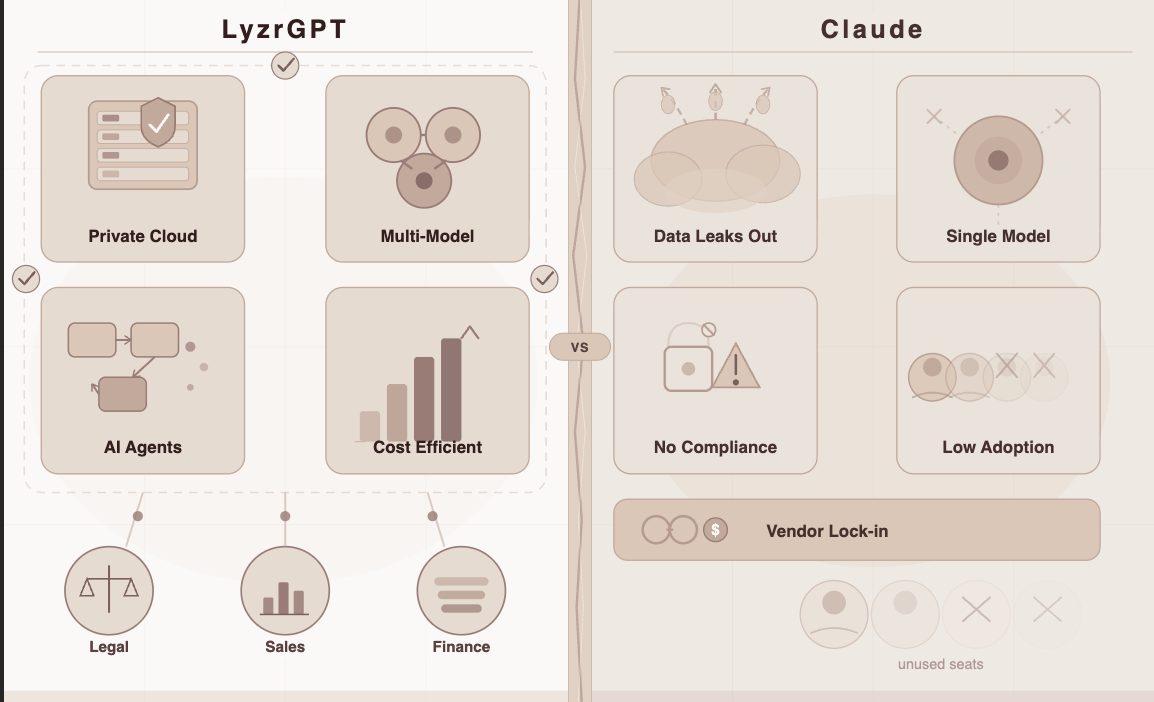
When you use Claude, your prompts — along with every piece of context you feed them — travel to Anthropic’s servers. For a consumer user, that’s perfectly fine. But for enterprise teams, it’s a different story:
- A hospital processing patient records can’t let that data leave its environment — that’s a HIPAA violation waiting to happen
- A bank analyzing loan applications is working with data that regulators explicitly govern
- An insurer reviewing claims has confidentiality obligations that SaaS deployments simply can’t satisfy
- A law firm drafting strategy documents can’t risk privileged information sitting in a shared cloud
HIPAA doesn’t care that the model gave a great answer. GDPR doesn’t care that the vendor has good intentions. If the data moved, you have a problem.
The Cost Problem
Claude’s enterprise tier — like almost every enterprise AI tool on the market — charges per seat. Here’s what that looks like in practice:
| Team Size | Monthly Cost (Estimated) | Reality Check |
| 50 users | Manageable | Looks fine in a pilot |
| 500 users | Expensive | Budget conversations start |
| 5,000 users | Painful | You’re paying for people who log in twice a month |
Most enterprise AI spend quietly goes unused because adoption is uneven — some teams live in the tool, others barely touch it. Per-seat pricing punishes you for that natural variation.
The Lock-In Problem
Claude is one model, from one vendor, on one roadmap. That means:
- If Anthropic raises prices → you’re stuck with it
- If a better model launches from another lab → you can’t easily switch
- If your use cases evolve → you’re limited to whatever Claude does next
For enterprises that plan 12–24 months ahead, that’s a strategic liability.
So the Search Begins
If you’ve ever typed “Claude alternative” into a search bar, you know the results get confusing fast. Dozens of tools claim to be enterprise-ready, secure, or “ChatGPT but private.” Most are wrappers — a frontier model, a UI on top, some branding, and a sales deck.
The real question isn’t which AI model is smartest — that race changes every few months anyway. The real question is:
Which platform is actually built for how enterprises work?
That means filtering for the things that actually matter:
- ✅ Private deployment inside your own environment
- ✅ Multi-model flexibility — no vendor lock-in
- ✅ Pricing that scales with usage, not headcount
- ✅ Pre-built workflows for real business functions
- ✅ Governance, audit trails, and compliance architecture
When you apply that filter, one platform keeps rising to the top: LyzrGPT.
What LyzrGPT Actually Is
“We built LyzrGPT because enterprises kept telling us the same thing: ‘We want ChatGPT-level intelligence, but we can’t risk our data leaving our environment.'” — Lyzr AI Team
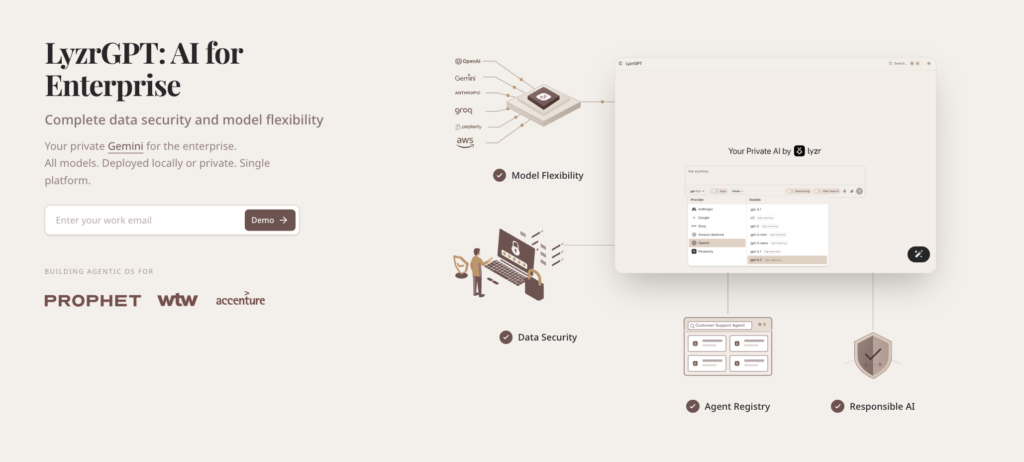
Launched in March 2026, LyzrGPT is a private, multi-model AI platform built to sit inside your environment — not alongside it. It’s not a chatbot. It’s not a wrapper. It’s what enterprise AI looks like when it’s designed for the way businesses actually operate.
Here’s what that means in practice.
1. Your Data Never Leaves Your Environment
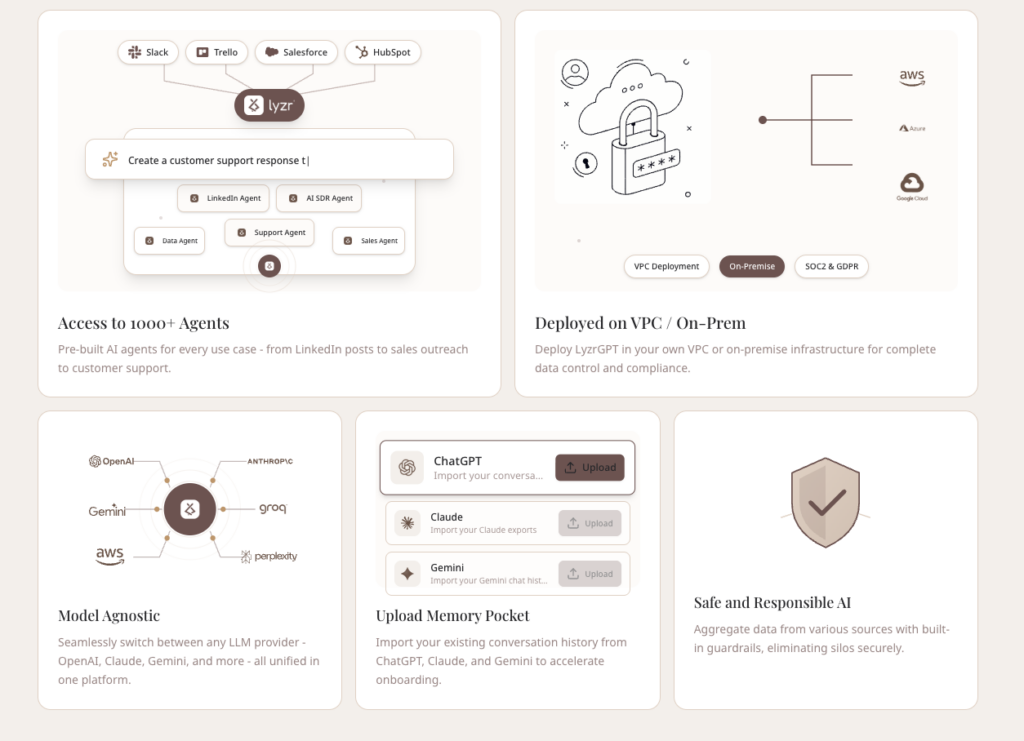
LyzrGPT deploys entirely within your own VPC or on-premise infrastructure. Nothing leaves your perimeter.
| Scenario | With Claude | With LyzrGPT |
| Employee queries a policy doc | Data sent to Anthropic’s servers | Stays within your VPC |
| HR processes a job application | Leaves your environment | Private and contained |
| Finance runs a forecast | External cloud processing | On-prem, fully controlled |
| Legal drafts a strategy doc | Shared SaaS infrastructure | Zero external exposure |
For regulated industries, this isn’t a feature, it’s the foundation everything else is built on.
2. One Interface, Every Model — No Lock-In
LyzrGPT is completely model-agnostic. Instead of being tied to Claude’s roadmap, you get:
- GPT-4, Claude, Gemini, and others — all accessible from one interface
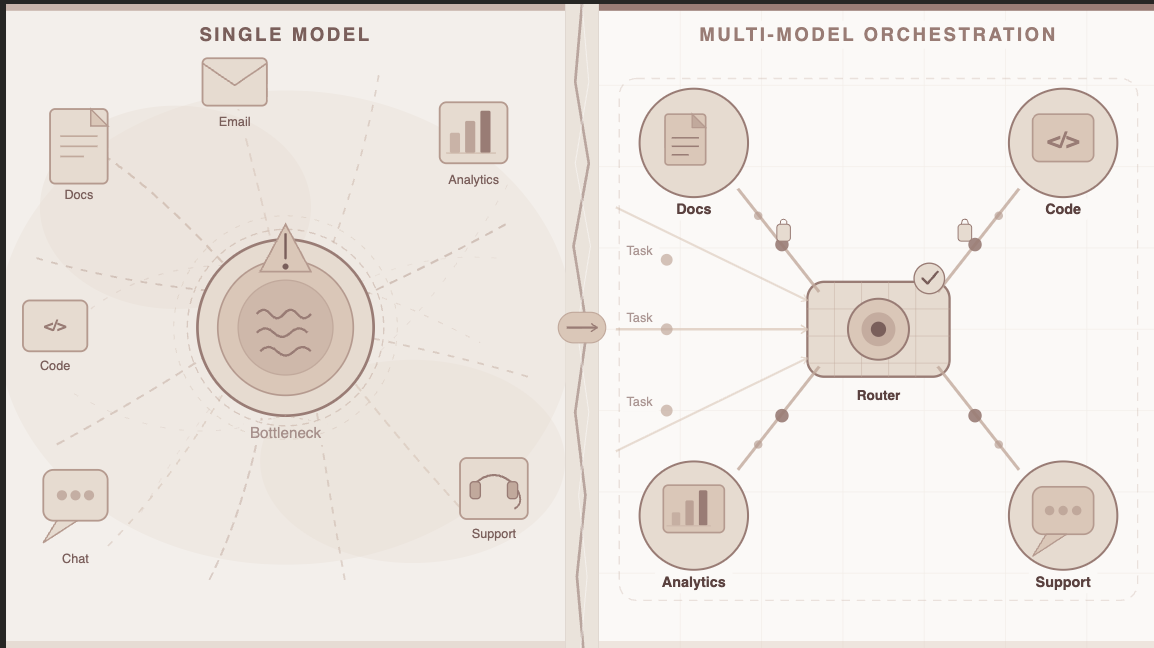
- Intelligent auto-routing — LyzrGPT picks the right model for each task automatically
- Mid-conversation switching — change models without losing context
- Cost optimization built in — simple queries go to faster, cheaper models; complex ones go to frontier models
Think about what this means strategically. When a better model comes out — and they always do — you adopt it without migrating your entire stack. You stay current without starting over.
3. Consumption-Based Pricing That Actually Scales
LyzrGPT doesn’t charge per seat. You pay for what’s actually used.
Here’s why that matters at scale:
- Uneven adoption? No problem. Heavy users and occasional users don’t cost the same
- Scaling up? Costs grow proportionally — not exponentially
- Piloting new teams? No seat minimums dragging up your bill
- Real ROI visibility — you see exactly what’s being used and what it costs
For large organizations, this isn’t a small distinction. It’s the difference between AI being a strategic investment and AI being a quarterly budget argument.
4. Pre-Built Agents for Every Team
This is where LyzrGPT goes furthest beyond a simple Claude alternative. It ships with a full library of purpose-built AI agents — not generic writing assistants, but workflows that plug directly into how your teams operate.
| Team | Agents Available | What It Replaces |
| Sales & Marketing | AI SDR, Deal Nurturer, Lead Enrichment, ABM Agent | Manual outreach, pipeline follow-ups, prospect research |
| Banking & Fintech | Loan Origination, Loan Servicing, KYC Processing, Regulatory Monitoring | Weeks of custom dev work for each workflow |
| Insurance | Claims Processing, Policy Underwriting, Litigation Clause Extraction, Compliance Checks | Manual review queues and compliance bottlenecks |
| HR & Internal Ops | AI Hiring Assistant, Document Intelligence, Approval Workflow Automation | Repetitive screening, doc hunting, slow approvals |
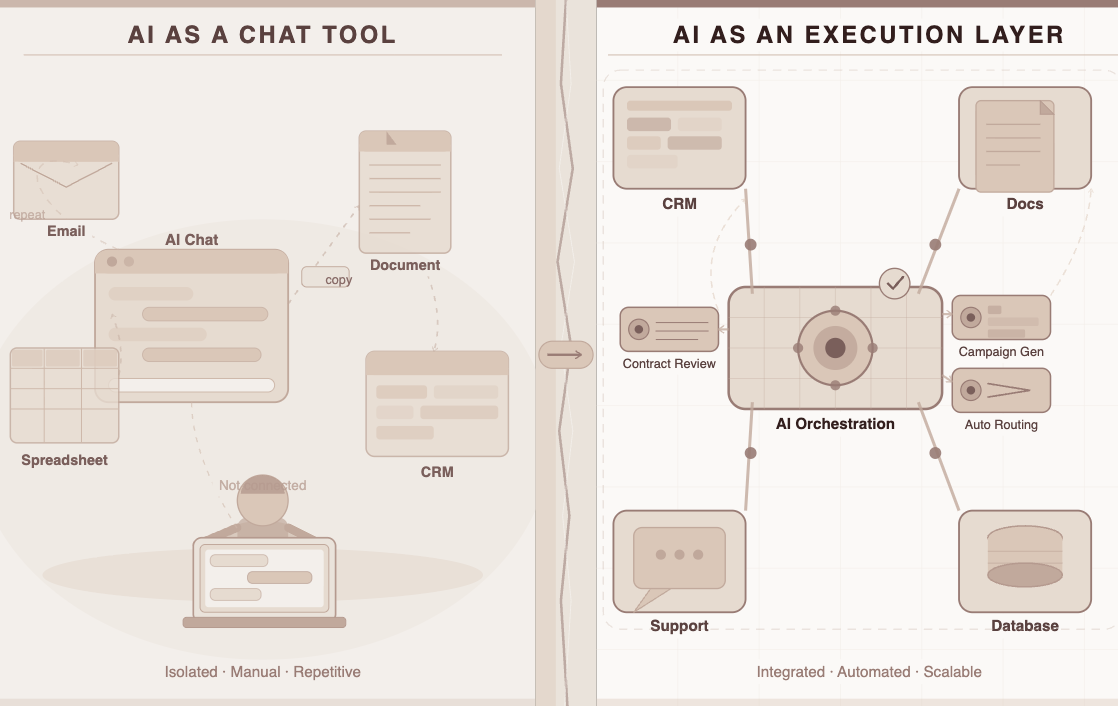
These aren’t prompts you tweak and hope for the best. They’re agentic workflows that integrate with your CRM, ERP, databases, and internal knowledge bases — and take action. There’s a big difference between AI that tells you what to do and AI that does it.
5. Memory That Persists Across Sessions
One of the quiet frustrations of Claude in a business context: context amnesia. Every new session, you start from scratch, re-explaining your organization’s terminology, your product nuances, your team’s context, every single time.
LyzrGPT’s memory system works differently:
- Previous session context is importable across conversations
- Memory persists even when you switch between models
- Teams can maintain shared context without manually re-entering it
- Everything is stored securely and privately within your environment
For sales teams managing complex deals, legal teams tracking ongoing matters, or support teams handling recurring customer relationships — this continuity directly affects output quality.
6. Governance That Holds Up Under Scrutiny
Enterprise AI without governance is just liability with a friendly interface. LyzrGPT bakes compliance into the architecture from the ground up:
| Governance Feature | What It Does |
| Role-Based Access Control (RBAC) | Sensitive data only reaches the right people |
| Immutable Audit Logs | Every AI decision is traceable and defensible |
| Automatic PII Redaction | Personal data stripped before it reaches any model |
| Configurable Guardrails | Set firm limits on what AI can and can’t do |
| RAG-Grounded Responses | Every answer tied to your internal verified documents |
When your compliance team asks “Can you show us what the AI decided and why?” — you have a complete, defensible answer. That’s what being audit-ready actually looks like.
LyzrGPT vs. Claude: The Full Picture
| Feature | Claude | LyzrGPT |
| Private / On-Prem Deployment | ❌ | ✅ |
| Multi-Model Support | ❌ Single model | ✅ GPT-4, Claude, Gemini + more |
| Pricing Model | Per seat | ✅ Consumption-based |
| Pre-Built Enterprise Agents | ❌ | ✅ Sales, HR, Banking, Insurance |
| Vendor Lock-In | ✅ Yes | ❌ None |
| Audit Trails & RBAC | Limited | ✅ Full enterprise-grade |
| PII Redaction | ❌ | ✅ Built-in |
| Cross-Session Memory | ❌ | ✅ |
| HIPAA / GDPR Architecture | Partial | ✅ Full support |
| Industry-Specific Workflows | ❌ | ✅ |
So Where Does This Leave You?
Claude is still excellent — for individuals, freelancers, and small teams doing everyday knowledge work, it’s one of the best tools available. Keep using it for that.
But if you’re here because your organization is trying to take AI seriously — and you’re running into any of these walls:
- Compliance teams blocking SaaS AI tools
- Per-seat pricing that doesn’t make sense at your scale
- Data privacy requirements that shared cloud can’t satisfy
- Vendor lock-in limiting your model choices
- Need for AI that does work, not just answers questions
— then Claude was never really designed for the problem you’re trying to solve.
LyzrGPT was.
Your data stays yours. Your model choices stay open. Your costs stay proportional. And your AI actually does the work.
That’s not a small improvement on Claude. That’s a different category entirely.
Ready to See It for Yourself?
Deploy it in your environment. Switch models freely. Pay only for what you use.
Book A Demo: Click Here
Join our Slack: Click Here
Link to our GitHub: Click Here