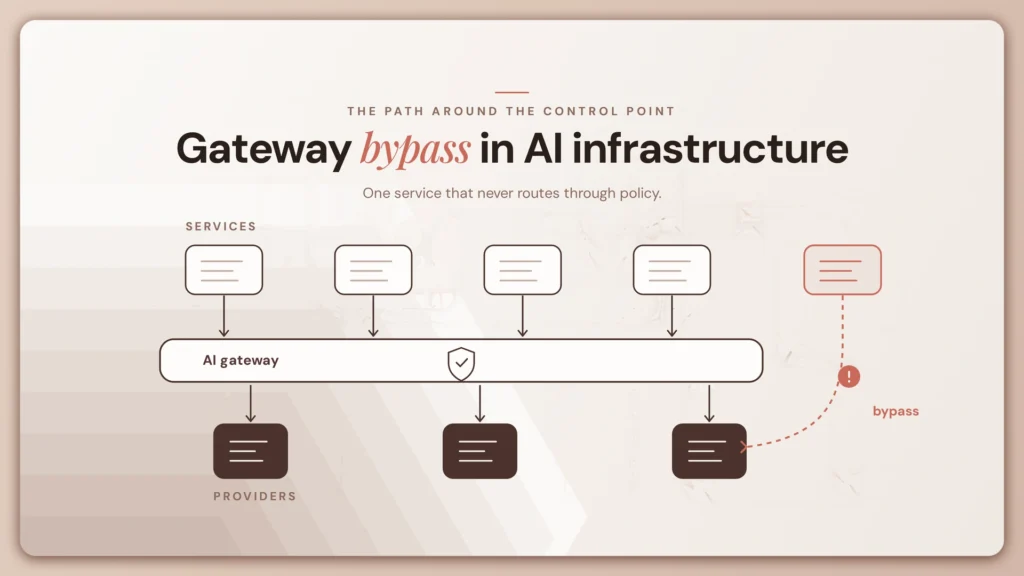
Your microservices architecture is chaos without a bouncer.
An API Gateway is a management tool that sits between a client and a collection of backend services. It acts as a single, unified entry point for all client requests, routing them to the appropriate service.
Think of it as the front-of-house host at a busy, complex restaurant.
You, the customer, don’t walk into the kitchen.
You don’t shout your appetizer order at the fry cook.
You don’t ask the pastry chef for your bill.
Instead, you talk to one person: the host.
The host takes your request, directs it to the right station in the kitchen, handles your payment, and ensures you have a smooth experience without needing to know about the complex operations happening behind the scenes.
This is the core of modern application security and scalability. Without a gateway, you’re exposing your entire kitchen staff directly to the public, which is inefficient, messy, and incredibly insecure.
What exactly does an API Gateway do?
It’s the intelligent front door for your entire application.
While its main job is to route requests, its real value comes from handling a bunch of common tasks in one central place. This means your individual microservices don’t have to worry about them.
Key responsibilities include:
- Request Routing: The most basic function. When a request like
/api/users/123comes in, the gateway knows to send it to the User Service. A request for/api/products/456goes to the Product Service. - Authentication and Authorization: The gateway acts as a security guard. It checks incoming requests to ensure the user is who they say they are (authentication) and has permission to do what they’re asking (authorization). The individual services can trust that any request they receive has already been vetted.
- Rate Limiting and Throttling: It protects your backend services from being overwhelmed. The gateway can be configured to say, “This user can only make 100 requests per minute.” This prevents abuse and ensures stability.
- Logging and Monitoring: It provides a single point to log all incoming requests and monitor traffic patterns, error rates, and performance metrics. This is invaluable for observability.
- Response Caching: For common requests that don’t change often, the gateway can cache the response and serve it directly, reducing the load on backend services and speeding up response times for clients.
How is an API Gateway different from a Load Balancer?
This is a common point of confusion.
A Load Balancer is like a traffic cop for a single highway.
Its job is to distribute traffic evenly across multiple identical lanes (servers) to prevent any one lane from getting jammed. It operates at the transport layer (Layer 4), mostly concerned with IP addresses and ports. It doesn’t understand the content of the traffic.
An API Gateway is like an entire city’s logistics and dispatch center.
It operates at the application layer (Layer 7). It looks inside the requests.
It understands the HTTP methods (GET, POST), the paths (/users), and the headers.
It makes intelligent decisions based on the content and intent of the request, not just the traffic volume.
A system often uses both: a load balancer might distribute traffic across several instances of the API Gateway itself for high availability.
Why is this so crucial for microservices?
Because microservices create complexity by design.
Imagine an e-commerce application without a gateway.
A mobile app would need to know the direct addresses of the:
- User Service (for login)
- Product Service (for browsing)
- Search Service
- Shopping Cart Service
- Order Service
- Payment Service
The mobile app’s code would be a brittle mess of different endpoints. If the development team ever wanted to split the Product Service into two smaller services, they’d have to update and redeploy the mobile app.
With an API Gateway, the mobile app only ever talks to one address: api.ecommerce.com.
The gateway handles the complexity of fanning out the requests to the correct services. The backend can be refactored, services can be added or removed, and the client application never needs to change.
What key technical functions does an API Gateway manage?
Let’s look under the hood.
The core isn’t just simple routing; it’s about robust enforcement and transformation.
- Authentication Schemes: Developers don’t have to implement authentication in every single service. The gateway centralizes it, often by validating API keys or decoding JWT (JSON Web Tokens) to verify a user’s identity before passing the request along.
- API Composition / Schema Stitching: Sometimes a client needs data from multiple services at once. The gateway can receive one request from the client, make multiple requests to different backend services, combine the results, and send back a single, unified response.
- Protocol Translation: It can act as a translator. For instance, a client might communicate with the gateway using a modern RESTful API over HTTP, while the gateway communicates with legacy backend services using older protocols like SOAP.
Quick Test: Can you spot the flaw?
A new startup builds its app with three microservices: one for user accounts, one for photo uploads, and one for messaging. To get to market fast, they let their mobile app call each service directly.
What are the top two immediate problems they are going to face as they start to scale?
- Security: Every single service is exposed to the public internet, dramatically increasing the attack surface. Each service is responsible for its own authentication and rate limiting, which is easy to get wrong.
- Developer Experience & Brittleness: The mobile development team is now tightly coupled to the backend architecture. Every time the backend team changes a service endpoint, the mobile app breaks and needs an update. It’s slow and error-prone.
Diving Deeper: Your Questions Answered
Isn’t an API Gateway a single point of failure?
Yes, it can be. That’s why in any production environment, you would run multiple instances of the API Gateway behind a load balancer. If one gateway instance fails, traffic is automatically rerouted to the healthy ones, ensuring high availability.
What’s the difference between an API Gateway and a service mesh?
They solve different problems.
An API Gateway manages north-south traffic (traffic coming from outside the network, from a client into your services).
A service mesh manages east-west traffic (communication between the different services already inside your network). They often work together.
Should I build my own or use a managed service like AWS API Gateway?
For most teams, using a managed service is the right call. Products like AWS API Gateway, Google Cloud API Gateway, or Azure API Management handle the scaling, security, and maintenance for you. Building your own (using open-source tools like Kong or Tyk) gives you more control and flexibility but also means you’re responsible for its upkeep and reliability.
How does an API Gateway handle different versions of an API?
It’s excellent for this. The gateway can route requests based on the path or headers. For example, api.example.com/v1/products can be routed to the old Product Service, while api.example.com/v2/products is routed to the new one. This allows you to roll out changes without breaking existing clients.
Can an API Gateway improve performance?
Absolutely. By caching frequently accessed, non-dynamic data, the gateway can serve responses instantly without ever hitting a backend service. This reduces latency for the user and decreases the load on your infrastructure.
The API Gateway isn’t just a piece of infrastructure.
It’s the disciplined, intelligent conductor that turns a chaotic orchestra of microservices into a coherent and secure application.
Did I miss a crucial function? Have you seen a gateway used in a way that surprised you? Let me know.