Compare the best platforms using LangGraph for stateful agent workflows, from durable execution and memory to enterprise governance.
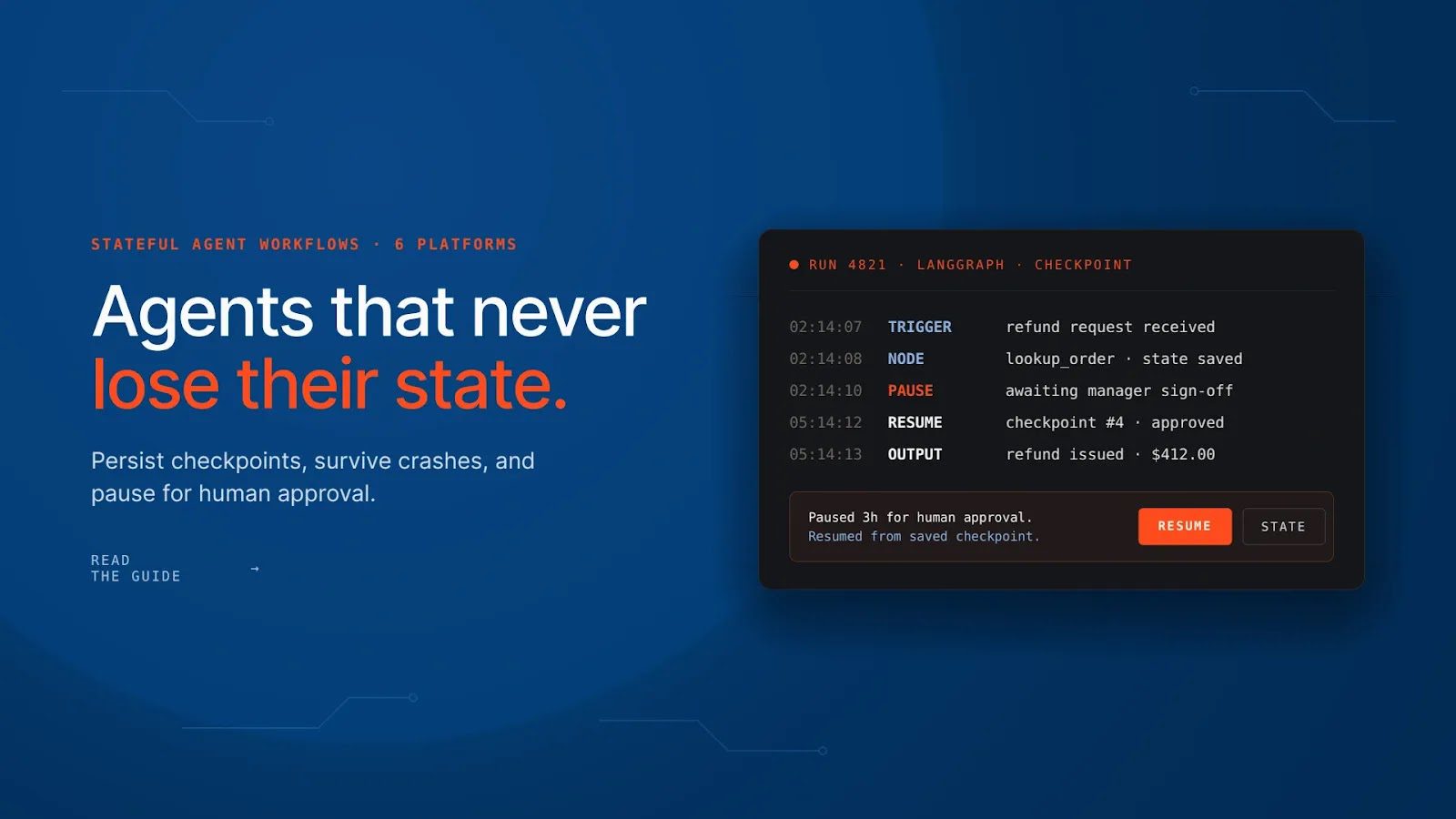
Your support agent starts a refund request, checks an order database, and pauses for a manager’s sign-off. Three hours later, the manager clicks approve. Now, the agent has forgotten the customer, the order ID, and why it asked in the first place. Without persistent state, every timeout, API hiccup, or human pause sends an agent right back to square one.
Stateful workflows fix that amnesia by saving context, decisions, and progress at every step. Developers often wire those graphs in LangGraph, then look for a production platform that can host, scale, and govern them without brittle glue code. Let’s understand how platforms handle stateful agent workflows with LangGraph, and where each one fits.
TL;DR
- LangGraph is LangChain’s open-source framework for stateful, long-running AI agents. It models a workflow as a graph of nodes and shared state and saves a checkpoint after every step so runs can pause, loop or recover from crashes.
- Stateful agent workflows keep context, decisions and progress across every step, retry and human pause. An agent waiting days for approval picks up from its last checkpoint instead of starting over.
- Lyzr Agent Studio connects to existing LangGraph agents over the A2A protocol without rewriting them. Its SuperFlow builder adds durable runs, retries, approval gates and loops around the graph.
- Lyzr also covers what other platforms leave to separate tools: built-in governance and audit trails, private-cloud, on-prem or air-gapped deployment through Sovereign AI and Optimus.
What is LangGraph?
LangGraph is an open-source orchestration framework and runtime from LangChain for building stateful, long-running AI agents. Instead of forcing prompts into a rigid linear chain, it models an agent workflow as a directed graph of nodes, conditional edges, and shared state. Each node can run an LLM call, execute a tool, or apply deterministic code, while built-in checkpointing saves state after every step so runs can pause, loop, or recover from crashes.
Hallucinations, low reliability, and missing explainability are hurdle for enterprise AI pilots before they reach production. Watch the video where Siva Surendira, CEO, Lyzr shows how Lyzr builds hallucination management and responsible AI guardrails directly into the agent core, removing the need for third party compliance APIs.
What is a stateful agent workflow?
A stateful agent workflow is a multi-step AI process that tracks and updates shared context across every action, branch, and pause until the job finishes. When an agent waits days for human approval or retries a failed API call, it resumes from its last saved checkpoint rather than restarting from scratch. It also pairs short-term thread state with long-term memory across sessions, so agents carry verified facts from one interaction to the next.
Running durable workflows alongside LangGraph leaves observability and policy enforcement split across separate tools. Explore framework-agnostic agent platforms to see how a unified control plane governs agents built on any runtime.
Stateful vs stateless agent workflows
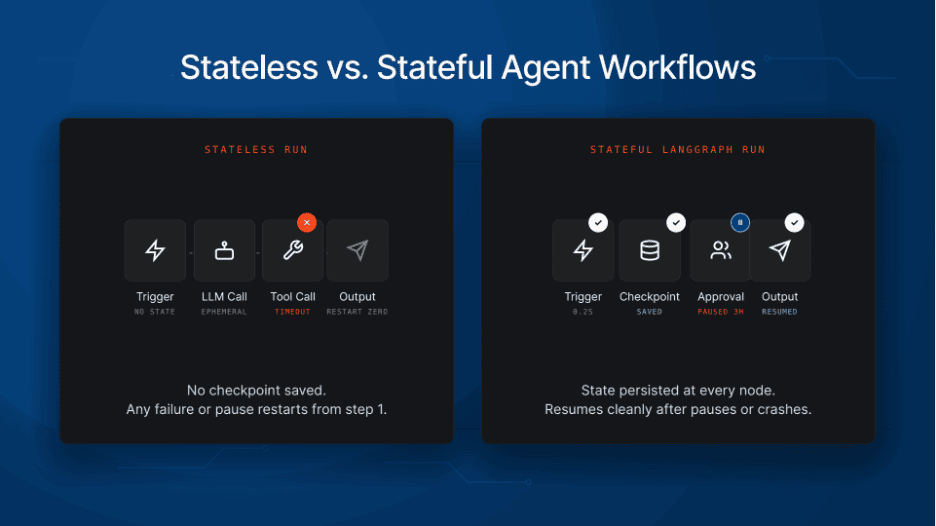
Stateless workflows treat every prompt as an isolated call, which works for single-turn summaries or classification but breaks down when tasks span multiple steps. Stateful workflows maintain a live execution record, making branching, retries, and human sign-offs reliable in production.
| Aspect | Stateful agent workflows | Stateless agent workflows |
| Context handling | Persists shared state across steps and pauses | Starts fresh on every request |
| Failure recovery | Resumes from the last saved checkpoint | Restarts the entire run from zero |
| Human-in-the-loop | Pauses for sign-off and continues mid-flow | Cannot pause and resume cleanly |
| Control flow | Supports loops, retries, and dynamic branching | Follows a fixed, single-pass sequence |
| Best fit | Multi-step operations, approvals, long tasks | Single-turn Q&A, tagging, quick drafts |
Wondering how visual builders handle durable state? In Lyzr SuperFlow, every completed step is journaled with exactly-once execution and native human-in-the-loop pauses, so long-running processes never repeat finished work.
Best platforms using LangGraph for stateful agent workflows
1. Lyzr for enterprise stateful agent workflows
Lyzr Agent Studio is an enterprise platform for building, orchestrating, and governing stateful AI workflows, combining its visual SuperFlow builder with native support for connecting external LangGraph agents over the Agent-to-Agent (A2A) protocol. Inside SuperFlow, every run is journaled, retried on failure, and paused for days on a Wait for Approval node without losing state, while Lyzr Architect turns plain-English prompts into full-stack agentic apps backed by isolated per-app databases. Organizations that want hands-on help mapping processes onto SuperFlow can start with Lyzr Reimaginer to ship a working prototype in 72 hours and move to production in weeks. Employees interact with those governed workflows through Open Cowork, a permission-aware workspace with working memory and built-in approval gates. For strict data residency, Lyzr Sovereign AI and Lyzr Optimus run the entire stateful stack inside your private cloud, data center, or air-gapped hardware.
Manual review could not keep up with thousands of daily change entries at NTT Data. Engineers deployed a Lyzr agentic workflow that scores each change for incident risk and drafts remediation steps from past tickets, catching high-risk updates early.
2. LangSmith Agent Server for managed LangGraph deployment
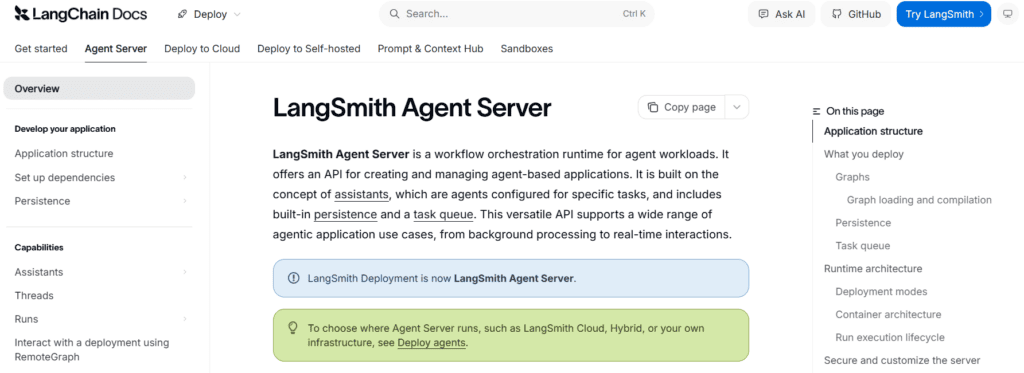
LangSmith Agent Server (formerly LangSmith Deployment and LangGraph Platform) is LangChain’s managed runtime for deploying and scaling stateful LangGraph workflows in production. It handles durable execution, checkpoint persistence, background task queues, and real-time streaming across cloud, hybrid BYOC, or self-hosted infrastructure. Developers can also inspect thread state, rewind past runs, and link traces directly to LangSmith evaluations. The catch is cost layering: LangSmith Plus starts at $39 per seat per month with one small serverless deployment, while extra deployments, compute, storage, and extended trace retention might incur metered usage charges.
Writing raw graph code means configuring hosting, tracing, and governance yourself:
See how Lyzr compares with LangGraph
Explore why builders move to GitAgent as a DeepAgents alternative for version-controlled agent deployments.
3. Amazon Bedrock AgentCore for serverless AWS LangGraph hosting

Amazon Bedrock AgentCore is AWS’s serverless runtime and managed memory platform for hosting production AI agents, including stateful LangGraph workflows. Through the langgraph-checkpoint integration and AgentCore Memory, LangGraph graphs persist both short-term session state and long-term cross-session context inside isolated AWS microVMs. It also includes built-in identity, Cedar policy enforcement, and OpenTelemetry telemetry for LangGraph nodes. Pricing spans 12 independent components: like separate consumption billing for runtime CPU, memory, and short-term memory, which might make monthly bills complex to forecast as traffic scales.
Global IT provider Saksoft built a centralized multi-agent system with Lyzr on AWS and Amazon Bedrock. By coordinating specialized agents across cloud operations, the company automated complex internal workflows without stitching together custom orchestration.
4. Databricks Mosaic AI for Lakebase-backed stateful agents
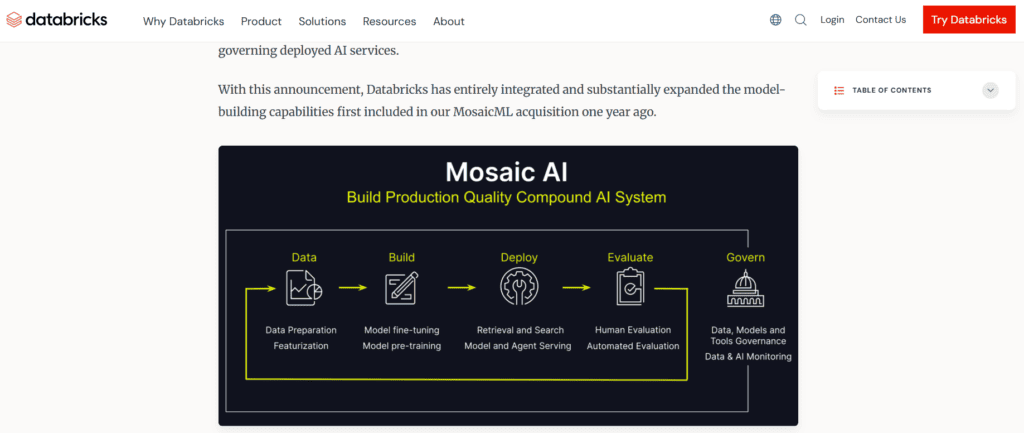
Databricks Mosaic AI pairs Databricks Apps and Model Serving with Lakebase to run stateful LangGraph agents directly on enterprise lakehouse data. Through the databricks-langchain integration, LangGraph uses Lakebase as a managed checkpointer backend to persist conversation state and recall long-term semantic memory across sessions. Workspace-managed authentication and Unity Catalog governance keep agent state and tool access inside your data perimeter. Consumption-based DBU pricing, separate cloud infrastructure charges, and a steeper learning curve for organizations without existing Spark or MLOps experience might make costs and setup harder to predict.
Storing session checkpoints is only half of stateful design. Agents also need governed long-term recall across data silos. Read our comparison of AI agent memory systems to see how persistent memory architectures stack up.
5. CopilotKit for frontend-connected stateful LangGraph agents
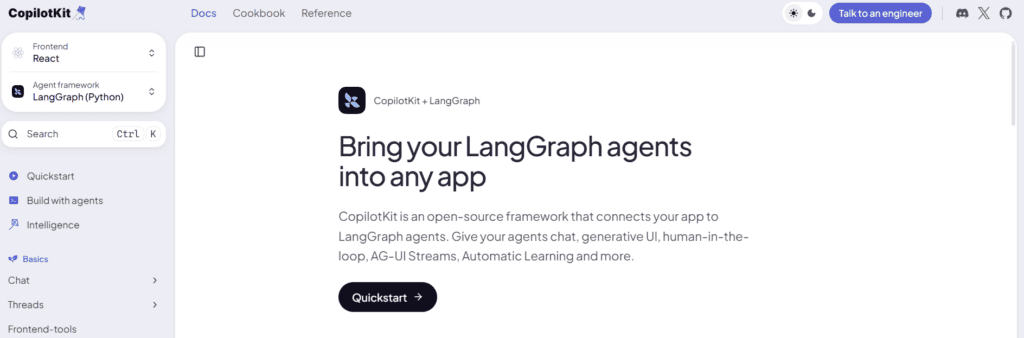
CopilotKit is an open-source agentic UI and runtime platform that connects React and Next.js applications to stateful LangGraph workflows over the AG-UI protocol. Its CoAgents layer and React hooks synchronize state bidirectionally between the user interface and a running LangGraph graph. Users can watch intermediate steps stream live, edit agent state from the UI, and approve human-in-the-loop actions mid-run. According to a production review article, CopilotKit focuses on the frontend and interaction layer, so production multi-tenant isolation, custom error classification, and backend observability might remain your engineering responsibility.
Interactive approvals are often where stateful workflows stall if the backend cannot pause cleanly. Compare 10 tools for human-in-the-loop agent workflows to see how different platforms handle sign-off gates.
How to integrate Lyzr with LangGraph for stateful agent workflows
You do not have to rewrite existing LangGraph agents to run them inside Lyzr Agent Studio. Using the Agent-to-Agent (A2A) protocol, Lyzr connects to your hosted LangGraph endpoint, persists workflow state in SuperFlow, and adds approval gates, memory, and audit trails around every run.
Prerequisites:
- LangGraph A2A endpoint: A deployed LangGraph agent on a public HTTPS URL that serves an A2A v1.0 agent card (with supportedInterfaces)
- Authentication credentials: An API key header or OAuth service principal if your endpoint is private
- Lyzr Agent Studio access: An active workspace in Lyzr Agent Studio with access to Agent Registry and SuperFlow
1. Expose your LangGraph agent as an A2A server
Host your LangGraph graph behind an A2A-compatible server URL so Lyzr Agent Studio can invoke it remotely without inspecting or altering your graph code. Confirm that the endpoint accepts structured JSON tasks and returns a structured result.
| Endpoint type | Authentication method in Lyzr |
| Public endpoint | No Auth |
| Private server with static key | API key in request header |
| Azure AI Foundry hosted agent | Microsoft OAuth via Entra service principal |
| Databricks App endpoint | Databricks OAuth (service principal client credentials) |
2. Register the LangGraph agent in the Lyzr Agent Registry
Open Lyzr Agent Studio and select Agent Registry from the left sidebar. Click + New > Import (A2A) to open the Import A2A Agent modal, then fill in the fields below and click Create:
- Name and Description: Enter a recognizable agent name and optional description
- Server URL and Agent Card Path: Paste your LangGraph A2A endpoint (for example, https://example.com/api) and optional card path (such as agentCard/v1.0)
- Authentication and Credential: Choose the Authentication method; a saved Credential is only needed when it isn’t No Auth.
- Custom tags and metadata: Add optional tags or notes for filtering in the Agents list
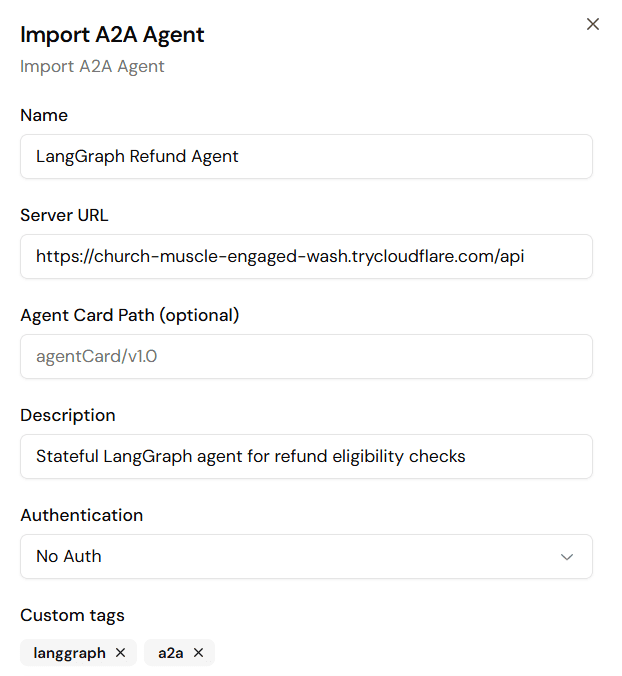
Lyzr Agent StudioAgent Registry showing the Add A2A Agent form and server URL field
3. Add the A2A Agent node to a SuperFlow
In the left sidebar, expand Orchestrate > SuperFlow and click New SuperFlow (or open an existing workflow). In the left node library, select the AI category tab, drag A2A Agent onto the canvas and connect Trigger to it. Open the node, paste the LangGraph Agent URL, set Authentication, and turn on Retry on failure under Node Settings.
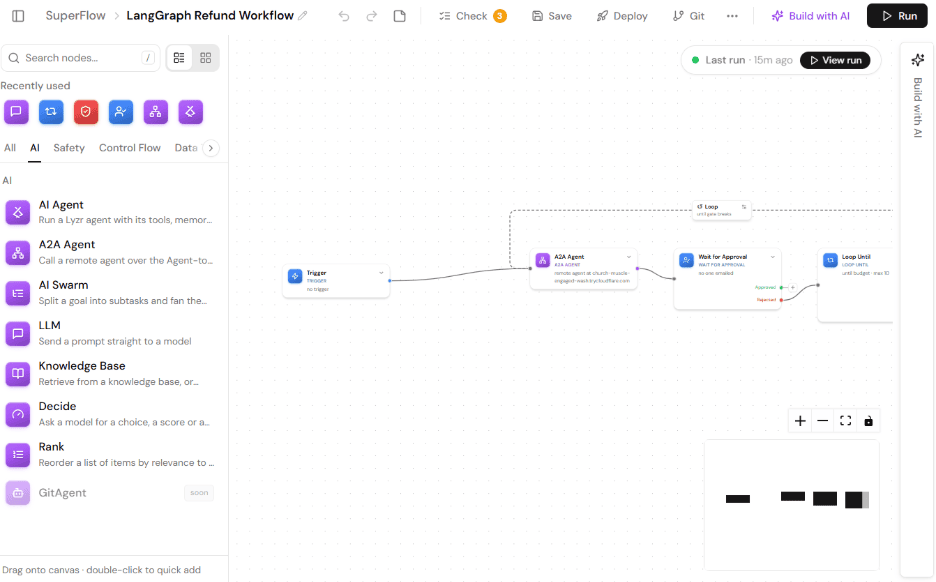
SuperFlow canvas showing AI node library with the A2A Agent node connected after Trigger
4. Configure loops and approval gates
Turn the flow into a durable, stateful pipeline by adding SuperFlow control primitives around your LangGraph node:
- Loop Until (Control Flow): Route execution back to an earlier node through its Continue output; set Max iterations on the node (the flow-wide cap is under ⋯ > Settings > Max loop iterations)
- Wait for Approval (Control Flow): Pause execution for a reviewer to approve or reject before sensitive actions run, viewable under Approvals
- Guardrails (Safety): Check inputs and outputs against PII, prompt injection, or custom compliance policies (requires a Responsible AI policy).
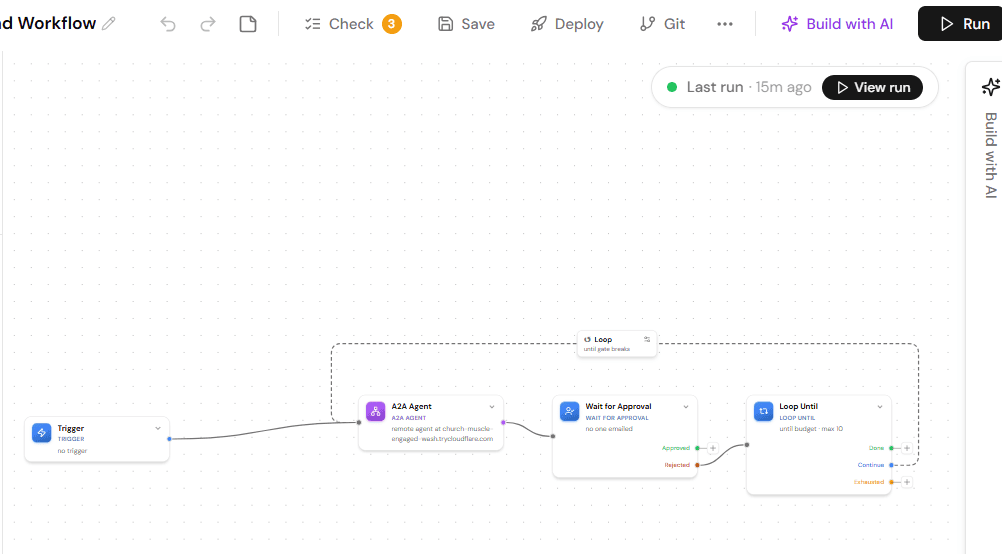
SuperFlow canvas with the A2A Agent wired to Loop Until and Wait for Approval
5. Check, test, and deploy the workflow
Click Check to review warnings, then Run with sample input and review … > Execution history. To go live, open Deploy, click Save version, then Deploy that version so webhooks, schedules and API calls use it.
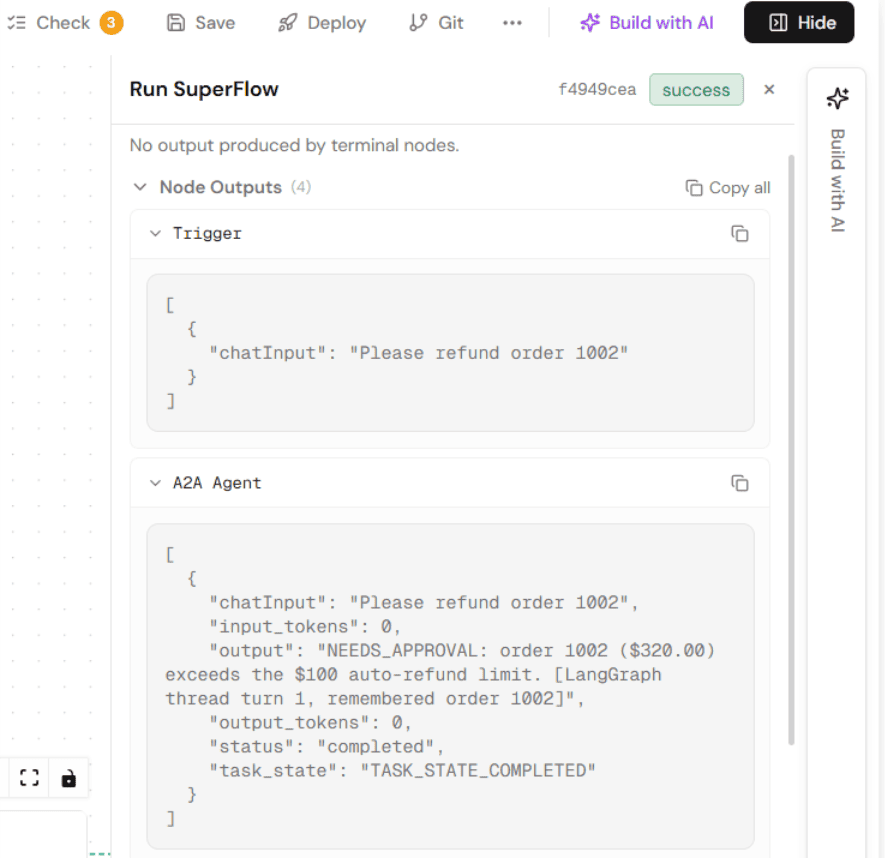
SuperFlow toolbar showing Check, Save, and Deploy controls with live run trace panel
Keep in mind the protocol boundary: MCP connects an agent to its own tools and data sources, while A2A connects two separate agents. A single Lyzr Manager Agent or SuperFlow can combine both without rewriting your LangGraph graph.
Build stateful agent workflows with Lyzr
Lyzr brings visual stateful orchestration, human approval gates, and enterprise governance together in one stack, whether you build in SuperFlow or connect LangGraph agents over A2A.
- Agent Studio and SuperFlow: Stateful orchestration, crash recovery, and A2A LangGraph support
- Lyzr Architect: Plain-English builder for full-stack agentic apps
- Sovereign AI and Optimus: VPC, on-prem, or air-gapped deployment
- Lyzr Reimaginer: Engineers map one workflow and take it live in weeks
See stateful workflows running on your own processes with a Lyzr agent test drive.
Best platforms using LangGraph for stateful agent workflows FAQs
What is the best platform for running LangGraph agents with stateful workflows?
It depends on what you need around the graph. LangSmith Agent Server is LangChain’s managed host for LangGraph. Lyzr Agent Studio connects LangGraph agents over A2A and adds approval gates, retries and enterprise governance in one place.
Can I use my existing LangGraph agents in Lyzr without rewriting them?
Yes. Expose the graph on a public A2A endpoint, then import it into Lyzr’s Agent Registry or call it from an A2A Agent node in SuperFlow. Your graph code stays unchanged.
How do stateful workflows handle human approvals and failures?
They save progress at every step, so a run can pause for approval or retry after an error without starting over. In Lyzr SuperFlow, a Wait for Approval node holds the run until a reviewer approves or rejects, and failed steps can retry automatically.
Can I run stateful LangGraph workflows in my own cloud or on-premises?
Yes. LangSmith offers hybrid and self-hosted options. Lyzr Sovereign AI and Lyzr Optimus run the full stateful stack inside your private cloud, data center or air-gapped hardware.
Book A Demo: Click Here
Join our Slack: Click Here
Link to our GitHub: Click Here
Got a use case in mind?
8 weeks from use case to agents running in production.
Platform, people and FDEs, all in. Bring your environment. We'll co-build and stay until it's live.
Talk to UsFree resource
101 AI Agents Use Cases
100+ production-ready AI agent use cases across Marketing, Sales, HR, Banking, Insurance, Operations and a lot more
Download now