For prompt routing alone, a gateway is the more direct tool. For routing that has to be owned, budgeted, and audited per team and per agent, use OpenController.
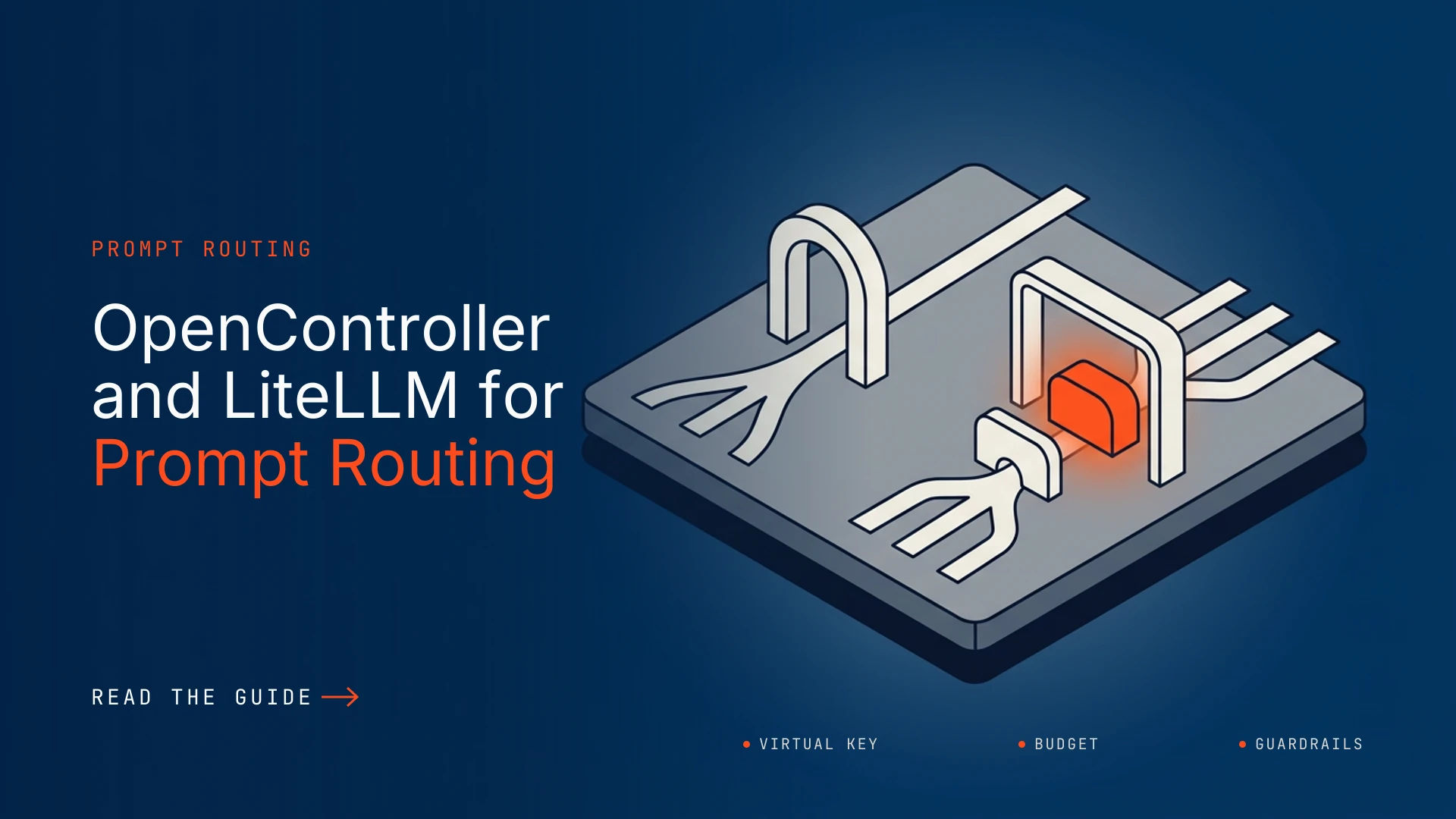
LiteLLM is an open-source AI gateway that sends your requests to the model you pick. OpenController by Lyzr is a control plane for AI agents, and its Model Gateway applies routing rules to each registered agent.
Which one you need depends on who has to answer for a routing decision once many teams are running agents.
Prompt Routing and Optimization, Specifically
Both products touch prompt routing, at different points in the request.
LiteLLM routes through one OpenAI-compatible API, so an application can switch models without code changes, and it includes prompt compression to reduce token count.
OpenController's Model Gateway also exposes an OpenAI-compatible interface. Routing, fallback, and semantic cache are set on a virtual key, so each team or agent gets its own rules, budget, and rate limit.
The practical difference is where the rule lives. In OpenController a routing rule is attached to a registered agent that has an owner, so a change to it is visible to the people accountable for that agent. Guardrails then check each request on the way in.
What Happens to a Routed Call in OpenController
Every call through the Model Gateway follows the same fixed pipeline. It is authenticated, authorized, checked on the way in, metered, invoked, checked on the way out, and recorded.

Every call is authenticated, authorised, checked, metered, invoked, checked again and recorded. Demo environment, sample data.
Each virtual key has its own ceiling and rate limit. When a team reaches its ceiling, the gateway refuses the call and no provider call is made. Refusals are kept, with the reason, so a blocked request can be traced afterward.
Guardrails run at the same gateway. They can mask personal data, refuse prompt injection and secret leaks, and block banned topics before the model sees the prompt.
Cost is reported per successful task, with failures and retries counted, so a cheaper route that fails more often does not look like a saving.
Choose the Right Tool for the Job
Your decision comes down to your primary challenge.
Are you standardizing how your applications call a growing list of LLMs? You're looking for an API gateway.
LiteLLM provides a single OpenAI-compatible API to solve this, and its open-source version is free to self-host.
It can be deployed to production on major clouds using Helm, Terraform, and Kubernetes.
Or is your challenge broader?
Are you trying to get a complete picture of every AI agent and asset across your company, including "Shadow AI"?
Do you need to enforce consistent security and cost policies on agents built by different teams using different frameworks?
Do you need an audit trail showing who owns each agent, what it does, and whether it's approved for production?
That is a governance problem. Prompt routing is just one small piece of it.
OpenController is built to govern and observe every AI agent in your company. It discovers what you have, helps you register and approve it, and applies guardrails to keep it safe in production.
A Head-to-Head Comparison
The choice depends entirely on the job you need to do. A gateway manages API calls.
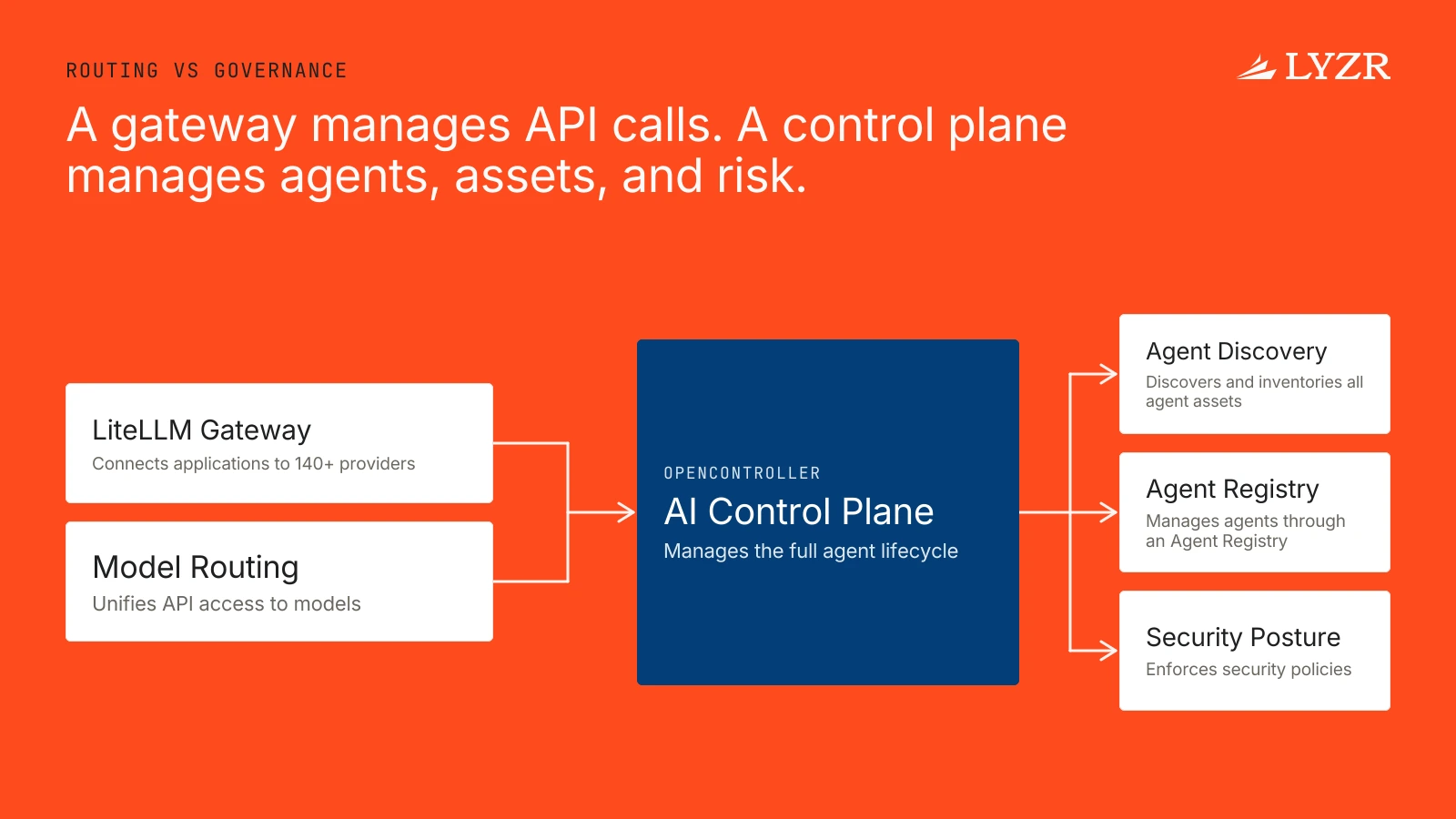
A control plane manages agents, assets, and risk.
| Capability | OpenController | LiteLLM |
|---|---|---|
| Primary Function | An AI control plane for enterprise-wide discovery, governance, and observability of all AI agents and assets. | An open-source AI gateway that connects applications to 140+ providers and 1,800+ models via a single OpenAI-compatible API. |
| Prompt & Routing Control | Its Model Gateway sits in front of your models with an OpenAI-compatible interface. Each team or agent gets a virtual key with its own budget, rate limit, routing, fallback, and semantic cache, and guardrails check requests on the way in. | Provides a unified API for routing to different models without changing app code. Also includes prompt compression to reduce token count. |
| Agent Governance | Discovers and inventories all agent assets, including Amazon Bedrock AgentCore harnesses and Bedrock Guardrails. Manages agents through an Agent Registry and formal Approvals workflows. |
Connects your apps to LLMs, agents, and MCP servers through its gateway API. It also maintains audit logs of key events such as authentication and updates. |
| Security & Compliance | Enforces security policies (e.g., "Assets anyone can use without signing in") and maps findings to compliance frameworks like OWASP Top 10 for LLMs. This provides deterministic compliance findings for auditors. | Has achieved SOC 2 Type II certification. Uses OSV-Scanner and Grype to check for vulnerabilities and supports air-gapped deployments in enterprise plans. |
The Takeaway
Use an AI gateway for API management. Use a control plane for agent governance.
While both can sit in the request path, they operate at different levels of abstraction and solve for different outcomes. An API gateway manages calls; a control plane manages risk.
If you are building an enterprise AI practice, you will likely need both.
Think of it like this: a gateway is the universal adapter for your power cords. A control plane is the circuit breaker box for the entire building.
You need the right tool for the job.
If your job is enterprise-wide AI governance, let's talk.
Want to see how it fits your stack? Talk to us about OpenController by Lyzr.
Got a use case in mind?
8 weeks from use case to agents running in production.
Platform, people and FDEs, all in. Bring your environment. We'll co-build and stay until it's live.
Talk to UsFree resource
101 AI Agents Use Cases
100+ production-ready AI agent use cases across Marketing, Sales, HR, Banking, Insurance, Operations and a lot more
Download now