Your agent fleet is a mix of home-grown scripts, third-party frameworks, and vendor solutions.
Yes. It does not matter who built the agent or with what tools.
Once an agent is registered with OpenController by Lyzr, a neutral control plane that works across agent frameworks, it is subject to full policy enforcement. This includes the ability to quarantine or "kick out" non-compliant agents on the spot.
Every production agent stack needs a control plane. OpenController is a framework-agnostic, cloud-agnostic one, built for enterprise governance.
How It Works: From Discovery to Control
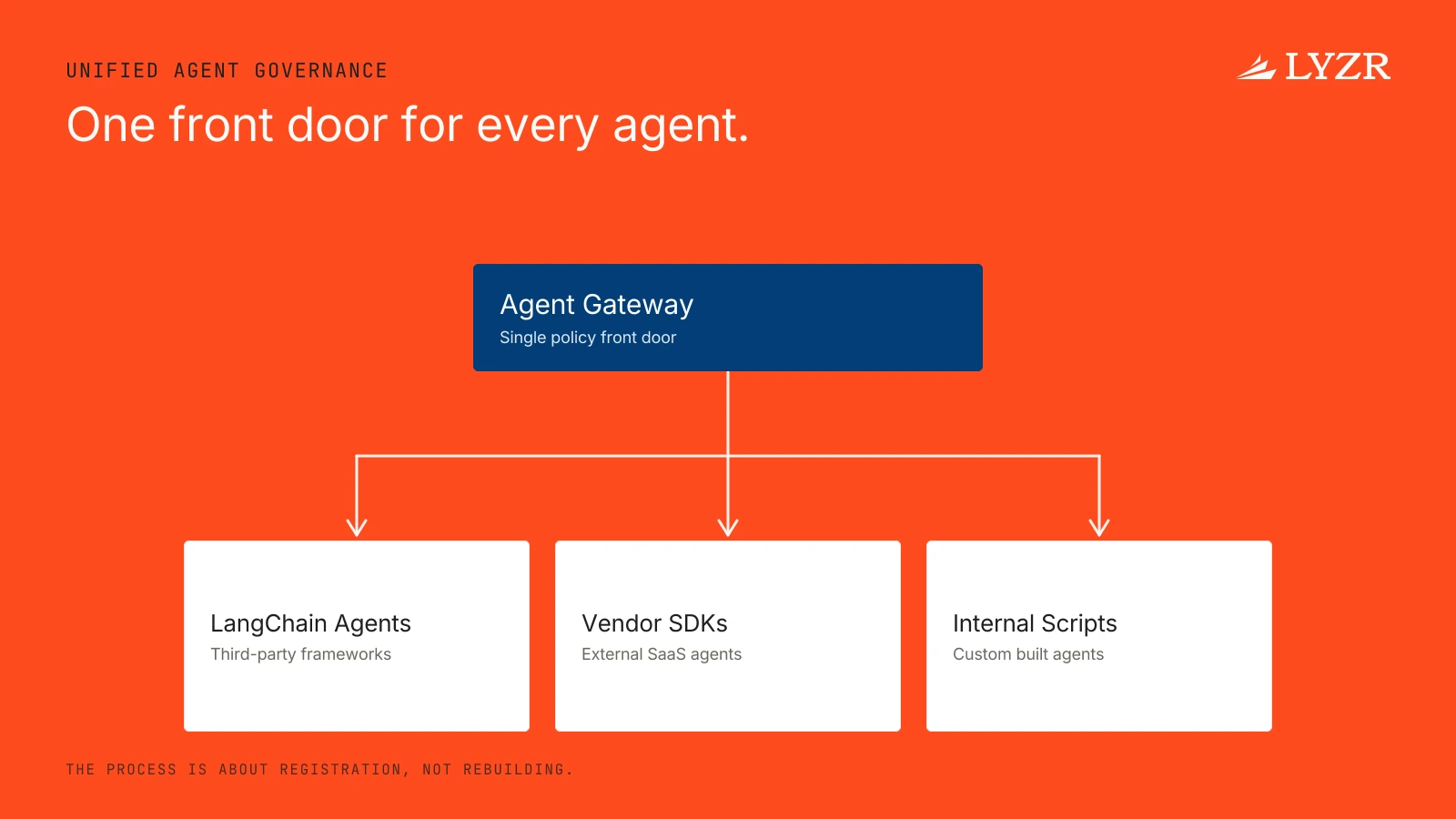
OpenController doesn't need to be where your agent was built. It just needs to become its new front door.
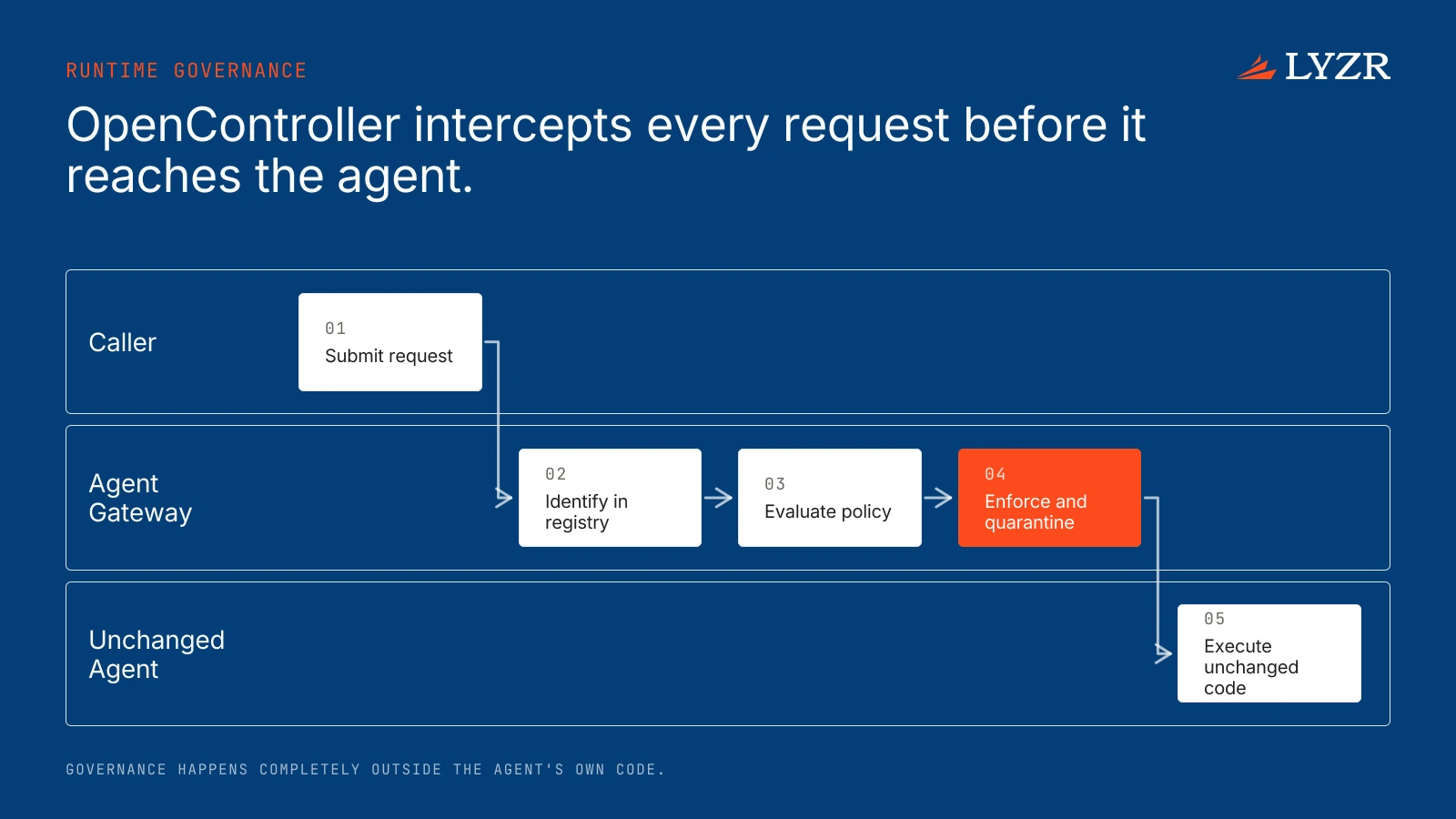
The process is about registration, not rebuilding.
-
Discover and Register: OpenController identifies agent endpoints across your environment. You register an existing agent by pointing its traffic through the control plane.
The agent itself remains unchanged.
-
Policy Interception: Once registered, every call to and from that agent is intercepted by Lyzr's control plane. This is where governance happens, completely outside the agent's own code.
-
Real-Time Enforcement: Policies you define for data handling, tool use, or model interaction are applied to every transaction, for every registered agent.
-
Quarantine Action: If an agent attempts a forbidden action, OpenController can block the request, alert security teams, or revoke the agent's credentials entirely, effectively quarantining it from the network.
Unified Governance for a Mixed Fleet
This approach means you apply one set of rules to every agent.
It doesn't matter if it was built with LangChain, a vendor's SDK, or an internal script.
You avoid rebuilding or refactoring existing agents just to make them compliant. This saves significant development time and cost.
It allows your teams to use the best tool for the job. They can innovate with new frameworks, knowing that any resulting agent can be brought under a central governance model.
This separates the agent's function from its operational security, a core tenet of modern platform architecture. You can adopt only the components you need and govern agents built on any framework, including external ones like LangChain.
Control Is About Where You Stand, Not Where You Started
An agent's origin doesn't determine its risk profile. The control plane that governs it does.
If you're managing a mixed fleet of AI agents, let's talk about unified control.
Want to see how it fits your stack? Talk to us about OpenController by Lyzr.
Got a use case in mind?
8 weeks from use case to agents running in production.
Platform, people and FDEs, all in. Bring your environment. We'll co-build and stay until it's live.
Talk to UsFree resource
101 AI Agents Use Cases
100+ production-ready AI agent use cases across Marketing, Sales, HR, Banking, Insurance, Operations and a lot more
Download now