Key takeaways
- Approval has to apply to an identifiable agent version and its full configuration.
- Risk determines the required tests, reviewers and number of approvals.
- A failed mandatory check should block promotion automatically.
- Reviewers need evaluation results, permission changes and supporting evidence, not just a summary.
- Changes after approval may require re-evaluation and a fresh approval.
- Audit records and post-release monitoring complete the workflow.
A finance team requires two sign-offs on every wire transfer. The first person prepares the payment, and the second reviews and approves it. On paper that’s a strong control. Then an incident review finds that the approved payment was for one amount and the released payment was for another, because the details were edited after the second person clicked approve. Both signatures were real, and the control still failed. The approval wasn’t bound to the exact transaction that went out.
AI agent releases hit the same weakness, with more moving parts. A reviewer approves a version, and then a prompt, a tool permission or a dependency changes before it ships. An approval workflow for AI agents only works when the decision attaches to a specific version, rests on evidence, comes from authorised reviewers and is enforced by the promotion gate. This guide gives you a model for building that.
Why do AI agents need a dedicated approval workflow?
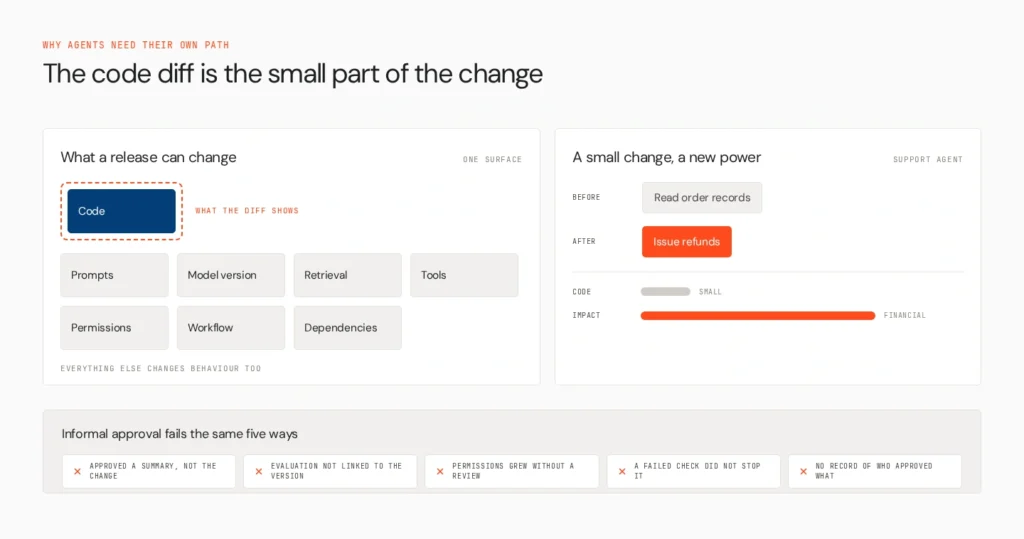
An agent release is broader than a code deployment. Behaviour can change through prompts, model versions, retrieval sources, connected tools, permissions, workflows and dependencies. A code diff shows only part of that surface.
Take a customer-support agent with read-only access to order records. A new release gives it permission to issue refunds. The code change may be small, but the agent can now perform a financial action, so the release belongs in a different review path.
Informal approval breaks down in predictable ways. Reviewers approve a summary and never see the actual change. Evaluation results aren’t linked to the version that gets deployed. Permissions expand without a security review. A failed check doesn’t stop the release. After an incident, nobody can reconstruct who approved what.
Lyzr already covers adjacent ground. Its guide to a governance approval pipeline focuses on input and output guardrails that gate individual requests, and its piece on managing agent environments covers environments. This guide covers the decision that comes first: whether a given version is allowed into production at all.
Three activities that are easy to confuse
- Action approvals: pausing an agent’s proposed action for human review while it runs.
- Release approvals: deciding whether a specific agent version can move into production.
- Runtime governance: monitoring and controlling behaviour after deployment.
This guide centres on release approvals, with runtime governance as a connected control.
What should an approval workflow include?

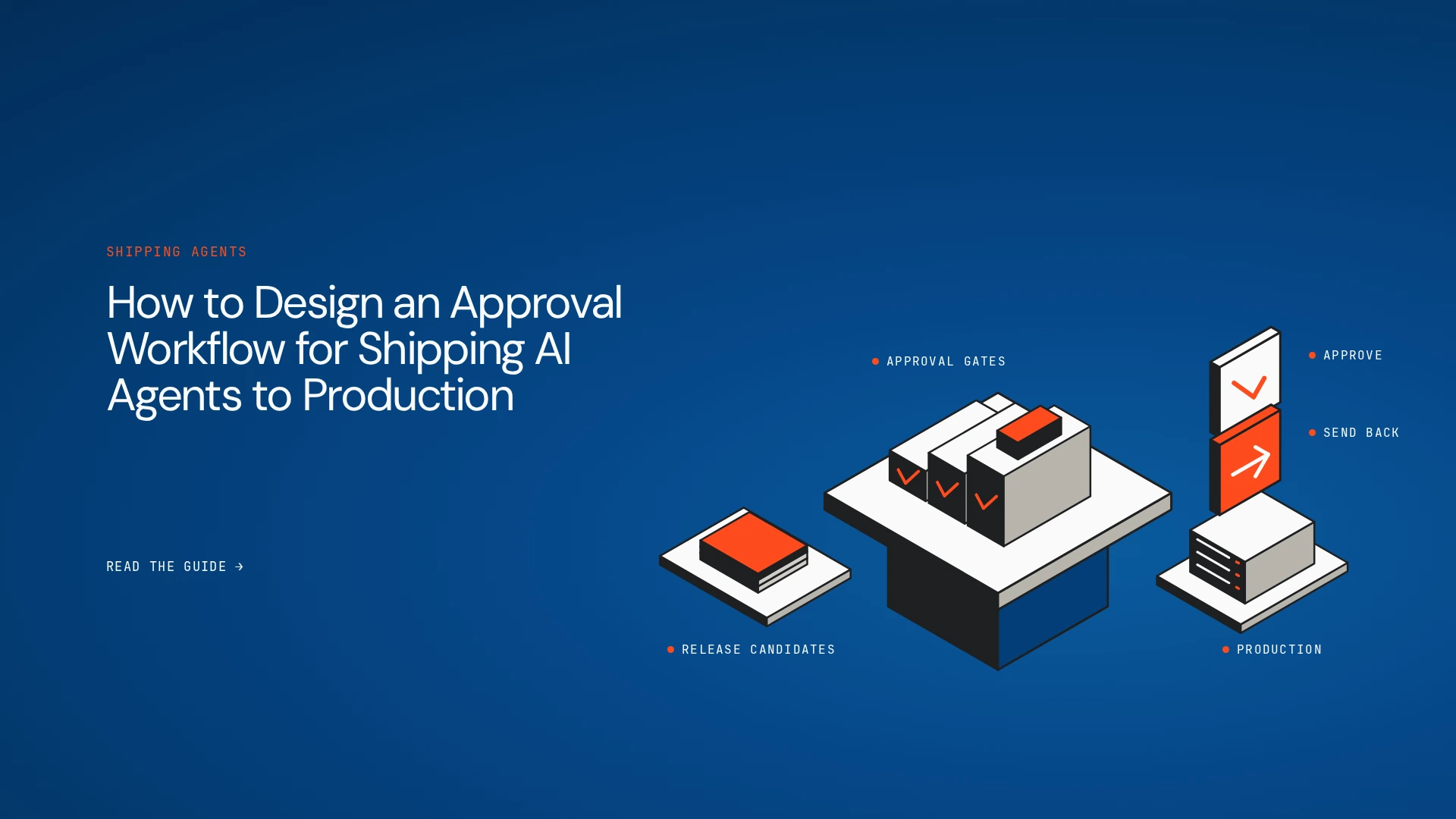
| Component | Responsibility |
|---|---|
| Agent package | Identifies the exact version, prompts, model, tools, configuration and dependencies under review |
| Evaluation and policy checks | Tests quality, safety, permissions and release requirements |
| Approval and decision record | Routes evidence to authorised reviewers and records approve, reject or request-changes decisions |
| Promotion and audit layer | Blocks unauthorised releases, records the deployed version and preserves the decision trail |
This is a logical architecture. An organisation doesn’t need four separate products. A chat-based approval message can route a decision, but the deployment mechanism has to enforce the result.
Step 1: Classify releases by risk
Define risk by the impact of the change, not by the number of files touched. An illustrative three-tier model:
- Low risk: documentation or non-behavioural changes that don’t affect permissions or production actions. Automated checks and lightweight review are enough.
- Medium risk: changes to prompts, retrieval, model configuration or business logic that could affect outputs. Require evaluation evidence and an owner or domain reviewer.
- High risk: new write permissions, sensitive-data access, financial actions, external communications or changes in regulated workflows. Require security or domain approval alongside technical checks.
Organisations should set their own thresholds. These tiers are a starting point, not a standard.
Step 2: Define mandatory pre-production gates
List the checks that must pass before a reviewer can approve:
- Functional and task-success evaluations
- Safety, prompt-injection and data-leakage tests where relevant
- Review of tool permissions and data scope
- Latency, cost and reliability thresholds
- Regression tests against a known evaluation set
- Dependency, configuration and version checks
Separate hard requirements from advisory signals. When policy calls a check mandatory, a failure should block the release. No single aggregate score proves an agent is safe. The Agents to Production playbook covers readiness criteria in more depth.
Step 3: Route approvals to the right people
Assign reviewers by risk and by what changed. Engineering reviews system behaviour, security reviews permissions and data access, and a business owner reviews consequential business actions. High-risk releases may need multiple independent approvals.
Show every reviewer:
- The version and a summary of changes
- Evaluation results, including failures
- Tool and permission changes
- Known limitations and unresolved risks
- The rollback or recovery plan
- The release owner
Approval shouldn’t depend on a natural-language summary the agent wrote about itself.
Step 4: Enforce the decision and handle changes
Model the release as a state machine: SUBMITTED, CHECKS_RUNNING, REVIEW_PENDING, APPROVED, DEPLOYED, with alternate outcomes REJECTED, CHANGES_REQUESTED and BLOCKED. Enforce these rules:
- No promotion before every required check and approval is complete.
- A rejected release can’t advance.
- Material changes after approval invalidate the approval or trigger re-review.
- A timeout or an unavailable approval service never counts as approval.
- A retry must not deploy the same release twice.
- The deployed version has to match the version that was approved.
In practice that means immutable release identifiers, durable decision records and promotion that can safely run more than once. Think back to the wire transfer. The approval has to be tied to the exact thing released.
Step 5: Monitor the release and close the loop
Approval isn’t the end of governance. Set rollback and containment criteria before launch, then compare real behaviour against what the release promised. Watch release health, error rates, task success, cost, latency, policy violations and unexpected tool activity. A serious issue should trigger a defined response, and any fix should re-enter the right approval path. See AI agent tracing, how to roll back a bad agent deployment and what an AI agent kill switch is.
A worked example: a procurement agent
A procurement agent reads supplier records and prepares purchase orders. The thresholds below are illustrative, not standards.
| Release | Risk tier | Required checks | Approver | Promotion rule |
|---|---|---|---|---|
| Reworded reporting prompt | Medium | Regression set, output-quality evaluation | Agent owner | Promote when all checks pass and the owner approves |
| New supplier-data source | Medium | Retrieval tests, data-scope review | Owner and data steward | Promote after both approve |
| Permission to submit orders above a set value | High | Full evaluation, injection and leakage tests, permission review | Owner, security and business approver | Promote only after all three approve, with rollback plan on file |
Walk it through. The team submits a version, and automated tests run against it. Reviewers see the evidence, including the permission diff. They approve, and the gate promotes only that version. Monitoring then watches order-related activity. If the approved version changes before release, the approval no longer applies.
Where Opencontroller fits
A deployment approval pipeline and a runtime control plane are related but separate controls, and teams need both. Lyzr’s Opencontroller is the control-plane layer for governing agents across frameworks, models, tools and runtimes, giving consistent visibility, policy and oversight across a growing agent estate. See the AI control plane overview and AI agent governance.
On the release side, Lyzr documents Approval Flows in the Control Plane of Agent Studio. They are branch-based gates built on GitAgent that move an agent between branches such as dev, main and prod only after a set number of reviewers approve. Each gate sets required approvals, merge method and reviewers, and can dismiss stale approvals when new changes are pushed or require an up-to-date branch. A reviewer who requests changes blocks the promotion until it’s addressed and re-approved. No single tool guarantees safety or compliance, and Opencontroller should complement your existing deployment process, not require you to rebuild every agent.
Common approval workflow mistakes
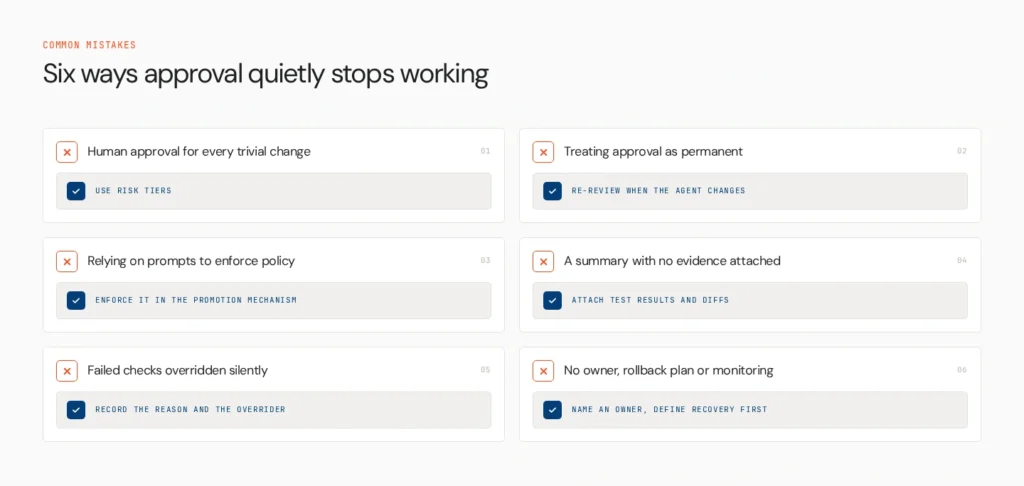
- Requiring human approval for every trivial change. It creates bottlenecks. Use risk tiers.
- Treating approval as permanent. Invalidate or re-review when the agent changes after sign-off.
- Relying on prompts to enforce release policy. Enforce it in the promotion mechanism.
- Showing reviewers a summary without evidence. Attach test results and diffs.
- Letting failed checks be overridden silently. Require a recorded reason and an authorised overrider.
- Having no release owner, rollback plan or monitoring. Name an owner and define recovery before launch.
Make the approval stick
Reliable production approval depends on traceable evidence, explicit decision rights and an enforced release path. Start with the Agents to Production playbook, then see how Opencontroller can govern agents across your enterprise, or book a demo to talk through your release process.
FAQs
Start with the task, then define the steps, tools, data access, checks and human review points, and test it before release. Add approval gates in proportion to risk.
Classify releases by risk, set mandatory test gates, route evidence to the right reviewers, record decisions against a specific version and block promotion until every condition is met.
AI can draft, run and adapt workflow steps. Automating the steps isn’t the same as automating the approval decision, and high-impact decisions may still need human authorisation.
Limit permissions to what each task needs, gate releases, screen inputs and outputs, monitor behaviour and keep audit trails and a rollback path.
Book A Demo: Click Here
Join our Slack: Click Here
Link to our GitHub: Click Here
Got a use case in mind?
8 weeks from use case to agents running in production.
Platform, people and FDEs, all in. Bring your environment. We'll co-build and stay until it's live.
Talk to UsFree resource
101 AI Agents Use Cases
100+ production-ready AI agent use cases across Marketing, Sales, HR, Banking, Insurance, Operations and a lot more
Download now