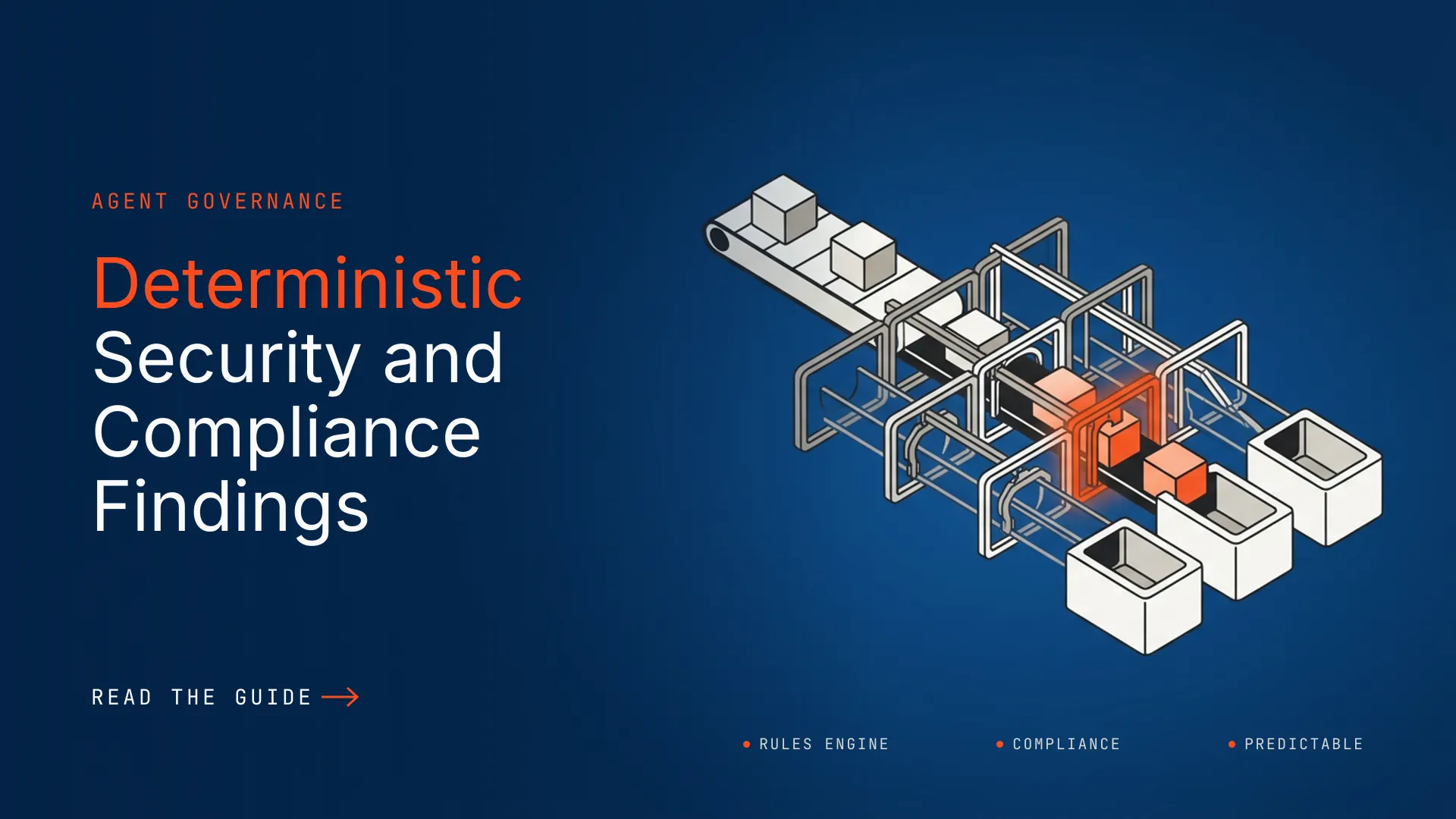
OpenController’s security and compliance findings are deterministic, based on out-of-the-box definitions that you can fully customize.
The analysis does not use a large language model.
This means every finding is predictable, repeatable, and auditable.
You get a standard set of rules to start, the power to adapt them to your needs, and the assurance of consistent enforcement. This approach is central to OpenController by Lyzr, Lyzr's agent control plane.
A control plane is the neutral layer that governs everything beneath it. For AI agents, OpenController is that layer, and its governance must be absolute and predictable.
Deterministic Rules, Not Probabilistic Guesses
Security findings in OpenController are generated by a rules engine.
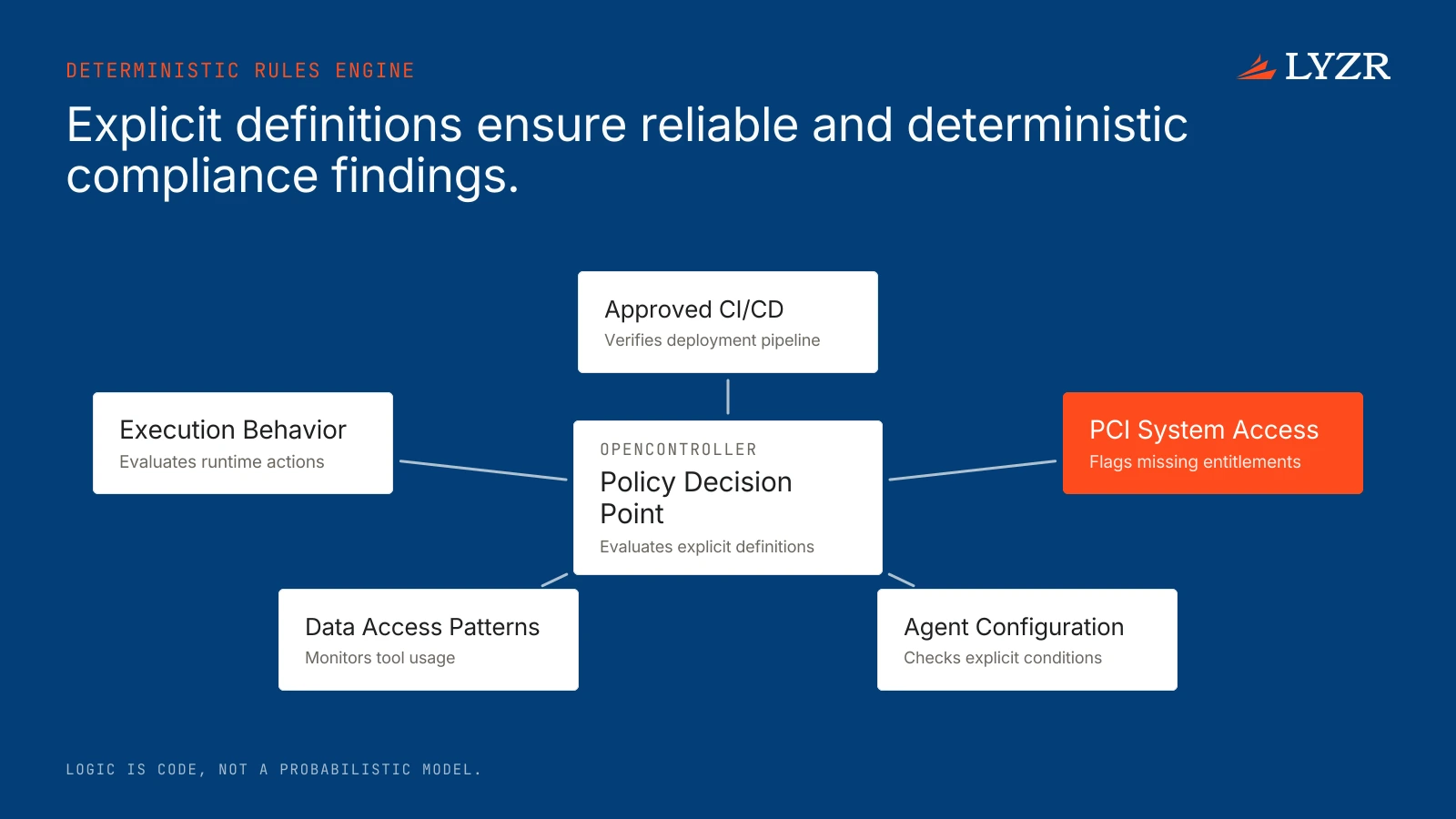
These rules are explicit definitions that check for specific conditions in an agent's configuration, data access patterns, or behavior during execution.
For example, a rule might flag any agent attempting to call a tool that accesses a system tagged as 'PCI' without the proper entitlements. Or it might identify an agent that was not deployed through an approved CI/CD pipeline.
Because the logic is code, not a probabilistic model, the outcome is always the same.
Given the same agent and the same policy, the engine will always produce the same findings. This is essential for building a reliable system of record for compliance and security reviews.
Start Fast, Then Make It Your Own
The control plane ships with a core set of security and compliance definitions.
These cover common risks and best practices for agentic systems, allowing you to establish a baseline of governance immediately.
But your environment is unique.
You can write your own policies from scratch or extend the built-in ones. This allows you to align agent governance with your specific internal security standards, data handling policies, and regulatory obligations.
The policies you define are then applied universally. You can enforce them on any non-compliant agent, regardless of whether it was built internally or with a third-party framework.
The Right Tool for the Job
LLMs are powerful for summarization, generation, and semantic search.
They are not the right tool for mission-critical policy enforcement.
Relying on an LLM to interpret a security policy introduces unacceptable risk. Its probabilistic nature means a violation might be missed, or a false positive might be generated, based on the nuances of a prompt or a change in the model version.
OpenController uses deterministic logic for enforcement precisely to avoid this ambiguity.
This ensures that when an auditor asks why an agent was blocked, the answer is a clear rule violation, not a model's "best guess." It's one of the core built-in security features that provides a foundation for trust in your agent ecosystem.
Predictable Control is Real Control
Your takeaway: Security and compliance findings in OpenController are designed for reliability.
They are deterministic, customizable rules that give you an auditable and consistent way to govern your AI agents.
See how it works.
Want to see how it fits your stack? Talk to us about OpenController by Lyzr.
Got a use case in mind?
8 weeks from use case to agents running in production.
Platform, people and FDEs, all in. Bring your environment. We'll co-build and stay until it's live.
Talk to UsFree resource
101 AI Agents Use Cases
100+ production-ready AI agent use cases across Marketing, Sales, HR, Banking, Insurance, Operations and a lot more
Download now