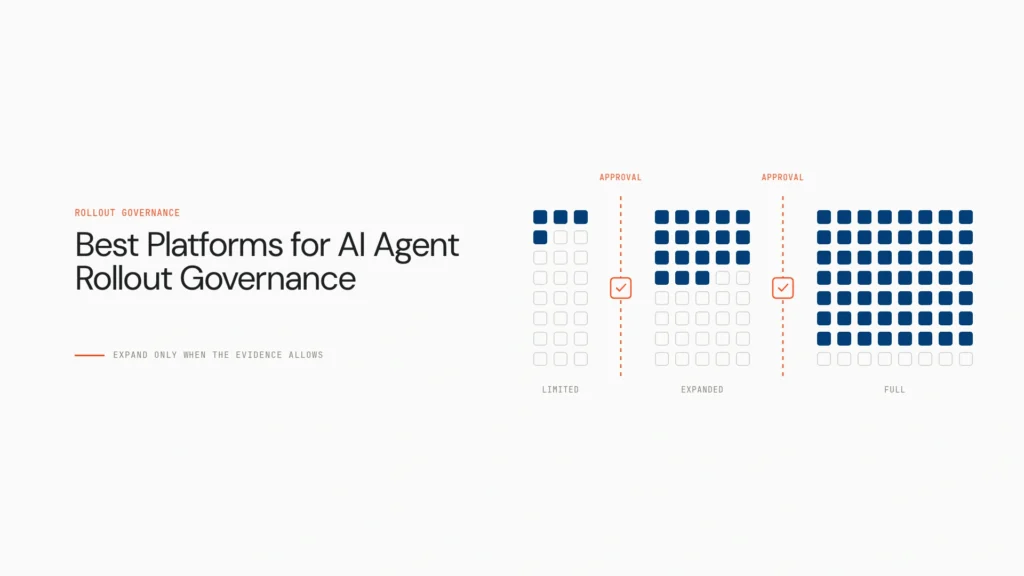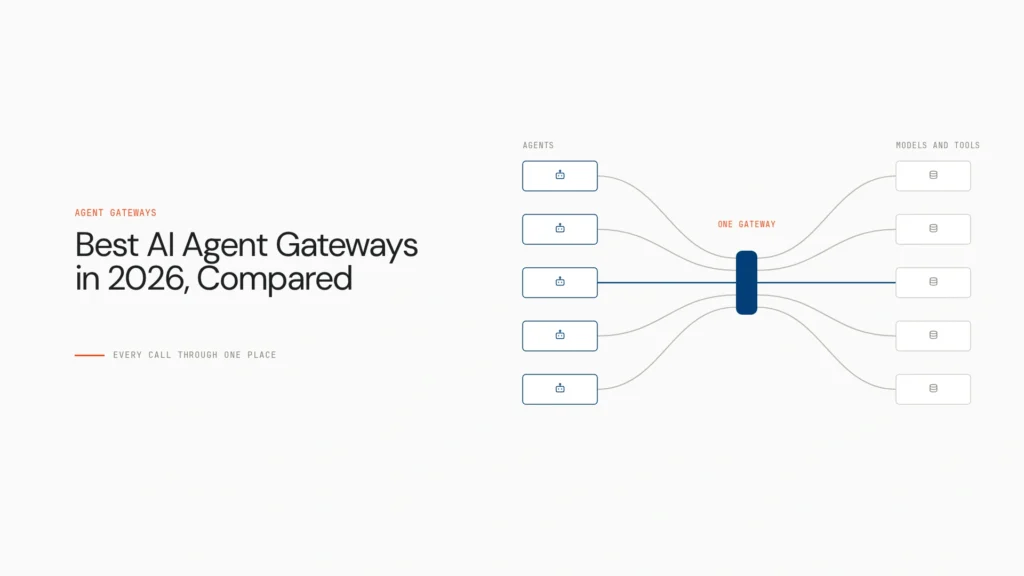
Ask three teams how their agents reached production and you’ll get three answers. A Lambda function. A notebook endpoint. A container on a VM that only one engineer knows how to restart. Each one works. None of them can be rolled back by anybody else.
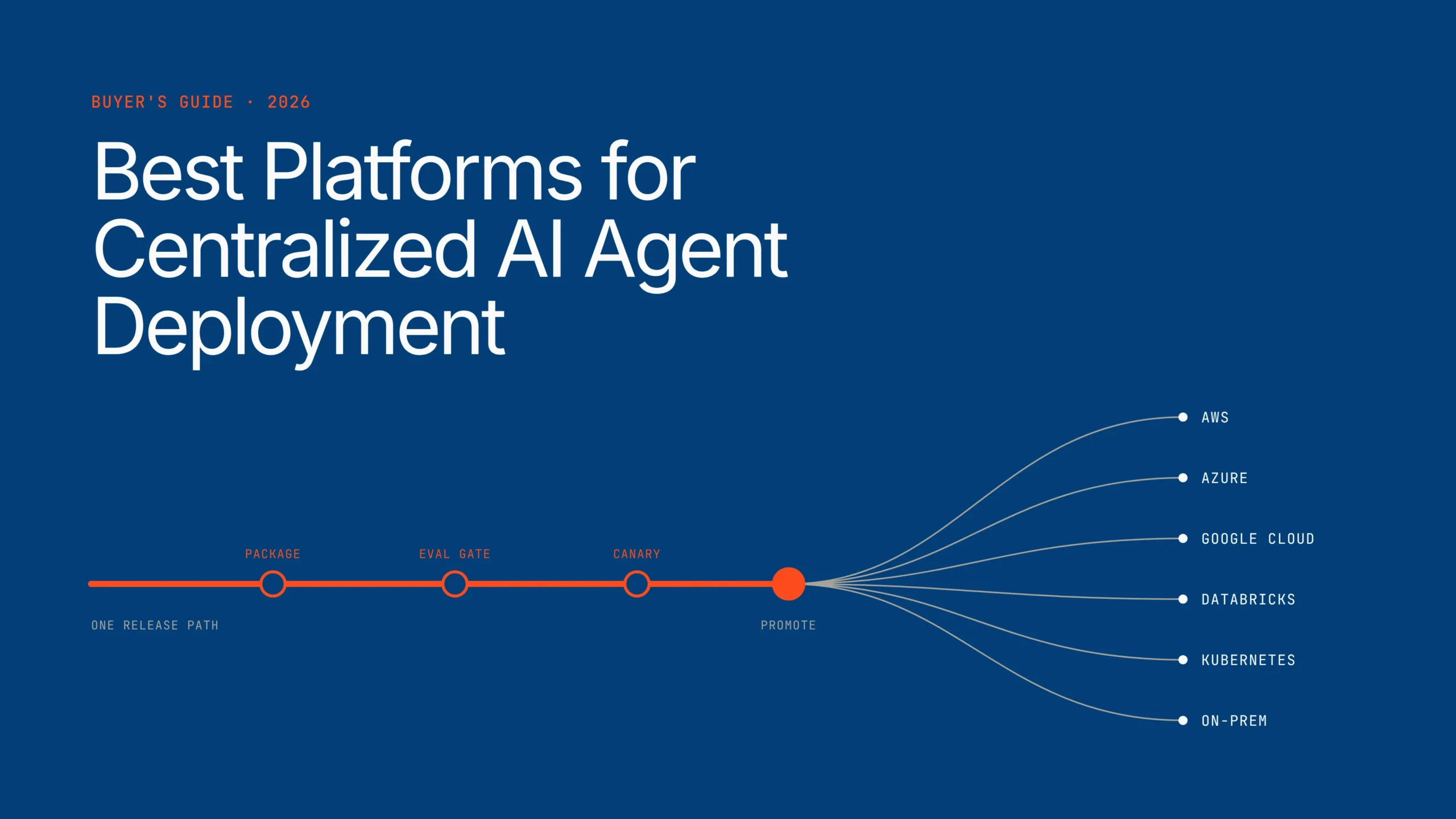
That’s what the best platforms for centralized AI agent deployment fix. They give every team one way to package an agent, promote it from development to production behind evaluation gates, assign it its own identity, and roll it back in one step, whichever framework it was written in.
Below are six, held to that promise. Deployment is one stage of the wider agent lifecycle. This guide stays on the stretch between “works in the notebook” and “live for every customer.”
Quick shortlist
- Lyzr Studio + OpenController: one release path for every agent, inside your network.
- Microsoft Foundry Agent Service: Microsoft 365-centric teams.
- Amazon Bedrock AgentCore Runtime: AWS builders who want versioned endpoints.
- Google Gemini Enterprise Agent Platform: Google Cloud teams on ADK.
- Databricks Agent Bricks: agents that live next to lakehouse data.
- LangSmith Deployment: teams that want a managed agent server they can self-host.
Deployment is where agent programs stall
Building agents got cheap. Shipping them didn’t.

Deloitte’s State of AI in the Enterprise 2026 surveyed more than 3,000 director-to-C-suite leaders. Only 25% of respondents had moved 40% or more of their AI pilots into production. Close to three-quarters of companies plan to deploy agentic AI within two years, yet only 21% of those report a mature governance model for agents.
McKinsey’s The state of AI in 2026, drawn from 1,719 respondents in 97 countries, shows who gets through. Among respondents at organizations with more than $1 billion in revenue, 40% report scaling AI agents, up from 27% a year earlier. At smaller organizations the share stayed flat at 22%.
Big companies aren’t writing smarter agents. They’ve paved a shared road to production, so the tenth agent ships faster than the first.
Centralize the release path, not the runtime
Here’s where we’ll pick a fight. Many “centralized deployment” pitches really mean: move every agent onto our runtime. That holds until the data team needs Databricks, the Microsoft shop wants Teams publishing and the KYC agent has to stay on-prem. Forcing one runtime trades agent sprawl for a migration backlog.
What belongs in the center is the path an agent takes to go live. We scored every platform on five parts of it:
- Package: does it accept code from any framework, or only its own?
- Promote: versioned releases, canaries and one-step rollback.
- Gate: can a failed evaluation stop a release?
- Identify: does each deployed agent get its own identity instead of shared API keys?
- Place: can it run where your data has to stay, and on runtimes the vendor doesn’t own?
A platform can host agents beautifully and still miss three of these.
The 6 best platforms for centralized AI agent deployment
1. Lyzr Studio + OpenController
Lyzr covers both halves. In Lyzr Studio, every agent you build is published as an API endpoint with no containers or hosting to wire up. OpenController then brings one release path to every agent, including ones written in LangGraph, running on AgentCore or hosted in Foundry. Those agents stay on the runtimes they use today. OpenController decides how new versions go live.
Its Deploy block runs ordered environments, approvals, canaries and one-step rollback, plus quarantine, while your CI keeps building. Releases are gated on multi-turn, red-team and regression evals.
Here’s what a gate looks like on the product page. A claims-intake agent’s v15 hit 96.8% task success but scored 89.6% on groundedness against a 92% bar. Promotion to staging stopped, the 38 failing cases went to the owner, and v14 kept serving production. A pipeline that only checks whether the build passes would have shipped it.
Each agent gets a workload identity through your IdP, so nothing ships holding shared keys. The control plane runs in your VPC, on-prem or air-gapped, and a first environment connects in under a week. Optimus, Lyzr’s air-gapped appliance, ships Q4 2026 for teams that want the hardware too.
Good fit when agents come from more than one framework or cloud, or a regulator decides where they run. Think twice when you have two agents on one cloud and its native pipeline already covers you.
How to Take Agents to Production: The release, evaluation and ownership steps that get an agent from pilot to live traffic without a rewrite. Get the playbook →
2. Microsoft Foundry Agent Service
Hosted agents in Foundry reached general availability in July 2026. Bring a containerized agent built with Microsoft Agent Framework, LangGraph or your own code, and Foundry handles scaling, session state and security. Each agent gets its own Entra identity and can be published into Teams and Microsoft 365 Copilot. Rolling back means pointing the endpoint at the previous version.
- Good fit when the people using your agents already live in Microsoft 365.
- Watch for: Microsoft’s docs say traffic splitting between versions isn’t supported, so every release is a full cut-over, not a canary.
- With Lyzr: OpenController’s Foundry adapter puts these releases behind shared gates. See Lyzr vs Microsoft Copilot.
3. Amazon Bedrock AgentCore Runtime
AgentCore Runtime is serverless hosting with session isolation for agents from any framework or model, and each deployed agent gets a workload identity. Every update creates a new version, and named endpoints such as production stay pinned until someone moves them, so rollback means pointing the endpoint back. The now-GA AgentCore harness lets teams A/B test prompt and tool changes without redeploying code.
- Good fit when platform engineers want serverless agent hosting and infrastructure-as-code control on AWS.
- Watch for: the release path ends at the AWS boundary, and the DEFAULT endpoint follows the latest version automatically, so pin production to a named endpoint.
- With Lyzr: OpenController’s AgentCore adapter brings AWS releases into one view. See Lyzr on AWS.
4. Google Gemini Enterprise Agent Platform
Google folded Vertex AI into Gemini Enterprise Agent Platform in April 2026, and Agent Engine became Agent Runtime. It added custom containers, sub-second cold starts and runs of up to seven days. agents-cli deploy ships an agent in one command, and Agent Identity gives each one its own IAM principal.

- Good fit when your teams are standardizing on ADK and Gemini.
- Watch for: redeploying creates a new agent resource with a new identity, so IAM grants have to follow it.
- With Lyzr: OpenController’s adapter keeps Google releases under shared rules.
5. Databricks Agent Bricks
Databricks starts from the data. At Data + AI Summit 2026, Agent Bricks became a full agent platform: agents, tools and models register in Unity Catalog beside the tables they read. agentbricks deploy ships a LangGraph, OpenAI Agents SDK or custom agent to an authenticated endpoint on Databricks Apps.
- Good fit when an agent’s main job is reasoning over lakehouse data.
- Watch for: the deploy docs don’t cover version rollback or canary releases, and the release path stays inside Databricks.
- With Lyzr: Unity Catalog keeps data permissions; OpenController holds release rules for agents outside the lakehouse.
6. LangSmith Deployment
LangChain’s Agent Server gives agents durable execution, streaming and horizontal scaling, for agents built with any framework, plus versioning and instant rollbacks. Placement is where it shines: LangChain’s cloud, agent servers in your VPC, or a fully self-hosted, air-gapped setup.

- Good fit when you want a managed agent server and data residency is non-negotiable.
- Watch for: hybrid and self-hosted need the Enterprise plan, and agents have to move onto Agent Server.
- With Lyzr: see Lyzr vs LangGraph.
Compare the six side by side
| Platform | Managed hosting for any agent | Versioned releases and rollback | Canary traffic split | Eval-gated promotion | Per-agent identity | On-prem or air-gapped | Releases on runtimes it doesn’t own |
| Lyzr Studio + OpenController | ◐ | ✓ | ✓ | ✓ | ✓ | ✓ | ✓ |
| Microsoft Foundry Agent Service | ✓ | ✓ | ✗ | ◐ | ✓ | ✗ | ✗ |
| Amazon Bedrock AgentCore Runtime | ✓ | ✓ | ◐ | ◐ | ✓ | ✗ | ✗ |
| Google Gemini Enterprise Agent Platform | ✓ | ◐ | ✗ | ◐ | ✓ | ✗ | ✗ |
| Databricks Agent Bricks | ✓ | ◐ | ◐ | ◐ | ◐ | ✗ | ✗ |
| LangSmith Deployment | ✓ | ✓ | ✗ | ◐ | ◐ | ✓ | ◐ |
✓ built in and documented · ◐ partial, limited to some agent types, or needs extra setup · ✗ not supported or not in public documentation. Editorial assessment, October 2026. Confirm current features with each vendor.
Every runtime vendor wins the first column, and should. Lyzr Studio hosts Studio agents; OpenController doesn’t host agents built elsewhere, it controls how they ship. The last four columns decide whether deployment is truly centralized, and that’s where the gap opens.
Choose the pattern before the product
Most shortlists collapse into one of three shapes.
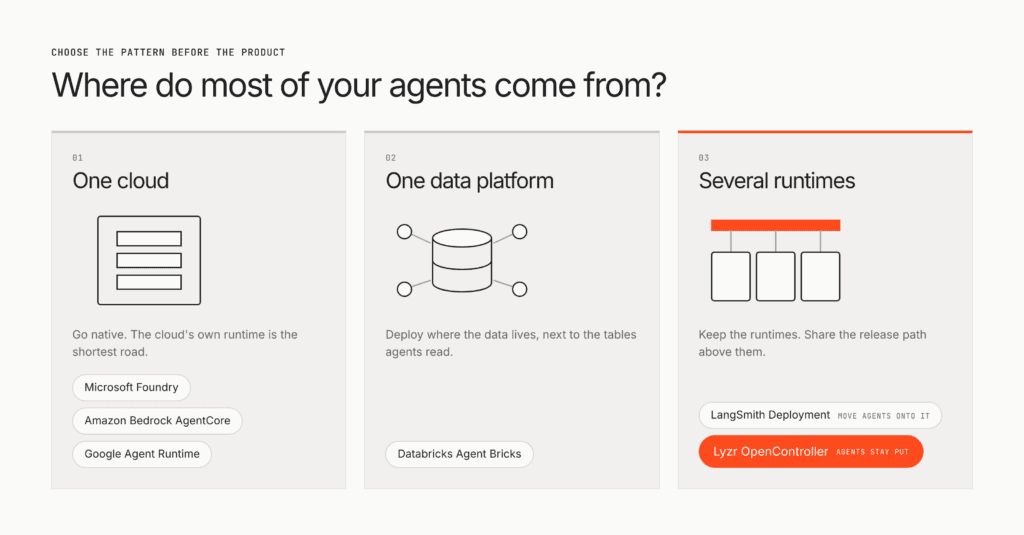
If one cloud owns nearly everything, its native runtime is the shortest road. If agents mostly reason over lakehouse data, deploy where the data lives with Databricks. If agents come from several runtimes, either move them onto one managed server, as LangSmith offers, or keep them where they run under one release layer, as OpenController does.
- One cloud (single box with stacked agents) → chips: Microsoft Foundry · Amazon Bedrock AgentCore · Google Agent Runtime
- One data platform (agents orbiting a database cylinder) → chip: Databricks Agent Bricks
- Several runtimes (three boxes under one amber bar) → chips: LangSmith Deployment (grey, note “move agents onto it”) · Lyzr OpenController (amber, slightly larger, note “agents stay put”) Footer note under column three: “Keep the runtimes. Share the release path.” Alt text: how to choose an AI agent deployment platform
Run a deploy-day dry run
Demos ship a sample agent to an empty environment. Bring yours and ask for these five, live:
- “Deploy this agent from a framework you don’t sell.” Packaging is where lock-in hides.
- “Send 10% of traffic to v2, then roll back while I watch.” Count the clicks.
- “Fail an eval, then try to promote anyway.” A real gate says no.
- “Show me the identity this agent uses to call tools.” Shared keys are a fail.
- “Deploy it where our data has to stay.” Get the region, VPC or on-prem answer in writing.
If a platform passes 2 and 3 but fails 1, you’ve found a good runtime, not a centralized deployment platform.
Find out whether your teams are ready for a shared release path, and which gaps to close before the next agent ships with Agentic AI Maturity Assessment for Enterprises. Take the assessment →
Judge the platform by your second agent
Any platform can get one agent live. The real test comes six weeks later, when a different team ships a second agent in a different framework. If it takes the same road, through the same gates, with the same rollback, you’ve centralized deployment. If it needs a new pipeline, you’ve added another runtime.
Book a demo and route one real release through OpenController, gate and canary included.
FAQ
The best platforms for centralized AI agent deployment in 2026 include Lyzr Studio with OpenController, Microsoft Foundry Agent Service, Amazon Bedrock AgentCore Runtime, Google Gemini Enterprise Agent Platform, Databricks Agent Bricks and LangSmith Deployment. Native runtimes suit single-cloud teams; mixed estates need a shared release layer.
It means every team ships agents through one shared path: the same packaging, staged environments, evaluation gates, identity model and rollback. The agents themselves can still run on different clouds or frameworks. What’s centralized is how a version reaches production, and who can see or reverse it.
Yes. LangSmith Deployment supports a fully self-hosted setup for air-gapped sites, and Lyzr OpenController runs in your VPC, on-prem or air-gapped, with no control-plane data required to reach Lyzr. The hyperscaler runtimes covered here run only in their own clouds.
Keep every release as an immutable version and route traffic through named endpoints or environments. Rolling back then means pointing production at the previous version, as AgentCore and Foundry endpoints and OpenController’s one-step rollback do, rather than rebuilding and redeploying older code under pressure.
Book A Demo: Click Here
Join our Slack: Click Here
Link to our GitHub: Click Here