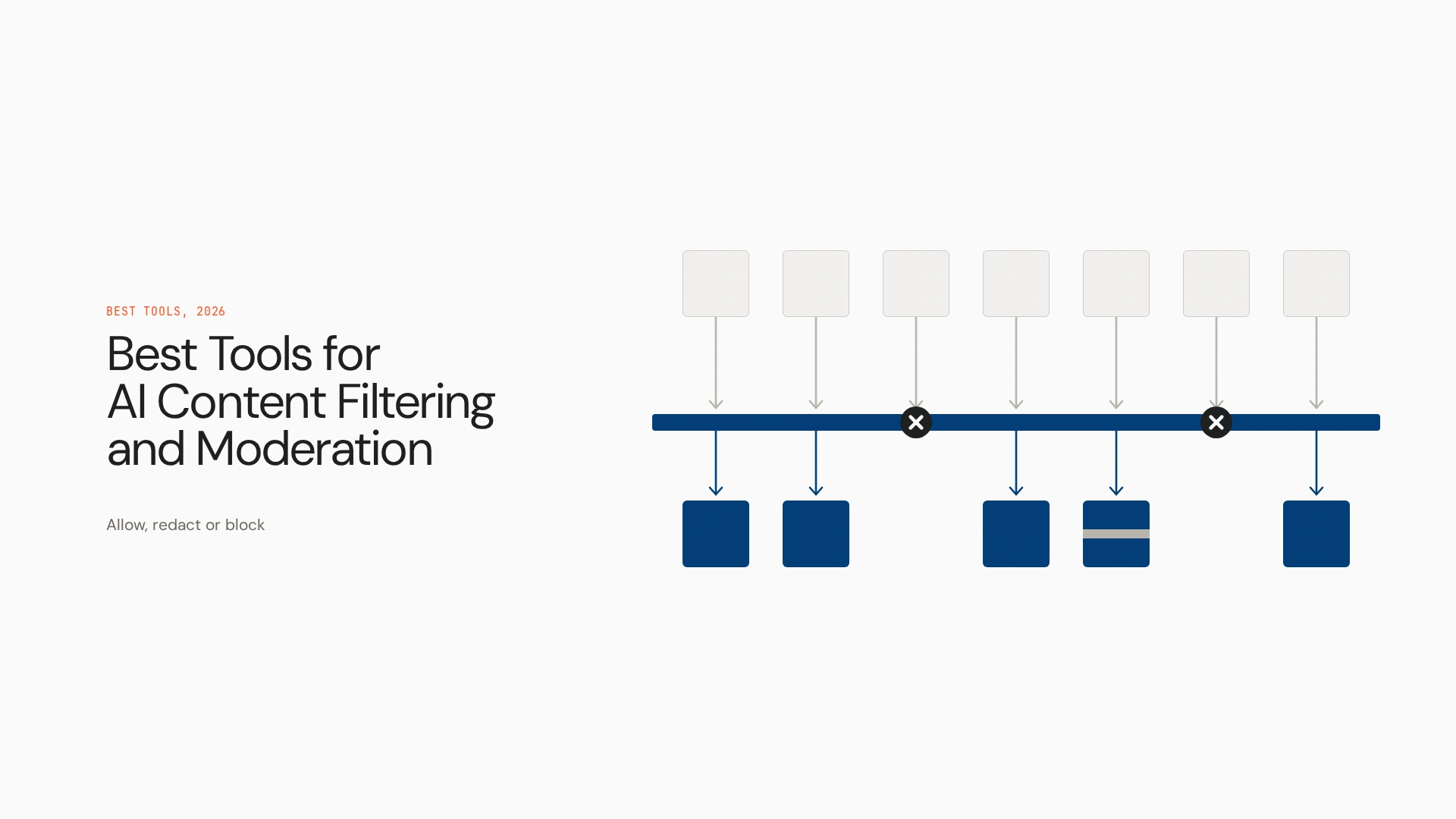
An AI application can receive or generate content that breaks a safety policy, exposes sensitive information, or puts users and the business at risk. A keyword filter won’t catch most of it, because modern content is contextual, multimodal, adversarial and often generated on the fly by a model.
Today’s moderation tools classify content, score severity, detect unsafe prompts, analyze several media types, apply custom policies and support real-time enforcement. But moderation is one decision inside a larger AI workflow. Enterprises also need to know which agent produced the content, which policy applied, whether that agent was approved, and what happens afterward. This guide compares tools for AI content filtering and moderation across classification, multimodal coverage, AI-specific safety controls, custom policies, runtime enforcement, human review, and where an AI control plane fits.
Get The Short Answer
- Best for enterprise governance: Opencontroller. An AI control plane for the agents around moderation, not a standalone moderation API.
- Best for enterprise cloud content safety: Azure AI Content Safety. Text and image harm detection, Prompt Shields, groundedness, protected material and task adherence.
- Best for multimodal moderation: Hive. Text, images, video and audio through one platform.
- Best for synthetic media and deepfakes: Sightengine. Image and video analysis is its core.
- Best for hybrid automated and human moderation: Besedo. Automation for scale, people for ambiguity.
- Best for real-time communication: Stream Moderation. Built for chat and feeds.
What is AI Content Filtering and Moderation?
AI content filtering checks whether content meets safety, policy or business rules. AI content moderation uses machine learning to classify, score, flag, block, filter or route content for review. Both apply to user-generated and AI-generated content, across text, images, video, audio and mixed inputs.
A moderation API usually returns a classification or score. The application then decides what to do. Azure AI Content Safety shows how far the category has widened: it detects harmful user-generated and AI-generated content, and adds groundedness, protected-material and prompt-attack detection to basic harm classification.
Detection tells you what content appears to contain. Enforcement decides what the application does about it. Governance decides how those decisions fit the larger AI system.
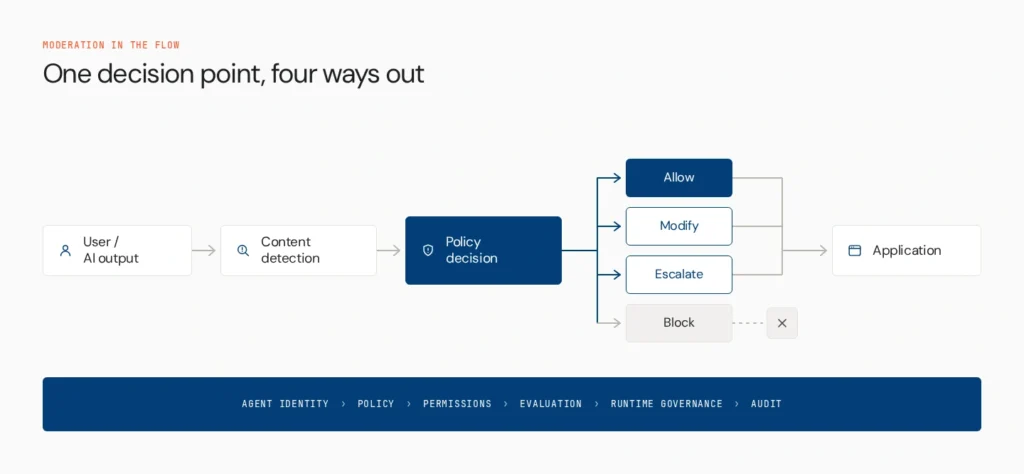
The AI Content Moderation Layers
1. Content classification. Detects categories such as hate, sexual content, violence, self-harm and harassment. Good systems return severity levels, not a yes or no. For example, Azure uses a severity threshold of low, medium or high for hate, sexual, self-harm and violence content, which sets what gets flagged.
2. Multimodal moderation. Evaluates text, images, video, audio or combinations. A text-only API and a multimodal platform aren’t interchangeable, so match the tool to the modalities you actually handle.
3. AI-specific safety filtering. Covers prompt injection, jailbreaks, unsafe responses, protected material and groundedness. Azure’s Prompt Shields address both jailbreak attacks and indirect attacks, and Task Adherence helps keep agents aligned with user instructions and task goals.
4. Custom policy enforcement. Custom categories, blocklists, thresholds and industry rules. Generic categories rarely cover every enterprise’s needs. Custom-category functionality at some vendors is changing, so check current product docs rather than older API names.
5. Runtime action and human review. Classification alone doesn’t moderate anything. The action layer runs from allow, block, warn, redact and modify to escalate and human review, and it needs thresholds, appeals and an audit trail.
6. Agent-level governance. When agents generate content or act on it, organizations also need identity, ownership, permissions, evaluation history, deployment state and auditability. That is where an AI control plane becomes relevant.
How We Compared the Tools
We looked at content types supported, text, image, video and audio capability, AI-generated content support, harm categories, custom policy options, real-time performance, integration model, runtime enforcement, human review, enterprise deployment, governance and auditability, fit for agentic workflows, and distinct positioning. We didn’t include a generic AI safety or observability platform just because it is popular, and we didn’t pad the list.
The best tools for AI content filtering and moderation
1. Opencontroller

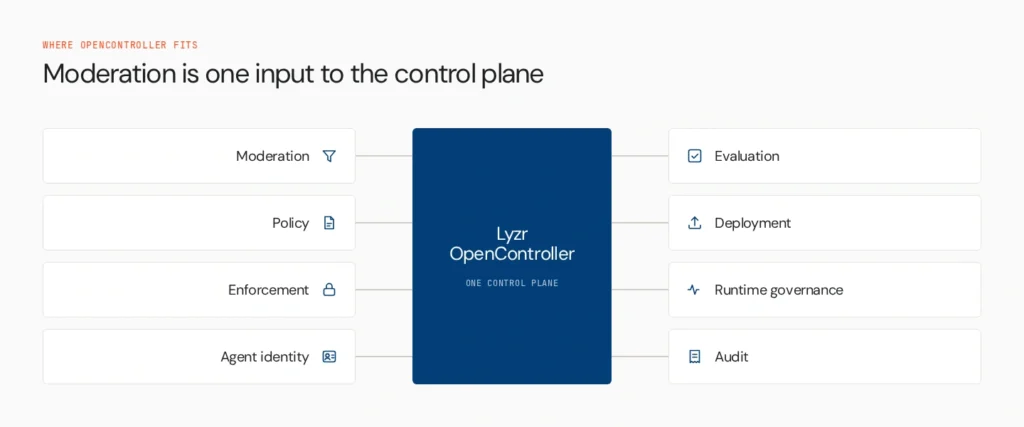
Opencontroller is Lyzr’s AI control plane. It isn’t a content moderation API, and it doesn’t replace Azure, Hive or any engine below. It governs the agents and workflows that use them. A moderation tool evaluates the content. Opencontroller governs the agent and workflow around that decision.
Consider what follows a flagged output. A moderation API flags a response as unsafe. A filter blocks it. A reviewer takes the edge case. Then the harder questions arrive. Which agent produced it? Which version was running, and who owns it? What policy applies, and what is that agent allowed to access? Was it evaluated before production? What happens if it violates policy repeatedly: restrict, stop, roll back? How is the decision recorded?
That is the gap Opencontroller addresses. Moderation detects. Policy decides. Enforcement acts. Governance controls the agent around the decision. It sits above existing content safety, moderation, evaluation and observability tools, and doesn’t try to substitute for them.
What it covers
- Agent registry and identity. Each agent is discovered, owned and traceable through an agent registry, so a moderation event maps to a specific agent and version.
- Evaluation before production. Safety and quality gates hold a version back until required checks pass. See AI agent evaluation.
- Staged promotion. Agents move to production in stages, with approvals recorded.
- Policy and permissions. Rules and access limits apply around agents, consistently across tools and teams.
- Runtime governance and observability. Live activity sits next to identity and policy. See AI agent observability.
- Audit and improvement. Decisions are logged, and production signals feed back into evaluation. This is AI agent governance in practice.
Why it matters across a mixed estate. Large organizations run several agents, frameworks, models and clouds, including vendor-built and custom agents, each possibly using a different moderation provider and business-unit policy. The moderation engines will differ. The governance layer shouldn’t. Lyzr positions OpenController as one control plane across clouds, frameworks, teams and environments.
Strengths
- Ties safety decisions to the agent, version and owner behind them
- Consistent governance even when moderation tools differ
- Covers evaluation, promotion, runtime and audit in one place
Weaknesses
- It doesn’t classify or moderate content, so you still need a moderation engine
- It doesn’t replace human moderation
- More than a single-application team needs
Best for: Enterprises moving from individual moderation APIs to governed AI systems across several agents. Skip it for now if you run one chatbot and only need a harm filter. Lyzr’s Responsible AI work covers built-in safety checks, and the Agents to Production playbook covers staging.
2. Azure AI Content Safety

Azure AI Content Safety is Microsoft’s enterprise content safety service, now surfaced through Foundry guardrails. It covers text and image harm detection, prompt attacks, groundedness, protected material and agent task adherence. Its documentation notes that groundedness and task adherence are preview features, and that groundedness isn’t yet supported for agent guardrails.
An important distinction: the service classifies and scores. In standalone use, your application decides whether to allow, tag, remove or escalate. Inside Foundry guardrails, thresholds can block model inputs and outputs directly.
Key features: Four-category harm severity thresholds, Prompt Shields, Groundedness and protected-material detection, Task adherence and custom categories
Strengths: Broadest AI-specific safety set in this list, Native fit with Azure and Foundry, Configurable severity per category
Weaknesses: Strongest inside Microsoft’s ecosystem, Some features are in preview or region-limited, Product naming and custom-category APIs have shifted, which complicates documentation
Best for: Azure-centric enterprises that want integrated, configurable content safety. Not ideal if you need video and audio moderation depth.
Where Opencontroller fits: Azure flags the response. Opencontroller tracks which agent produced it and whether that agent should keep running.
3. Hive Moderation

Hive is a multimodal moderation platform. Its dashboard API lets one request go to several models at once: a video task can be submitted to visual moderation, audio moderation, demographics and AI-generated content detection together, and rules can combine their results, such as removing a video and banning the user when two models agree. Hive also offers deepfake and AI-generated media detection.
Key features: Text, visual, audio and OCR moderation, Multi-model submission, AI-generated and deepfake detection, Moderation dashboard for review
Strengths: One integration across many media types, Strong for high-volume trust and safety teams, Includes synthetic-media detection
Weaknesses: Managing policies across modalities adds complexity, Premium positioning, and published costs vary by model, Independent benchmarks for audio and video are limited
Best for: Platforms with mixed media at scale. Not ideal for a text-only chatbot.
Where Opencontroller fits: Hive classifies the media. Opencontroller governs the AI agents that generate or act on it.
4. Sightengine
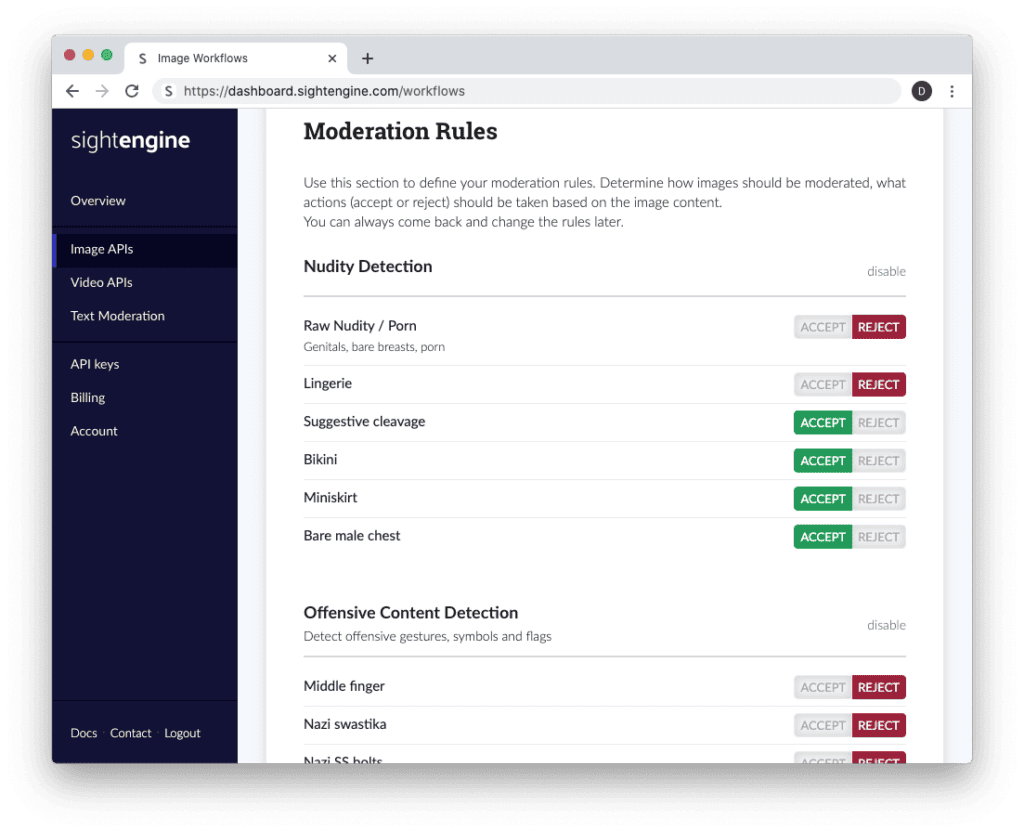
Sightengine is an API-first media moderation service with a synthetic-media and deepfake angle. It handles image and video moderation and nudity detection, along with detection of AI-generated media.
Key features: Image and video moderation, NSFW detection, AI-generated and deepfake detection, API-first integration
Strengths: Strong focus on visual media, Easy to integrate, Separates synthetic-media detection from harm classification
Weaknesses: Less relevant for text-heavy applications, Limited governance and workflow tooling, Detection quality on your content needs testing
Best for: Apps where image and video analysis is central. Not for chat moderation.
Where Opencontroller fits: Sightengine inspects the media. Opencontroller governs the agent pipeline around the result.
5. WebPurify
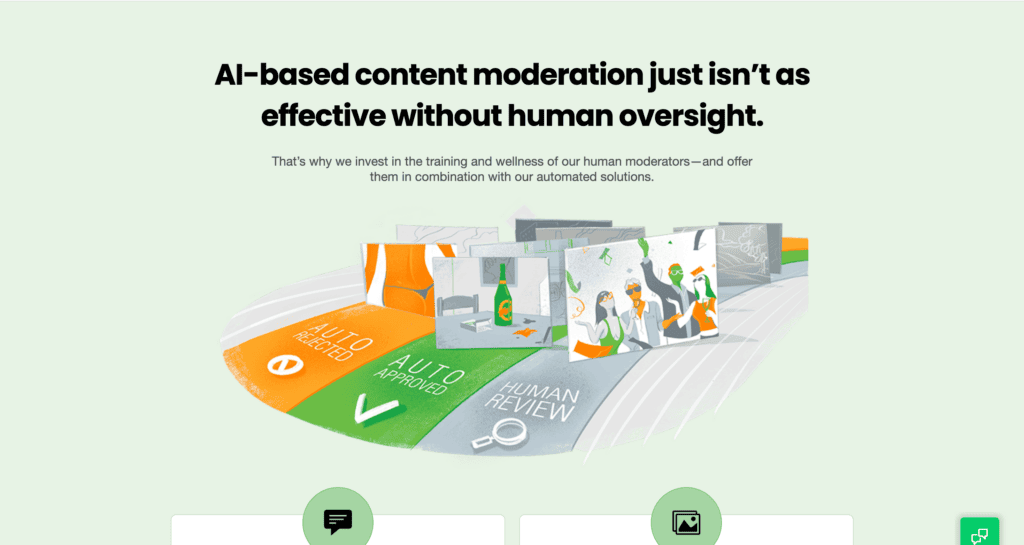
WebPurify is a focused filtering and moderation service covering profanity filtering, image moderation, and human moderation options. It suits teams that want a direct service without a larger AI safety stack.
Key features: Profanity filtering, Image moderation, Human moderation option, Probability scores
Strengths: Straightforward integration, Mix of automated and human options, Practical for smaller teams
Weaknesses: Narrower on AI-specific safety such as prompt attacks, Not an agent governance platform, Less suited to complex multimodal policies
Best for: Teams needing simple, dependable filtering. Not ideal for governing AI agents.
Where Opencontroller fits: WebPurify filters content. Opencontroller governs the agents sending it.
6. Besedo

Besedo combines automated classification with human review for trust and safety operations. The idea is that automation handles scale and humans handle ambiguity. That model suits marketplaces and communities where a model score can’t settle every decision.
Key features: Automated classification and tagging, Human review and escalation, Localization, Trust and safety operations
Strengths: Handles edge cases and appeals, Operational support not only an API, Useful for platforms with nuanced policies
Weaknesses: Service model costs more than an API alone, Slower than fully automated checks, Less relevant to agent-specific risks
Best for: Marketplaces and communities that need people in the loop. Not ideal for low-latency AI guardrails.
Where Opencontroller fits: Besedo’s reviewers decide cases. Opencontroller records which agent triggered them and what follows.
7. Stream Moderation

Stream Moderation is built into Stream’s communication infrastructure for chat, feeds and social products, where moderation has to happen inside a live experience.
Key features: Chat and feed moderation, Low-latency checks, Automated workflows, Integration with Stream products
Strengths: Moderation inside real-time experiences, Review tooling alongside automation, Fast to adopt for Stream customers
Weaknesses: Strongest within Stream’s ecosystem, Less focused on multimodal or AI-agent safety, Not an enterprise governance layer
Best for: Products built on Stream that need live chat moderation. Not for standalone agent safety.
Where Opencontroller fits: Stream moderates the conversation. Opencontroller governs agents participating in it.
Compare All Tools Side by Side
| Tool | Text | Image / video / audio | AI-specific safety | Custom policies | Runtime enforcement | Human review | Enterprise controls | Best for |
|---|---|---|---|---|---|---|---|---|
| Opencontroller (AI control plane) | — | — | — | ✓ (policy) | ✓ | Partial (escalation) | ✓ | Governing agents around moderation |
| Azure AI Content Safety | ✓ | Image ✓ | ✓ | ✓ | ✓ | — | ✓ | Enterprise cloud safety |
| Hive | ✓ | ✓ | Partial | ✓ | Partial | ✓ (dashboard) | ✓ | Multimodal moderation |
| Sightengine | ✓ | ✓ | Partial | ✓ | Partial | — | Partial | Synthetic media |
| WebPurify | ✓ | Image ✓ | — | Partial | Partial | ✓ | Partial | Focused filtering |
| Besedo | ✓ | ✓ | — | ✓ | ✓ | ✓ | ✓ | Hybrid AI plus human |
| Stream Moderation | ✓ | Partial | Partial | ✓ | ✓ | ✓ | Partial | Real-time chat and feeds |
✓ built in · Partial · — not a focus.
Why Content Moderation is Only One Layer of AI Safety
Content moderation evaluates the content moving through an AI system. Agent governance evaluates and controls the agent producing or acting on it.
| Content moderation asks | AI agent governance asks |
|---|---|
| Is this content harmful? | Which agent produced it? |
| Does it violate a policy? | Is that agent approved to operate? |
| Should it be blocked? | What can the agent access? |
| Should it go to human review? | Which version is running? |
| What severity did it receive? | What evaluation history does it have? |
| What should happen to this content? | What should happen to the agent if this repeats? |
A moderation system can flag an unsafe output correctly and still leave the enterprise unable to say who generated it, what permissions that agent held, whether it was evaluated, and whether the issue is isolated or systemic.
How to Choose an AI Content Moderation Tool
- What content types? Text only points to a text-focused API. Mixed media points to Hive or Azure.
- Real time? Stream and low-latency APIs.
- AI-generated content and prompt attacks? Azure’s AI-specific controls.
- Deepfakes or synthetic media? Sightengine or Hive.
- Custom categories, blocklists and thresholds? Azure, Hive and Besedo.
- Human review? Besedo, Hive’s dashboard or WebPurify’s human option.
- On-prem or private-cloud deployment? Check each vendor.
- Auditability and multiple agents? That is the control-plane question.
Enterprises often combine layers: Azure, Hive or Sightengine to detect, a policy engine to decide, a guardrail or application to enforce, human review for edge cases, and Opencontroller to govern the agents and workflows around them. Few teams need every layer.
A Practical AI Content Moderation Checklist
- Define the content categories that matter to your product
- Separate hard-block categories from review-worthy ones
- Set severity thresholds from business risk
- Test false positives and false negatives
- Test multilingual and multimodal inputs where relevant
- Include adversarial prompts and filter-bypass attempts
- Decide which cases need human review
- Define what happens when moderation fails or is uncertain
- Log decisions with context
- Track performance after deployment and review policy as threats change
- Link safety decisions to the identity and lifecycle of any agent involved
Where does an AI Control Plane Fit into AI Content Moderation?
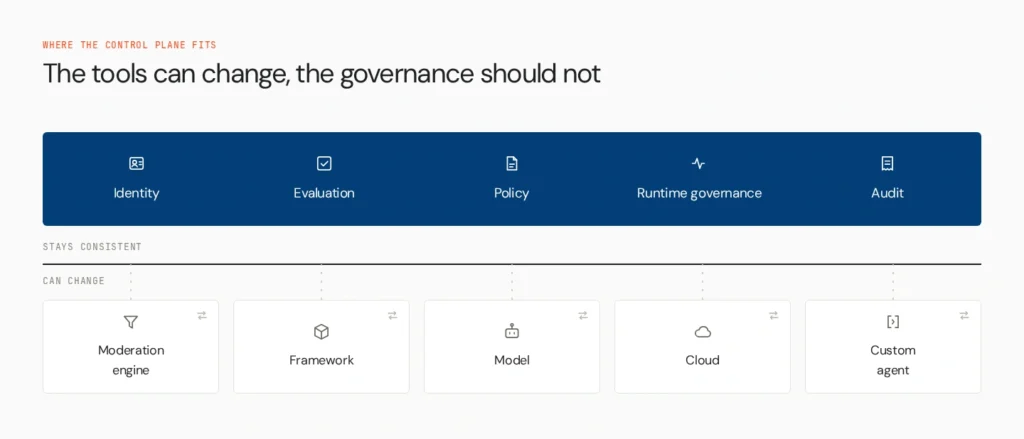
The progression runs from content detection to a policy decision, runtime enforcement, agent governance and continuous improvement.
A moderation tool identifies harmful content. A policy layer decides what should happen. A guardrail or application blocks, modifies or escalates. An AI control plane governs the agent and production workflow around those decisions.
Moderation checks the content. Policy determines the rule. Enforcement acts on the result. Governance controls the agent around the decision.
In practice, that means registering the agent, assigning identity, evaluating it before production, applying policy, controlling permissions, tracking version and deployment, monitoring runtime activity, auditing decisions, restricting or stopping an agent when required, and feeding production signals back into evaluation. Opencontroller doesn’t need to replace the moderation engine. It provides the governance layer around the agents using those engines.
That becomes important with multiple agents, frameworks, models and clouds, vendor and custom agents, different moderation providers and different business-unit policies. The tools below the line can change. The governance above it should stay consistent.
Govern the agents behind your moderation
Content moderation can tell you whether an AI output or user input violates a rule. Enterprise AI also needs to govern the agent making the decision or acting on the content. For enterprises moving from individual moderation APIs to governed AI systems, Lyzr’s Opencontroller connects content-safety and evaluation signals with agent identity, policy, deployment, runtime governance and auditability across the agent lifecycle. See how it fits your existing AI stack, or book a demo to assess how the control layer could work across your production agents. The AI agent governance guide is a good next read.
FAQs
Using AI to classify, score, flag, block or route content that may violate safety or policy rules. It applies to user-generated and AI-generated text, images, video and audio.
It depends on your content and workflow. Azure AI Content Safety for enterprise AI safety, Hive for multimodal, Sightengine for synthetic media, Besedo for human review, Stream for real-time chat.
Largely, for clear cases. Automated systems classify and act at scale, but ambiguous or high-stakes content still benefits from human review and clear escalation rules.
Filtering applies rules to allow or block content. Moderation is broader, including classification, scoring, review, escalation and appeals. In practice the terms overlap.
Hate, sexual content, violence, self-harm, harassment and profanity are common. Many tools also detect prompt attacks, protected material, synthetic media and sensitive information.
Yes, with multimodal or visual tools such as Hive, Sightengine and Azure’s image analysis. Check support for each modality, because text-only APIs don’t cover them.
A moderation model scores content as it is sent or generated, and the application allows, blocks, redacts or escalates based on thresholds. Low latency matters most in chat and feeds.
Yes, in both cases, using separate capabilities. Harm classifiers detect unsafe content, while dedicated detectors, such as those from Hive and Sightengine, target synthetic media. Neither is perfect.
Moderation checks the content. Governance controls the agent producing it, including identity, permissions, evaluation, deployment, policy and audit.
Often yes, because they do different jobs. A moderation tool evaluates content, and a control plane like OpenController governs the agents and workflows around those decisions.
Yes. Apply input and output filters with a moderation service or guardrails, set severity thresholds, and route uncertain cases to review.
There’s no single standard meaning. The phrase is used for different ideas across AI and content work, so check the source before relying on it.
Book A Demo: Click Here
Join our Slack: Click Here
Link to our GitHub: Click Here