Table of Contents
ToggleProcurement has quietly become one of the most complex functions inside large organizations.
Procurement operations face significant operational challenges, including managing cost, risk, compliance, sustainability, and supplier relationships, while being expected to move faster, operate leaner, and respond to constant disruption.
For years, digital procurement focused on system upgrades and workflow automation.
Today, the conversation has shifted. Procurement organizations are now strategically integrating AI to address these operational challenges, leveraging technology to improve decision-making, automate manual tasks, and manage complex data. Artificial intelligence is no longer about speeding up transactions alone; it is about changing how procurement decisions are made, governed, and scaled.
This article takes a deep look at how AI is reshaping procurement, from foundational automation to advanced, intelligence‑led execution, drawing from insights published by SAP, IBM, McKinsey, and The Hackett Group.
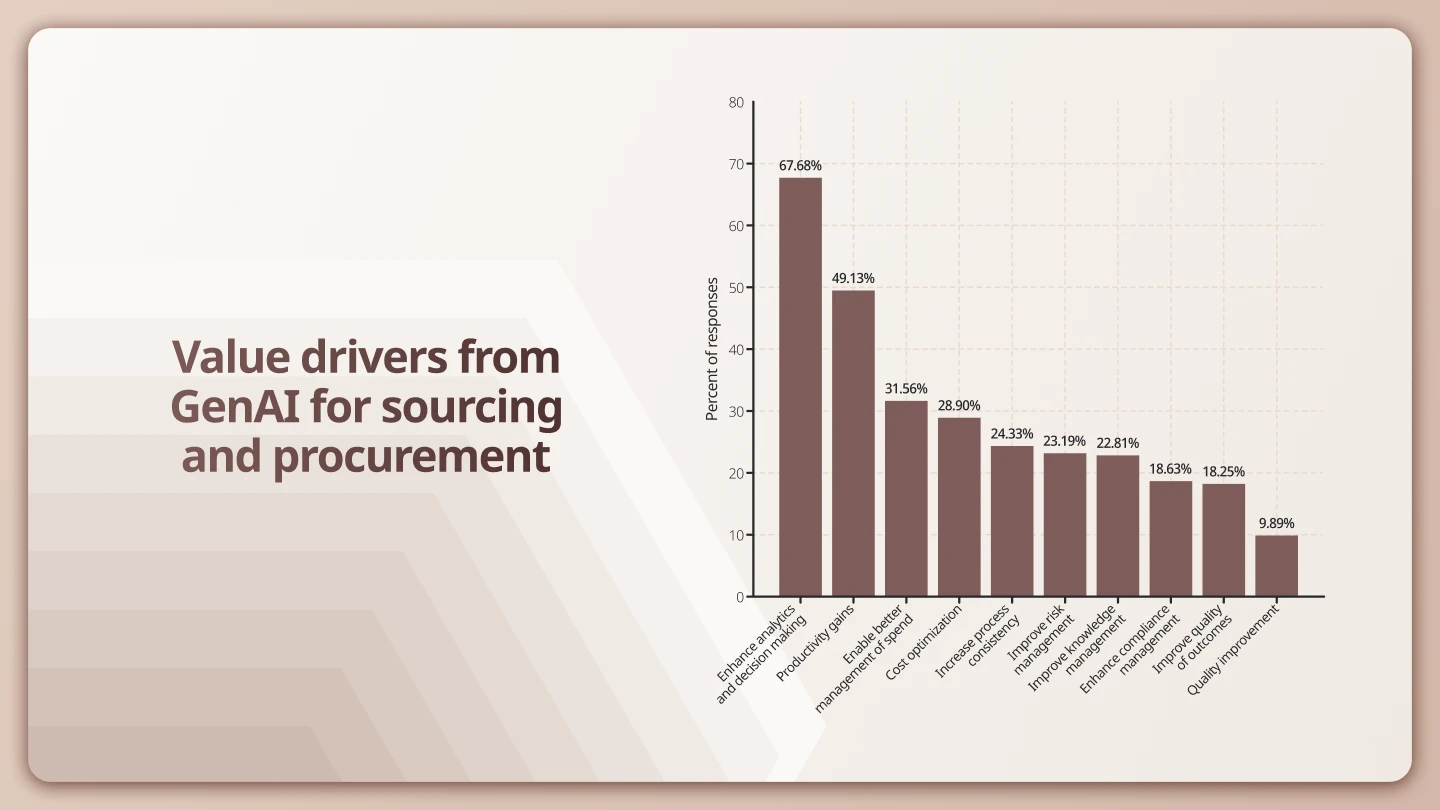
The adoption of AI within procurement organizations has seen a rapid increase over the past 12-24 months.
Procurement Is Drowning in Complexity: AI Is the Pressure Valve
Modern procurement teams manage:
-
- Millions of spend records across categories and geographies
-
- Thousands of suppliers with varying risk profiles
-
- Contracts filled with unstructured legal language
-
- Compliance requirements that change across regions
-
- Volatile pricing driven by geopolitical and macroeconomic forces
Traditional systems were not designed for this level of complexity. Reports are backward‑looking. Controls are manual. Risk is often identified too late.
AI changes this dynamic by continuously analyzing large volumes of structured and unstructured data, surfacing insights as events unfold rather than after the fact.
Instead of asking “What happened last quarter?”, procurement teams can ask:
-
- Where is spend drifting off‑contract right now?
-
- Which suppliers are showing early risk signals?
-
- What sourcing decisions will protect margins over the next six months?
What “AI in Procurement” Actually Covers
AI in procurement is not a single capability. It is a layered stack of technologies, including procurement AI, AI technology, and AI systems, working together across the source‑to‑pay lifecycle.
These core capabilities are supported by practical AI tools that procurement professionals use to automate workflows, analyze data, and improve decision-making.
| Layer | Description |
|---|---|
| Data & Integration | Collects, cleans, and connects procurement data from multiple sources |
| Analytics & Insights | Uses machine learning to identify patterns, risks, and opportunities |
| Automation | Streamlines routine tasks such as invoice processing and contract management |
| Decision Support | Provides recommendations and predictive analytics for strategic choices |
Integrating AI solutions with existing procurement systems minimizes disruption and maximizes benefits. Ensuring data quality and volume is crucial for the success of AI in procurement.
Core AI Capabilities in Procurement
| Capability | What it does in procurement |
|---|---|
| Machine Learning | Learns from historical spend, supplier performance, and demand data to predict outcomes |
| Natural Language Processing (NLP) | Reads contracts, invoices, RFx responses, and emails |
| Robotic Process Automation (RPA) | Executes repetitive, rule‑based tasks |
| Generative AI | Drafts content such as contracts, RFx documents, summaries |
| AI Agents | Coordinate tasks across systems with minimal human intervention |
From Manual Effort to Self‑Improving Operations
One of the earliest and most measurable impacts of AI in procurement is operational efficiency. Many procurement teams still spend a majority of their time on activities that add little strategic value.
AI-powered tools are increasingly used to automate repetitive tasks and reduce manual tasks in procurement, such as contract analysis, purchase order processing, and data extraction, which streamlines workflows and frees up staff for more strategic activities.
High-impact areas include:
-
- Automating repetitive tasks such as monthly processes, procurement performance reporting, data analysis, document summarization, and error detection, which improves operational efficiency and productivity.
-
- Enhancing contract management and spend analysis through advanced AI-powered tools.
-
- Improving decision-making and predictive analytics within procurement functions.
High‑Impact Areas Where AI Removes Manual Load
-
- Invoice processing: AI extracts, validates, and matches invoice data automatically
-
- Purchase order creation: Requests are converted into compliant POs without manual intervention
-
- Spend classification: Line items are categorized accurately at scale
-
- Exception handling: Only anomalies are routed to human review
These changes do more than save time. They improve data quality at the source—creating a stronger foundation for analytics, forecasting, and control.
McKinsey notes that organizations applying AI across transactional procurement processes often unlock double‑digit productivity improvements, primarily by eliminating rework and manual corrections.
Spend Visibility That Goes Beyond Reporting
Spend visibility has long been a procurement goal, yet most teams struggle to achieve it consistently. Data is fragmented across ERPs, regions, and suppliers.
Categories are mislabeled. Reports lag reality. To fully leverage AI in procurement, organizations should capture as much relevant procurement data as possible before deploying AI solutions.
AI changes spend analysis in three important ways: AI-powered spend analytics and predictive analytics extract deeper insights from raw data, enabling organizations to identify patterns, trends, and opportunities that were previously hidden.
-
- Dynamic insights into supplier performance, risk, and compliance
-
- Automated classification and cleansing of spend data
-
- Real-time anomaly detection and fraud prevention
AI enables more sophisticated approaches to spend management by augmenting the analytical capabilities of procurement professionals and reducing the risk of human error. It also provides timely analytics and data-driven insights to make better sourcing decisions.
How AI Upgrades Spend Analysis and Intelligence
-
- Continuous classification instead of periodic cleansing
-
- Pattern detection across suppliers, categories, and regions
-
- Anomaly identification that flags unusual or non‑compliant spend early
Rather than static dashboards, procurement teams receive dynamic insights such as:
-
- Which suppliers show pricing variance beyond negotiated terms
-
- Where maverick spend is emerging
-
- Which categories are suitable for consolidation
This level of visibility enables procurement leaders to act while savings opportunities are still recoverable, not months later.
Supplier Decisions Informed by Signals, Not Assumptions
Supplier selection and management have traditionally relied on scorecards and periodic reviews.
These methods struggle to capture fast‑changing risk conditions. AI-driven supplier risk management tools such as Apexanalytix, analyze supplier data, including company credit ratings, to predict and mitigate risks, enabling more proactive and informed decision-making.
AI introduces continuous supplier intelligence by combining internal performance data with external signals. AI supports supplier relationship management and vendor management by providing fact-based insights that improve collaboration, negotiations, and strategic oversight.
| Data Source | Example Use Case |
|---|---|
| Internal spend data | Identify cost-saving opportunities |
| Market reports | Benchmark supplier performance |
| News/social media | Detect emerging supplier risks |
AI enhances supply continuity by providing real-time visibility into supplier risks and market changes. AI can also help improve demand forecasting, spend analysis, and vendor management.
Supplier Intelligence Dimensions Powered by AI
| Dimension | Signals analyzed |
|---|---|
| Delivery risk | Lead times, fulfillment history, logistics disruptions |
| Financial health | Credit indicators, payment behavior, market data |
| Compliance | Contract adherence, audit findings, policy deviations |
| ESG exposure | Sustainability data, regulatory disclosures |
Instead of reacting to supplier failure, procurement teams gain early warning indicators, allowing them to rebalance sourcing strategies or trigger contingency plans.
According to McKinsey, organizations using advanced analytics and AI in supplier management reduce disruption impact significantly compared to those relying on periodic assessments.
Contract Management: Contracts Stop Being Static Documents
Contracts are one of procurement’s most underutilized assets. They contain pricing rules, obligations, penalties, and renewal terms—yet much of this information remains locked in unstructured text.
AI transforms contract management by making contracts machine-readable and continuously monitored, especially when supported by the best AI contract review software designed to extract insights and enforce compliance at scale. AI algorithms and data processing tools are now used to extract and analyze contract data, enabling procurement teams to quickly access key terms, monitor compliance, and identify risks. Teams looking to operationalize these capabilities typically evaluate purpose-built enterprise contract management software to bridge the gap between AI-driven insights and day-to-day contract execution.
How AI Changes Contract Lifecycle Management
-
- Extracts key clauses automatically
-
- Compares contract language against policy standards
-
- Tracks obligations, renewals, and pricing terms
-
- Flags deviations between contracts and actual spend
This reduces risk while ensuring negotiated value is actually realized in execution. SAP emphasizes that AI‑enabled contract intelligence directly improves compliance while reducing manual review cycles.
Generative AI: From Analysis to Action
Generative AI introduces a new layer of capability, moving procurement systems from analysis to active contribution. Procurement generative AI and generative AI capabilities are transforming procurement processes by enabling advanced automation, data analysis, and decision-making.
Instead of simply presenting insights, generative AI can:
-
- Draft RFx documents based on category context
-
- Summarize supplier responses
-
- Create negotiation scenarios
-
- Generate executive‑ready insights from complex datasets
-
- Generate human language for supplier communications and strategic tasks, enabling tailored messages, contract drafts, and improved collaboration
Generative AI leverages natural language processing (NLP) to understand, interpret, and generate human language, allowing procurement systems to automate supplier communications and strategic tasks.
The use of virtual assistants, such as AI chatbots and voice-based applications, further streamlines communication and automates routine procurement activities.
Over 90% of Chief Procurement Officers are actively assessing or deploying generative AI capabilities in 2026.
Examples of Generative AI in Procurement Workflows
| Workflow | Generative AI contribution |
|---|---|
| Sourcing events | Drafts RFIs and RFQs using historical context |
| Supplier evaluation | Summarizes strengths, risks, and trade‑offs |
| Contracting | Produces first drafts aligned to policy |
| Stakeholder communication | Converts data into plain‑language summaries |
The Hackett Group reports that procurement teams adopting generative AI early are seeing measurable improvements in speed, quality, and stakeholder engagement, especially in knowledge‑intensive work.
AI Agents: Coordinating Procurement at Scale
The next evolution moves beyond individual AI features to AI agents, advanced AI systems capable of orchestrating multiple procurement tasks end‑to‑end.
These AI systems leverage sophisticated AI algorithms to support data-driven decision making, enabling procurement teams to optimize sourcing strategies, manage risk, and focus on strategic initiatives that align with organizational goals. As procurement operations become more automated, Procurement management software helps unify these AI-driven processes by improving workflow visibility, supplier coordination, and strategic decision-making across teams.
An AI agent can:
-
- Interpret a free‑text purchase request
-
- Determine sourcing rules and approval paths
-
- Generate RFx documents
-
- Evaluate supplier responses
-
- Trigger contract workflows
-
- Update ERP systems
Chief procurement officers play a critical role in overseeing the deployment of AI agents, ensuring that these technologies are effectively integrated to enhance risk management, data analysis, and strategic decision-making within procurement processes.
This does not remove human oversight. Instead, it shifts procurement professionals into exception handling, strategy, and governance roles. Successful AI implementation requires active guidance and support from procurement experts, as well as bringing in key stakeholders early in the process to build understanding and secure buy-in.
AI agents are particularly valuable in large enterprises where procurement workflows span multiple systems and teams.
Why Many AI Initiatives Stall
Despite strong interest, not all AI procurement initiatives succeed. Common obstacles include:
-
- Fragmented data across systems
-
- Inconsistent master data and taxonomy
-
- Data quality issues that hinder effective AI adoption
-
- Legacy ERPs with limited integration capability
-
- Integration complexities when connecting AI systems with existing procurement technologies
-
- Security concerns regarding data privacy and information security
-
- Lack of trust in AI recommendations
-
- Change resistance from procurement professionals
-
- Skills gaps in procurement teams
-
- Insufficient governance and controls
-
- Difficulty understanding the art of the possible with AI
Regular audits of AI models are necessary to ensure fairness and compliance with data privacy regulations. Additionally, there is an adoption chasm between early adopters of AI in procurement and those who are hesitant to implement it.
IBM and SAP both emphasize that AI must be embedded into core procurement systems and workflows—not deployed as disconnected pilots.
What Strong AI Adoption Looks Like in Practice
Organizations that scale AI successfully in procurement tend to follow consistent patterns. Leveraging the procurement team’s expertise is crucial for successful AI adoption, as collaboration between procurement professionals and AI tools ensures that human knowledge and skills complement technological advancements.
Some common characteristics include:
-
- Clear alignment between AI initiatives and business objectives.
-
- Strong executive sponsorship and active guidance throughout the process.
-
- Starting with a small pilot project to assess the effectiveness of AI solutions in a controlled environment.
-
- Cross-functional collaboration between IT, procurement, and other relevant departments.
-
- A focus on data quality and integration.
Providing training and change management helps procurement professionals become familiar with AI tools and adapt to new processes. Teams can also take a change management quiz to assess their grasp of new practices. Additionally, organizations should capture as much relevant procurement data as possible before using AI to ensure optimal results.
Characteristics of Effective AI‑Led Procurement Programs
-
- Clear value‑driven use cases
-
- Clean, governed data foundations
-
- Incremental rollout across workflows
-
- Human‑in‑the‑loop controls
-
- Defined accountability for AI decisions
McKinsey highlights that procurement leaders who treat AI as an operating model change—not a technology upgrade—capture significantly higher value.
The Direction Procurement Is Heading
AI is pushing procurement toward a future defined by:
-
- Continuous decision support rather than periodic reporting
-
- Embedded intelligence across source‑to‑pay
-
- Proactive risk management
-
- Faster response to market volatility
-
- Stronger alignment with enterprise strategy
AI-driven analytics, spend analytics, and spend management are transforming procurement by improving procurement performance, enabling cost optimization, and driving cost savings.
Leveraging external data sources and analyzing market trends, AI empowers procurement teams to make more informed, data-driven decisions. AI-driven analytics help unlock savings by identifying maverick spending and optimal consolidation opportunities. AI-driven monitoring has reduced global sourcing and ESG violations by over 40%.
Companies using AI report 50% fewer supply chain surprises and a 25% reduction in related disruptions. Organizations deploying AI-driven analytics report an average of 20% higher cost savings than peers relying on manual processes.
AI can reduce procurement costs and mitigate risks in procurement and throughout the supply chain and supply chain management by providing timely analytics and actionable insight—capabilities that are often explored in depth through an AI ML course focused on real-world business applications.
Procurement is no longer evaluated only on savings. It is increasingly measured on resilience, speed, compliance, and strategic contribution.
Closing Perspective
AI is not replacing procurement teams. It is reshaping how procurement work gets done.
By absorbing complexity, surfacing insight, and coordinating execution, AI allows procurement professionals to focus on what matters most, strategic decisions, supplier relationships, and long‑term value creation.
Organizations that invest thoughtfully in AI today are building procurement functions capable of operating with precision, control, and intelligence at enterprise scale.
Book A Demo: Click Here
Join our Slack: Click Here
Link to our GitHub: Click Here