Most of a procurement professional’s time is spent on repetitive work, chasing approvals, checking contracts, updating systems, and following up with vendors. Very little of that time goes into strategic decisions.
Traditional procurement processes rely on static, rule-based systems that lack adaptability, whereas AI-driven approaches introduce dynamic, autonomous solutions that can learn and react to changing circumstances.
The impact of AI agents in Procurement is likely to transform and adapt to the changing nature of roles and responsibilities within procurement teams.
This article covers where AI agents fit in the procurement processes, which platforms are credible, and what to check before deploying one.
Key takeaways
- AI agents plan, decide and act across sourcing, RFPs, approvals and supplier workflows, unlike rules-based automation.
- Adoption has moved past pilots, but confidence in in-house AI capability still lags interest.
- RFP sourcing and approval routing are the two workflows delivering the clearest, fastest ROI.
- Seven credible platforms serve different parts of the stack, from intake orchestration to AI-native sourcing.
- Evaluate any platform on autonomy limits, human checkpoints, spend thresholds and audit trails before rollout.
Why procurement teams need AI agents?
Procurement teams need AI agents because the function has run out of headcount to throw at growing transaction volume, sprawling supplier bases, and category managers who are increasingly asked to do sourcing, risk review and cost analysis at the same time.
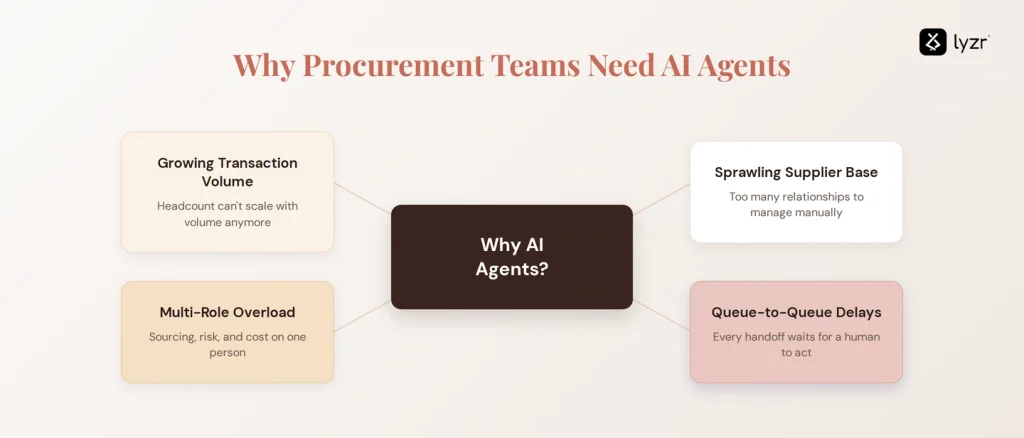
An AI agent for procurement takes on that volume directly: it reads a request, plans the steps to fulfill it, and executes across systems without waiting for a human to move it from one queue to the next.
This has stopped being a pilot conversation. According to the 2025 ProcureCon CPO Report, 90% of procurement leaders have considered or are already using AI agents and 66% of CPOs cite leveraging AI in procurement processes and decision-making as a top priority for 2025. That is not vague enthusiasm. It is procurement leaders embracing the future.
The gap is now capability, not appetite. The same report found that 88% of procurement leaders say integration issues are hurting their confidence in AI, and 75% cite data quality as a barrier.
That confidence gap is exactly why the platform question matters more than the concept question at this stage. Teams already believe procurement AI agents are worth deploying. What they are less sure about is which platform to trust with live spend data and supplier relationships, and how to configure guardrails before turning autonomy on.
AI agents vs. procurement automation and RPA
The difference is autonomy. Procurement automation and RPA execute fixed, rules-based steps: if a field matches, route it here; if a threshold is exceeded, flag it. They break the moment a scenario falls outside the script.
AI agents plan toward a goal instead of following one. Given “source three vendors for this category,” an agent decides which databases to query, how to score candidates, and when to escalate ambiguity to a human. Agentic procurement systems handle the judgment calls that traditional automation has always had to route around, which is the real line between procurement automation vs AI agents.
AI agent use cases across the procurement lifecycle
Before the two workflows that deserve the most attention, several other tasks are already running on agents in production.
Intake agents triage purchase requests arriving through email or Slack, clarify missing details with the requester, and create a structured record in the source-to-pay system without a human retyping anything.
Negotiation-support agents pull historical pricing, contract benchmarks and market data from tools like Order.co so a buyer walks into a supplier call with numbers instead of instinct.
PO and invoice-matching agents run three-way matches, catch discrepancies that rule-based matching misses, and message suppliers directly to resolve exceptions.
Supplier-management agents track contract lifecycle management milestones, flag approaching renewal dates and non-standard clauses before they become risk exposure, and continuously monitor spend against contracted rates in real time.

Spend-analysis agents apply predictive analytics to detect payment-pattern anomalies, model PO scenarios against budget, and surface maverick spend that would otherwise sit buried in a monthly report.
How AI agents automate RFP sourcing
AI agents automate RFP sourcing by handling supplier discovery, document generation and initial bid scoring as one continuous workflow instead of three separate manual steps.
Given a category and a budget, the agent queries internal preferred-vendor lists and external sources, compiles a longlist, drafts the RFP document from a template, distributes it, and scores returned proposals against a rubric before a human ever opens a spreadsheet.
A category manager tasked with sourcing new marketing agencies for a $100,000 digital campaign, for example, can have an agent pull internal vendor history, search platforms and public databases such as Apexon’s agentic AI resources for new candidates, and return a ranked shortlist scored on experience, reviews and cost, ready for the manager to approve before the RFP goes out.
AI agents for procurement approvals
AI agents speed up procurement approvals by routing requests to the correct approver automatically, attaching the context that the approver needs, and following up without a human having to chase anyone.
The agent already knows the approval matrix: which spend thresholds trigger which sign-offs, and which categories need legal or IT review before finance sees them.
A $25,000 software subscription request is a clean example. The agent checks it against budget, recognizes it as a software purchase requiring both departmental and IT security review, and routes it sequentially, delivering a summary (“Approve $25k HubSpot renewal”) to the department head first, then a security-specific summary to IT, cutting a cycle that used to take weeks down to days.
This is the use case where the ROI argument is easiest to make to a CFO, because cycle time is a number everyone already tracks.
AI agents for supplier and buyer communications
AI agents run supplier and buyer communication as a standing channel rather than a queue of tickets.
On the supplier side, agents collect onboarding documentation, answer routine questions about payment terms or invoice status, and push proactive updates on RFP timelines.
On the buyer side, agents answer policy questions and give requesters real-time status on their own purchase requests, reducing the “where is my PO” volume that eats a procurement ops team’s week. Getting this right often means investing in the change management needed to get both suppliers and internal buyers comfortable routing requests through an agent instead of a person.
Best AI agents for enterprise procurement
Procurement leaders evaluating an ai purchasing agent in 2026 are choosing between two categories: source-to-pay suites layering agentic capability onto an existing platform, and AI-native tools built around agents from the start. The right fit depends on whether the priority is consolidating an existing stack or adding an execution layer on top of it.

Platform comparison table
| Platform | Key capability / best for |
|---|---|
| Zip | Procurement orchestration and intake layer that sits in front of existing ERP/source-to-pay systems; known for structured intake and approval routing. |
| Coupa | Large source-to-pay suite adding agentic capabilities (request creation, sourcing-event creation, supplier assistance) across the full procurement workflow. |
| Ivalua | Source-to-pay platform positioning AI agents as an extension of its existing suite, covering supplier intelligence, sourcing, contracts and spend analysis. |
| GEP | Procurement transformation and managed-services provider, with agentic AI framed around multi-agent orchestration for intake, supplier risk, contracts and invoice exceptions. |
| Levelpath | AI-native procurement platform built around embedded agents (contract discovery, negotiation, quarterly business reviews) rather than automation layered onto a legacy suite. |
| Arkestro | Predictive, agentic sourcing platform focused on supplier negotiation and pricing intelligence within sourcing events. |
| Lyzr Studio | Agentic OS for building and governing custom procurement agents across sourcing, RFPs, approvals and supplier management, with production controls (audit trails, human-in-the-loop, spend thresholds) built in. |
How to evaluate an AI agent platform for procurement
Evaluating a platform means checking how it behaves at the edges of its authority, not just what it can do when everything goes right. Walk through each criterion below with any vendor before signing:
- Autonomy scope and limits – what can the agent do without asking, and where does it have to stop?
- Human-in-the-loop checkpoints – are approval gates configurable by role, category and spend level?
- Spend-threshold controls – can you hard-cap the dollar amount an agent can commit to without escalation?
- Audit trail and observability – is every decision and action logged in a format your compliance team can actually read?
- Integration with your source-to-pay stack – does it work with the ERP and S2P tools you already run, or require replacing them?
- Data security and vendor transparency – where does your data live, and will the vendor show you how the agent reached a decision?
Bring this list into your first vendor call, and use it to map a 90-day pilot for procurement agent deployment before committing to a full rollout.
Risks, controls and governance
The main risk in AI agents in procurement is not the model being wrong. It is the model being right about the wrong thing at scale, approving an out-of-policy purchase or contacting the wrong supplier before anyone notices. Governance has to be built in before autonomy is turned up, not bolted on after an incident.
Four controls do most of the work: hard autonomy limits by task type, spend thresholds that force escalation past a set dollar amount, human-in-the-loop approval on anything category managers haven’t explicitly cleared for full automation, and an audit trail that reconstructs every decision after the fact. Before expanding an agent’s authority, run Lyzr’s agent governance maturity assessment to see where your current setup has gaps.
How Lyzr helps procurement teams
Lyzr Studio gives procurement teams a platform to build and govern their own agents across sourcing, RFPs, approvals and supplier management, rather than accepting a fixed set of workflows from a vendor.
The same evaluation criteria above apply directly: autonomy limits, spend thresholds, human-in-the-loop checkpoints and audit trails are built into the platform rather than left to a custom integration project. Teams overseeing the procurement function get outcome-level visibility while AI agents handle the step-by-step execution, backed by the same agentic automation foundation Lyzr uses for compliance checks and finance workflows elsewhere in the enterprise. Teams building governance from scratch can also start from Lyzr’s AI compliance checklist as a baseline.
One global enterprise used Lyzr to consolidate a procurement process that had supplier discovery, onboarding, negotiation and approvals running across disconnected systems into a single AI-powered procurement operating system. Supplier onboarding ran up to 50% faster, sourcing cycle times dropped by 30 to 50%, and supplier discovery broadened by 55% once agents took over the legwork. Read the full case study to see how the rollout was sequenced.
Frequently asked questions
What are AI agents in procurement?
AI agents in procurement are autonomous software systems that plan, decide and execute multi-step tasks like sourcing, RFP scoring and approval routing without step-by-step human instruction. They differ from bots by adapting to exceptions and ambiguity rather than following a fixed script.
How do AI agents automate sourcing?
AI agents automate sourcing by identifying and vetting suppliers from internal and external data, scoring candidates against set criteria, and compiling a ranked shortlist for a category manager to review. Some platforms extend this further into generating and distributing RFPs automatically.
What is the difference between procurement automation and AI agents?
Procurement automation and RPA follow fixed, rules-based steps and break down outside their script. AI agents pursue a goal, reasoning through exceptions and making decisions across multiple systems, which lets them handle the judgment-based work automation has always had to route to a human.
How do AI agents help with RFPs?
AI agents help with RFPs by automating supplier discovery, drafting RFP documents from templates, distributing them, and scoring returned bids against a rubric. This compresses a process that typically spans weeks of manual coordination into a workflow a category manager reviews rather than runs.
Can AI agents negotiate with suppliers?
Most platforms today support negotiation rather than run it independently, surfacing pricing benchmarks and historical data to strengthen a buyer’s position in real time. A smaller set of predictive sourcing platforms are extending agents into low-value, high-volume negotiation, but complex strategic deals still need a human at the table.
What are the risks of AI agents in procurement?
The primary risks are unintended autonomous actions at scale, such as approving out-of-policy spend or contacting the wrong supplier, along with data security and decision transparency gaps. These are managed through spend thresholds, human-in-the-loop checkpoints and complete audit trails, not by limiting the technology itself.
Every criterion in this article, autonomy scope, spend thresholds, audit trails, applies whether you’re evaluating Lyzr Studio or any platform in the comparison table above. The next step is putting a real workflow in front of one and watching where it holds up and where it needs a human checkpoint.
Book a Lyzr Studio demo to walk through your RFP or approval workflow directly.
Related reading
Other useful references: what is an MRP system, outsourced ecommerce fulfillment operations, and manage supplier risk.
Join the conversation on Slack or explore Lyzr’s open-source projects on GitHub.
Book A Demo: Click Here
Join our Slack: Click Here
Link to our GitHub: Click Here