
Download the insurance use cases handbook with agent blueprints, case studies & deployment guide.
Your underwriters take 14 days to quote what insurtechs do in 4 hours.
Your claims adjusters spend 30% of their time on admin tasks. Your compliance team burns 40 hours assembling NAIC reports. Meanwhile, insurtechs operate at half your cost.
The problem isn’t your people. It’s that insurance operations became admin work.
Insurance AI agents automate claims processing, underwriting, and compliance workflows so your teams actually manage risk instead of spreadsheets.
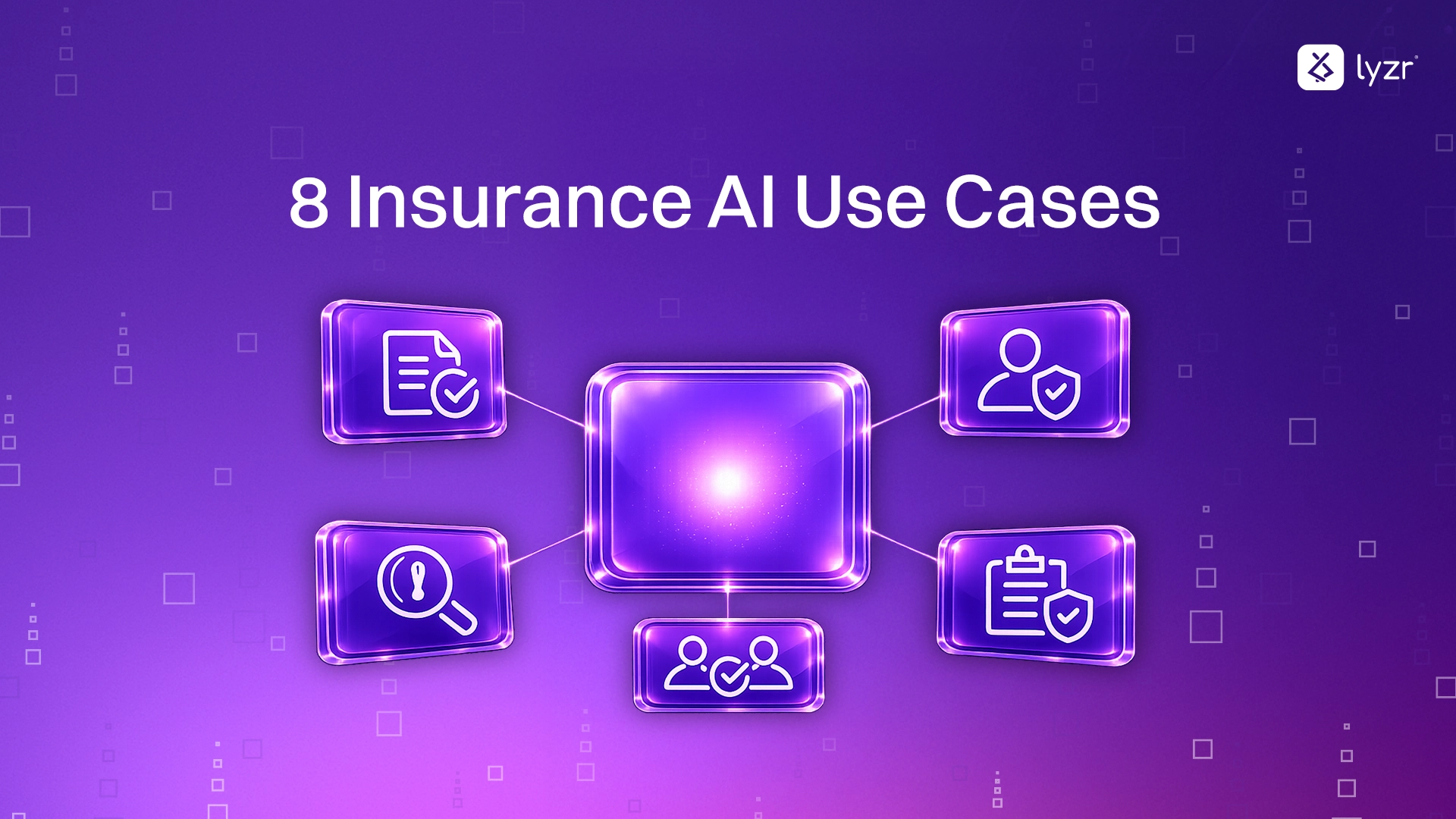
Inside the Handbook: 8 Insurance Agent Use Cases
This handbook documents exactly how P&C carriers, MGAs, and reinsurers deploy AI agents, from claims automation to partner QA to regulatory compliance.
Each of the 8 insurance AI agents includes:
✓ The Challenge: Specific operational pain it eliminates
✓ The Solution: How the agent automates end-to-end workflows
✓ The Impact: Quantified results (65% faster processing, 50% cost reduction, 12% better loss ratios)
✓ Built For: Which insurance roles benefit (VPs Claims, Chief Underwriting Officers, Compliance Heads)
✓ How It Works: Complete workflow diagram from intake to output
✓ Deployment Steps: Exactly how to implement in your organization
Plus:
- Quick Decision Guide (match your operational challenge to the right agent)
- Agent Deployment Roadmap (phased implementation strategy for carriers)
- Real case studies with verified metrics
- Integration requirements (Guidewire, Duck Creek, Applied Epic, Vertafore)
- FAQ section (ROI timeline, partner integration, compliance requirements)
What Are AI Agents for Insurance?
Insurance AI agents are autonomous systems that execute complete workflows, from FNOL intake to policy binding to regulatory reporting, without constant human intervention.
Unlike traditional insurance automation that requires manual setup and monitoring, AI agents think, plan, and execute tasks across your entire insurance stack.
Examples of Insurance AI Agents:
- Claims Processing Agents: Automate FNOL intake, triage claims by complexity, detect fraud patterns, route to settlement
- Underwriting Agents: Extract application data, score risk predictively, flag fraud, generate quotes in minutes
- Compliance Agents: Monitor 100% of partner transactions, auto-generate audit trails, track regulatory changes across 50 states
- Litigation Agents: Process millions of documents, cull 97% of irrelevant files, reduce e-discovery costs 99.97%
The difference between insurance automation and AI agents:
Traditional insurance tech = you operate the system (set rules, monitor workflows, pull reports)
Insurance AI agents = agents operate your systems (autonomous execution across claims, underwriting, compliance)
The ROI of Insurance AI Agents
| Metric | Impact | Timeline |
|---|---|---|
| Claims Processing Speed | 65% faster settlement cycles | 90 days |
| Underwriting Efficiency | 70% less review time (14→4 days) | 60 days |
| Compliance Costs | 80% reduction in manual audit work | 90 days |
| Loss Ratios | 12% improvement through better risk selection | 6 months |
| Partner Error Rates | 74% reduction with continuous monitoring | 90 days |
| E-Discovery Costs | 99.97% reduction in litigation expenses | Immediate |
Integrates With Your Insurance Stack
Works with Guidewire, Duck Creek, Applied Epic, Vertafore, and legacy core systems. SOC 2 Type II certified for enterprise security.
Beyond Insurance: 101 AI Agent Use Cases Across Your Enterprise
These 8 insurance agents are part of a larger enterprise ecosystem. HR needs AI agents for hiring and onboarding. Finance needs agents for invoice processing. IT needs agents for helpdesk automation.
The complete 101 AI Use Cases Playbook covers agents across Insurance, Banking, HR, Sales, Marketing, Customer Support, Finance, Legal, and IT Operations.
Inside the full playbook:
- 101 detailed use cases across 9 business functions
- ROI calculators for each use case
- Cross-functional workflows (how Claims, Underwriting, and Compliance agents work together)
- Integration requirements for enterprise tech stacks
Deploy These Insurance Use Cases with Lyzr
At Lyzr, we help insurance carriers, MGAs, and reinsurers move from AI strategy to AI execution. Our platform enables you to build and deploy insurance AI agents that integrate seamlessly with your existing core systems, whether you’re automating claims processing, accelerating underwriting, or ensuring continuous compliance.
What Makes Lyzr Different for Insurance
Multi-agent orchestration that works like an insurance operations team
Benjie isn’t a single bot, it’s a suite of specialized agents (Claims Processing, Underwriting Support, Partner QA, Compliance Monitoring) that work together autonomously. One agent processes FNOL, another triages by complexity, another flags fraud patterns. No manual handoffs between systems.
Built-in responsible AI with insurance-grade security
SOC 2 Type II certified out of the box. Your claims data never trains public models. Enterprise-grade security, compliance, and governance built into every agent. Audit trails for every decision.
Production-ready deployment, not pilot purgatory
Forward Deployment Engineers work directly with your claims, underwriting, and compliance teams to ensure agents go live and deliver ROI, not stuck in proof-of-concept limbo. We share the risk of getting you to production.
Pre-built insurance agent blueprints
Don’t start from scratch. Deploy proven agent workflows for claims processing, underwriting automation, partner QA, and regulatory compliance, then customize for your lines of business and state requirements.
Native integration with insurance core systems
Works with Guidewire, Duck Creek, Applied Epic, Vertafore, and legacy systems. Agents operate across your entire insurance stack without replacing existing infrastructure.
By downloading this Insurance AI Agents Handbook, you’re taking the first step from “where do we start?” to knowing exactly which insurance process to deploy AI agents for first.
FAQs on Insurance AI Agents
What are AI agents in insurance?
AI agents are autonomous systems that execute complete insurance workflows, from FNOL intake to policy binding to regulatory reporting, without constant human intervention. Unlike traditional insurance automation that you operate manually, AI agents operate your systems for you.
How is this different from insurance automation?
Traditional insurance automation requires you to set rules, monitor workflows, and pull reports manually. You’re still doing the operating work. Insurance AI agents autonomously execute tasks across your entire insurance stack, claims, underwriting, compliance, learning, adapting, and optimizing without constant oversight.
What are examples of AI agents for insurance?
Common insurance AI agents include:
- Claims Processing Agents: FNOL automation, intelligent triage, fraud detection, settlement processing
- Underwriting Agents: Data extraction, risk scoring, fraud flagging, quote generation
- Compliance Agents: Partner transaction monitoring, regulatory tracking, audit trail generation
- Partner QA Agents: Quality simulation, performance scoring, gap analysis, feedback delivery
How do AI agents improve insurance operational efficiency?
AI agents handle the 60-70% of insurance work that’s pure execution: data entry, document processing, transaction monitoring, report generation. This frees your claims adjusters, underwriters, and compliance officers to focus on complex risk decisions, strategic partnerships, and high-value work that requires human judgment.
Can AI agents integrate with our insurance core systems?
Yes. Insurance AI agents are built on open API standards and integrate with Guidewire, Duck Creek, Applied Epic, Vertafore, and legacy core systems. Custom integrations are available for your specific insurance technology stack.
How long until we see ROI from insurance AI agents?
Most carriers see measurable efficiency gains within 60-90 days. Claims cycles accelerate, underwriting capacity increases, compliance workload drops. Clear cost savings and loss ratio improvement typically appear within the first quarter. Typical payback period is 3-6 months.
Does this replace our insurance professionals?
No. AI agents replace grunt work: data entry between systems, manual document review, transaction monitoring, pulling reports from multiple systems. Your adjusters stop being data processors and become risk managers. Your underwriters stop doing data entry and focus on complex risk assessment. Your compliance team stops pulling reports and focuses on strategic risk mitigation.
How do AI agents maintain underwriting quality and brand standards?
AI agents learn from your best underwriters and claims handlers. You set approval thresholds: auto-approve straight-through processing for simple claims and policies, require human review for complex risks or large exposures. The agent adapts through feedback loops and improves over time.
What about data security with insurance AI agents?
Enterprise-grade security is standard. Insurance AI agents are SOC 2 Type II certified and follow insurance data protection regulations. Your policyholder data never trains public models, everything stays within your infrastructure. Role-based access controls ensure agents only access data they need for specific tasks.
Do we need technical expertise to deploy insurance AI agents?
No. Insurance AI agents are built for insurance professionals, not engineers. You configure agents using intuitive interfaces, no coding required. Your claims, underwriting, and compliance teams can set up and refine agents without IT support.
What if we already use Guidewire/Duck Creek/other insurance platforms?
AI agents work with your existing platforms, not instead of them. Think of agents as an intelligent orchestration layer that makes your entire insurance stack smarter and more connected. They automate the work of operating your current systems.
How do AI agents handle regulatory compliance?
Compliance is built-in. Agents automatically generate audit trails for every decision, monitor regulatory changes across all jurisdictions where you operate, and flag compliance gaps in real-time. Every action is logged, timestamped, and audit-ready for NAIC, DFS, or state regulator review.
Two Ways to Get Started
Talk to an Insurance AI Expert
Book a 30-minute strategy session. We’ll identify your highest-impact use case (claims, underwriting, or compliance) and build a custom deployment roadmap for your carrier.
Build It Yourself
Start free on Lyzr Agent Studio. Get instant access to all insurance agent blueprints and deployment guides.
Your competitors are reading this handbook too.
The difference between leading your market and playing catch-up?
Starting today instead of next quarter.