
- Lyzr's research
Engineering the future of enterprise AI
We design the core technologies that let organizations deploy AI agents across critical workflows with confidence.
A - sim: Multi - objective Agent Improvement Through Compositional World Models And Reinforce - Ment Hardening
Abstract
This paper introduces A-SIM (Agent Simulation Engine), a framework for sys-tematically testing, evaluating, and automatically improving LLM agents through compositional world models and multi-objective reinforcement hardening. A-SIM enables users to define world models as factorized evaluation spaces composed ofpersonas (user archetypes) and scenarios (task contexts), generating groundedsimulations (trajectories) that test agent behavior across all combinations.
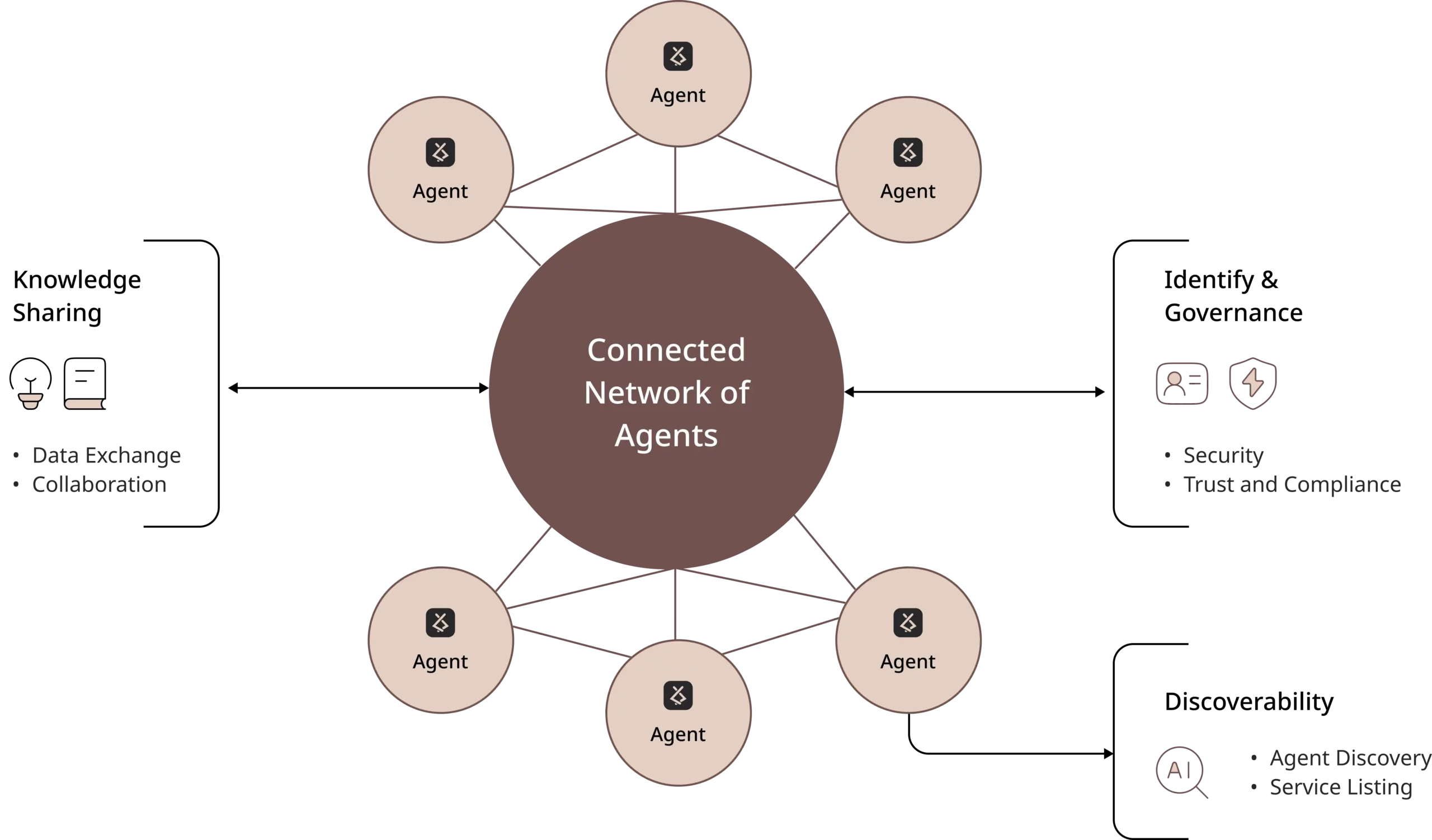
Achieving enterprise-grade reliability in LLM systems through consensus-driven decomposed execution
The Six Sigma Agent architecture treats LLM outputs as probabilistic and designs for failure tolerance rather than assumed correctness. Complex goals are decomposed into verifiable tasks, executed redundantly by multiple agents, and resolved through consensus. This approach delivers stable, enterprise-grade reliability across long, multi-step workflows.
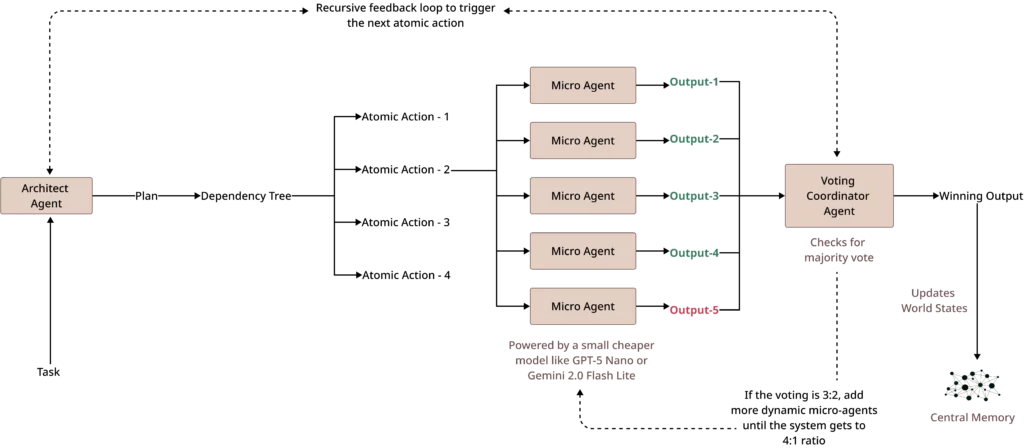
AgentMesh: Distributed Collective Intelligence for AI Agents with Integrated Governance
AgentMesh, a governed architecture that connects distributed AI agents into a discoverable, secure mesh network. By leveraging a central knowledge graph built on a shared ontology, AgentMesh enables seamless knowledge sharing, dynamic skill collaboration, and cross-agent intelligence synthesis. The architecture enforces responsible AI practices through embedded governance, providing identity-driven access control, policy enforcement, and complete auditability transforming isolated agents into a unified ecosystem of collective intelligence where agents learn together, share capabilities, and solve problems collaboratively while maintaining enterprise trust and compliance
This research presents AgentDefender, a neural embedding–based system for detecting prompt injection attacks in AI agents. Through extensive benchmarking against traditional ML and agent-based methods, AgentDefender achieves up to 99% detection accuracy across multiple datasets. The paper outlines practical considerations for deploying robust prompt security in real-world agent systems.
BATON introduces a relay-based architecture that enables long-running agent systems without cognitive drift. By breaking execution into discrete legs and passing only distilled state via a structured “Baton,” agents retain first-hour clarity while running indefinitely. The result is higher reliability, lower cost, and consistent performance at enterprise scale.
This paper introduces Lyzr’s Fluid Intelligence Architecture, which replaces rigid ontologies and ETL pipelines with agent-driven, on-demand reasoning. Agents interpret data directly at the source—structured or unstructured—adapting instantly to new questions and schemas. The result is faster insight with dramatically lower long-term maintenance overhead.
ACE-V is a governance protocol designed to prevent hallucinations and blind agreement in AI agents. It uses a tri-agent system—proposer, challenger, and judge—where conclusions change only when supported by evidence. This introduces controlled friction that improves correctness without relying on self-policing by a single model.
CAMP is a structured simulation framework for systematically improving AI agents across real-world scenarios. By evaluating agents over compositional world models and enforcing Pareto constraints on accuracy, relevance, and task completion, CAMP enables targeted hardening through interpretable failure patterns. It reframes agent optimization as a disciplined engineering process.
Governor is an open-source framework for governing AI agents in production. Using a simple Python decorator, it enables policy enforcement, human-in-the-loop approvals, and state management. Governor provides a lightweight yet powerful foundation for responsible enterprise agent deployment.