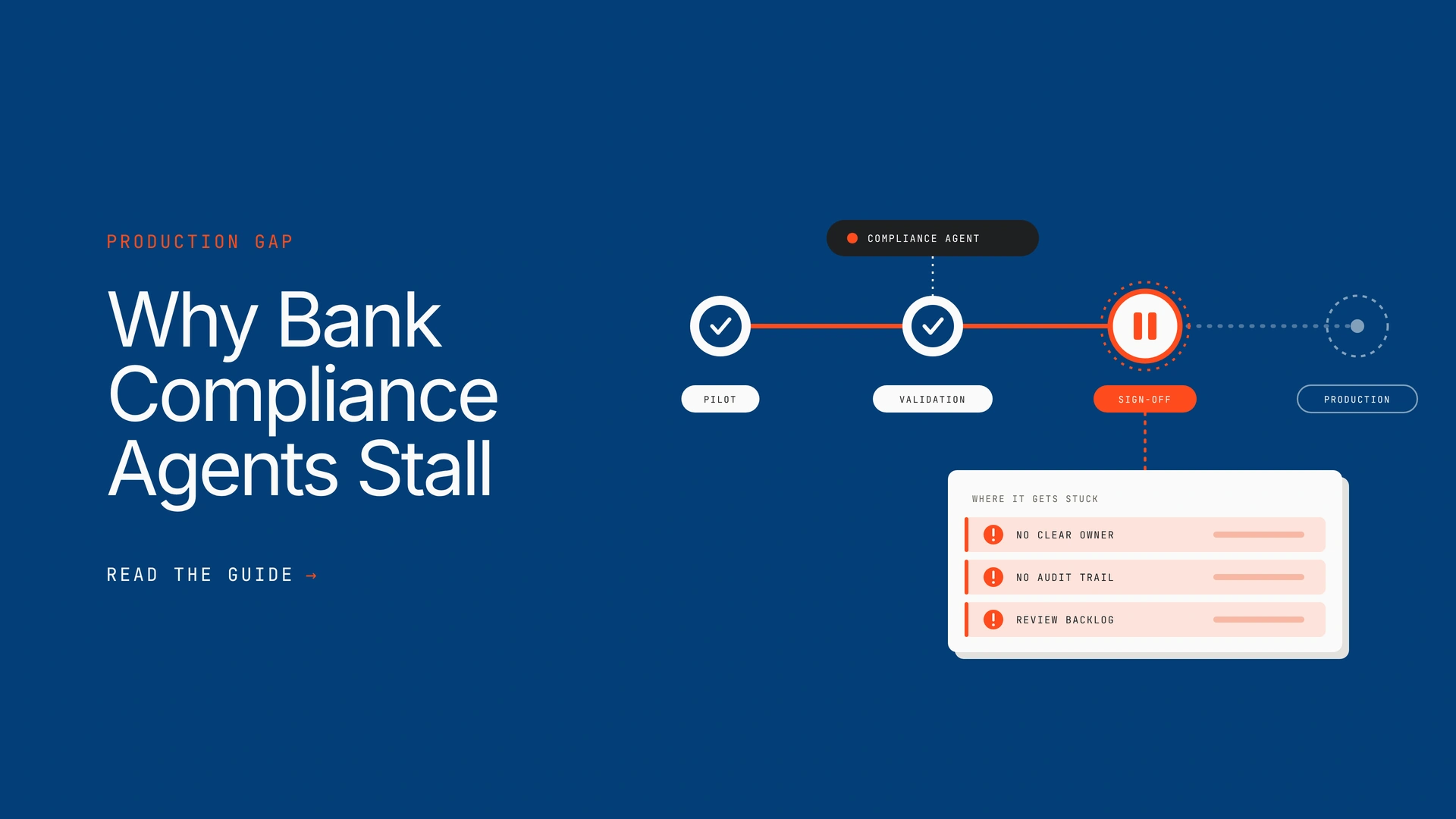
Banks that build their own AI compliance agents usually stall between a working prototype and production because the prototype proves a model can do the task, while production needs infrastructure the demo never did: a record that reconstructs every decision, one governed path to many systems, an identity and permission scope for each agent, governance enforced in the execution path, and a human review model that survives volume. None of the five is a model-quality problem. Opencontroller, Lyzr’s agent control plane, addresses three of them directly (the audit record, agent identity and policy in the execution path) and helps with two more. It does not fix fragmented source data or organizational silos, and it does not build the agent. This guide covers each barrier, what the evidence says and what to build or adopt.
TL;DR
- Five barriers, one pattern: the demo skips the record, the identity, the policy and the review model. Production cannot.
- Reproducibility is mostly a record problem: we found no supervisory text requiring deterministic generative AI. What a bank must show is what the agent did and why.
- Integration cost grows with agents: NTT DATA estimates $100,000 to $500,000 per AI-to-system integration. One governed path changes the math for agent traffic, not for inconsistent source data.
- Identity and policy belong in the runtime: an agent needs its own ID, an owner, a scoped delegation and limits enforced outside the agent.
- Humans still sign: Deloitte warns that a person at every step can defeat the purpose, so design tiers, limits and sampling.
- Fair warning: much of the commentary here is from vendors, including us. We label it.
What is the wall that bank-built compliance agents hit?
The wall is the gap between an agent that works in a demo and one a bank can run in production under supervision. Industry figures suggest the gap is wide. They are about agentic or generative AI projects generally, not only banks, so read them as direction.


For the supervisory backdrop, see SR 26-2 and the banking AI governance gap and what regulators ask banks about AI agents.
Barrier 1: Can the bank reconstruct what the agent did?
The common framing is that regulators require deterministic, repeatable rules and large language models are probabilistic. We could not find supervisory text that says this for generative AI. SR 26-2, the model risk guidance issued on April 17, 2026 that replaced SR 11-7, places generative and agentic AI outside its scope and leaves banks to govern them through their own risk management (we explain it in SR 11-7 vs SR 26-2; confirm against the primary text). The practical test is different: when an examiner asks about a decision months later, can the bank show the inputs, sources, model version, tool calls, approval and policy version behind it?

| What the demo needs | What production needs | Why teams miss it |
|---|---|---|
| Good answers on sample cases | A regression set that fails the release when quality drops | Demos are judged by eye, once |
| A chat log | A record of inputs, sources, model version, tool calls and approvals per decision | Standard API logs omit the policy decision |
| The latest model | A way to re-test when the model, prompt or vendor changes | Behavior can change without a retraining event |
| One run that worked | Repeated runs with a measured failure rate | One good run hides variance |
Two vendor voices make the same point from different sides, and both are opinion. Cerbos, an authorization vendor, says engineers end up rebuilding which control was live from commit history and deployment records. Lumenova, a governance vendor, suggests running each test case several times, reporting distributions and setting failure-rate thresholds. Deloitte’s March 2026 risk paper lists opaque or untraceable decisions among six agentic risks for banks. A signed record shows what happened. It does not make a model deterministic.
How Opencontroller helps: a signed audit trail of lifecycle events, model calls and tool executions, OpenTelemetry GenAI traces, and a simulation engine with golden and challenger datasets, a regression gate and adversarial probes. See best tools for AI agent observability in banking.
Barrier 2: Why does every new agent add integration cost?
Each agent needs access to the systems where its data lives, and a prototype gets that access with a one-off connector. NTT DATA’s analysis estimates that UK banks typically use hundreds of systems and that each AI-to-system integration costs $100,000 to $500,000, and says global banks needing thousands of connections could exceed $25 billion. These are NTT DATA’s own estimates with no stated method, so treat them as order of magnitude. Deloitte’s banking paper makes the qualitative point that legacy systems may only complicate deployment and proposes a smart overlay on top of them.

The arithmetic is why teams that scale from one agent to ten feel the cost jump: connectors multiply with agents and systems, and each one carries its own credentials, logging and review. A governed path for agent traffic turns that into additions. It does not make the source data agree. If fraud, KYC and transaction systems hold different versions of the same customer, a gateway will route the question faithfully and the agent will still see conflicting answers. That is a data problem, and neither Opencontroller nor any control plane fixes it.
How Opencontroller helps: Lyzr describes it as tracing every model call, tool call, token and data access through one gateway, and as registering agents built on Bedrock AgentCore, Vertex AI, Agentforce, ServiceNow or Databricks. Start with the inventory in AI agent inventory for banks.
Barrier 3: Who is the agent, and what is it allowed to do?
Bank security was designed around people: sessions, static credentials and behavioral signals. An agent has none of these markers, acts at machine speed and often acts for someone else. Deloitte’s March 2026 paper warns that misconfigured permissions could lead to unauthorized data access and recommends treating agents as active operators. Cerbos, as a vendor, argues a bank must attribute each agent action to a specific identity and a specific authorization policy version. Lumenova suggests inventorying every tool a system can call, whether each is read or write, and any transaction or spend limits.
| Question | Without an identity layer | With one |
|---|---|---|
| Who is acting? | A shared service account | A unique, immutable agent ID with a named owner |
| On whose authority? | Unclear or implied | Delegation recorded: the agent acting on behalf of a person or team |
| What may it call? | Whatever the connector allows | Per-tool authorization, with policy that reads the call’s arguments |
| What stops runaway use? | An alert after the fact | Budgets that refuse calls once spent, and a reversible stop |
| Does the agent hold secrets? | Yes, in its configuration | Credentials brokered, never held by the agent |
Without this layer, every agent needs its own bespoke guardrails, which is the second multiplication problem after integrations.
How Opencontroller helps: immutable agent IDs and a named owner, delegation and on-behalf-of recording, per-tool authorization, budgets, egress policy, credential brokerage and reversible quarantine at the gateway. It also discovers unsanctioned AI clients and MCP configurations. See best platforms for AI agent safety in regulated industries.
Barrier 4: Why does governance arrive too late?
Teams often build a pilot first and bring in model risk management, legal and compliance at the end. The result is a review that has no checklist to apply. Lumenova describes an “orphaned system” problem: when a bank’s AI policy routes every use case through model risk intake, generative and agentic systems can lose their only control owner once SR 26-2 places them outside that guidance. Where use must start before validation, Lumenova advises a capped pilot with full human review. Both are vendor views. The structural fix is the same either way: rules that exist only as policy documents cannot stop an agent, so the policy has to be enforced where the agent acts.
| Governance as a document | Governance in the execution path |
|---|---|
| A policy PDF reviewed at the end | Limits, approvals and scopes enforced on every call |
| Approval by email | Approvals where the approver is never the requester, recorded with identity |
| Review each agent from scratch | Review the control layer once, then govern each agent against it |
| Evidence assembled before an exam | Evidence produced as the agent runs |
Silos make this harder. When fraud, AML and compliance teams have separate reporting lines, data and tooling, an agent built for one rarely inherits the context or permissions of another. Neither a control plane nor a GRC platform removes that organizational split, but a shared inventory and a shared record give the teams one place to disagree productively. The record side is where Madison fits: it connects the obligation to the policy, the control, the test and the evidence, with a named person signing each decision. See AI in compliance vs AI governance and how to map policies to controls with an agent.
How Opencontroller helps: approvals for publish, modify, disable and retire where the approver is never the requester, policy enforced at the gateway, and a registry of agents with owners.
Barrier 5: Why do human reviewers become the bottleneck?
The bank carries the legal responsibility for its compliance outcomes, so a person signs. SEON’s guide notes that suspicious activity reports go to FinCEN within 30 calendar days of detection, and Wolters Kluwer’s compliance consultants recommend that analysts must review and confirm AI-generated outputs, including at SAR determinations. We found no regulator text in these sources on whether AI may draft a SAR, so confirm with counsel. The trap is volume: an agent that drafts at machine speed hands the reviewer a faster-growing queue. Oscilar, a vendor, cites false-positive rates above 90 to 95 percent in legacy transaction monitoring, a figure it takes from Retail Banker International, which we did not read.
Deloitte’s March 2026 paper goes further and says human-in-the-loop designs may be insufficient or even counterproductive for agentic AI, because a person at every step could defeat the purpose. It points toward human oversight at defined points and stronger observability instead.

A ladder like this only works if the limits are enforced outside the agent and each approval is recorded. Policy that reads the arguments of a call can enforce a transfer limit or an approved-destination list, and the approver’s identity can be written into the trail. Madison’s own design follows the same shape: agents propose and a named person approves, signed against the exact version. See agentic AI for the BSA officer.
How Opencontroller helps: policy that reads call arguments, per-tool authorization and a signed trail that records the approver. It does not describe triaging a reviewer’s queue, so ask Lyzr how exceptions reach a person in your workflow.
What should a bank build, and what should it adopt?
The agent’s logic is your process, so it is usually worth building. The layers around it are the same for every agent and every bank, which is why rebuilding them per agent is the usual way pilots stall. MIT’s reported finding, as cited by NTT DATA, attributes pilot failure to enterprise integration rather than model quality.
| Layer | Usually build | Usually adopt | Why |
|---|---|---|---|
| Agent logic, prompts and workflow | Yes | It encodes your process and risk appetite | |
| Model access | Yes | Models change faster than banks can build them | |
| Agent identity, policy, budgets, stop | Yes: control plane | Identical for every agent; costly to repeat | |
| Audit trail and regression testing | Yes: control plane | Needs to be consistent across agents | |
| Rules-to-evidence record | Yes: GRC record | Ties agents to obligations and sign-offs | |
| Connectors to core systems | Yes, or integrate | Specific to your estate |
This is our view, not a standard. Many banks will build parts of the control layer. The cost is that every agent then inherits whatever that layer lacks.
How does each barrier map to what clears it?
| Barrier | What clears it | What Opencontroller provides | What it does not do |
|---|---|---|---|
| 1. Decision record | Captured evidence per decision; regression tests | Signed audit trail, OpenTelemetry GenAI traces, simulation with regression gate | Make a model deterministic |
| 2. Integration sprawl | One governed path for agent traffic | One gateway for model and tool calls; agents from other platforms registered | Reconcile inconsistent source data |
| 3. Identity and permissions | Unique ID, owner, scoped delegation, limits | Immutable IDs, delegation recording, per-tool authorization, budgets, credential brokerage, quarantine | Replace your identity provider |
| 4. Late governance | Policy in the execution path; separated approvals | Approver never the requester; policy at the gateway; agent registry | Resolve organizational silos |
| 5. Review bottleneck | Tiers, limits, sampling | Argument-aware limits and a signed record of approvals | Triage a reviewer’s queue (not described) |
Capabilities are from Lyzr’s Capability Reference and overview material; confirm current scope with Lyzr. Highlighted rows are the three it addresses most directly.
What is a path through the wall?
Step 1: Inventory and tier every agentList each agent, its owner and what it can reach, and tier by consequence. See AI agent inventory for banks.
Step 2: Write a permission scope per agentDefine what each agent may call, read or write, and the limits that apply, then enforce them outside the agent.
Step 3: Route agent traffic through one governed pathSend model and tool calls through a single policy point so each new agent adds a connection, not a connector. See the Lyzr agent control plane.
Step 4: Build the replay testPick one real decision and prove you can reconstruct its inputs, sources, model, tool calls, approval and policy version. Add a regression set that blocks release on failure.
Step 5: Set approval points and samplingDecide which actions need a named person, which run inside limits, and how outcomes are sampled. See how to evaluate a regulatory change agent for an evaluation example.
Step 6: Bring governance in at designReview the control layer with risk, compliance and legal before agents arrive, and keep obligation, policy, control and evidence in one record. See what regulators ask banks about AI agents.
Where does Opencontroller fit?
Opencontroller is Lyzr’s control plane for agents, including ones built on other platforms. It gives each agent an immutable ID and owner, authorizes each call, applies budgets and egress policy, requires separated approvals, keeps a signed audit trail and can quarantine an agent reversibly. It runs in the customer’s cloud account.

Pair it with Madison:Madison, Lyzr’s agentic GRC product for US banks and credit unions, holds the record of why each control exists and who approved it. See best tools for AI agent observability in banking. Wording on Opencontroller is from Lyzr’s own materials.
Test your agents against the five barriers
Bring your agent list to a working session. You leave with a map of what is registered, what is permitted and what you could replay for an examiner.
Frequently asked questions
Why do banks’ own compliance agents stall before production?
A prototype proves the model can do the task. Production needs a record that reconstructs each decision, a governed path to many systems, an identity and permission scope per agent, governance enforced in the execution path and a human review model that survives volume. None of those is a model-quality problem, and demos skip all five.
Do regulators require AI compliance agents to be deterministic?
We found no supervisory text requiring generative AI to be deterministic. SR 26-2, issued April 17, 2026, places generative and agentic AI outside its scope and leaves banks to govern them through their own risk management. The practical expectation, per commentary, is that a bank can show what the system did and why. Confirm against the primary guidance.
What does SR 26-2 mean for bank AI agents?
SR 26-2, issued with OCC Bulletin 2026-13 and FDIC FIL-15-2026, replaces SR 11-7 and describes generative and agentic AI as novel and outside its scope. That does not exempt them: banks are expected to govern them through their own risk and control practices. One governance vendor calls the resulting situation an orphaned system when AI policy relied on model risk intake.
What is the audit reconstruction problem for AI agents?
It is the difficulty of proving, months later, why an agent acted as it did. Reconstructing inputs, retrieved sources, model version, tool calls, approvals and the policy version live at the time from separate logs can take days. Capturing those items at decision time in a signed record avoids rebuilding them later.
What is agent identity and why do banks need it?
Agent identity means each AI agent has its own unique ID, a named owner and a recorded scope of authority, including whom it acts for. Banks need it because shared service accounts hide who acted and under what authority. It also lets limits, approvals and a stop switch apply to a specific agent.
What is an agent control plane?
A control plane is the layer that registers agents, authorizes each call, applies limits and budgets, requires approvals, records an audit trail and can stop an agent. It sits outside the agent so that limits hold even if the agent misbehaves. Opencontroller by Lyzr is one example, and it also covers agents built on other platforms.
Should a bank build or buy its compliance agents?
Usually build the agent logic, which encodes your process, and adopt the layers every agent needs: model access, identity and policy, audit and regression testing, and the rules-to-evidence record. Rebuilding those per agent is a common reason pilots stall. This is our view, not a standard, and many banks build parts of the control layer.
Can AI agents file suspicious activity reports?
The bank remains responsible for its SARs, and sources we read describe analysts reviewing and confirming AI-generated outputs. One guide says SARs go to FinCEN within 30 calendar days of detection. We found no regulator text in those sources on whether AI may draft a SAR, so confirm with counsel before automating any step.
What is the difference between human in the loop and human on the loop?
Human in the loop puts a person at each step. Human on the loop sets limits and approval points and has people oversee outcomes, often by sampling. Deloitte’s March 2026 paper says in-the-loop designs may be insufficient or even counterproductive for agentic AI, because a person at every step could defeat the purpose.
Why does integration cost grow as banks add AI agents?
Each agent needs connectors to the systems it uses, each with its own credentials, logging and review, so connectors multiply with agents and systems. NTT DATA estimates $100,000 to $500,000 per AI-to-system integration. Routing agent traffic through one governed path turns multiplication into addition, but it does not reconcile inconsistent source data.
How does Opencontroller help banks get agents into production?
Opencontroller gives each agent an immutable ID and owner, authorizes each tool call with policy that reads its arguments, applies budgets and egress policy, requires separated approvals, keeps a signed audit trail and offers reversible quarantine plus simulation with a regression gate. It does not build the agent, fix source data or remove organizational silos. Confirm current capabilities with Lyzr.
How does Madison fit with Opencontroller?
Opencontroller governs the agents at runtime. Madison, Lyzr’s agentic GRC product for US banks and credit unions, holds the record of why each control exists and who approved it, connecting obligations to policies, controls, tests and evidence with a named person signing each decision. Together they cover the runtime and the record.
Book A Demo: Click Here
Join our Slack: Click Here
Link to our GitHub: Click Here
Got a use case in mind?
8 weeks from use case to agents running in production.
Platform, people and FDEs, all in. Bring your environment. We'll co-build and stay until it's live.
Talk to UsFree resource
101 AI Agents Use Cases
100+ production-ready AI agent use cases across Marketing, Sales, HR, Banking, Insurance, Operations and a lot more
Download now