A single AI agent, regardless of its capabilities, operates with inherent limitations. To tackle enterprise-scale complexity, you need coordinated intelligence. A multi-agent framework is a structured system where multiple AI agents with specialized skills and defined roles collaborate through coordinated communication protocols and shared resources to solve complex problems that would overwhelm any single agent working in isolation.
Think of an emergency room during a critical incident. You don’t have one physician handling triage, diagnosis, surgery, and recovery. You have a trauma surgeon, an anesthesiologist, emergency nurses, radiologists, and pharmacists. Each specialist brings distinct expertise. They communicate constantly through standardized protocols, coordinating seamlessly toward the common goal of saving a life. This same principle applies to modern AI systems designed for enterprise deployment.
This represents a fundamental shift from building monolithic AI models to architecting digital ecosystems capable of tackling complexity through collaboration. Multi-agent systems are transforming how enterprises approach automation, decision-making, and intelligent workflow orchestration.
What Defines a Multi-Agent Framework in Enterprise AI?
A multi-agent framework establishes the infrastructure for AI teamwork. Rather than consolidating all capabilities into a single model, it distributes responsibilities across specialized agents, each optimized for specific functions. This mirrors organizational structure in successful companies where marketing, finance, engineering, and operations departments handle distinct responsibilities while working toward unified business objectives.
Traditional AI systems operate as isolated units with predetermined inputs and outputs. They process requests independently without external collaboration. A multi-agent framework creates a dynamic ecosystem where agents can negotiate priorities, compete for resources, or collaborate on solutions. The final outcome often emerges from their interactions rather than being calculated by a single intelligence.
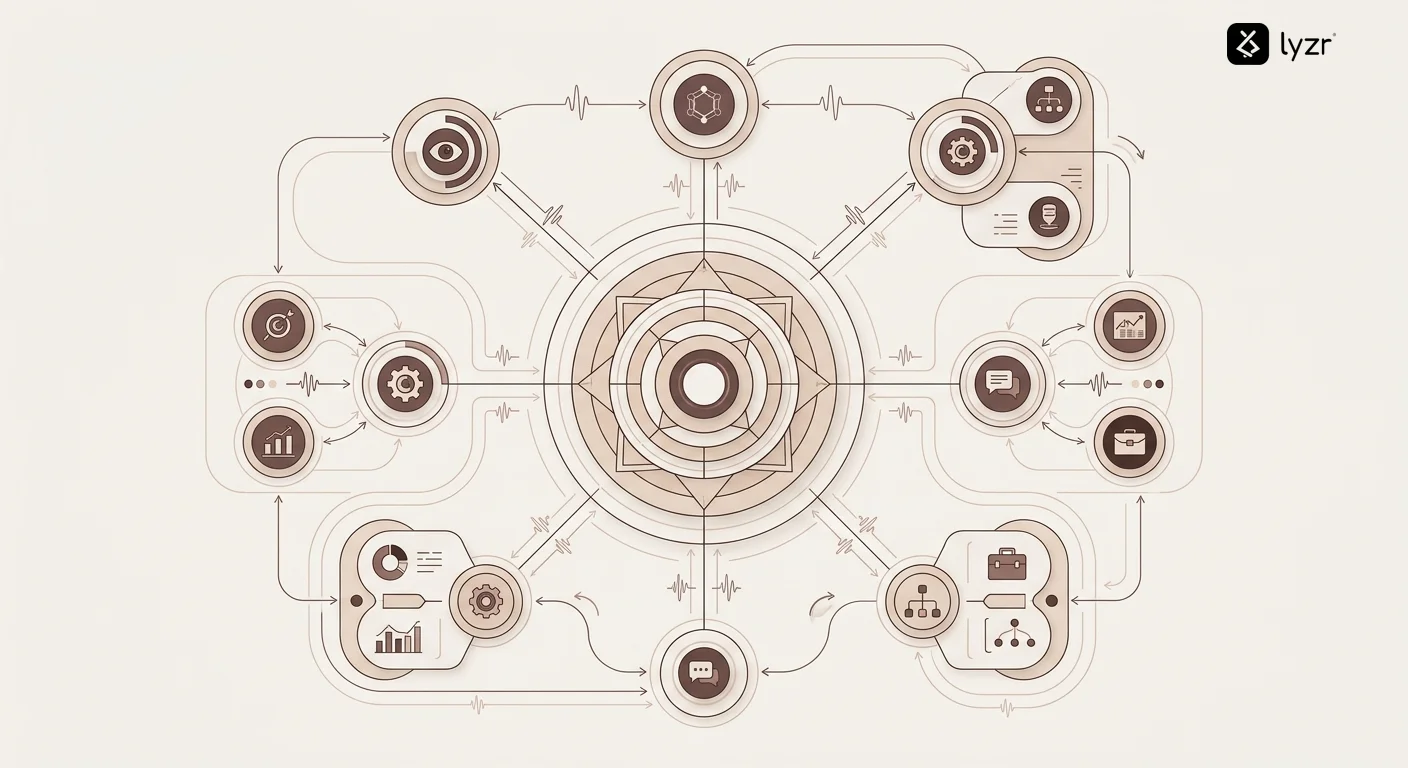
The framework provides several critical components that enable this collaboration. First, it establishes standardized communication protocols so agents can exchange information, requests, and status updates without ambiguity. Second, it defines roles and capabilities so agents understand what their teammates can contribute. Third, it implements coordination mechanisms that prevent conflicts and ensure coherent action toward shared goals.
Modern agent frameworks like those powering Lyzr’s platform provide the orchestration layer that manages these interactions at scale, ensuring that multiple specialized agents work together efficiently without manual intervention.
How Do Multi-Agent Frameworks Enable Effective Collaboration?
Collaboration between AI agents requires more than simple data exchange. It demands structured communication, shared context, and coordination protocols that prevent chaos when multiple autonomous systems operate simultaneously.
The framework establishes a common communication language. This isn’t just about data formats but about conveying intent, priorities, constraints, and requests in ways that other agents can interpret and act upon. Agents need to understand not just what information they’re receiving, but why it matters and what action, if any, is expected from them.
Multi-agent frameworks provide several collaboration mechanisms:
- Message Passing Systems: Agents send structured messages containing requests, data, or status updates through defined channels
- Shared Memory Spaces: Common data stores where agents can read and write information accessible to the entire team
- Service Registries: Directories that catalog each agent’s capabilities so others know who to contact for specific tasks
- Coordination Protocols: Rules governing how agents request assistance, delegate tasks, or resolve conflicts
- Shared World Models: Common representations of the environment that all agents can perceive and reason about
Platforms like Lyzr’s multi-agent orchestration handle these coordination challenges automatically, allowing enterprises to deploy complex agent teams without building custom communication infrastructure from scratch.
What Are the Core Benefits of Multi-Agent Frameworks?
The advantages of multi-agent frameworks extend far beyond simple task distribution. They fundamentally change what’s possible with AI in enterprise environments.
Specialization and Expertise: Instead of training a generalist model that performs adequately across many domains, you can deploy highly optimized agents that excel at specific functions. One agent might specialize in financial analysis, another in natural language generation, and another in code execution. Each becomes an expert in its narrow domain, achieving performance levels that generalist models cannot match.
Scalability and Flexibility: When workload increases, you can add more agents to the system without retraining existing models. When new capabilities are needed, you introduce new specialist agents rather than reengineering your entire AI infrastructure. This modularity makes enterprise AI systems more adaptable to changing business requirements.
Robustness and Fault Tolerance: Single-agent systems create single points of failure. If the model fails or produces incorrect output, the entire workflow breaks. In multi-agent frameworks, if one agent encounters an error, others can compensate. The system can route around failures, retry with different approaches, or escalate to human oversight without complete breakdown.
Parallel Processing: Multiple agents can tackle different aspects of a complex problem simultaneously. While one agent gathers data, another can perform preliminary analysis, and a third can prepare reporting templates. This parallelism dramatically reduces time-to-solution for complex workflows.
Explainability and Auditability: When a single black-box model makes a decision, explaining that decision is challenging. With multi-agent systems, you can trace exactly which agents contributed to the outcome, what information they processed, and what reasoning they applied. This transparency is critical for enterprise AI governance and regulatory compliance.
What Architectures Power Multi-Agent Systems?
The organizational structure of your agent team profoundly impacts performance, reliability, and complexity. There’s no universal “best” architecture – the optimal choice depends on your specific problem characteristics, coordination requirements, and organizational constraints.
Hierarchical Architecture: This mirrors traditional corporate structures. A coordinator or manager agent receives high-level objectives, decomposes them into subtasks, and assigns work to specialized worker agents. The coordinator monitors progress, handles exceptions, and aggregates results. This provides clear control and straightforward debugging but can create bottlenecks if the coordinator becomes overwhelmed. It works well for structured workflows with well-defined task decompositions.
Decentralized Architecture: Agents operate as peers without a central authority. They communicate directly, negotiate roles dynamically, and self-organize to solve problems. This approach offers exceptional flexibility and robustness since there’s no single point of failure. However, achieving effective coordination without central control is significantly more complex. This architecture excels in unpredictable environments where rigid hierarchies would be too brittle.
Hybrid Architecture: Many enterprise systems combine elements of both approaches. High-level coordination might be hierarchical while lower-level execution uses peer-to-peer collaboration. This balances control with flexibility, providing structure where needed while allowing autonomy where beneficial.
Understanding the tradeoffs between multi-agent and single-agent approaches helps organizations choose architectures aligned with their specific requirements and constraints.
What Challenges Exist in Building Production Multi-Agent Systems?
Deploying multi-agent frameworks in enterprise production environments introduces challenges that don’t exist with single-agent systems. Successfully navigating these obstacles separates proof-of-concept demonstrations from mission-critical deployments.
Coordination Complexity: Ensuring agents work toward common objectives rather than pursuing conflicting goals requires sophisticated orchestration. Without proper coordination, agents might duplicate work, contradict each other’s outputs, or create circular dependencies that prevent progress. The coordination challenge grows exponentially with the number of agents.
Communication Overhead: Every message exchanged between agents consumes computational resources and introduces latency. Poorly designed communication protocols can create bottlenecks where agents spend more time coordinating than working. Balancing communication needs against performance requires careful protocol design.
Conflict Resolution: When multiple agents compete for limited resources or propose incompatible actions, the framework needs mechanisms to resolve conflicts fairly and efficiently. Without robust conflict resolution, systems can deadlock or make inconsistent decisions.
Credit Assignment: When a team of agents succeeds or fails, determining which agents contributed most significantly is challenging. This matters for system optimization, debugging, and continuous improvement. Proper credit assignment enables targeted refinement of underperforming agents.
Security and Trust: In distributed agent systems, you must consider scenarios where agents might be compromised or act maliciously. Security risks multiply when multiple agents access sensitive data or control critical operations. Frameworks need authentication, authorization, and audit mechanisms to maintain security postures.
How Do Multi-Agent Frameworks Handle Resource Allocation?
Managing shared resources – computational capacity, API quotas, database connections, or human attention – requires mechanisms that prevent conflicts while maximizing efficiency. Multi-agent frameworks borrow approaches from economics, game theory, and distributed systems.
Market-Based Mechanisms: Agents can bid on tasks or resources using virtual currency that represents their need and capability. The agent offering the best value proposition wins allocation. This creates efficient resource distribution while allowing agents autonomy in decision-making. Market mechanisms work particularly well when agents have heterogeneous capabilities and preferences.
Priority-Based Allocation: Resources are assigned based on predefined priority levels. Critical agents or urgent tasks receive preferential access. This ensures important work completes even under resource constraints but requires careful priority calibration to avoid starving lower-priority agents.
Negotiation Protocols: Agents engage in structured bargaining to reach mutually acceptable resource sharing arrangements. Negotiation allows flexible, context-aware allocation that adapts to changing conditions. However, it introduces communication overhead and requires sophisticated agent reasoning capabilities.
Centralized Coordination: In hierarchical systems, a dedicated resource manager agent monitors availability and assigns resources based on global optimization criteria. This provides predictable allocation and prevents conflicts but creates a coordination bottleneck and single point of failure.
Production platforms like Lyzr’s Control Plane implement these resource management strategies automatically, handling the complexity of multi-agent coordination while providing visibility into resource utilization and bottlenecks.
What Real-World Applications Use Multi-Agent Frameworks Today?
Multi-agent frameworks have moved beyond academic research into production systems solving critical business problems across industries.
Autonomous Vehicle Development: Waymo uses massive multi-agent simulations where thousands of vehicle agents and pedestrian agents interact to test rare and dangerous driving scenarios safely. This multi-agent approach identifies edge cases that would take years to encounter in real-world testing.
Enterprise Sales Automation: Modern AI SDR systems deploy multiple specialized agents. One agent researches prospects, another crafts personalized outreach, a third handles objection handling, and a fourth schedules meetings. This specialization delivers better results than monolithic sales automation tools.
Healthcare Diagnostics: Medical diagnostic systems use agent teams where specialists in radiology, pathology, patient history analysis, and treatment planning collaborate to generate comprehensive diagnostic assessments that consider multiple clinical perspectives.
Digital Marketing Orchestration: Marketing agent frameworks coordinate content generation agents, SEO optimization agents, campaign management agents, and performance analysis agents to execute integrated marketing strategies across channels.
Financial Trading: Algorithmic trading systems employ agent teams where some agents analyze market conditions, others identify opportunities, some execute trades, and others manage risk. This specialization enables sophisticated strategies that respond to market dynamics in real-time.
Supply Chain Optimization: Logistics companies use multi-agent frameworks where agents representing different warehouses, transportation modes, and delivery zones negotiate optimal routing and inventory allocation dynamically as conditions change.
Deep Dive FAQs
How Do Multi-Agent Frameworks Differ from Microservices Architecture?
While both decompose complex systems into specialized components, multi-agent frameworks and microservices solve different problems. Microservices are stateless, reactive components that respond to requests deterministically. They don’t make autonomous decisions or negotiate with peers. Multi-agent frameworks create autonomous entities that proactively pursue goals, adapt to changing conditions, and collaborate dynamically. Agents have internal state, memory, and decision-making capabilities that microservices lack. The distinction matters when building intelligent systems that must handle ambiguity and adapt without human intervention.
What Role Does Reinforcement Learning Play in Multi-Agent Systems?
Reinforcement learning enables agents to improve coordination strategies through experience. In multi-agent reinforcement learning, agents learn optimal behaviors not just for task completion but for effective collaboration. They discover communication protocols, negotiation strategies, and resource sharing approaches that humans might not explicitly program. This is particularly valuable in complex environments where optimal coordination strategies aren’t obvious upfront. However, multi-agent reinforcement learning introduces challenges around credit assignment and non-stationarity since each agent’s learning changes the environment for others.
How Do Enterprise Multi-Agent Frameworks Handle Compliance and Governance?
Production multi-agent frameworks require robust governance mechanisms to meet regulatory requirements. This includes comprehensive audit trails tracking which agents accessed what data and made which decisions. AI agent compliance frameworks implement role-based access controls limiting what actions each agent can perform. They enforce data residency requirements ensuring sensitive information stays within approved boundaries. Policy engines validate that agent decisions comply with business rules and regulatory constraints before execution. Monitoring systems detect anomalous agent behavior that might indicate security issues or malfunctions. These governance layers are essential for deploying multi-agent systems in regulated industries like finance, healthcare, and government.
What Technical Mechanisms Enable Agent Decision-Making and Reasoning?
Modern agents use several reasoning approaches. Planning algorithms like hierarchical task networks decompose high-level goals into executable action sequences. Belief-Desire-Intention (BDI) architectures model agent mental states, allowing them to maintain consistent goals while adapting tactics. Monte Carlo tree search enables agents to explore potential action sequences and select optimal paths. Large language models provide natural language understanding and generation capabilities that enable sophisticated communication. Knowledge graphs supply structured domain knowledge agents can reason over. The specific mechanisms depend on the agent’s role – a data analysis agent might use statistical reasoning while a customer service agent relies primarily on language model capabilities.
How Do You Choose Between Open-Source and Commercial Multi-Agent Frameworks?
The choice depends on several factors. Open-source frameworks like LangGraph or CrewAI offer flexibility and transparency but require significant engineering effort to deploy at scale. They’re ideal when you have specialized requirements or strong in-house AI expertise. Commercial platforms like Lyzr provide production-ready infrastructure, security features, monitoring, and support but with less customization flexibility. They accelerate time-to-value for enterprises without deep AI engineering teams. Consider your technical capabilities, security requirements, timeline constraints, and long-term maintenance burden. Many organizations start with open-source for experimentation then migrate to commercial platforms for production deployment. The vendor lock-in versus flexibility tradeoff requires careful evaluation of your strategic priorities.
What Performance Metrics Matter for Multi-Agent System Evaluation?
Evaluating multi-agent systems requires metrics beyond single-agent performance. Task completion rate measures what percentage of assigned objectives the agent team successfully achieves. Coordination efficiency tracks how much time agents spend coordinating versus executing productive work. Resource utilization shows whether agents use computational resources effectively or create bottlenecks. Communication overhead quantifies the cost of inter-agent messaging relative to task processing. Fault tolerance tests measure how system performance degrades when individual agents fail. Scalability metrics evaluate how performance changes as you add agents or increase workload. Response time distribution shows end-to-end latency including coordination delays. These metrics together provide comprehensive visibility into multi-agent system health and identify optimization opportunities.