An AI agent can give you a perfectly confident answer that has almost nothing to do with the evidence it was given.
That is the problem groundedness scoring is designed to catch.
A retrieval system may return the right documents. The model may read them. The final answer may even sound authoritative. But if the response adds unsupported claims, combines facts incorrectly, or draws conclusions that the retrieved context does not justify, the system is still unreliable.
That makes groundedness different from simply asking whether an answer is “good.”
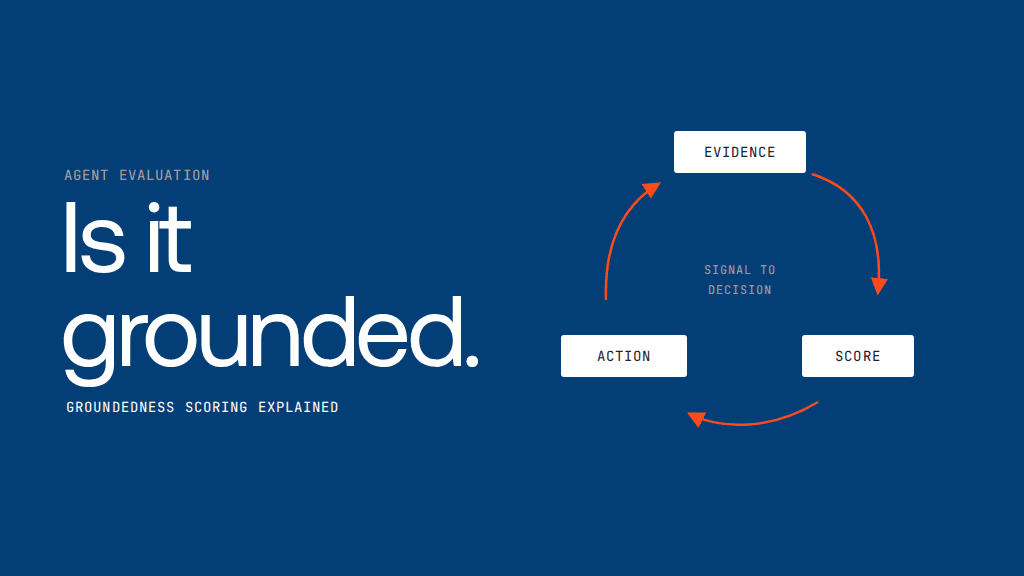
Groundedness asks a narrower question: how well is the generated response supported by the evidence available to the agent?
For teams evaluating AI agents for production, that distinction matters because a score is only useful if you know:
- what is actually being scored,
- which evaluation method produced the score,
- what threshold counts as acceptable,
- what happens when the score falls below that threshold,
- and whether the result is connected to the agent’s production lifecycle.
This guide breaks down those decisions and shows how groundedness scoring fits into a broader AI agent evaluation and governance strategy.
What Is Groundedness Scoring?
Groundedness scoring measures how strongly an AI-generated response is supported by a defined source of truth.
That source might be:
- retrieved documents,
- a knowledge base,
- database results,
- approved policies,
- structured records,
- tool outputs,
- or another explicitly defined evidence set.
A grounded response should not introduce claims that cannot be supported by that evidence.
For example, suppose an enterprise knowledge agent retrieves this policy:
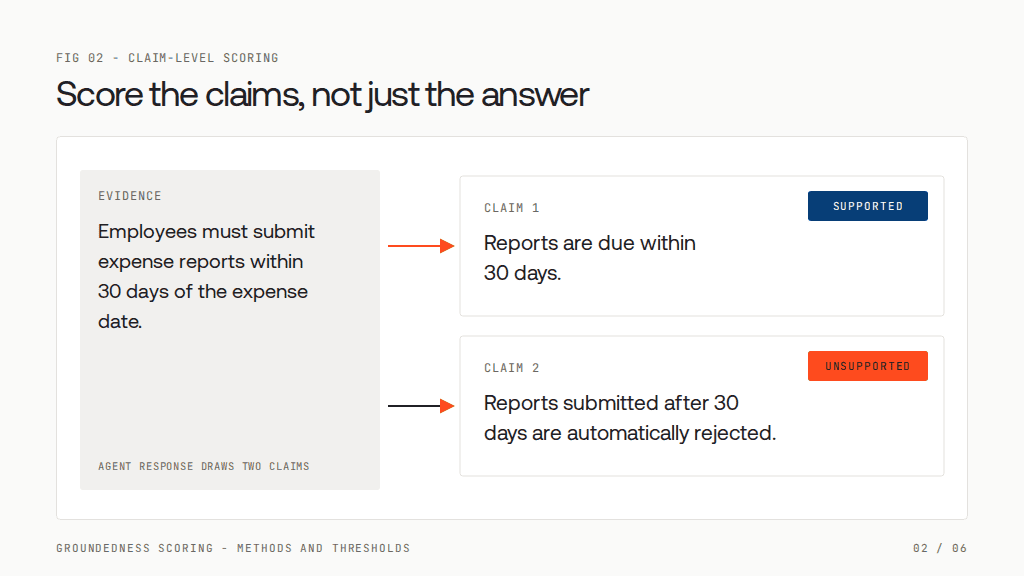
The first claim is grounded.
The second is not necessarily grounded. The source says when the report must be submitted, but says nothing about automatic rejection.
A groundedness evaluator should be able to distinguish between those two claims.
Groundedness is not the same as answer quality
This is where evaluation systems often become confusing.
An answer can be:
- Relevant but poorly grounded
- Grounded but incomplete
- Grounded but irrelevant
- Factually correct but unsupported by the supplied context
- Well-written but hallucinated
Consider this simple distinction:
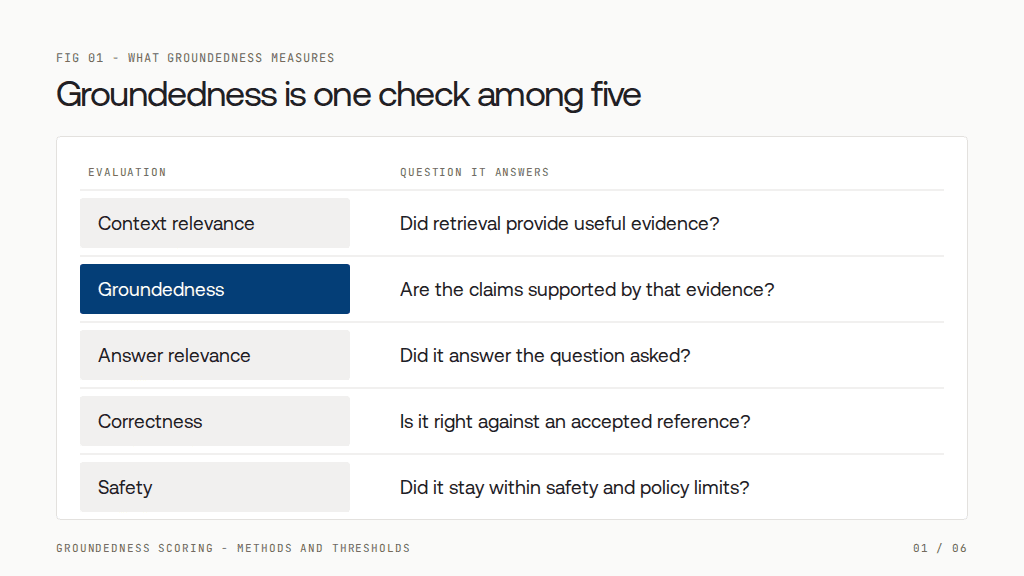
| Evaluation | Question it answers |
| Context relevance | Did retrieval provide useful evidence? |
| Groundedness | Are the response’s claims supported by that evidence? |
| Answer relevance | Did the response actually answer the user’s question? |
| Correctness | Is the answer factually correct against an accepted reference? |
| Safety | Did the response stay within safety and policy requirements? |
This is why groundedness should not become the single score used to judge an entire AI agent.
It measures one important failure mode.
And once you understand that, the next question becomes much more useful: how should that score actually be calculated?
The Four Main Methods for Groundedness Scoring
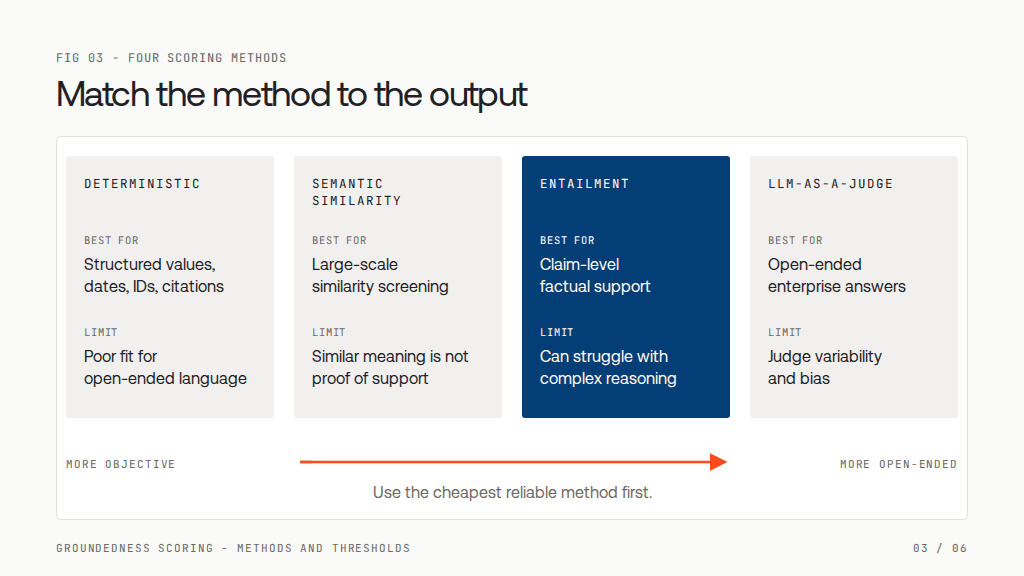
There is no single groundedness metric that works equally well for every agent.
The right method depends on what the agent produces, how much structured evidence is available, and how expensive a false positive or false negative would be.
The most common approaches fall into four categories.
| Method | How it works | Best for | Main limitation |
| Exact / deterministic checks | Checks claims against structured or predefined values | Structured outputs, citations, required fields | Poor fit for open-ended language |
| Semantic similarity | Compares generated statements with source content using embeddings | Large-scale similarity screening | Similar meaning does not prove factual support |
| Entailment-based scoring | Tests whether source evidence logically supports a claim | Claim-level factual support | Can struggle with complex reasoning |
| LLM-as-a-judge | A judge model evaluates response claims against supplied evidence | Open-ended enterprise responses | Judge models have their own variability and bias |
The strongest production systems generally don’t force one method to do everything.
Instead, they combine deterministic checks where possible with semantic or judge-based evaluation where interpretation is required.
That gives us an important principle:
The more objective the expected answer, the more deterministic your groundedness check can be. The more open-ended the response, the more you need semantic evaluation.
1. Deterministic Groundedness Checks
The simplest form of groundedness evaluation is also the easiest to trust.
If the agent is expected to return a structured value, you can verify it directly.
You can deterministically validate:
- whether the customer exists,
- whether the renewal date matches,
- whether the status matches.
There is little reason to spend another LLM call judging something that can be checked directly.
Where deterministic checks work well
They are particularly useful for:
- dates,
- IDs,
- monetary values,
- database fields,
- classifications,
- required citations,
- structured JSON,
- tool-call parameters,
- policy conditions.
They are fast, reproducible, and relatively inexpensive.
But they become less useful when the agent is generating natural-language explanations.
If the source says:
“The policy allows reimbursement for business travel.”
and the response says:
“Business travel expenses may be reimbursed when they meet the company’s eligibility requirements.”
A simple exact-match check cannot tell you whether the second statement is properly supported.
That’s where semantic methods become useful.
2. Semantic Similarity Scoring
Semantic similarity evaluates how closely a generated statement resembles the information in the retrieved evidence.
Instead of looking for identical words, an embedding-based evaluator converts the source and response into representations and calculates how similar they are.
A simplified score might look like:
Groundedness score = semantic similarity(response claim, supporting evidence)
For example:
| Source | Generated claim | Similarity |
| “Reports must be submitted within 30 days.” | “Reports are due within 30 days.” | 0.94 |
| “Reports must be submitted within 30 days.” | “Reports are automatically rejected after 30 days.” | 0.61 |
| “Reports must be submitted within 30 days.” | “Employees can submit reports at any time.” | 0.18 |
The exact numbers here are illustrative, not universal thresholds.
And that caveat is important.
Similarity is not proof of groundedness
Two statements can be semantically similar while one introduces an unsupported detail.
For example:
Source: “The company operates 20 offices globally.”
Response: “The company operates 20 offices across Europe and North America.”
The response sounds highly similar to the source.
But Europe and North America were never stated.
This is why embedding similarity is useful as a screening signal, but risky as the only groundedness metric for high-stakes workflows.
The evaluation problem therefore moves from “are these statements similar?” to “does the evidence actually support this claim?”
3. Entailment-Based Groundedness
Entailment takes the evaluation one step further.
Instead of asking whether two pieces of text are similar, it asks whether the evidence supports the generated claim.
Think of it as:
Evidence → Does it justify the claim?
Consider:
Evidence
“The account has been active since 2019.”
Claim A
“The account has been active since 2019.”
Claim B
“The account has been active for more than five years.”
Claim C
“The account was renewed in 2019.”
Claim A is directly supported.
Claim B may be logically supported depending on the evaluation date.
Claim C is not supported by the evidence.
This makes entailment particularly useful when your agent produces longer responses containing multiple claims.
Claim-level scoring is better than response-level scoring
Suppose an answer contains five factual claims.
Four are supported.
One is not.
A single response-level score can hide the problematic claim.
A better evaluation breaks the response into claims:
You can then calculate an aggregate score while still retaining the underlying evidence.
That distinction becomes critical once groundedness scores start influencing deployment decisions.
4. LLM-as-a-Judge
For open-ended responses, LLM-as-a-judge is often the most flexible approach.
The evaluator receives:
- the user request,
- the retrieved context,
- the generated response,
- and a groundedness rubric.
It then evaluates whether the response is supported by the evidence.
A basic rubric might ask the judge to score:
| Criterion | Question |
| Evidence coverage | Are the major claims supported? |
| Unsupported claims | Does the response introduce information absent from the evidence? |
| Contradiction | Does the response conflict with the source? |
| Attribution | Can important claims be traced to evidence? |
| Logical support | Do conclusions actually follow from the available information? |
This approach is powerful because the judge can evaluate language rather than relying on literal matching.
But it introduces a new problem:
Who evaluates the evaluator?
LLM judges can disagree with human reviewers, vary across models, and produce inconsistent results. Lyzr’s recent evaluation work similarly treats LLM-as-a-judge as useful but not something teams should blindly treat as ground truth. (Lyzr)
That is why a serious groundedness pipeline should validate its evaluator against human-reviewed examples before using the score as a production gate.
Which Groundedness Method Should You Use?
The answer depends on what your agent actually does.
A useful decision framework looks like this:
| Agent output | Recommended method | Why |
| Structured database values | Deterministic | Direct verification is possible |
| API/tool parameters | Deterministic | Expected values can be validated |
| Citation presence | Deterministic | Easy to check mechanically |
| Short factual answers | Entailment + deterministic | Claim support can be evaluated directly |
| RAG knowledge answers | Entailment + LLM judge | Claims can vary significantly in wording |
| Long-form research | LLM judge + claim-level checks | Requires contextual interpretation |
| Legal/compliance explanations | Hybrid + human review | False grounding can have material consequences |
| Agent decisions | Hybrid evaluation | Output alone is not enough; action and evidence both matter |
The pattern is clear: use the cheapest reliable evaluation method first, then add more sophisticated evaluation where uncertainty remains.
That is more scalable than sending every response through an expensive judge model.
How Should a Groundedness Score Be Calculated?
Once you choose the evaluation method, you still need to decide what the final score means.
A simple claim-level model is:
Groundedness = supported claims ÷ total factual claims
For example:
- 8 supported claims
- 10 total claims
Groundedness = 0.80
But this approach treats every claim equally.
That may be wrong for enterprise systems.
Consider an insurance agent that produces ten claims:
- nine minor descriptive statements,
- one incorrect statement about policy eligibility.
A simple average could still produce a high score.
Yet the one unsupported claim could be the only thing that matters.
Weighted groundedness
A better approach is to assign greater weight to critical claims.
For example:
| Claim | Weight | Grounded? |
| Customer name | 1 | Yes |
| Account status | 2 | Yes |
| Renewal date | 3 | Yes |
| Regulatory requirement | 5 | No |
The weighted score would penalize the unsupported regulatory claim much more heavily.
This leads to a more useful formula:
Weighted groundedness = Σ(weight × support score) ÷ Σ(weights)
The exact weighting should come from your business risk model, not from an arbitrary scoring convention.
Groundedness Thresholds: What Score Is Good Enough?
This is where many evaluation programs go wrong.
Someone chooses:
“Anything above 0.8 passes.”
And suddenly 0.80 becomes a universal definition of quality.
It isn’t.
A groundedness score is only meaningful relative to:
- the evaluator,
- the dataset,
- the domain,
- the severity of errors,
- the type of evidence,
- and the consequences of failure.
A useful starting framework is:
| Score | General interpretation | Typical action |
| 0.95–1.00 | Very strong evidence support | Usually safe to pass, subject to critical-claim checks |
| 0.90–0.94 | Strong grounding | Pass for many lower-risk use cases |
| 0.80–0.89 | Mixed / needs scrutiny | Review or apply additional checks |
| 0.70–0.79 | Weak grounding | Usually fail or escalate |
| <0.70 | Significant unsupported content | Block, regenerate, or route to human |
These are starting bands, not universal standards.
A financial compliance agent might require near-perfect support for regulatory claims.
A customer-support summarizer might tolerate a lower aggregate score if critical facts are separately validated.
That means the better question isn’t:
“What is the correct groundedness threshold?”
It is:
“What level of unsupported information can this particular workflow tolerate?”
Why One Threshold for Every Agent Doesn’t Work
Consider three agents.
Agent A: Internal knowledge assistant
It answers questions about company documentation.
A minor unsupported sentence may be inconvenient but recoverable.
Possible policy: 0.85+ with citation checks.
Agent B: Customer support agent
It answers customers about orders, subscriptions, and policies.
Unsupported claims can directly affect customer experience.
Possible policy: 0.90+ plus deterministic validation of order and account information.
Agent C: Compliance agent
It explains regulatory requirements or recommends actions.
An unsupported regulatory statement can create material risk.
Possible policy: 0.95+ for general claims, with critical regulatory claims requiring deterministic or human verification.
The score hasn’t changed.
The cost of being wrong has.
That is what should change the threshold.
Don’t Turn Groundedness Into a Single Pass/Fail Number
A mature evaluation system should use multiple gates.
For example:
| Evaluation layer | Example rule | Outcome |
| Groundedness | ≥ 0.90 | Pass |
| Critical claim support | 100% | Required |
| Citation validation | All required claims cited | Required |
| Safety | No critical violation | Required |
| Task completion | ≥ 95% | Required |
| Tool correctness | 100% for sensitive actions | Required |
This prevents a dangerous situation where a high groundedness score hides another failure.
An agent could be highly grounded and still:
- call the wrong API,
- expose restricted information,
- take an unauthorized action,
- fail to complete the task,
- or violate a policy.
That is why groundedness belongs inside a broader AI agent evaluation strategy, rather than replacing one.
Lyzr’s evaluation material similarly separates groundedness from other dimensions such as truthfulness, safety, and agent behavior. (Lyzr)
The Threshold Should Also Depend on What Happens Next
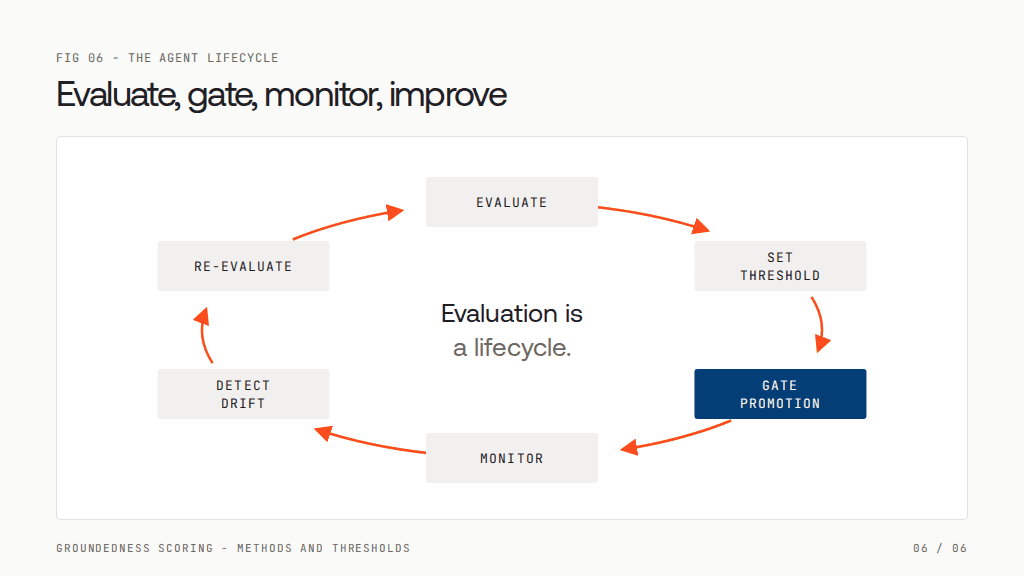
This is the point where evaluation connects to production.
Imagine an agent receives a groundedness score of 0.78.
The score itself doesn’t tell you what to do.
You need a policy.
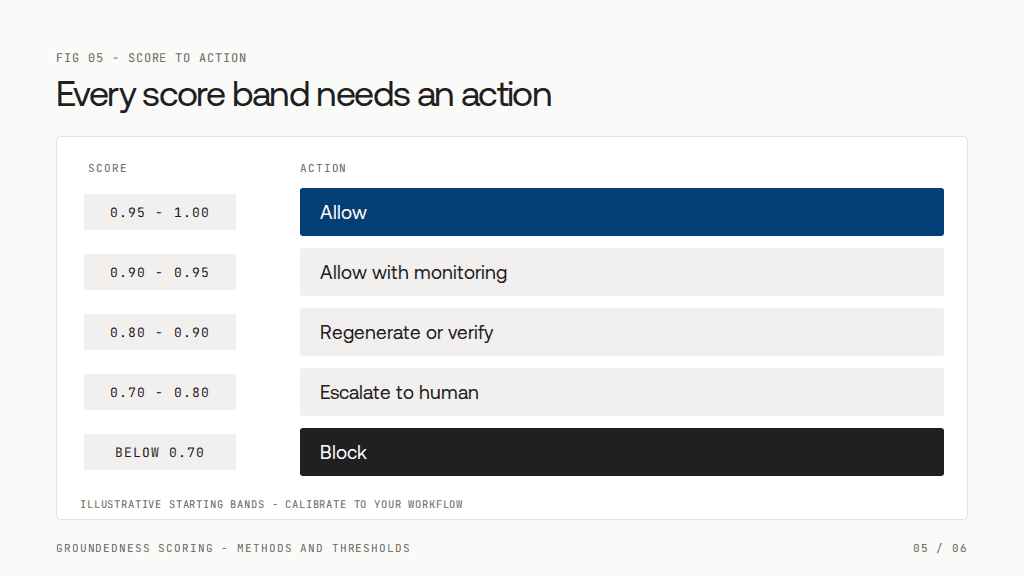
| Groundedness result | Possible response |
| ≥ 0.95 | Allow |
| 0.90–0.95 | Allow with monitoring |
| 0.80–0.90 | Regenerate or verify |
| 0.70–0.80 | Escalate to human |
| < 0.70 | Block |
Now the score has become operational.
Instead of being a number sitting in an evaluation dashboard, it becomes a decision signal.
That distinction is especially important for AI agents because agents don’t only generate text. They can call APIs, access data, modify systems, and trigger downstream workflows.
Lyzr’s AI agent observability guidance makes the same broader distinction: teams need visibility into outputs, tool invocations, decision paths, and evaluation signals rather than simply knowing that an agent ran. (Lyzr)
Where OpenController Fits
Groundedness scoring tells you whether an agent’s response is supported by its evidence.
It does not, by itself, answer:
- Which agent produced the response?
- Which version was running?
- Was that version evaluated before production?
- Who approved it?
- What policies apply to it?
- What happens when its evaluation score drops?
- What did the agent do in production?
- Can the team trace that decision later?
That’s the layer Lyzr OpenController is designed to address.
OpenController provides a governance layer across agents, models, tools, workflows, and environments. Its Find, Ship, Run, and Improve model connects discovery and evaluation with deployment, runtime monitoring, policy enforcement, and ongoing improvement. (Lyzr)
The distinction is important:
| Groundedness evaluation | OpenController |
| Measures evidence support | Governs the agent around that result |
| Produces an evaluation score | Connects evaluation to lifecycle decisions |
| Identifies unsupported responses | Helps determine what happens next |
| Focuses on response quality | Covers identity, policy, deployment, runtime and auditability |
| Primarily an evaluation signal | Operational control layer |
This is also why OpenController should not be thought of as a replacement for every evaluation or observability system.
The evaluation tells you whether the agent performed well.
The control layer determines what the organization should do about that result.
Lyzr’s broader AI agent governance framework makes this distinction explicit: behavioral evaluation such as grounding sits alongside identity, permissions, human-in-the-loop controls, and runtime monitoring. (Lyzr)
Book A Demo: Click Here
Join our Slack: Click Here
Link to our GitHub: Click Here