An enterprise can have a detailed AI policy document, clearly defined access rules, and an entire team responsible for compliance. But what happens when an AI agent accesses a customer record it shouldn’t, shares confidential information in a response, or triggers an action that violates an internal business rule?
The policy might already exist. The problem is that having a policy and enforcing it are two very different things.
This distinction is becoming increasingly important as organizations move from using AI to answer questions to deploying AI agents that can access enterprise systems, retrieve information, make decisions, and execute tasks.
Traditional governance processes were largely designed around human oversight, periodic reviews, and predefined approval workflows. AI systems introduce a different challenge: decisions and actions can happen continuously, across multiple applications, often without someone reviewing every individual step.
That’s where AI policy enforcement comes in.
Rather than relying entirely on employees and teams to interpret and follow policy documents, organizations need mechanisms that translate those policies into rules, apply them consistently across AI systems, and respond when something falls outside permitted boundaries.
Let’s look at what this means, why it matters, and how enterprises can build an effective AI policy enforcement framework.
What Is AI Policy Enforcement?
AI policy enforcement is the process of translating an organization’s rules, regulatory requirements, and acceptable-use guidelines into controls that govern how AI systems operate.
These controls determine what an AI system can access, what information it can process, which actions it can perform, and when it needs human approval.
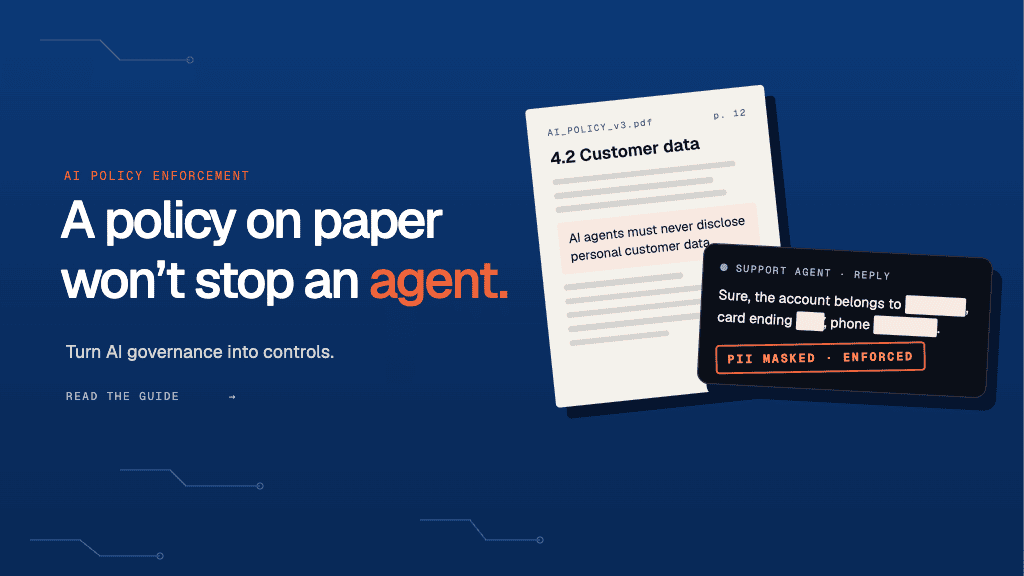
For example, an organization might have a policy stating that customer-facing AI agents must never disclose personally identifiable information (PII). AI policy enforcement translates that requirement into operational controls that can detect sensitive information and prevent it from appearing in an unauthorized response.
Similarly, a financial services company might require human approval before an AI agent initiates a high-value transaction. The policy enforcement mechanism ensures that the agent cannot independently complete that action.
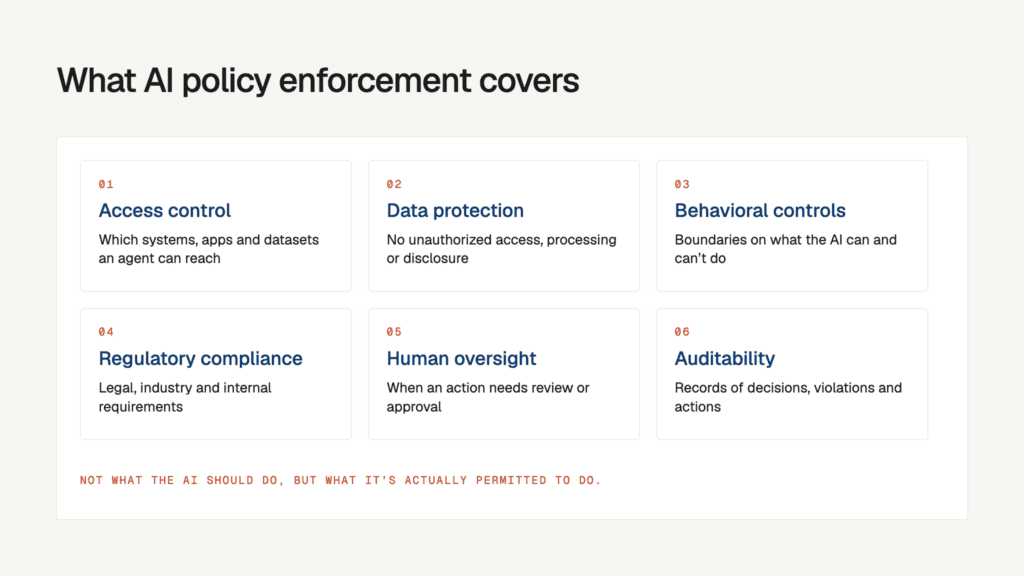
In practice, AI policy enforcement covers several areas:
- Access control: Defining which systems, applications, and datasets an AI agent can access.
- Data protection: Preventing unauthorized access, processing, or disclosure of sensitive information.
- Behavioral controls: Establishing boundaries around what an AI system can and cannot do.
- Regulatory compliance: Applying relevant legal, industry, and organizational requirements.
- Human oversight: Identifying situations where an action requires human review or approval.
- Auditability: Maintaining records of policy decisions, violations, and enforcement actions.
The important distinction is that policy enforcement is not simply about telling an AI system what it should do. It is about establishing controls that determine what it is actually permitted to do.
Why Is AI Policy Enforcement Becoming Important?
AI adoption rarely happens through one centralized initiative. Different departments introduce AI systems to solve specific problems, often using different models, applications, integrations, and data sources.
The sales team might use an AI agent to qualify leads. HR might deploy one to screen applications. Finance could use agents to process invoices, while customer support relies on AI to retrieve customer information and resolve queries.
Individually, these applications may have well-defined permissions. But as they become interconnected, enforcing consistent organizational policies becomes more complicated.
There are three underlying challenges.
1. AI Systems Can Act Across Multiple Enterprise Applications
Traditional software generally follows predefined workflows. AI agents, on the other hand, can interpret instructions, retrieve contextual information, select available functions, and execute actions through connected systems.
This introduces a larger set of possible actions that organizations need to govern.
Consider a procurement agent with access to vendor records, internal contracts, and payment systems. Even if its primary responsibility is to compare vendor proposals, excessive permissions could allow it to access or modify information beyond its intended purpose.
The challenge is not simply controlling what the agent knows. It is controlling what it can do with that information.
2. Policies Are Often Documented but Not Operationalized
Most enterprises already have policies covering data privacy, information security, employee conduct, access permissions, and regulatory compliance.
However, these policies are frequently maintained across separate documents, departments, and approval processes.
An employee might understand that confidential customer information cannot be shared externally. But how does an AI agent apply that same restriction when generating a response, summarizing a document, or sending information to another application?
A policy that exists only in documentation cannot automatically prevent an AI system from violating it.
Organizations need a way to translate policy requirements into enforceable controls.
3. Manual Oversight Cannot Cover Every AI Interaction
Human reviews are important, particularly for decisions involving financial transactions, sensitive customer information, and regulated business processes.
However, reviewing every AI interaction manually becomes increasingly difficult as deployment expands.
This creates a practical problem: organizations need to identify which actions can happen autonomously, which require additional checks, and which should never be permitted.
This is also reflected in the risks highlighted by the OWASP Top 10 for LLM Applications, including prompt injection, sensitive information disclosure, insecure output handling, and excessive agency. These risks demonstrate why organizations need controls around both AI-generated outputs and the actions connected systems can execute.
The common thread across all three challenges is the need to move from policy documentation to policy enforcement.
AI Governance vs. AI Policy Enforcement: What Is the Difference?
AI governance and AI policy enforcement are closely connected, but they serve different purposes.
AI governance establishes the overall framework for how an organization develops, deploys, manages, and monitors AI systems. It defines responsibilities, acceptable risk levels, accountability structures, and organizational standards.
AI policy enforcement makes those requirements operational.
Think of governance as defining the rules of an organization and policy enforcement as ensuring those rules are followed when AI systems operate.
| AI Governance | AI Policy Enforcement |
|---|---|
| Purpose: Defines how the organization develops, deploys, manages, and oversees AI. | Purpose: Makes those requirements work in day-to-day AI operations. |
| Focus: Accountability, risk management, acceptable-use policies, and organizational standards. | Focus: Access restrictions, data protection, behavioral controls, approvals, and monitoring. |
| Where it applies: Across the organization’s AI strategy and lifecycle. | Where it applies: During individual AI interactions, workflows, and actions. |
| Examples: Assigning AI system owners, setting risk thresholds, and defining acceptable use. | Examples: Blocking unauthorized access, masking sensitive data, and escalating restricted actions. |
| Result: A framework that tells the organization how AI should be managed. | Result: Controls that help ensure AI systems follow that framework. |
Neither works effectively in isolation.
An organization may have a well-designed governance framework, but without enforcement mechanisms, its policies can remain disconnected from actual AI behavior.
Similarly, implementing individual restrictions without an overarching governance framework can result in inconsistent controls across departments.
This is why enforcement should be treated as an essential operational layer within a broader enterprise AI governance framework.
What Does an Effective AI Policy Enforcement Framework Include?
AI policy enforcement is not a single security feature or a standalone compliance process. It requires multiple controls working together to ensure that AI systems operate within clearly defined boundaries.
A practical framework should address the following six areas.
1. Identity and Access Management
Every AI agent should have a clearly defined identity, purpose, owner, and set of permissions.
Without this, organizations can struggle to determine which agent accessed a resource, whether that access was authorized, and who is accountable for its actions.
Identity and access controls should establish:
- Which users or agents can access specific applications.
- What information each agent is permitted to retrieve.
- Which operations it can perform within connected systems.
- Whether access is restricted by role, department, or business function.
- When elevated permissions require additional authorization.
For example, a recruitment agent might need access to candidate applications and interview schedules. It should not automatically receive access to payroll records simply because both systems are part of the organization’s HR environment.
The principle is straightforward: an agent should receive only the permissions necessary to perform its assigned responsibilities.
2. Data Privacy and Information Protection
AI systems frequently process information from multiple sources, including internal documents, customer records, databases, and external applications.
This makes data protection an important part of policy enforcement.
Organizations should define rules around how information can be retrieved, processed, stored, and shared.
Some practical controls include:
- Detecting and masking personally identifiable information.
- Preventing unauthorized disclosure of confidential business information.
- Restricting access to sensitive datasets.
- Applying data retention and deletion requirements.
- Controlling how information moves between integrated applications.
Consider an AI customer support agent that retrieves a customer’s account information to answer a query.
The agent may need access to the customer’s name, subscription details, and support history. It does not necessarily need access to payment credentials or another customer’s records.
Policy enforcement helps ensure that information access remains aligned with the agent’s purpose.
3. Behavioral Guardrails
Access permissions determine what an AI system can reach. Behavioral guardrails determine how it should operate within those permissions.
This distinction matters because an AI system can have legitimate access to information and still generate an inappropriate response or take an unintended action.
Behavioral controls can include:
- Restricting responses to approved business contexts.
- Detecting harmful or inappropriate outputs.
- Checking responses against trusted knowledge sources.
- Preventing prompt injection from overriding established instructions.
- Flagging potentially misleading or unsupported responses.
For instance, a financial advisory agent might be allowed to explain investment products using approved company information. However, it should not make unauthorized financial commitments or present unverified information as an approved recommendation.
This is where mechanisms such as Responsible AI guardrails become relevant. They help organizations establish boundaries around AI behavior rather than relying entirely on the model to interpret instructions correctly.
4. Human Approval and Escalation
Not every AI action should be treated equally.
An agent summarizing an internal document presents a different level of risk from an agent approving a payment or modifying a customer account.
Effective enforcement frameworks should therefore define which actions can happen automatically and which require human authorization.
| Example AI Task | What the Organization Should Enforce |
|---|---|
| Summarize an internal document | Allow the task only if the agent and requesting user have permission to access that document. |
| Retrieve customer information | Verify the user’s identity and limit the agent to the records needed for the request. |
| Draft an external email | Check the content and require approval before sending it when the communication is sensitive. |
| Update a customer record | Confirm that the agent is authorized to make that specific change and record the activity. |
| Approve a financial transaction | Require the appropriate human authorization before the transaction is approved. |
| Execute an irreversible action | Require explicit human approval, or prevent the agent from performing the action autonomously. |
The examples above show that the level of control should depend on what the agent is doing and what could happen if it gets that action wrong.
The objective is not to introduce human approval into every workflow. It is to place human oversight where the consequences justify it.
Organizations can also define escalation conditions. For example, an agent that encounters conflicting policy instructions or cannot establish whether an action is authorized should pause the workflow and request human intervention.
5. Continuous Monitoring and Violation Detection
Policy enforcement cannot end once an AI system is deployed.
An agent’s operating environment can change as new integrations are introduced, datasets are updated, permissions evolve, and workflows become more complex.
Organizations need visibility into how agents behave during actual operations.
Continuous monitoring should help answer questions such as:
- Is the agent accessing information outside its intended scope?
- Are there repeated attempts to perform restricted actions?
- Is it generating responses that violate established policies?
- Are policy violations increasing after a workflow or model update?
- Are agents consistently following their assigned permissions?
Monitoring also helps teams identify patterns that individual alerts might miss.
For example, a single failed attempt to access a restricted resource might not indicate a major incident. Repeated attempts across multiple agents, however, could point to a broader configuration or security problem.
6. Audit Trails and Accountability
When an AI system violates a policy, organizations need to understand what happened, which controls were involved, and what corrective action was taken.
Auditability makes this possible.
A useful audit trail should capture:
- The identity of the AI agent involved.
- The user or workflow that initiated the activity.
- The resource or information accessed.
- The action attempted or executed.
- The policy applied to that action.
- Whether the action was allowed, blocked, or escalated.
- Any human approvals or interventions.
These records are particularly important for organizations operating in regulated environments, where demonstrating compliance can be as important as implementing the underlying controls.
The NIST AI Risk Management Framework also emphasizes documented policies, clear organizational responsibilities, ongoing monitoring, and accountability throughout the AI lifecycle.
Taken together, these six capabilities create the foundation for an enforcement framework that can operate consistently across different AI systems and business functions.
How Does AI Policy Enforcement Work in Practice?
Understanding the individual controls is useful, but the real value of policy enforcement becomes clearer when we look at how they work together during an AI interaction.
Consider an AI agent responsible for processing employee reimbursement requests.
The agent retrieves submitted expense reports, checks receipts against company policy, identifies exceptions, and prepares reimbursement recommendations.
The enforcement process can be understood through the following stages:
| Stage | What Happens | Policy Enforcement in Action |
|---|---|---|
| 1. Request initiation | An employee submits an expense report, triggering the AI agent’s workflow. | The system identifies the request and the workflow responsible for processing it. |
| 2. Identity and permission validation | The agent accesses the relevant employee and expense records. | The system verifies the employee’s identity and checks which records the agent is permitted to access. |
| 3. Policy evaluation | The agent reviews the expense against company rules. | The system checks spending limits, eligible categories, and documentation requirements. |
| 4. Risk and exception detection | The agent identifies missing receipts, unusual expenses, or restricted categories. | Potential violations and uncertain cases are flagged for further review. |
| 5. Enforcement decision | The request is classified based on the applicable rules. | Compliant requests proceed, exceptions are escalated, and prohibited actions are blocked. |
| 6. Audit logging | The system records the checks and decisions made. | The organization retains a record of enforcement actions and human interventions. |
The process produces three possible outcomes:
| Outcome | What Happens Next |
|---|---|
| Compliant | The request proceeds within the agent’s approved permissions. |
| Exception | The request is flagged and sent for human review. |
| Policy violation | The restricted action is blocked and the event is logged. |
The important part is that enforcement happens throughout the workflow, not just after the agent has completed its task.
A policy violation should not need to become a financial loss or compliance incident before the organization discovers it.
This approach also makes it easier to standardize controls across different workflows. The same principles of identity validation, data protection, approval, and audit logging can be applied to procurement, finance, HR, and customer operations.
Common AI Policy Enforcement Challenges Enterprises Need to Address
Even when organizations understand the importance of policy enforcement, implementing it consistently across an enterprise is not straightforward.
The challenge often comes from the way AI systems are developed and deployed.
Different teams use different frameworks, models, integrations, and security practices. As a result, organizations can end up with several independent enforcement mechanisms that do not necessarily follow the same standards.
Here are some common challenges.
| Challenge | What Happens | What Organizations Need |
|---|---|---|
| Fragmented AI environments | Different teams deploy agents with different rules and permissions. | Centralized policy management |
| Shadow AI | Employees introduce AI applications without formal IT or security approval. | AI discovery and visibility |
| Inconsistent enforcement | Similar workflows follow different security and compliance rules. | Reusable, standardized policies |
| Excessive agent permissions | Agents receive broader access than their responsibilities require. | Least-privilege access controls |
| Limited runtime visibility | Teams cannot easily identify policy violations as they happen. | Continuous monitoring and alerts |
| Incomplete audit records | Organizations struggle to reconstruct decisions and actions. | Traceable enforcement logs |
The Challenge of Shadow AI and Agent Sprawl
One challenge deserves particular attention: the growing number of AI systems operating across enterprise environments.
Employees may introduce AI applications independently, while engineering teams build agents for specific workflows. Business units might also adopt third-party AI solutions without a centralized understanding of their permissions or data access.
Over time, organizations lose visibility into which agents exist, who owns them, what systems they can access, and which policies they follow.
This is commonly referred to as AI agent sprawl.
Policy enforcement becomes difficult when organizations cannot establish what needs to be governed in the first place.
A centralized approach to AI agent governance helps address this problem by bringing agent inventory, identity, permissions, oversight, and monitoring into a structured framework.
How to Build an Effective AI Policy Enforcement Strategy
Implementing AI policy enforcement does not mean introducing restrictions across every AI application overnight.
A better approach is to start with visibility, understand the risks, define the rules, and progressively introduce enforcement mechanisms.
The following steps provide a practical starting point.
Step 1: Establish Visibility Into Your AI Environment
Before defining enforcement rules, identify the AI systems already operating across your organization.
Build an inventory that captures:
- AI agents, models, and applications currently in use.
- The teams responsible for each system.
- The business processes they support.
- The data sources and applications they access.
- The permissions and integrations they use.
This inventory should also account for AI systems introduced outside formal IT procurement processes.
Without visibility, policy enforcement will inevitably have gaps.
Step 2: Classify AI Systems Based on Risk
Not every AI application requires the same level of control.
An internal document summarization agent and an AI system handling financial transactions have very different risk profiles.
Classify AI systems based on factors such as:
- Sensitivity of the information they process.
- Level of autonomy they have.
- Business impact of their decisions.
- Regulatory requirements applicable to their workflows.
- Potential consequences of unauthorized actions.
This allows organizations to prioritize enforcement efforts instead of applying identical restrictions to every application.
Step 3: Translate Organizational Policies Into Enforceable Rules
Once risks are understood, identify the policies that need to be operationalized.
For example:
| Organizational Policy | Enforceable Control |
|---|---|
| Customer data must remain confidential. | Detect and block unauthorized disclosure of customer information. |
| Only authorized employees can access financial records. | Validate user identity and agent permissions. |
| High-value transactions require approval. | Introduce mandatory human authorization. |
| AI-generated information must be verifiable. | Apply groundedness and output validation checks. |
| Agents must operate within their assigned responsibilities. | Restrict available tools, functions, and resources. |
| All sensitive activities must be traceable. | Maintain detailed activity and decision logs. |
The objective is to make each policy actionable.
A statement such as “AI agents must protect confidential information” needs to become a set of specific rules that can be evaluated during an actual interaction.
Step 4: Implement Controls Across the AI Lifecycle
Policy enforcement should not be treated as a deployment-time activity.
Controls need to exist at different stages:
- Before deployment: Review permissions, evaluate agent behavior, test security controls, and establish ownership.
- During execution: Validate requests, enforce access restrictions, inspect outputs, and control agent actions.
- After execution: Review audit logs, investigate violations, identify recurring issues, and update policies.
This lifecycle-based approach helps organizations address risks before and after an agent enters production.
Step 5: Introduce Continuous Monitoring and Policy Reviews
Policies need to evolve alongside the systems they govern.
New integrations, changing business requirements, updated regulations, and emerging security threats can all affect whether existing controls remain appropriate.
Organizations should periodically review:
- Whether agent permissions are still necessary.
- Whether new workflows introduce additional risks.
- Whether enforcement rules are generating too many false positives.
- Whether human approval thresholds are appropriate.
- Whether repeated violations indicate a larger issue.
Policy enforcement should be an ongoing operational process, not a one-time compliance exercise.
AI Policy Enforcement vs. Traditional Rule-Based Automation
Another important distinction is how AI policy enforcement differs from traditional rule-based automation.
Both approaches can execute predefined conditions. However, AI systems introduce additional complexity because they interpret natural language, work with contextual information, and may dynamically select actions.
Traditional automation is generally designed around explicit conditions and predictable execution paths. AI policy enforcement needs to account for both predefined rules and the less predictable behavior of AI systems.
| Evaluation Area | Traditional Rule-Based Automation | AI Policy Enforcement |
|---|---|---|
| Decision-making | Follows predefined conditions. | Applies controls to AI-generated decisions and actions. |
| Input handling | Typically works with structured inputs. | Needs to account for structured and unstructured information. |
| Behavioral control | Defined through workflow logic. | Requires guardrails around model behavior and agent actions. |
| Context awareness | Limited to programmed conditions and available data. | Can evaluate contextual information alongside policy requirements. |
| Security requirements | Focuses on application and workflow permissions. | Must account for application permissions, model interactions, data access, and agent capabilities. |
| Monitoring | Tracks workflow execution and failures. | Tracks AI behavior, policy decisions, and agent activities. |
| Human oversight | Triggered through predefined workflow steps. | Can be based on risk, uncertainty, or action sensitivity. |
This does not mean AI policy enforcement replaces traditional access control or rule-based systems.
In fact, organizations should continue using deterministic controls wherever possible, particularly for authorization, transaction limits, and other critical security requirements.
AI can help interpret context and identify potential violations, but critical enforcement decisions should rely on verifiable controls rather than trusting a model’s interpretation alone.
How Lyzr Approaches AI Policy Enforcement
As enterprises move towards agent-based workflows, policy enforcement needs to extend beyond individual AI applications.
Organizations need to establish consistent controls across agents, applications, and business processes, while maintaining visibility into how those systems operate.
This is the problem Lyzr addresses through its approach to enterprise AI governance and policy enforcement.
The Lyzr AI Policy Enforcement solution focuses on helping organizations monitor, interpret, and enforce organizational policies through AI agents.
Its approach highlights four important capabilities:
| Capability | What It Addresses |
|---|---|
| Proactive detection | Identifying potential policy violations before they escalate. |
| Uniform policy application | Applying organizational rules consistently across users and systems. |
| Audit-ready logs | Documenting enforcement actions for transparency and compliance reviews. |
| Adaptive policy management | Keeping enforcement logic aligned with evolving organizational policies. |
These capabilities become particularly important when organizations manage multiple AI agents across different departments.
Bringing Enforcement Into Centralized AI Governance
Policy enforcement also needs to connect with the broader infrastructure used to manage AI agents.
This is where Lyzr OpenController becomes relevant.
OpenController provides a centralized control layer for managing AI agents across enterprise environments. Its governance capabilities address areas such as agent visibility, identity, access control, security checks, and policy enforcement.
Rather than treating every agent as an independent deployment, organizations can work towards a consistent approach to managing their AI estate.
For example, an enterprise operating separate AI agents across finance, HR, and customer support needs to establish which agents exist, who owns them, and what permissions they have.
A centralized governance layer helps bring these elements together.
Organizations building and evaluating their agents can also explore Lyzr Agent Studio, which supports the development, testing, and deployment of production AI agents.
The larger idea is that building an AI agent and governing its behavior should not be treated as two disconnected activities.
Governance needs to be part of how agents are developed, deployed, and managed throughout their lifecycle.
AI Policy Enforcement Checklist: Is Your Organization Ready?
Before introducing AI policy enforcement across an enterprise, it helps to evaluate how prepared the organization actually is.
Use the following checklist to identify potential gaps.
AI Visibility and Ownership
- We maintain an inventory of AI agents and applications.
- Every deployed agent has a clearly assigned owner.
- We understand which applications and data sources each agent can access.
Access and Data Protection
- Agent permissions follow the principle of least privilege.
- Sensitive information is protected from unauthorized disclosure.
- Access restrictions are enforced across connected applications.
Behavioral Controls and Oversight
- We have defined acceptable and prohibited agent behaviors.
- Sensitive actions require appropriate human approval.
- We test agents against prompt injection and other adversarial inputs.
Monitoring and Accountability
- We monitor agent activity during execution.
- Policy violations trigger appropriate alerts or enforcement actions.
- We maintain records of decisions, actions, and human interventions.
- Policies are reviewed as AI systems and business requirements evolve.
This checklist is a starting point, not a formal compliance assessment. The specific controls required will depend on your organization’s industry, risk profile, and regulatory obligations.
Frequently Asked Questions About AI Policy Enforcement
1. What Is the Main Objective of AI Policy Enforcement?
The main objective is to ensure that AI systems operate within an organization’s defined rules, permissions, and compliance requirements. It helps prevent unauthorized actions, protect sensitive information, maintain accountability, and establish consistent standards across AI applications.
2. Is AI Policy Enforcement the Same as AI Governance?
No. AI governance establishes the broader framework for managing AI systems, including accountability, risk management, policies, and oversight. AI policy enforcement operationalizes those requirements through controls that govern actual AI behavior and actions.
3. What Are Some Examples of AI Policy Enforcement?
Examples include blocking an AI agent from accessing restricted customer records, masking sensitive information in generated responses, requiring human approval before financial transactions, detecting prompt injection attempts, and maintaining audit logs of agent activities.
4. How Does AI Policy Enforcement Help With Regulatory Compliance?
It helps organizations translate applicable regulatory and internal requirements into operational controls. These may include data access restrictions, information protection, human oversight, monitoring, and audit documentation.
However, implementing enforcement controls does not automatically make an organization compliant. Compliance also depends on the applicable regulations, organizational processes, and how effectively controls are implemented and maintained.
5. Can AI Policy Enforcement Work Across Multiple AI Agents?
Yes. Organizations can establish centralized policies and reusable enforcement mechanisms that apply across multiple agents and business workflows.
This helps reduce inconsistencies, simplify policy management, and provide better visibility into how AI systems operate across the enterprise.
6. What Is the Difference Between AI Guardrails and AI Policy Enforcement?
AI guardrails are specific mechanisms that constrain or validate AI behavior, such as output filtering, PII detection, and prompt injection protection.
AI policy enforcement is broader. It applies organizational rules through a combination of guardrails, identity and access controls, approval workflows, monitoring, and audit mechanisms.
Conclusion: AI Policies Need to Work Beyond Documentation
As enterprises introduce more AI agents into everyday business operations, managing their behavior becomes an increasingly important part of AI adoption.
A policy document can define what an AI system should and should not do. But without mechanisms to apply those rules during actual interactions, organizations are left relying heavily on manual oversight and the assumption that AI systems will behave as expected.
AI policy enforcement bridges this gap.
It connects organizational policies with practical controls around identity, data access, agent behavior, human approvals, and continuous monitoring. More importantly, it creates a consistent way to manage AI systems as they expand across departments and enterprise applications.
The goal isn’t to restrict every AI interaction. It’s to establish clear boundaries within which AI systems can operate responsibly, while ensuring that consequential actions remain visible, traceable, and accountable.
Because enterprise AI adoption is not only about what organizations allow AI to do. It’s also about having the controls to ensure that AI operates within those boundaries.
To explore how this can work across enterprise AI environments, visit Lyzr and learn more about AI policy enforcement and OpenController.
Recommended Internal Linking Opportunities
These are additional internal links to consider during publishing. Check each destination before publishing to ensure the URL is live and the page is the intended target.
| Suggested Anchor Text | Destination | Recommended Placement |
|---|---|---|
| Enterprise AI governance framework | AI Governance for Enterprises | Governance vs. enforcement |
| AI agent governance | AI Agent Governance | Shadow AI and agent sprawl |
| Responsible AI guardrails | Responsible AI | Behavioral guardrails |
| Governance approval pipeline | Governance Approval Pipeline | Human approvals and enforcement |
| Centralized AI governance | OpenController | Lyzr section |
| Build and test production AI agents | Agent Studio | Lyzr section |
| AI policy enforcement | Policy Enforcement | Introduction and conclusion |
| AI governance and compliance | AI in Risk and Compliance | Regulatory compliance |
Book A Demo: Click Here
Join our Slack: Click Here
Link to our GitHub: Click Here
Got a use case in mind?
8 weeks from use case to agents running in production.
Platform, people and FDEs, all in. Bring your environment. We'll co-build and stay until it's live.
Talk to UsFree resource
101 AI Agents Use Cases
100+ production-ready AI agent use cases across Marketing, Sales, HR, Banking, Insurance, Operations and a lot more
Download now