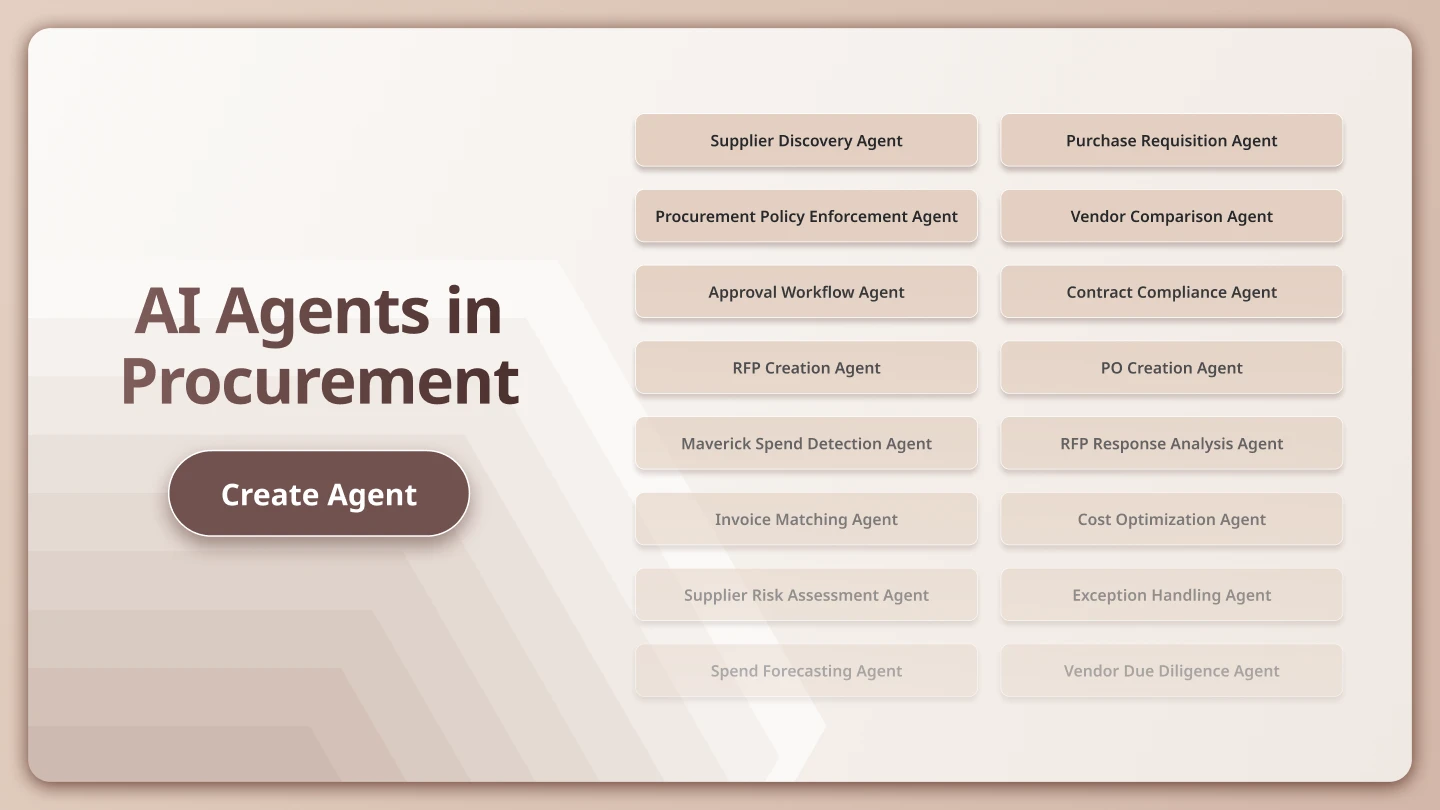
60–70% of a procurement professional’s time is spent on repetitive work, chasing approvals, checking contracts, updating systems, and following up with vendors. Very little of that time goes into strategic decisions.
Traditional procurement processes rely on static, rule-based systems that lack adaptability, whereas AI-driven approaches introduce dynamic, autonomous solutions that can learn and react to changing circumstances.
This gap is what procurement software providers are now pointing to when they talk about Agentic AI.
The pitch is simple: offload routine tasks to AI Agents and give procurement teams more breathing room. AI agents help procurement professionals by automating routine tasks, streamlining workflows, and supporting decision-making. That naturally leads to the bigger question, does this mean AI Agents will replace procurement roles?
The reality is more practical. AI Agents are still new, and full replacement is unlikely. What is already happening is a shift in how teams work.
The impact of AI agents is likely to transform procurement jobs rather than eliminate them, changing the nature of roles and responsibilities within procurement teams. Procurement professionals who use AI Agents are moving faster, seeing spend more clearly, and spending less time on manual follow-ups.
This shift enables professionals to focus on value orchestration, with AI agents creating measurable value through automation, risk reduction, and process optimization.
Let’s see how
Why procurement teams need AI Agents???
Procurement expectations have increased, but team size hasn’t. As spend, vendors, and approval paths grow, coordination work starts to dominate the day.
Instead of making decisions, teams spend time keeping processes moving.
Common pressure points in procurement today
| Area | Key Challenges |
|---|---|
| Purchase Requests & Approvals | High volume of daily purchase requests |
| Complex approval rules by amount, category, and department | |
| Budget Management | Budgets spread across teams |
| Limited real-time visibility | |
| Order Management | Purchase order creation and order tracking |
| Supply Operations | Managing supply and supply chain operations |
| Area | Key Challenges |
|---|---|
| Contract Management | Contracts and renewals tracked manually |
| Contract compliance across procurement activities | |
| Governance & Compliance | Ensuring policy and regulatory compliance |
| Risk Management | Managing vendor and procurement risk |
| Proactive supplier risk monitoring | |
| Audit & Control | Maintaining audit readiness |
| Area | Key Challenges |
|---|---|
| Supplier Management | Supplier onboarding and ongoing management |
| Monitoring supplier performance | |
| Strategic Sourcing | Optimizing sourcing and negotiations |
| Analytics & Insights | Predictive analytics and in-depth analysis |
| Market Intelligence | Market trends, benchmarking, and negotiation insights |
| Technology & AI | Adopting modern procurement technology |
| Understanding AI systems and AI in procurement |
Before implementing AI agent technology, organizations need to have their historical data and current data prepared to ensure effective deployment and results.
It is also important to deploy tests or pilot programs for specific procurement processes to allow for a more controlled and risk-managed integration. To prepare for the transformation brought by AI agents, organizations should invest in team training and change management software to support adoption and maximize value.
This is where AI Agents fit in, not as replacements, but as continuous coordinators.
| Without AI Agents | With AI Agents |
|---|---|
| Approvals chased manually | Approvals tracked and followed up automatically |
| Budget checks done after the fact | Real-time budget validation before approval |
| Exceptions found late | Exceptions flagged early |
| Procurement reacts to issues | Procurement stays ahead of issues |
AI agents can automate process automation, compliance checks, contract management, supplier onboarding, and supplier management, reducing manual effort and increasing efficiency.
They use predictive analytics and analysis to optimize procurement tasks and processes, enabling proactive and data-driven decision-making.
AI agents can streamline supplier selection, monitor supplier performance, manage supplier risk, and suggest corrective actions to strengthen supplier partnerships.
They analyze payment terms, identify savings opportunities, and generate detailed expense analysis to support cost control. AI agents automate contract compliance checks, flag off-contract purchases, and continuously monitor spend against contracts in real-time.
They can model the impact of various scenarios on procurement spend and supply availability, enabling rapid scenario analysis. AI agents autonomously communicate with suppliers, validate documents, and progress supplier onboarding, further streamlining operations. By automating routine procurement tasks, AI agents allow human workers to focus on higher-value activities.
What procurement teams gain??
- Fewer stalled requests and approval delays
- Better spend visibility at the time of decision
- Less manual follow-up work
- More time for supplier negotiations and cost control
AI Agents handle the flow of work. Procurement teams stay focused on judgment, accountability, and outcomes.
State of AI Agents in Procurement
Even after having so many benefits of adopting AI Agents, why are leaders hesitant to adopt them?
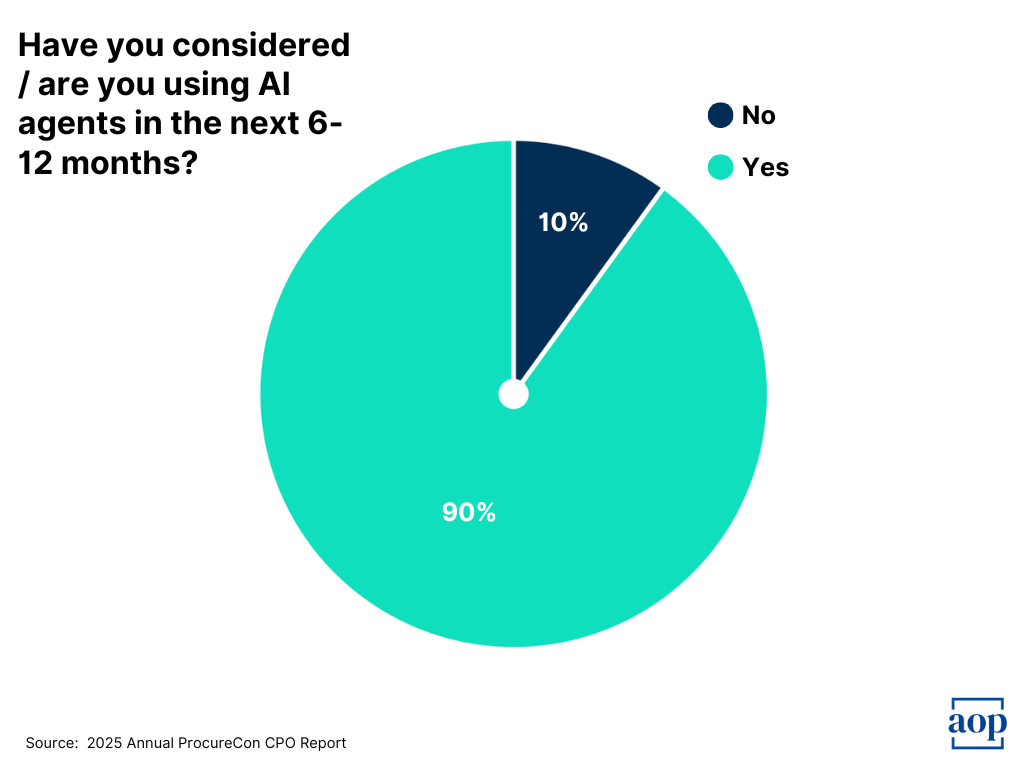
According to the 2025 Annual ProcureCon CPO Report:
- 90% of CPOs are considering AI Agents
- 82% have identified specific use cases
- Widespread deployment remains limited
Despite the interest, most procurement organizations are still in the experimental stage. The technology behind AI agents is still emerging, and leaders are cautious about the potential impact of new tools and ai systems on their existing processes.
How AI Agents are being used today
- Focused on simple, rule-based tasks
- Limited autonomy in decision-making
- Far from full agentic workflows
This gap between strategy and execution reflects common challenges:
- Integration with existing procurement systems
- Data quality and consistency issues
- Change management and skill readiness
Addressing these challenges requires advanced tools and generative ai to improve data integration, streamline workflows, and enhance automation.
Confidence levels tell the same story
- Only 27% report high confidence in their teams’ AI capabilities
- 65% remain only somewhat confident
The global AI in procurement market is projected to reach approximately $22.6 billion by 2033, growing from $1.9 billion in 2023 at a compound annual growth rate (CAGR) of 28.1%. This rapid market growth highlights the increasing adoption and investment in AI systems and technology within procurement.
AI agents have the potential to significantly impact procurement by transforming risk management, sourcing, and supplier relationships, unlocking new levels of efficiency and strategic outcomes. Market intelligence, powered by AI systems, is also playing a crucial role in driving adoption and building confidence among procurement leaders.
What Lyzr changes in procurement, and how
Lyzr shifts procurement from task-level automation to agent-led execution. Instead of managing workflows step by step, teams oversee outcomes while agents handle the flow of work. AI agents can analyze large amounts of data and automate decision-making tasks, enabling procurement managers to focus on strategic business outcomes.
They can track contract expiration dates, analyze contract performance history, and automate compliance checks. AI agents can analyze payment terms, identify savings opportunities, and generate detailed expense analysis. They can autonomously communicate with suppliers, validate documents, and progress supplier onboarding.
AI agents can monitor supplier performance, manage supplier risk, and suggest corrective actions. They can model the impact of various scenarios on procurement spend and supply availability.
AI agents can predict supplier needs and suggest strategic sourcing decisions. Generative AI enables teams to simulate sourcing scenarios and recommend negotiation tactics. AI agents can automate routine tasks, allowing human workers to focus on higher-value activities.
What changes with Lyzr
What the Agents Handle
| Focus Area | Coverage |
|---|---|
| End-to-End Operations | Run procurement workflows, track progress, resolve delays |
| Automation | Automate core procurement processes |
| Contracts & Compliance | Manage contracts and enforce compliance |
| Suppliers & Risk | Onboard suppliers, monitor performance, manage risk |
| Sourcing & Intelligence | Evaluate suppliers, analyze markets, support sourcing |
| Supply & Orders | Manage supply, purchase orders, and order flow |
How the Platform Works
| Platform Layer | Capability |
|---|---|
| Core Intelligence | AI built into the system architecture |
| Decision Support | Predictive analytics and scenario planning |
| Interaction | Natural language and generative AI |
| Document Understanding | Contracts and invoices processed natively |
| Deployment | Live in weeks with pre-configured logic |
| Control Model | Configuration over custom code |
Top AI Agents in Procurement by Lyzr
Upstream Agents
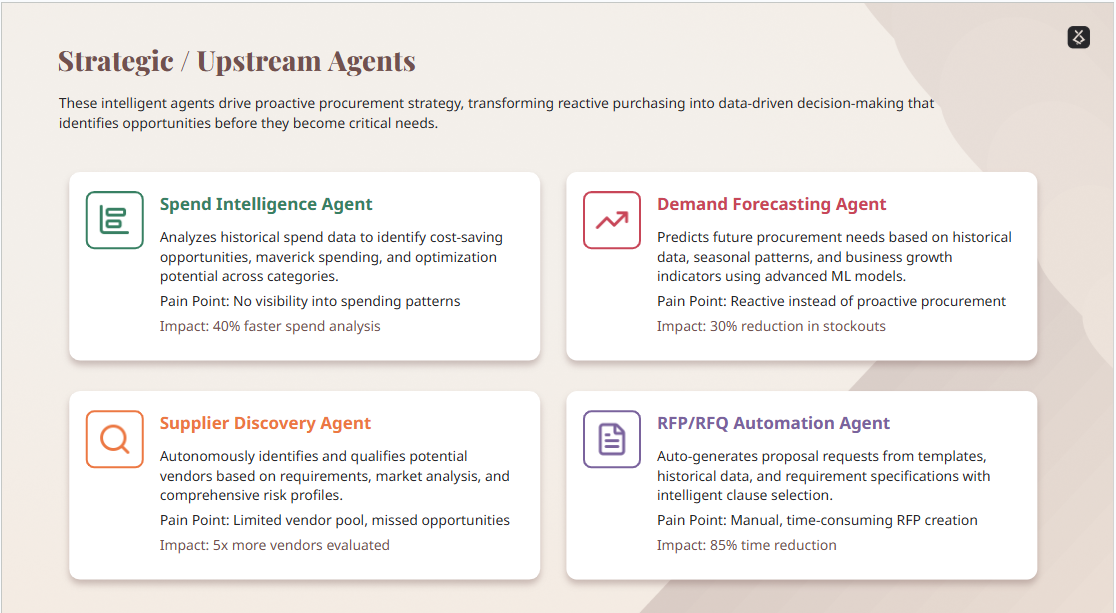
Upstream agents in procurement play a critical role in sourcing, supplier onboarding, and supplier management. They automate and optimize sourcing activities by evaluating suppliers, conducting bid analysis, and managing strategic sourcing events.
These agents streamline supplier onboarding by autonomously handling communication, document validation, and integrating new suppliers into procurement workflows. Upstream agents also enhance supplier management by monitoring supplier performance, flagging supplier risk, and automating interactions throughout the supplier lifecycle.
They continuously monitor supplier performance metrics and external news sources to proactively manage supplier risk, using predictive analytics and in-depth analysis to inform procurement decisions.
By leveraging market intelligence and market data, upstream agents benchmark contract terms against current market rates and assess external market conditions to support strategic sourcing and risk management.
For example, an upstream agent can streamline supplier selection by analyzing historical data, performance metrics, financial stability, and market conditions to identify the best-fit partners.
These agents also improve supplier relationships by managing onboarding, inventory, and expense management, and can suggest corrective actions to ensure stronger supplier partnerships. Additionally, upstream agents predict supplier needs and suggest strategic sourcing decisions based on comprehensive data analysis.
Mid Stream Agents
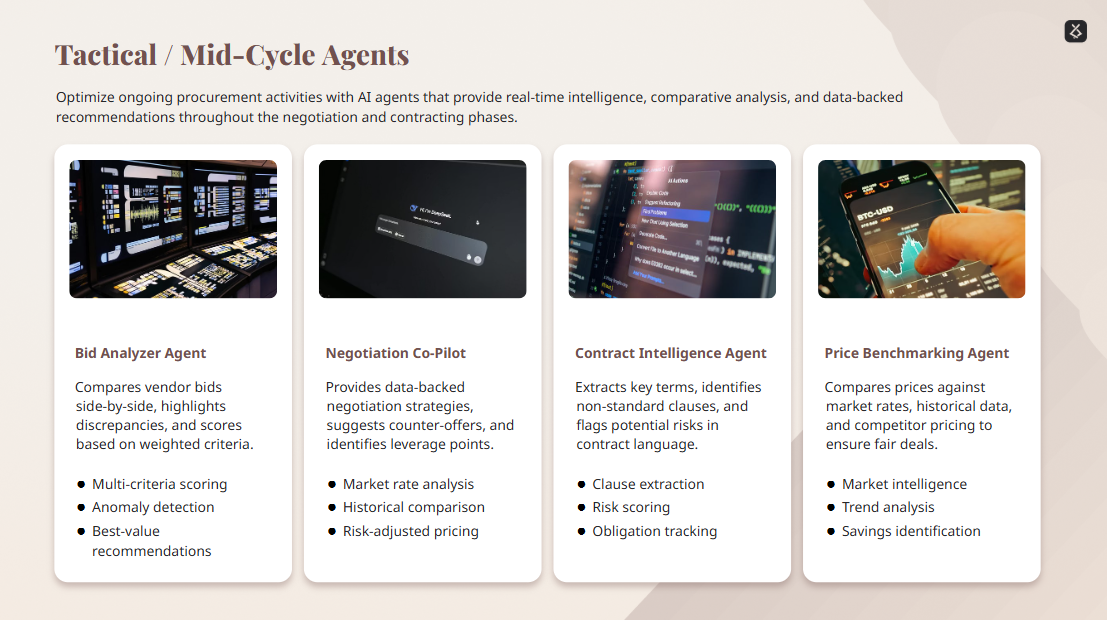
Midstream agents play a critical role in procurement by managing ongoing supplier relationships, contract management, and ensuring contract compliance through automated compliance checks. These agents continuously monitor spend against contracts in real-time, flagging off-contract purchases and enforcing compliance with negotiated terms.
They enable process automation by streamlining procurement processes such as purchase order creation, order management, and approval workflows, reducing manual effort and errors.
Midstream agents leverage advanced analysis and predictive analytics to evaluate procurement data, contract performance, and spend patterns. This allows them to identify savings opportunities, optimize payment terms, and assess supplier performance proactively.
They utilize a range of AI-powered tools and technology to automate decision-making processes, integrate with existing procurement systems, and enhance transparency across workflows.
For example, a midstream agent can track contract expiration dates, analyze contract performance history, and automate compliance checks to ensure ongoing adherence to agreements.
These agents can also analyze payment terms against actual payment patterns, identify opportunities for volume consolidation or demand aggregation, and generate detailed expense analysis to uncover areas for cost savings and contract renegotiation triggers.
Downstream Agents
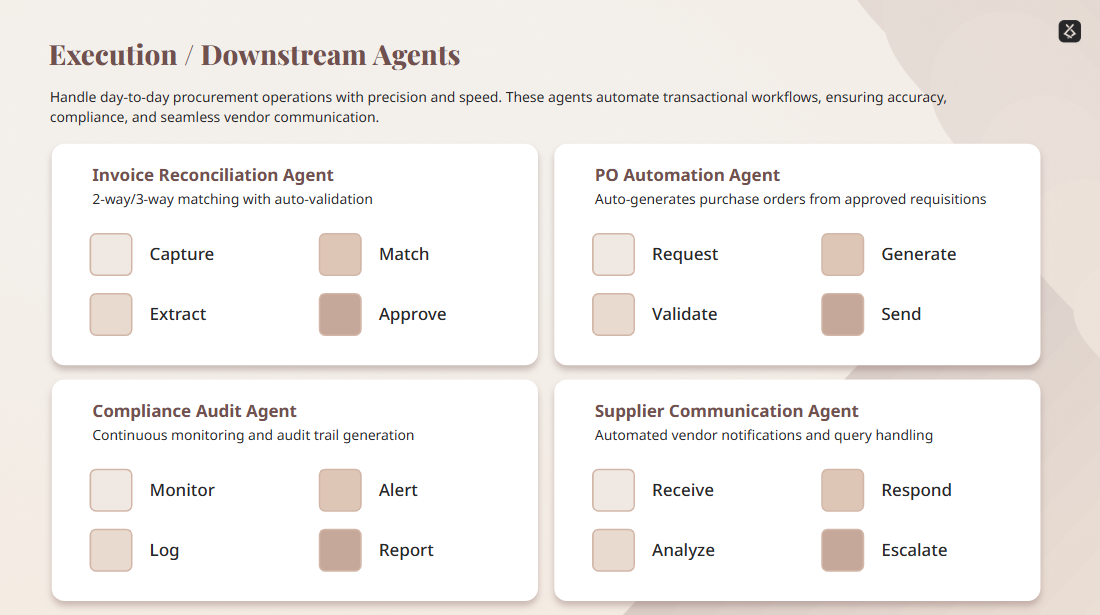
Downstream agents in procurement play a critical role in managing supply, overseeing supply chain operations, and driving process automation across procurement workflows.
These agents handle the end-to-end process of order and purchase order creation, processing, and management, ensuring compliance with contractual and regulatory requirements.
They utilize advanced AI tools and technology to streamline procurement activities, optimize supplier performance, and manage complex sourcing and risk mitigation tasks efficiently.
Downstream agents help manage procurement operations by automating routine tasks, monitoring supply chain disruptions, and supporting real-time decision-making. For example, a downstream agent can model the impact of various scenarios on procurement spend and supply availability, enabling rapid scenario analysis and proactive supply planning.
These agents analyze large amounts of data and automate decision-making, allowing procurement managers to focus on strategic business outcomes.
Wrapping UP
AI Agents are becoming a core part of how procurement teams operate, but most platforms still treat them as add-ons rather than foundational building blocks. This is where Lyzr takes a different approach.
Lyzr embeds agent-led execution directly into procurement operations.
Agents don’t just assist; they actively run workflows within defined guardrails, monitoring approvals, budgets, documents, and exceptions in real time. This allows procurement teams to step out of constant coordination without losing control.
The result is a procurement function that scales without adding operational overhead. Teams stay responsible for decisions and governance, while Lyzr handles execution at speed and consistency.
As AI adoption moves from experimentation to real operations, platforms like Lyzr set the direction for how procurement teams will work going forward. Book a demo to see how
Book A Demo: Click Here
Join our Slack: Click Here
Link to our GitHub: Click Here