
When someone tells you a phone number, you hold it briefly in your head while dialing.
That’s short-term memory. When you recall your favorite restaurant from years ago, that’s long-term memory. When you remember how to ride a bicycle, that’s procedural memory.
AI agents rely on a similar structure.
Modern agents are expected to do far more than answer a single prompt. They handle multi-step tasks, maintain conversations across sessions, and respond based on past interactions. For example, an AI support agent might remember a customer’s previous issue, while a productivity assistant may recall ongoing tasks from earlier in the week.
These capabilities are possible because AI agents rely on different types of memory, each serving a distinct role in storing, retrieving, and using information.
What Is Memory in AI Agents?
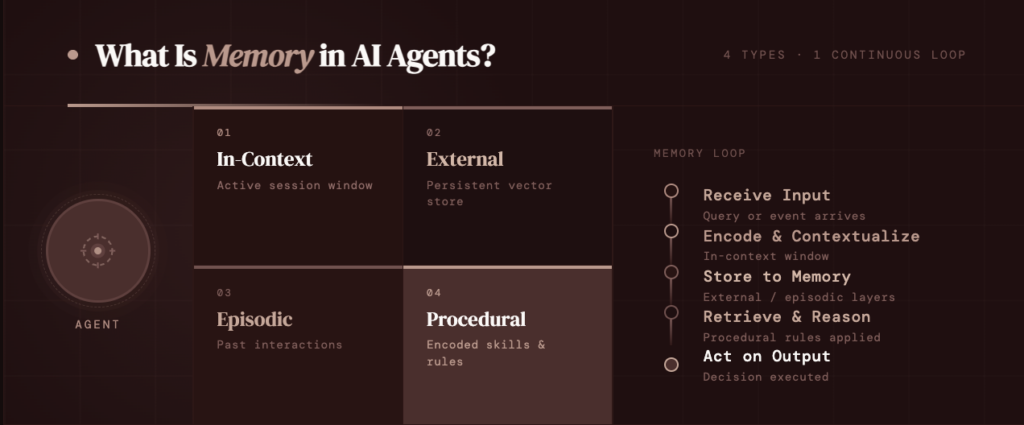
At its core, memory in AI agents refers to the ability to retain information across time and interactions. Memory allows an agent to:
- Recall previous conversations
- Understand user preferences
- Maintain context across sessions
- Learn from experience
- Make better decisions
If an AI agent could only process the current prompt, it would be limited to transactional interactions, like a calculator that resets after every entry. Memory changes that by enabling continuity and personalization.
Why Memory??
Without memory, agent interactions feel disconnected and shallow. Memory enhances:
1. Context Continuity
An agent that remembers prior context can deliver responses that are relevant and coherent over time. For example, remembering that a user prefers Spanish responses lets the agent adapt without repeated instruction.
2. Personalization
Memory enables personalization at scale. An agent that remembers preferences, goals, and history feels more natural and useful.
3. Task Persistence
Some tasks span multiple steps or sessions. Memory allows an agent to pick up where it left off, crucial for workflows like project planning or tracking goals.
4. Learning and Adaptation
Memory makes agents adaptable. Instead of treating each interaction as isolated, agents can refine responses based on historical data.
Understanding memory types is key to unlocking all these capabilities.
High‑Level Categories of AI Agent Memory Types
AI agent memory types can be grouped based on duration, structure, and function. The major categories include:
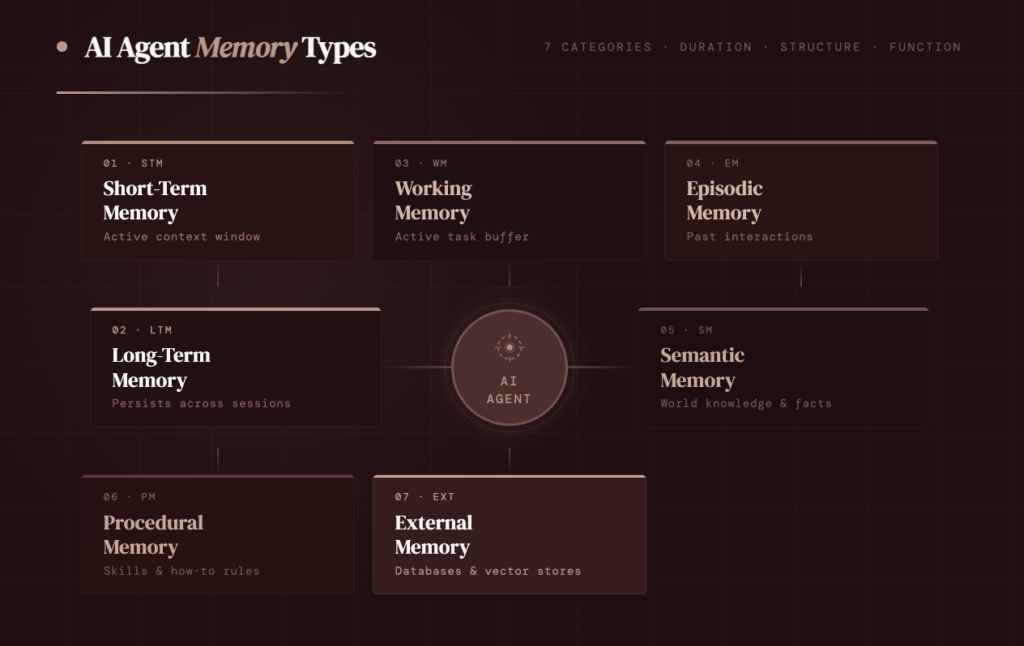
Each type plays a unique role in shaping agent behavior. Below is a detailed explanation of each.
1. Short‑Term Memory (STM)
Definition: Short‑Term Memory holds information briefly, usually only for the duration of the current interaction.
Role in AI Agents:
- Maintains conversation context for a single session.
- Helps track recent dialogue turns.
- Enables coherence when processing follow‑up questions.
Example:

Here, short‑term memory holds “flight to Paris” until the request is complete.
Limitations:
- Does not persist across sessions.
- Information is dropped at the end of a task or conversation.
Short‑term memory is essential for smooth conversational flow, but alone it is not enough for personalized or persistent behaviors.
2. Long‑Term Memory (LTM)
Definition: Long‑Term Memory stores information over extended periods, from days to years.
This type of memory is similar to how humans remember personal details, preferences, or historical events.
Subtypes of LTM in AI Agents:
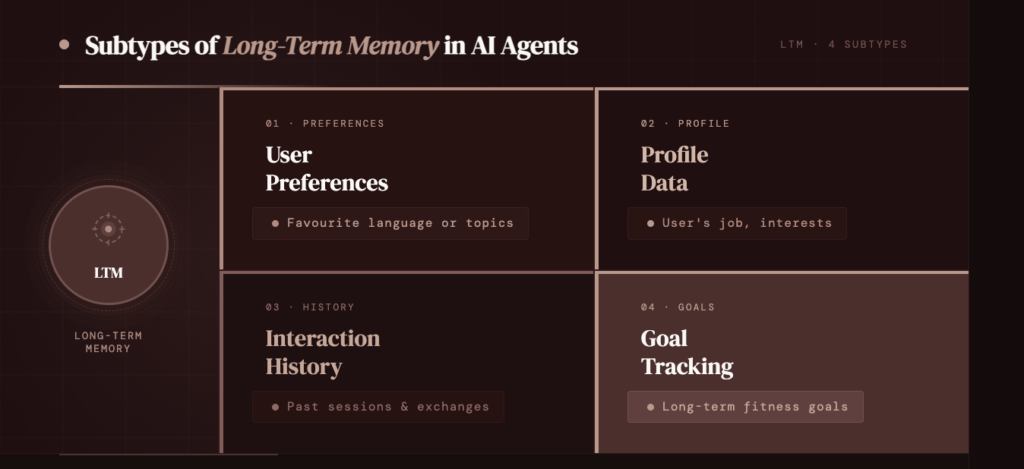
Example: If an agent remembers a user’s preference for evening reminders, it can automatically schedule future alerts without repeated instructions.
3. Working Memory
Definition: Working memory holds information temporarily while an agent processes complex tasks.
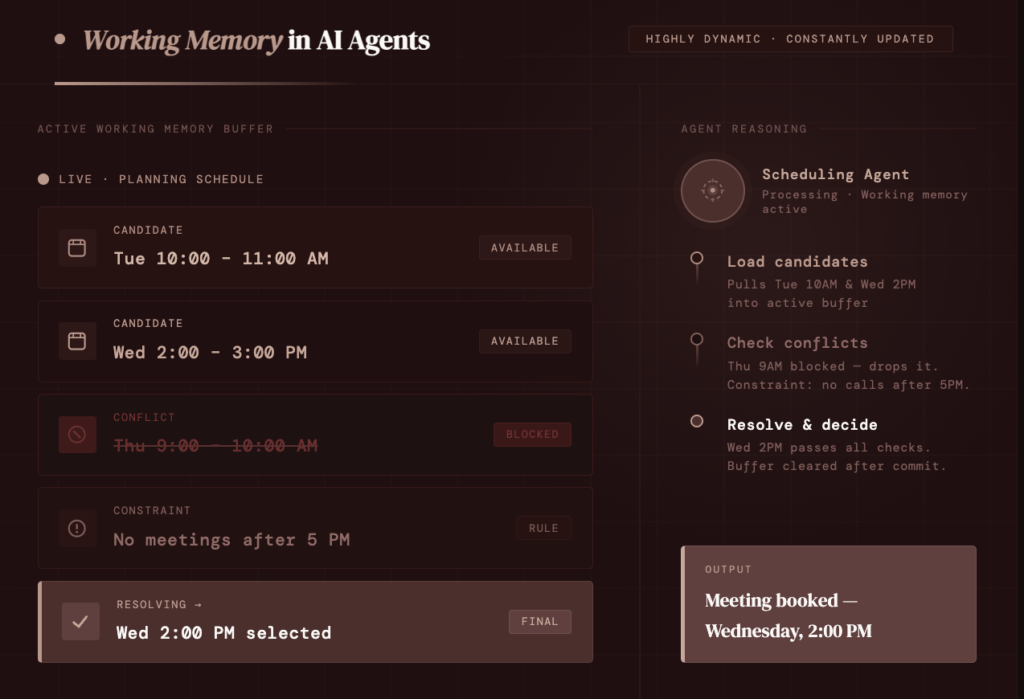
Think of it as the scratchpad where temporary data is kept while reasoning or problem solving.
Role in AI Agents:
- Supports multi‑step tasks
- Helps with reasoning and intermediate calculations
- Allows dynamic context updates
Example: When an agent is planning a schedule, working memory may hold multiple possible meeting times, conflicts, and constraints before deciding on a final plan.
Working memory is highly dynamic and constantly updated as the agent processes information.
4. Episodic Memory
Definition: Episodic memory refers to memories of specific events or experiences.
In AI agents, it captures what happened and when, similar to human recollection of specific moments.
Use Cases:
- Remembering specific past conversations
- Tracking when a user started a project
- Recalling a user’s reaction to a previous suggestion
Example:
User: “Last time we discussed books by Haruki Murakami.”
AI Agent: “Yes, we talked about ‘Norwegian Wood’ and your interest in literary fiction.”
Episodic memory helps the agent recall concrete events, which can be useful for engaging and context‑rich conversation.
5. Semantic Memory
Definition: Semantic memory refers to general knowledge, facts, and concepts, not tied to specific experiences.
This is analogous to a knowledge base.
Role in AI Agents:
- Provides factual information
- Supports knowledge retrieval (e.g., definitions, facts, explanations)
Example:
User: “Explain how photosynthesis works.”
AI Agent retrieves semantic memory to answer accurately.
Semantic memory is not personal, it’s shared knowledge the agent uses across all users.
6. Procedural Memory
Definition: Procedural memory stores information about how to perform tasks, skills and actions.
In AI agents, procedural memory guides how the agent performs specific functions.
Role:
- Supports repeatable workflows
- Helps automate common processes
- Enhances performance consistency
Example: If an agent has procedural memory for scheduling meetings, it can consistently apply guidelines like avoiding weekends or conflicting times.
Procedural memory is about method, not facts or events.
7. External Memory Systems
Many modern AI agents integrate with databases, documents, or other external storage systems to support memory.
These external systems allow:
- Scalable storage
- Cross‑platform integration
- Secure, retrievable user data
External memory can be structured (SQL databases), unstructured (text files), or hybrid.
Example:
An agent that integrates with a customer relationship system (CRM) can retrieve customer notes or previous support tickets.
How Memory Enhances Agent Experiences
To understand the impact of AI agent memory types, consider the following scenarios:
Scenario 1: Personalized Fitness Coach
- Short‑Term Memory: Tracks current workout details.
- Long‑Term Memory: Remembers fitness goals over months.
- Episodic Memory: Recalls previous achievements or milestones.
- Procedural Memory: Knows how to adjust workouts based on performance.
- External Memory: Stores workout data for progress tracking.
This combination enables an agent to offer ongoing, personalized coaching.
Scenario 2: Customer Support Agent
- Short‑Term Memory: Holds the current customer’s problem context.
- Long‑Term Memory: Tracks customer history and prior issues.
- Semantic Memory: Provides factual explanations about products.
- External Memory: Integrates with support logs for seamless access.
This enables faster, more efficient problem resolution that feels informed and continuous.
Challenges in Implementing Memory
While memory unlocks many benefits, it also presents challenges:
1. Privacy and Security
Storing sensitive information requires strict security policies, access control, and data protection practices.
2. Relevance
Agents must decide what to remember, what to forget, and when to recall information.
3. Scalability
As memory storage increases, retrieval must remain fast and efficient.
4. Bias and Accuracy
Memory must be accurate and free of harmful biases that degrade agent behavior.
Addressing these challenges requires careful architecture design, secure storage, and robust governance.
Designing Memory for AI Agents: Best Practices
Here are key principles when implementing memory in AI agents:
1. Define Clear Memory Types
Classify memory based on duration, relevance, and privacy requirements.
2. Set Memory Policies
Determine what to store, how long to keep it, and when to purge.
3. Use Modular Memory Stores
Separate short‑term, long‑term, and external memory systems for better performance.
4. Apply Privacy Controls
Ensure users can view, edit, or delete stored memories.
5. Balance Relevance with Efficiency
Keep memory stores lean to optimize retrieval and avoid overload.
Wrapping Up
Understanding AI agent memory types is critical for designing intelligent, responsive, and engaging systems. From short‑term memory that holds conversational context to long‑term memory that builds personalized experiences, each type serves a distinct purpose.
Memory empowers agents to:
- Maintain continuity
- Personalize interactions
- Learn and adapt over time
- Support complex task execution
The future of AI interaction lies in memory systems that are secure, efficient, and user‑centric. Whether building conversational assistants, productivity helpers, or specialized task agents, choosing and managing the right memory types can define success.
Book A Demo: Click Here
Join our Slack: Click Here
Link to our GitHub: Click Here