TL;DR: AI agents for stock market research are LLM-based systems that read, extract, and organize financial information at a scale no analyst team can match manually. They work best when decomposed into specialized roles: news and sentiment, fundamentals, technical, and risk, coordinated into one research output. Core use cases: filing analysis, earnings-call extraction, sentiment aggregation, peer comparison, and portfolio exposure monitoring. What they do not do: predict prices, replace analyst judgment, or place trades autonomously. Regulated deployment requires model risk governance, explainability, audit trails, and data residency controls, not just a fast model.
An earnings season generates more written material than any research desk can physically read. Ten-Ks, transcripts, broker notes, regulatory filings, wire stories, all landing in the same three-week window, across every name a team covers.
That’s the actual bottleneck in equity research. Not conviction. Not access to data. Throughput.
AI agents for stock market research exist to solve exactly that problem: not by predicting where a stock goes next, but by reading what a human team cannot get to and surfacing what matters in a form an analyst can act on. This piece covers where that actually works, where it doesn’t, and what a bank or asset manager needs in place before deploying it.
What are AI agents for stock market analysis?
AI agents for stock market analysis are semi-autonomous systems that pair a large language model’s reasoning with financial data tools, filings repositories, and market feeds, capable of researching, extracting, and organizing information across a coverage universe. They are not chatbots answering one question at a time. They run multi-step workflows against a defined task.
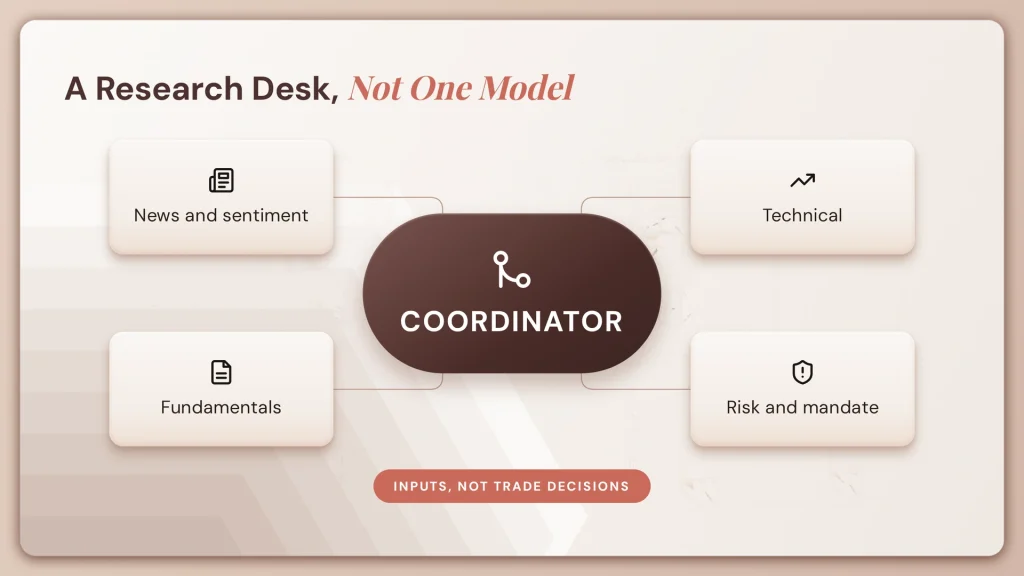
The pattern that holds up best in production mirrors how a research desk is already structured: specialized roles, not one model trying to do everything.
- News and sentiment analyst. Monitors news flow and social signal, classifies relevance and materiality, flags tone shifts.
- Fundamentals analyst. Parses filings, earnings transcripts, and financial statements for the numbers that matter.
- Technical analyst. Reads price and volume structure, calculates indicators, flags pattern shifts for review.
- Risk analyst. Checks positions against mandate constraints, concentration limits, and restricted lists.
- Coordinator. Assembles the specialist outputs into one research brief a human can act on.
This is the multi-agent architecture pattern, and it’s worth being direct about what it produces: research inputs, not trade decisions. An agent that extracts a guidance change from a transcript has done useful, verifiable work. An agent that tells you whether to buy the stock has done something else entirely, and that distinction runs through everything below.
Where agents actually help in equity research
They compress the distance between raw information and something an analyst can use, across five workflows that show up on almost every research desk.

Filing and disclosure analysis. A 10-K running several hundred pages doesn’t get read cover to cover, not by anyone, not on a coverage list of forty names. Agents extract segment performance, guidance changes, year-over-year shifts in risk factor language, and related-party disclosures, so the analyst reads the extraction and verifies it against source, rather than hunting through the document first. This is close to what a finance analysis and reporting agent is built to do.
Earnings call processing. During peak weeks, a single analyst might have a dozen companies reporting in three days. Agents transcribe, extract the guidance language against consensus, and flag shifts in management tone or hedging relative to prior quarters. The value isn’t depth on one call, it’s coverage breadth across all of them.
News and sentiment aggregation. The morning scan across wires, filings, and trade press consumes real hours and still misses things. Agents monitor continuously, deduplicate, classify by materiality, and route by coverage assignment, functioning much like a prospect research agent tracks company signals for a sales team, just pointed at markets instead of pipeline.
Peer and comparable analysis. Building a comp set and normalizing metrics across different reporting conventions is grinding, repetitive work, exactly the kind badly suited to human attention over long stretches. Agents assemble the set, normalize the numbers, and flag where a company’s disclosure diverges from its peer group, similar to techniques already used in private equity automation.
Portfolio exposure and constraint monitoring. Agents check holdings against mandate rules, concentration limits, and restricted lists, and flag breaches before they become a problem. Monitoring and flagging, not rebalancing, a distinction that matters for how AI in wealth management workflows are actually scoped in practice.
What agents do not do
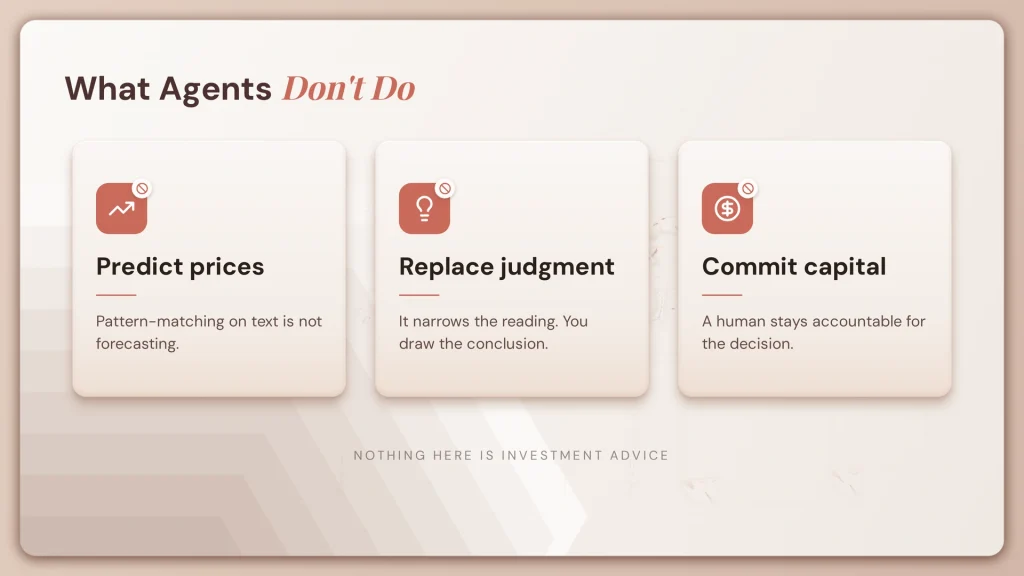
They do not predict stock prices. An LLM (large language model, the system behind most conversational AI) reading a week of price history and issuing a directional call is pattern-matching on text, not forecasting a market. Tools built around AI trading bots that market predictive accuracy on short price windows should be treated with real skepticism, because the confidence in the output has no relationship to its reliability.
They do not replace judgment on positioning. Extraction is mechanical, and it can be checked. Deciding what a guidance cut means for a thesis, or whether it changes conviction, is not mechanical at all. The agent narrows what an analyst has to read. It does not decide what to conclude from it.
They should not autonomously commit capital. Not because the technology can’t execute an order, but because every serious institution’s governance model requires a human accountable for the investment decision. Moving that accountability into a system that cannot be held responsible for it is not a capability gain, it’s a liability nobody signed up for.
If you landed here looking for automated retail trading tools: automated order placement and investment recommendations sit inside specific regulatory perimeters in most markets, and loss rates among retail traders using leveraged, automated strategies are documented and high. Nothing in this article is investment advice.
How the architecture works
Under the hood, four layers do the actual work.
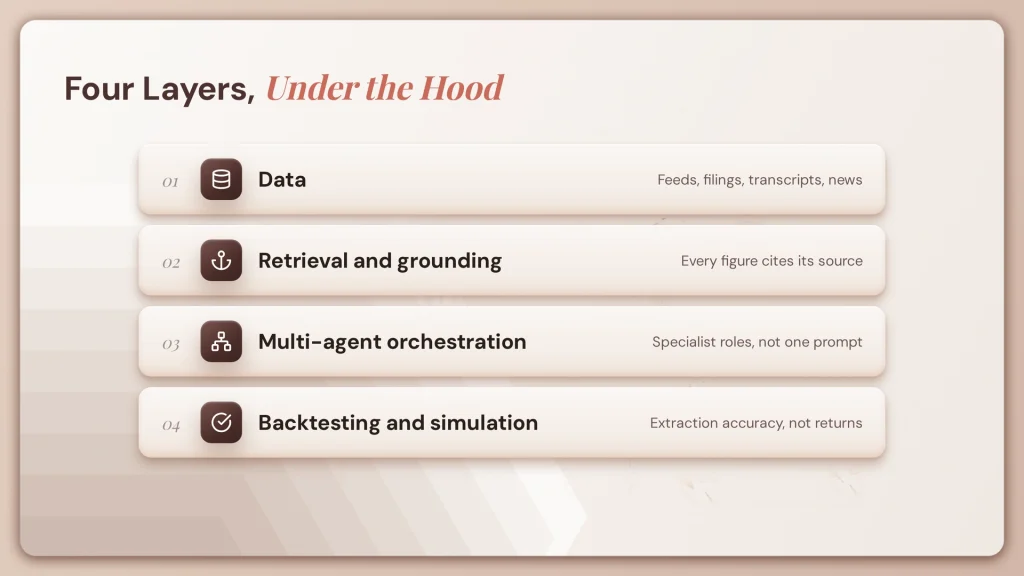
Data layer. Market data APIs, filings repositories, transcript feeds, and news wires feed the system. Data licensing is a real constraint here, most market data comes with redistribution restrictions that shape what an agent can legally be built on, which is a design question, not an afterthought.
Retrieval and grounding. An agent’s output is only usable if it can be traced back to a source. This is where Retrieval-Augmented Generation, pulling live, verified data into a model’s context before it answers, becomes the difference between a research tool and a liability. Every extracted figure needs a citation to the source document and location, drawn from a maintained knowledge base. An ungrounded number is worse than no number.
Multi-agent orchestration. Role decomposition, described above, consistently outperforms a single model trying to do fundamentals, sentiment, and risk in one prompt. This is core to how machine learning systems scale in production, and it’s a distinct discipline from the machine learning fundamentals most teams already know from other use cases.
Backtesting and simulation. What can genuinely be validated: extraction accuracy against a human-labeled sample of documents. What cannot: whether a given research output actually improved returns. Be honest about that second point. Attribution in research is genuinely hard, and claiming otherwise is how credibility gets spent before it’s earned. This differs meaningfully from reinforcement learning applications built for trading strategy optimization, which operate on a different objective entirely.
What regulated deployment requires
This is the part most guides on this topic skip, and it’s the part that decides whether a deployment survives contact with compliance.
Model risk management. In most institutions, any model informing investment decisions sits inside a formal model risk framework requiring documentation, independent validation, and periodic review. An agent is a model. Treating it as a productivity tool to route around that framework is the fastest way to get a deployment shut down after launch, not before.
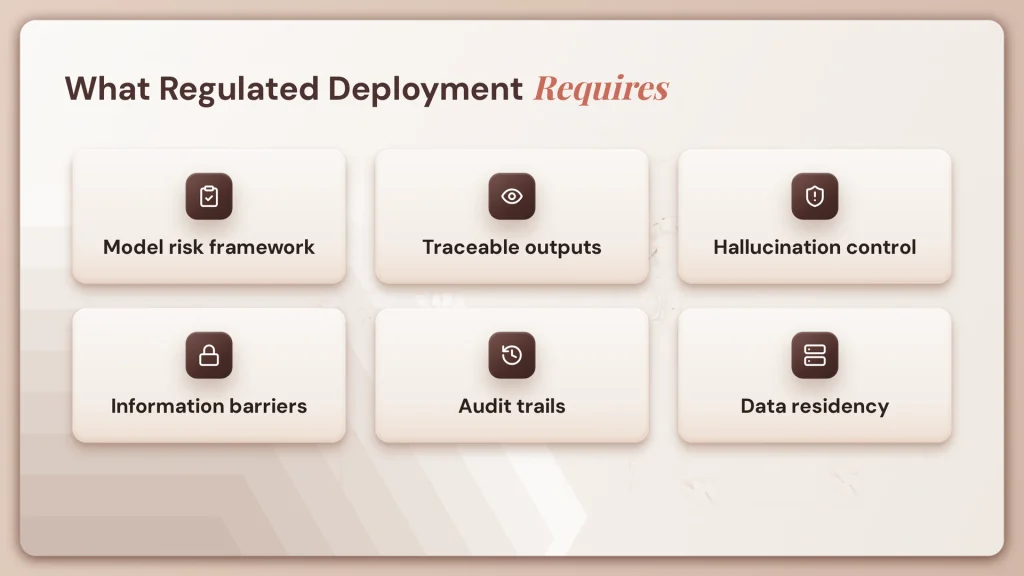
Explainability of analytical output. An extraction an analyst can’t trace to a source paragraph is worse than no extraction at all, because it introduces confident error into a research process that other decisions get built on. Every output needs a citation to a specific document and location.
Hallucination control on financial figures. A misread number in a research note propagates into models, memos, and eventually decisions that reference it. Grounding, verification against structured sources, and refusal on low confidence aren’t nice-to-haves, they’re the baseline. This is what a Hallucination Manager is built to enforce.
Information barriers. Agents with broad access across an institution’s data can inadvertently cross the line between public and private-side information. Access scoping is a compliance control here, not a convenience setting, and it connects directly to AI in risk and compliance programs already in place.
Audit trails. Every retrieval, extraction, and output logged with timestamps and versioning, retained per record-keeping requirements. A Control Plane is what makes that log queryable when a regulator or internal auditor asks for it.
Deployment control and data residency. Market data licensing, client data sensitivity, and cross-border rules frequently require deployment inside the institution’s own environment rather than a shared public service, which is the premise behind sovereign AI deployment models.
Financial services agents built on this foundation, model-agnostic, deployable in the institution’s own environment, governed under Responsible AI controls, are how AI for banking teams are actually approaching this, including banking-specific deployments like Amadeo. The same governance logic extends to adjacent workflows in AI agents for investment banking, AI agent risk management, and regulatory monitoring agents.
How to start
Start with extraction, not inference. Filing summarization and earnings extraction have a verifiable ground truth, you can check whether the agent pulled the right number. Sentiment scoring and thesis generation are more subjective and much harder to validate, so they come later.
Build the evaluation set before the agent. A human-labeled sample of fifty documents with known correct extractions is your benchmark. Without it, you have no objective way to tell whether the system is actually working.
Ground everything in source documents. Every output should cite the paragraph, table, or page it came from. This is a design requirement from day one, not something layered in after launch, and it’s the standard covered in resources on how to build an AI agent for regulated use.
Bring compliance in at design, not at launch. Access scoping and information barrier questions shape the architecture itself. Retrofitting them later costs more, in both time and rework, than most teams budget for. Firms working with AI agent development services or evaluating AI agent development partners should treat this as a gating requirement, not a nice-to-have.
Lyzr’s Analyst Army Starter Pack is built around this exact sequence, extraction first, evaluation before deployment, grounding as a default.

Frequently asked questions
Is there an AI agent for stock trading?
Yes, though most production systems in institutional finance are built for research and analysis rather than autonomous execution, because firms require a human accountable for every investment decision.
Can I use AI for stock market trading?
For research, screening, and document analysis, yes, and it’s widely used. For autonomous order placement, regulatory requirements apply in most markets, and retail loss rates in automated trading strategies are well documented.
Which AI is best for stock market trading?
No model reliably predicts price direction. Language models are genuinely useful for filing analysis and transcript extraction. Treat any tool claiming predictive trading accuracy with real skepticism.
Are AI agents good for trading?
They’re strong at reading and extracting from large volumes of documents fast. They’re not strong at forecasting returns. Match the tool to the task it can actually do.
Is AI trading legal in India?
Automated and algorithmic trading is permitted under SEBI’s framework, with specific requirements around broker approval and API-based order placement. Rules shift, so check current SEBI guidance before building anything.
Is ChatGPT good for trading?
It’s useful for summarizing filings and explaining financial concepts in plain language. It has no live market data by default, no execution capability, and no accountability for what it produces.
Is AI safe for trading?
The analysis layer is low risk when outputs are grounded in source documents and verified. Autonomous execution carries real risk, including amplified losses during volatile stretches.
Can you make money using AI agents?
In institutional research settings, the value shows up as analyst throughput and coverage depth, not guaranteed returns. Claims of consistent trading profits from retail AI tools should be read as marketing.
What is the 7% rule in stocks?
It’s a retail risk-management convention: sell a position that falls 7 to 8 percent below the purchase price. It’s a personal discipline heuristic, not a market rule, and not investment advice.
Can I make 1000 rupees per day from trading?
Consistent daily returns aren’t a realistic expectation for most traders. According to a SEBI study reported by Business Standard in August 2026, 87.7 per cent of individual traders incurred net losses in FY26, compared to 91 per cent a year ago.
Who is the best stock advisor in India?
That’s not something this article can or should answer. Before engaging any adviser, verify their registration with SEBI directly.
Agents don’t beat the market, and any framing that suggests otherwise is selling a story, not a capability. What they do is read what a research team cannot get to, extract it consistently, and hand back something an analyst can verify and act on. The institutions getting real value from this aren’t the ones chasing prediction. They’re the ones treating agentic research as infrastructure, with the governance to match.
See how Lyzr deploys governed research agents for financial services teams.
Book A Demo: Click Here
Join our Slack: Click Here
Link to our GitHub: Click Here