TL;DR
- Custom AI agents combine three components: an LLM “brain,” persistent memory, and tool integrations that let them act, not just answer.
- There are three ways to build one: no-code platforms, developer frameworks, and enterprise agent platforms that combine both.
- Five enterprise workflows already run on custom agents today: sales outreach, support resolution, HR screening, financial document processing, and marketing operations.
- Most agent projects don’t fail at the build stage. They fail on governance, memory, and the jump from pilot to production.
A custom AI agent is not a chatbot with a new name.
It’s a system built to do a specific job inside your business, using your data, your tools, and your rules, without someone rewriting the prompt every time the task changes slightly.
Every vendor page will tell you agents are transforming work. Fewer will tell you what actually separates a working custom agent from a demo that quietly stalls out three weeks after launch.
This guide covers both. What custom AI agents actually are, the three real paths to building one, where they’re already earning their keep in production, and the five mistakes that turn a promising pilot into a shelved project.
What are custom AI agents?
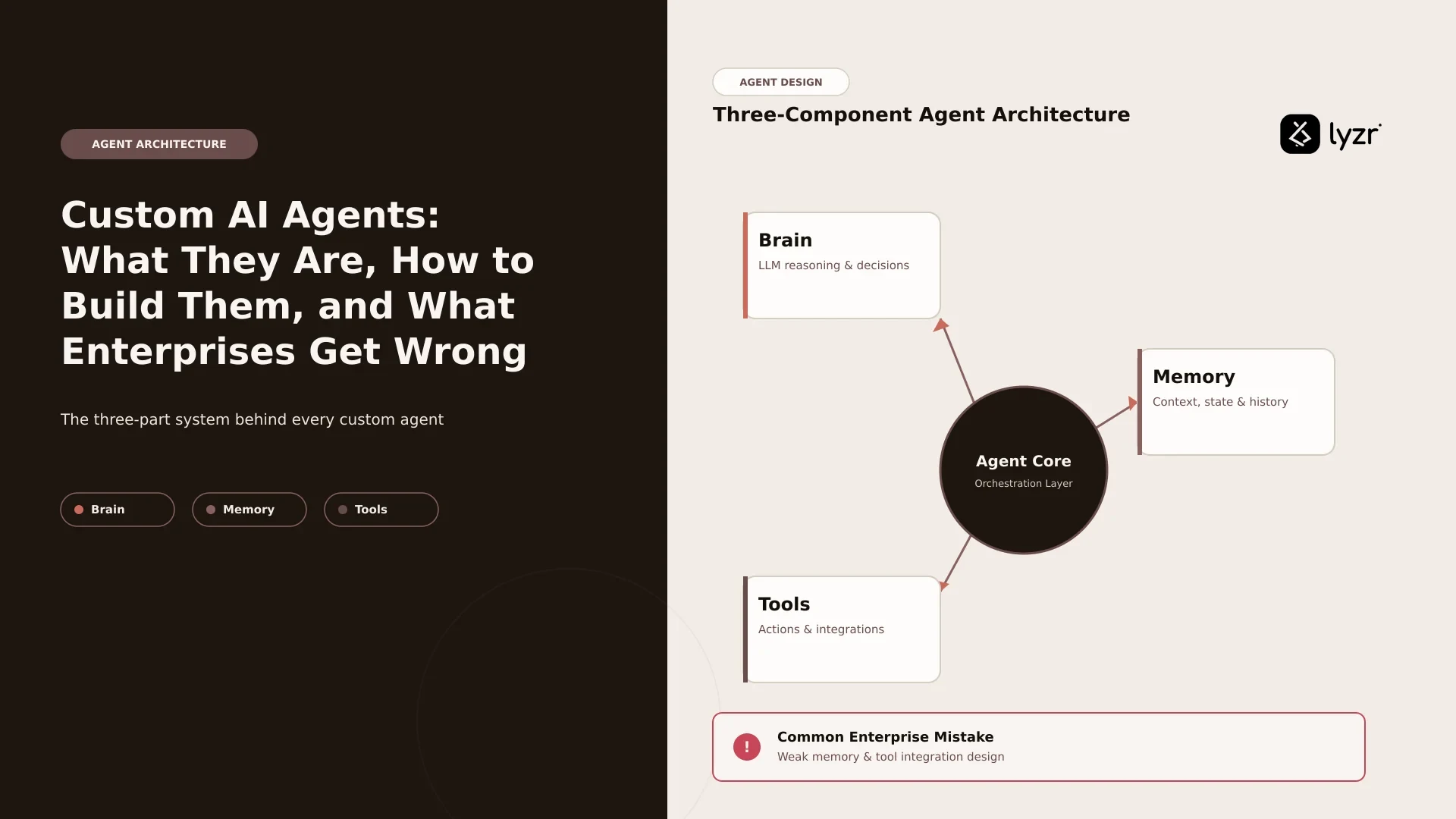
A custom AI agent is an autonomous software system built for a specific business workflow. It’s defined by three components working together, not by any single one of them.
Brain (LLM). This is the reasoning engine, powered by an LLM like GPT-4o, Claude, Gemini, or an open-source model such as Llama. The brain interprets instructions, plans a sequence of steps, and decides which tool to reach for at each step. Left on its own, though, an LLM has no memory of your business and no way to touch your systems. That’s what the other two components solve.
Memory. Short-term memory holds context for the current task. Long-term memory gives the agent persistent knowledge of your organization, usually through a knowledge base retrieved via Retrieval-Augmented Generation (RAG, the technique of pulling relevant company data into the model’s context before it answers). Without memory, an agent resets after every interaction. It can’t learn your product catalog, your support history, or your last five conversations with a given customer.
Tools. APIs, databases, and external services the agent can actually operate: update a CRM record, send an email, query a database, generate a document, trigger a downstream workflow. This is where an agent stops being a text generator and starts taking real action.
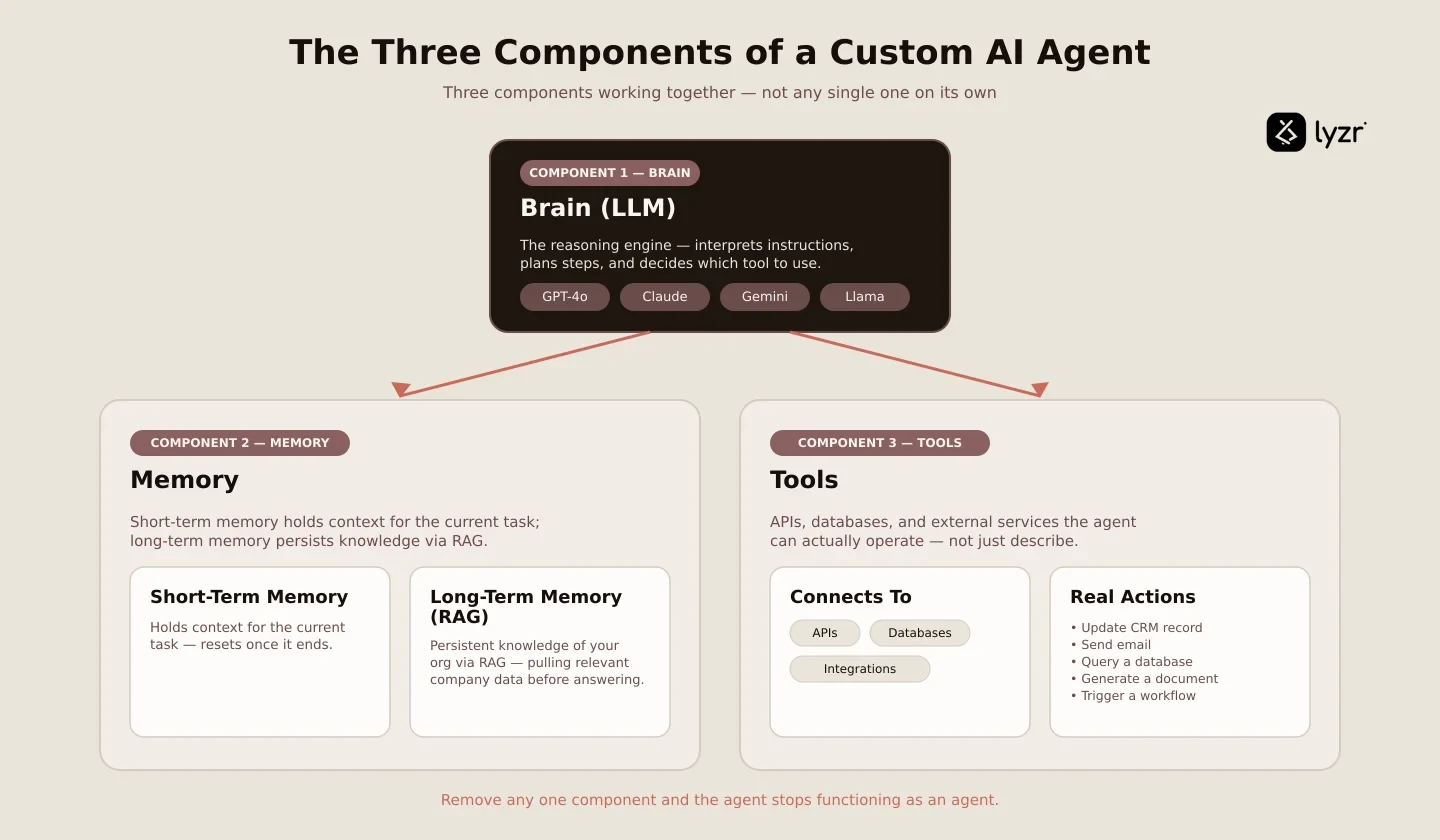
That architecture is what separates a custom AI agent from a chatbot (scripted, no tools, no persistent memory) or a copilot (human-driven, AI-assisted, no autonomous execution). Generic AI models can hold a conversation. A custom agent, fine tuned or configured on your organization’s own data, is built to act inside your specific workflow, using machine learning and natural language processing to interpret intent the way your team actually communicates, not the way a generic prompt assumes they do.
Three ways to build custom AI agents
Deciding how to build custom AI agents comes down to three paths, and each one assumes a different team, budget, and risk tolerance.
No-code and low-code platforms
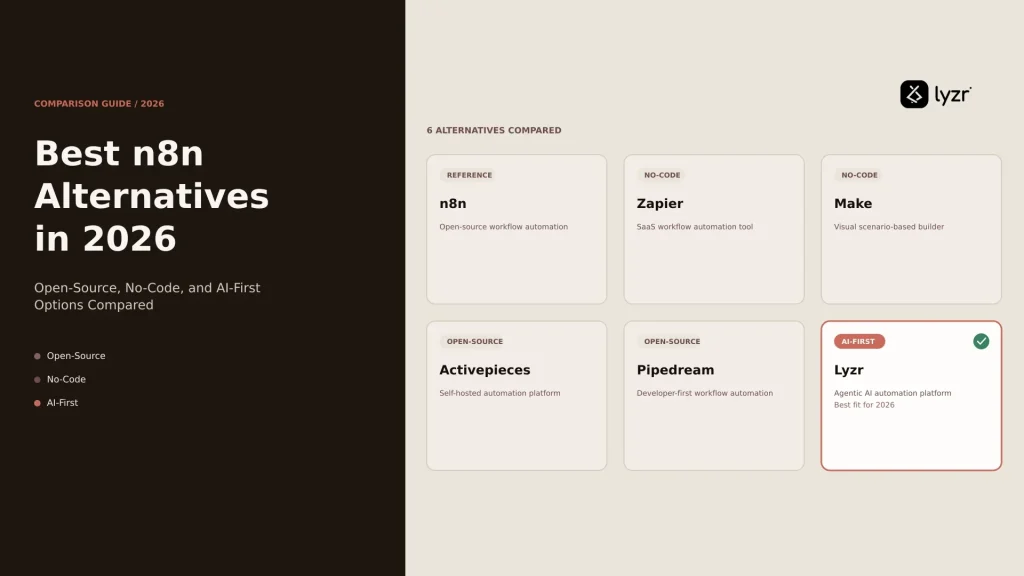
Built for business users and ops teams. Visual builders let you define an agent’s role, connect a knowledge source, set guardrails, and deploy without writing code. Lyzr’s Agent Studio, n8n, and MindStudio all fall here. Fast, accessible, and limited when the logic underneath gets genuinely complex. This is also where teams looking to build custom AI agents free of upfront engineering cost typically start.
Developer frameworks
Built for engineering teams with ML capacity. Open-source libraries like LangChain/LangGraph, CrewAI, AutoGen, and Google’s ADK give you modular components for custom reasoning loops and multi-agent coordination. See our breakdown of best AI agent frameworks for a side-by-side comparison. The tradeoff: you own the infrastructure, deployment, and governance stack yourself.
Enterprise agent platforms
Built for organizations that need both speed and control. These combine no-code accessibility with production-grade governance in one system, and they’re the category most guides skip entirely. Lyzr is one of the few platforms on our 20 best AI agent platforms list that runs all three build modes at once: Agent Studio for no-code building, Architect for co-building with AI through natural conversation, and framework-agnostic SDK import for teams already running agents in LangChain, CrewAI, or AutoGen.
Most platforms force a choice between accessibility and control. Lyzr’s approach lets a business user start in Agent Studio, a developer extend the same agent with custom code, and an ops team govern both through one control layer, instead of three disconnected systems that each need their own audit process. Once the agent exists, the real question becomes how you build and deploy an AI agent that survives contact with real users.
Where custom AI agents for business are already doing real work
Generic “types of agents” lists don’t tell you much. What matters is the workflow underneath, and this is where custom AI agents for business earn their budget line.
Sales pipeline acceleration
An agent qualifies inbound leads, researches the prospect’s company, personalizes outreach, and updates CRM records without a rep touching any of it. Lyzr’s Jazon runs this exact loop for high-volume pipelines where manual screening was the bottleneck.
Customer support resolution
An agent triages tickets by urgency and intent, pulls the right knowledge base article, drafts a response, and escalates only the genuinely complex cases, with full context attached so a human isn’t starting cold. Lyzr’s Jeff handles this, and it’s the same operational depth a SaaS development company builds into a support product from the ground up.
HR operations
An agent screens resumes against role requirements, schedules interviews, answers policy questions from the employee handbook, and processes onboarding tasks. Lyzr’s Diane automates this end to end.
Financial document processing
An agent extracts invoice data, reconciles it against purchase orders, flags discrepancies, and routes approvals. In banking specifically, AI agents for finance extend into KYC verification and fraud alert triage, and the same architecture underpins investment research and portfolio monitoring use cases.
Marketing content operations
An agent researches trending topics, drafts content in brand voice, schedules distribution across channels, and reports on performance. Lyzr’s Agentic OS for marketing, Skott, is built around this exact loop. Browse the full 101 AI use cases list for more, or read how customer AI agents handle interactions beyond scripted responses.
Every one of these replaces a task that used to consume hours of someone’s week, folding it into workflows that run without a person opening five tabs to do it manually. The broader glossary definition of an AI agent covers the mechanics; the use cases above are where that mechanics turns into hours saved.
What most teams get wrong when building customizable AI agents
The build is rarely the hard part. Production is, and this is where most customizable AI agents quietly stop delivering.
Skipping guardrails
An agent without hallucination controls, topic fencing, and human-in-the-loop approval gates will eventually invent a fact, approve a bad transaction, or expose data it shouldn’t have touched. This is a bigger stake than most Enterprise AI rollouts account for at the pilot stage, and Responsible AI controls, including a dedicated hallucination manager, aren’t optional once real customer data is in play.
Ignoring memory architecture
An agent that forgets everything at the end of a session is a fancy API wrapper, not an agent. It needs short-term context and long-term organizational memory, or it never actually gets better at your specific workflow.
Building on one LLM with no exit
Lock into a single model and you’re stuck when pricing shifts, performance degrades, or a better model ships. Custom agents should be model-agnostic from day one, not retrofitted to be.
No observability
If you can’t see what the agent decided, why, and what data it touched, you can’t debug it and you can’t pass an audit. A Control Plane with full decision traces is what turns “the agent did something weird” into a five-minute fix instead of a two-week investigation. This is also the foundation of real AI agent governance, not a compliance afterthought bolted on later.
Treating the pilot as the product
A demo running in a notebook isn’t a production system. Production means deployment infrastructure, version control, rollback capability, and monitoring, the same rigor that testing with AI applies to catching failures before they reach a real user. Our own agents to production playbook walks through exactly what that jump requires.
Here’s the part that doesn’t show up in most sales decks: teams that skip these five steps don’t fail loudly. They fail quietly, six weeks after launch, when nobody’s watching the agent closely enough to notice it drifted.
How much do custom AI agents cost, and how to evaluate a platform
Cost is usually the first question, and the honest answer is “it depends on the build path.” Open-source frameworks cost nothing but engineering time. No-code platforms often have a free entry tier, then scale with usage. Enterprise platforms typically run from a few hundred dollars a month upward, priced against LLM consumption, agent volume, and governance features.
Before you commit to any platform, run it through seven questions.
- Does it support no-code, code-first, and framework-import build paths, or does it force you into one?
- Can you swap the underlying LLM without rebuilding the agent?
- Are hallucination management, PII redaction, and topic fencing built in, not bolted on?
- Does it produce audit trails and decision logs you could hand to a compliance team today?
- Can it deploy on your cloud, on-prem, or sovereign infrastructure if that’s a requirement?
- Does it support real multi-agent architecture and agent orchestration, or just single agents wired together loosely?
- What does the bill look like once you’re running 100 agents, not one?
If your own team can’t build fast enough internally, custom AI software development services from We Capture Sales is one route to close that gap. If you want to see how a single platform answers all seven questions above, book a demo.
Custom AI agent platforms compared
| Build path | Best for | Main limitation |
|---|---|---|
| No-code (Lyzr Agent Studio, n8n) | Business users, fast deployment | Less flexible for complex custom logic |
| Developer frameworks (LangChain, CrewAI, AutoGen) | Engineering teams with ML capacity | You own infrastructure and governance |
| Enterprise platforms (Lyzr) | Organizations needing speed and governance together | Requires evaluating vendor depth upfront |
Frequently asked questions
What are custom AI agents?
Autonomous software systems built for a specific business workflow, combining an LLM brain, persistent memory, and tool integrations to execute tasks independently.
Can I create my own AI agent?
Yes. No-code platforms like Lyzr Agent Studio let you build and deploy a custom agent without writing code, often in minutes for a simple workflow.
How much do custom AI agents cost?
Costs range from free, using open-source frameworks, to $500 or more per month for enterprise platforms. The real driver is LLM usage volume, deployment model, and how many agents you’re running.
How can I build AI agents for free?
Open-source frameworks like LangChain or CrewAI cost nothing but engineering time. Several platforms, including Lyzr, also offer a free tier for building and testing a first agent.
What are the 5 types of AI agents?
The academic categories are simple reflex, model-based reflex, goal-based, utility-based, and learning agents. Most custom business agents fall into the goal-based or learning category.
Is ChatGPT an agent or LLM?
ChatGPT is an LLM delivered through a chat interface. It becomes an agent once it’s connected to tools, memory, and autonomous execution logic through a platform built for that purpose.
What are the top 3 AI agents?
It depends on the function. For sales, Jazon. For marketing, Skott. For customer support triage, Jeff, all built on Lyzr’s platform.
What is the best platform to build custom AI agents?
For enterprise governance paired with no-code access, Lyzr. For developer-first open source, LangChain. For visual workflow automation, n8n.
What are custom AI agents for business?
Purpose-built agents automating a specific business function: sales outreach, support triage, HR screening, financial document processing, or marketing content operations.
Who is responsible for building and deploying custom AI agents?
Usually a cross-functional group: engineering builds it, business stakeholders define the use case, and a compliance or governance function sets the guardrails before it touches production data.
What to do with this
Custom AI agents aren’t a question of whether the technology works anymore. By 2028, Gartner predicts that 33% of enterprise software applications will include agentic AI, a dramatic leap from less than 1% in 2024, driving over $450 billion in revenue. That number moves in one direction only, and it’s why the AI agents market size was valued at $7.6 billion in 2025, projected to grow from $10.9 billion in 2026 to $182.9 billion by 2033, at a CAGR of 49.6%.
The question that actually decides outcomes is narrower: can your team ship an agent with memory that persists, guardrails that hold, and observability that survives an audit, or will this one join the pile of pilots that quietly stopped mattering after week six.
Pull up the seven-question checklist above against whatever platform you’re currently evaluating. If it fails on three or more, that’s your answer before you’ve written a single line of agent logic.
Book A Demo: Click Here
Join our Slack: Click Here
Link to our GitHub: Click Here