
TL;DR
- Lyzr vs Traceloop compares two layers. Traceloop observes and evaluates agents whereas Lyzr Opencontroller controls them, and Lyzr Studio builds them.
- Traceloop fits developer teams that want OpenTelemetry tracing, prebuilt evaluators and CI checks on agents they’ve coded.
- Lyzr fits enterprises that need agent discovery, named owners, release gates and policy enforced before a call runs, inside their own network.
- Traceloop is now part of ServiceNow and powers runtime observability in ServiceNow AI Control Tower. OpenLLMetry stays open source.
- Traceloop’s free plan covers 50,000 spans a month. Traceloop Enterprise and Lyzr are priced on request.
- Already using OpenLLMetry? Keep your traces and add Opencontroller as the control layer on top.
An insurer’s platform team (a composite scenario) instrumented its claims and underwriting agents with OpenLLMetry, Traceloop’s open-source SDK. The traces are excellent. Every model call, tool call and retry sits on one timeline, and evaluators flag weak answers before customers see them.
Then internal audit asks three questions the dashboards can’t answer. Who approved the claims agent’s last release? Which models and tools may it call? If it sends policyholder data somewhere it shouldn’t, can anyone stop the call before it completes? Meanwhile, procurement notices Traceloop’s demo button now leads to servicenow.com.

That’s the real Lyzr vs Traceloop decision: do you need to see what agents do, control what they’re allowed to do, or both?
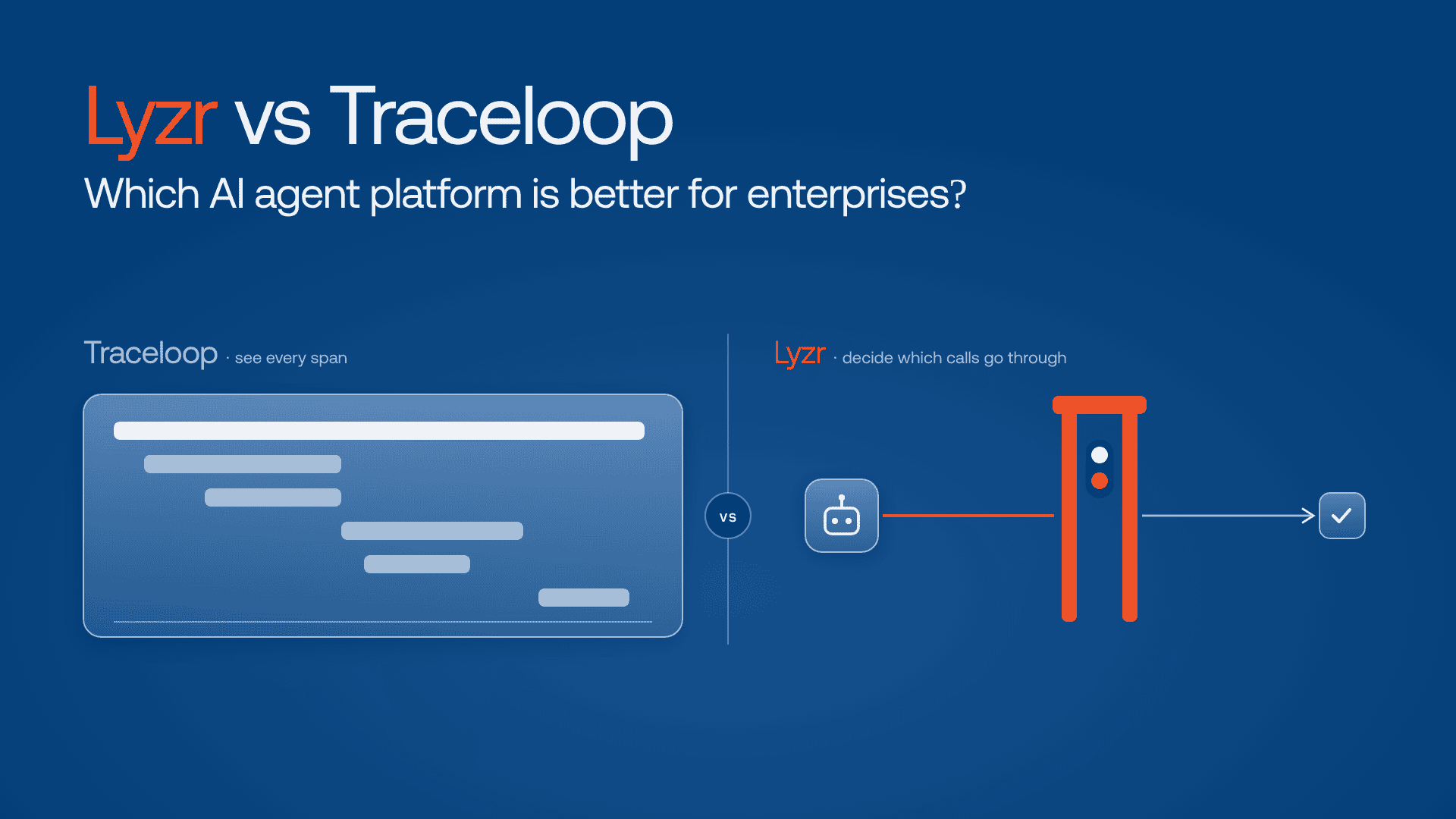
The short answer: Lyzr vs Traceloop comes down to scope. Traceloop is an OpenTelemetry-native observability and evaluation platform, now part of ServiceNow, for agents you build in your own stack. Lyzr Opencontroller is a control plane that governs agents from any framework, adding discovery, ownership, release gates and in-path policy to the traces you already collect.
Lyzr vs Traceloop: observability and control are different jobs
Traceloop observes and evaluates. It instruments code you’ve already written through OpenLLMetry, an Apache 2.0 SDK built on OpenTelemetry, then scores and monitors what your agents do. It doesn’t build agents or sit in their call path.
Lyzr Opencontroller controls. It finds every AI agent across your clouds, gives each one an owner, and controls what each can call, spend and touch. Agents stay on the runtimes they already use. Opencontroller registers them, observes them and enforces policy wherever their traffic passes through its gateways.
Lyzr Studio builds, if you want it to. It’s a no-code and low-code environment for building agents. Traceloop has no equivalent, and Opencontroller doesn’t require it.
How Lyzr and Traceloop compare for enterprise teams
| Criteria | Traceloop | Lyzr (Opencontroller + Studio) |
|---|---|---|
| Agents covered | Agents your team instruments | Any framework, cloud or runtime, including other teams’ agents |
| Agent discovery | Not offered | Across clouds, private infrastructure and developer devices |
| Ownership and identity | Not a focus | Every agent gets an owner; SAML, OIDC, SCIM |
| Tracing | OpenLLMetry, OpenTelemetry-native, 25+ backends | OpenTelemetry traces with cost, quality and owner per span |
| Evaluation | Prebuilt and user-defined evaluators; CI/CD checks | Evaluation gates before production |
| Stopping a risky call | Alerts on what agents did | Policy enforced in the request path |
| Deployment | Cloud; on-prem and air-gapped on Enterprise | VPC, on-prem or air-gapped; control-plane data stays with you |
| Vendor neutrality | Part of ServiceNow; demos route to ServiceNow | Independent; open standard interfaces |
| Entry price | Free plan up to 50,000 spans a month | On request |
As of November 2026.
What Traceloop does well
Open, portable tracing: OpenLLMetry is free and connects to more than 25 observability platforms, Traceloop included. Because the traces follow the OpenTelemetry standard, you can switch backends without re-instrumenting your code.
Agent-aware evaluators: Traceloop’s evaluator library checks correctness, relevance, task completion, tool usage, memory retention, safety and style, and teams can write custom evaluators. Its agent evaluators cover goal accuracy and goal completeness, with flow quality, efficiency, tool error and tool trajectory checks in beta.
Dev-loop checks and flexible deployment: Even the free plan includes evaluation dashboards, CI/CD integration and prompt management. Enterprise adds on-prem on AWS, GCP, Azure or Kubernetes, plus air-gapped support.
Watch-outs: Traceloop reports what happened and how good it was. It doesn’t decide what an agent may do before it acts, and free-plan data is kept for 24 hours.
What’s new after Traceloop became a part of ServiceNow
Traceloop is owned by ServiceNow. Its technology adds deep observability into agent behavior at runtime to ServiceNow AI Control Tower, where it supports continuous monitoring with live metrics and alerts.

Traceloop has made three commitments to customers. OpenLLMetry will remain open source. Traceloop will honor customer obligations and keep selling its product. Roadmap changes will be announced in advance.
What that means depends on your stack:
- If ServiceNow is your system of record, Traceloop is a natural path into AI Control Tower.
- If it isn’t, you’re buying an observability tool whose roadmap now serves a larger platform. Traceloop’s pricing page sends demo requests to ServiceNow.
Either way, keep instrumentation on OpenTelemetry so your traces stay portable.
How much does Traceloop cost?
Traceloop has two plans:
- Free Forever ($0): up to 50,000 spans a month, up to 5 seats and 24-hour data retention.
- Enterprise (custom): more than 50,000 spans, unlimited seats, custom retention, SOC 2, an on-prem option and dedicated Slack support.
A span is one event in a trace, such as an LLM call. Agents produce many spans per run, so budget on volume and retention. Lyzr is priced on request. In our view, licence price rarely decides this comparison. Control does.
Seeing an agent is not the same as controlling it
Back to the insurer. A trace shows the claims agent sent a policyholder’s medical notes to an external model. An evaluator flags it, and an alert fires. The trace is perfect.
The data still left the building.
Observability records and scores what already happened. Gartner predicts that by 2028 an average global Fortune 500 enterprise will have over 150,000 agents in use, up from fewer than 15 in 2025. Only 13% of organizations believe they have the right AI agent governance in place. At that scale, nobody reads every alert.
So ask four questions of any stack:
- Which agents exist across every cloud, and who owns each one?
- Which version of each is approved to run, and on what evidence?
- What is each agent allowed to call, spend and touch?
- What stops a risky call before it completes?
Traceloop’s evaluators and CI checks help with the evidence in question 2. A tracing tool can’t answer 1, 3 or 4, because it isn’t in the call path between the agent and what it calls. In our view, that’s the real dividing line in Lyzr vs Traceloop.
Tracing tells you what happened. Before you shortlist a control layer, see who sells one, what each really controls, and how to run a two-week bake-off. Get the buyer’s guide:
Lyzr vs Traceloop: which should your enterprise choose?
Choose Traceloop if:
- Your developers build agents in code and mainly need traces, evaluators and CI checks.
- You run ServiceNow and want agent observability that feeds AI Control Tower.
Choose Lyzr if:
- Agents are spreading across teams, clouds and frameworks, and nobody has the full list.
- Audit, risk or security needs owners, approvals and enforced policy, not just dashboards.
- Control has to run in your VPC, on-prem or air-gapped.
Use both if you’ve already instrumented with OpenLLMetry. Keep tracing and evaluating, and add a control layer above it. That’s the insurer, and most enterprises past their first few agents.
How Lyzr Opencontroller adds control to the traces you already have
Opencontroller is that control layer. It doesn’t replace your observability stack.
It connects through the standards your stack already uses: OpenTelemetry for telemetry, OpenAI-compatible APIs for models, MCP for tools, A2A for agents, and SAML, OIDC and SCIM for identity. There’s no proprietary SDK, and OpenTelemetry keeps flowing into the collectors you already operate.
On top of those traces, it answers the four questions a tracing tool can’t. It finds agents across clouds, private infrastructure and developer devices, and gives each an owner. It runs evaluation and promotion gates before a version reaches production. Its gateways check identity, spend and policy before the call reaches the model or tool, and when policy says no, the call is refused and logged. Every span carries cost, quality and owner, exported to the tools you already run.
Regulated buyers can run it in their VPC, on-prem or air-gapped, and control-plane data, credentials and telemetry never need to reach Lyzr.
Back at the insurer, developers keep instrumenting as before. When the claims agent tries to send those notes to a model nobody approved, the call is refused before it completes and logged against the agent, its owner and the policy that stopped it.
That’s the difference between seeing an agent and controlling it. Book a demo to see Opencontroller govern your agents on top of the traces you already collect.
Frequently asked questions
For enterprise-wide control, yes. Traceloop is strong for tracing and evaluating agents your developers build. Lyzr adds discovery, ownership, release gates and policy enforcement across every team and cloud.
Traceloop is an observability and evaluation platform built on OpenTelemetry and its open-source OpenLLMetry SDK. Lyzr Opencontroller is a control plane that finds, approves and controls agents. Lyzr Studio builds agents.
Yes. ServiceNow acquired Traceloop, whose technology now powers runtime agent observability in ServiceNow AI Control Tower. Traceloop says OpenLLMetry will remain open source and it will keep selling its product.
Yes. Opencontroller uses OpenTelemetry for telemetry and sends traces with cost, quality and owner on every span to your existing tools.
If you need more than tracing, Lyzr Opencontroller governs agents from any framework, enforces policy before calls run, and deploys in your VPC, on-prem or air-gapped.
Book A Demo: Click Here
Join our Slack: Click Here
Link to our GitHub: Click Here
Got a use case in mind?
8 weeks from use case to agents running in production.
Platform, people and FDEs, all in. Bring your environment. We'll co-build and stay until it's live.
Talk to UsFree resource
101 AI Agents Use Cases
100+ production-ready AI agent use cases across Marketing, Sales, HR, Banking, Insurance, Operations and a lot more
Download now