

Compare the best platforms for prompt chaining in agent workflows, from Lyzr Agent Studio to LangGraph and Dify, with strengths, limits and how to choose.
An operations analyst asks an agent to read a 40-page vendor contract, pull the renewal terms, check them against procurement policy and draft an email to legal, all in one prompt. The reply looks confident, but it skips the auto-renewal clause on page 31 and cites a policy rule that does not exist. One giant prompt asked the model to do four jobs at once, and it did none of them well. Prompt chaining fixes this by splitting the work into small steps, where each output feeds the next call and gets checked along the way.
The pressure to get things right is growing. Agents now run multi-step work in finance, support and procurement, and Microsoft is retiring Prompt flow in April 2027, which forces many builders to pick a new home for their chains. The strongest options give you state between steps, branching, a model choice per step and tracing for every call. Here is how the platforms compare, so you can pick the one that fits your stack and your skills.
Still running a ten-step process through one oversized prompt? Our playbook on how to reimagine enterprise workflows shows how to break a process into agent-sized steps before you write a single prompt.
TL;DR
- Prompt chaining breaks one big task into a sequence of smaller model calls, where each step output is checked before it goes to the next.
- Choose by who builds the chains (engineers in code or business users on a canvas), how much branching and saved state the work needs, whether each step can use a different model, and where the data has to stay.
- Lyzr Agent Studio builds chains in a no-code builder or through the API, and every step can have its own model and knowledge base.
- Guardrails and approval gates sit between steps, Opencontroller traces each call and caps spend, and the stack runs in your own cloud, on-prem or air-gapped.
What is prompt chaining?
Prompt chaining in AI is a technique where the output of one LLM call becomes the input of the next, so a complex task runs as a sequence of smaller, focused prompts. In agentic workflows, each link in the chain can be a prompt, a tool call or a full agent. The chain can run in a straight line, branch on a condition or loop back when a check fails. A platform for prompt chaining handles the plumbing: passing state, retrying failed steps and logging what each step received and returned.
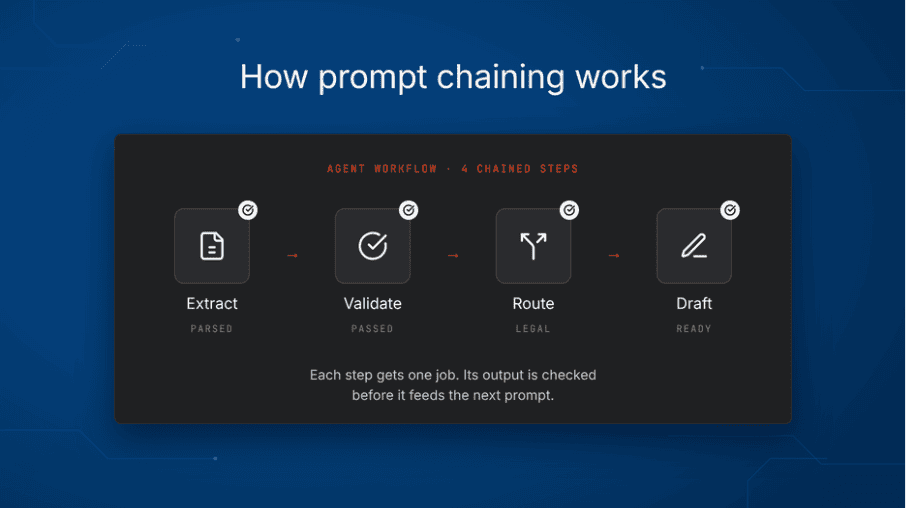
Prompt chaining in an agent workflow: extract, validate, route and draft steps with a check between each
Prompt chaining vs prompt caching vs chain of thought prompting
The three names sound alike, but they solve different problems. Prompt chaining splits a task into linked steps, and prompt caching reuses work a model has already done so repeat calls cost less. Chain of thought prompting asks one model to reason step by step inside a single call.
| Aspect | Prompt chaining | Prompt caching | Chain of thought prompting |
| Definition | Breaks one task into a sequence of prompts, where each output feeds the next | Stores a processed prompt prefix or a past response and reuses it on later calls | Asks the model to write out its reasoning before giving a final answer, all in one prompt |
| Workflow | Step 1 runs, its output is checked, then step 2 runs with that output as input | A request arrives, the cache is checked, and a hit skips reprocessing the stored part | One call: the model works through intermediate steps, then states the answer |
| Goal | Accuracy and control over multi-step work | Lower cost and latency on repeated input | Better reasoning on a single hard question |
| Use cases | Document processing, multi-agent pipelines, approval flows | Long system prompts, shared knowledge base context, repeat customer questions | Math and logic problems, policy checks with several conditions |
| Example | Extract contract terms, validate them against policy, then draft an email to legal | A support agent reuses the same 5,000-token product manual prefix across every chat | A model checks each clause of a refund policy before deciding if a request qualifies |
The three work well together: a chain can cache the shared instructions each step reuses, and any single step can use chain of thought prompting when it needs careful reasoning.
See a working chain before you build one. The Agent Orchestration 101 video walks through how multiple agents pass work to each other in under ten minutes.
Benefits of using prompt chaining
A single prompt has to plan, reason and format at once, and errors compound silently. Chaining spreads that load across steps you can inspect, test and tune one at a time.
Higher accuracy on multi-part tasks
Each prompt gets one narrow job, such as extracting dates or classifying a request. Narrow instructions leave less room for the model to drift. Accuracy on the full task goes up because no single call is overloaded.
Faster debugging when something breaks
When a chain fails, the trace shows which step produced the bad output. You fix that one prompt instead of rewriting a 2,000-word mega-prompt. LLM observability tools make this even quicker by logging inputs and outputs per step.
Lower cost through model choice per step
Not every step needs a frontier model. A small, cheap model can handle classification or formatting, while a larger one handles reasoning. Auto model routing applies the same idea automatically, sending each request to the cheapest model that can do the job.
Safer outputs with checks between steps
A validation step can stop a chain before a wrong answer reaches a customer or a system of record. You can insert guardrails, schema checks or a person’s approval at the exact point where risk is highest. Single prompts offer no such checkpoint.
Order handling stalled because one agent tried to do everything? Read how a telecom provider automated order processing with Lyzr agents, with each step owned by a dedicated agent.
How to select the right prompt chaining platform
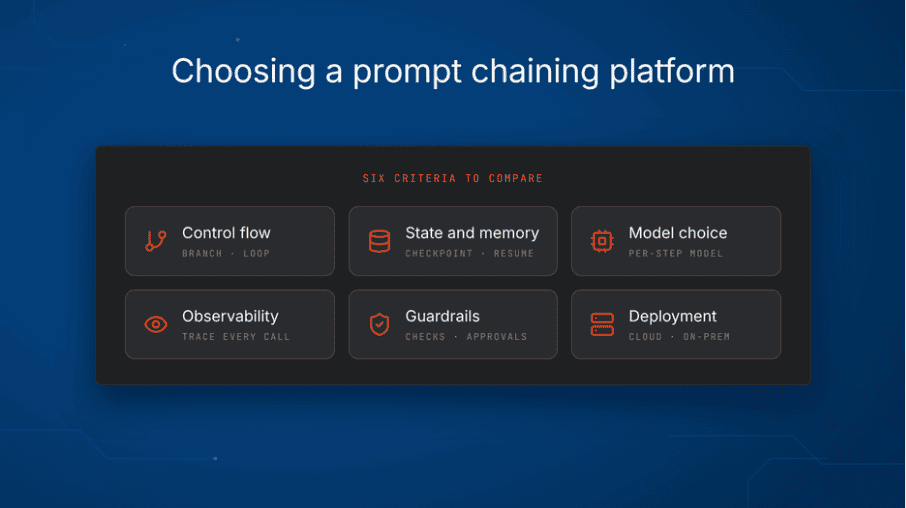
Six criteria for choosing a prompt chaining platform for agent workflows
The right platform depends on who builds the chains, how complex the agent orchestration logic gets and where the workflow has to run. Use these criteria to compare options against your actual use case, not a demo.
| Criteria | Key capability | Impact |
| Control flow | Branching, loops, parallel steps and conditional routing | Real workflows rarely run in a straight line |
| State and memory | Shared state across steps, checkpointing and resume | Long chains fail midway and need to restart without losing work |
| Model flexibility | A different model or provider per step | Cuts cost and avoids lock-in to one vendor |
| Observability | Traces, token counts and latency for every step | You can’t fix a step you can’t see |
| Guardrails and review | Built-in checks, approval gates and hallucination controls | Stops bad output before it moves downstream |
| Deployment | Cloud, private cloud, on-premises or air-gapped options | Regulated data often can’t leave your environment |
| Build experience | Code SDK, visual builder or both | Determines who can build and maintain chains |
Most chains look fine in a demo and fall apart at step four in production. Our white paper on the measurement gap between AI pilots and production deployments explains what to measure before you scale.
Best platforms for prompt chaining in agent workflows
The platforms for prompt chaining range from code-first frameworks to visual builders with governance built in. They differ most in how they pass state between steps and where they can run, so match the platform to who will build and maintain your chains.
| Tool | Best fit | Key features |
| Lyzr workflow automation | Governed multi-agent chains | No-code builder and API, per-step models, Responsible AI guardrails, MCP and A2A, air-gapped deployment |
| LangGraph | Stateful, branching chains | Graph-based workflows, shared state, loops and branches, checkpointing, human approval interrupts |
| LlamaIndex Workflows | Event-driven chains in Python and TypeScript | Event-driven steps, parallel execution, built-in tracing, OpenTelemetry support |
| Microsoft Agent Framework | Chains on the Microsoft stack | .NET and Python, graph-based workflows, handoff orchestration, checkpointing |
| Dify | Visual chain building | Visual canvas, per-node model choice, self-hosting, publish as API |
1. Lyzr workflow automation for governed multi-agent chains
Lyzr workflow automation is an enterprise platform for designing, building and deploying AI agents and multi-agent workflows through a no-code builder or an API. You can chain agents with orchestration templates or a manager agent, and each step can use a different model, its own knowledge base and its own memory. Guardrails sit inside the chain, with Responsible AI checks and a hallucination manager catching bad outputs before they reach the next step. Agents connect to outside tools over MCP and A2A, and the platform deploys on Lyzr cloud, your own cloud, on-premises or air-gapped. With Lyzr’s workflow automation agents, a global logistics firm cut invoice processing from five days to 15 minutes.
A chain is only as useful as the data each step can reach. See how MCP works inside Lyzr Agent Studio to pull live context from your tools at any step.
2. LangGraph for stateful, branching chains
LangGraph is an open-source orchestration framework from LangChain that models agent workflows as graphs of nodes and edges. Each node can run a prompt, a tool or a sub-agent, and shared state carries outputs forward, so you can build loops and conditional branches instead of a straight line. Checkpointing and interrupts give long chains pause-and-resume points for human approval. Hybrid and fully self-hosted deployment through LangSmith Deployment requires Enterprise plan, so smaller companies either use the cloud or run the open-source library on their own servers which might add to the cloud cost.
Weighing LangGraph’s flexibility against a managed platform? Our Lyzr Agent Studio vs LangGraph comparison breaks down build time, governance and deployment side by side.
3. LlamaIndex Workflows for event-driven chains in Python and TypeScript
LlamaIndex Workflows is an open-source, event-driven library in Python and TypeScript for chaining the steps of an AI application. Each step listens for one event type and emits the next, so a chain can branch, loop back after a failed check or run steps in parallel without a predefined graph. Workflows come instrumented for tracing, with support for Arize Phoenix and OpenTelemetry. Workflows ship with a 10-second default timeout, so long-running chains might stop with an error unless you raise it.
Event-driven chains get hard to follow once they branch and loop. Our guide to the best LLM tracing and debugging tools shows how to see every step a workflow took.
4. Microsoft Agent Framework for chains on the Microsoft stack
Microsoft Agent Framework is an open-source kit for .NET and Python that combines AutoGen’s agent abstractions with Semantic Kernel’s enterprise features. Its graph-based workflows support sequential, concurrent, handoff and Magentic orchestration, plus checkpointing and type-based routing between steps. Microsoft names it the migration path for Prompt flow, which retires on April 20, 2027, so it fits companies already building on Foundry. The sequential orchestration cannot pause midway for free-form user feedback or hand control back to a previous agent, so review loops might need handoff orchestration or a custom workflow.
Already building agents on Foundry and need one place to govern them? Read OpenController vs Microsoft Foundry to see how cross-platform control compares.
5. Dify for visual chain building
Dify is an open-source platform for building LLM apps and agent workflows on a visual canvas. Its Workflow Studio chains model, iteration, search and variable nodes, and you can swap providers such as OpenAI and Anthropic node by node. You can self-host it or publish a finished workflow as an API or a web app. Its license restricts multi-tenant SaaS use without written approval from Dify, so companies that resell AI services might need a commercial agreement.
Put Dify and Lyzr through the same workflow before you commit. The Lyzr Agent Studio vs Dify comparison shows where each one holds up once chains reach production.
Build reliable agent chains with Lyzr
Prompt chaining in a multi-agent architecture only pays off when every step is visible, governed and easy to change. Lyzr gives you the builder, the guardrails and the deployment options in one place, so chains move from prototype to production without a rebuild.
- Lyzr Agent Studio: chain agents with per-step models, memory and built-in guardrails
- AI agents for workflow automation: run event-triggered, multi-agent processes with approval checkpoints
- Opencontroller: trace, evaluate and set spending limits for every agent and model call in your chains
Start with one workflow that breaks today and rebuilds it as a chain.
Take Lyzr for an agent test drive!
Best platforms for prompt chaining in agent workflows FAQs
What is the difference between prompt chaining and chain of thought prompting?
Chain of thought prompting asks one model to reason step by step in a single call, while prompt chaining splits the task across several calls, each with its own prompt and output check. Use chain of thought prompting for one hard reasoning question, and use prompt chaining when the task has separate steps, such as pulling data from a contract and then drafting a reply. The two also work together: any step in a Lyzr Agent Studio workflow can use chain of thought prompting inside its own prompt.
How do you add human approval steps to a prompt chain?
Put an approval step between the step that drafts an action and the step that carries it out. The chain then pauses until a reviewer approves or rejects the output. Add these gates before anything costly or hard to undo, such as payments, emails or record updates. In Lyzr Agent Studio, the Superflow “Wait for Approval” node pauses the workflow and sends it down a separate path for approved or rejected outputs.
What is the best platform for building prompt chains in enterprise agent workflows?
It depends on who builds the chains. Engineers often pick code frameworks such as LangGraph, while business and IT groups need a visual builder with governance included. Lyzr Agent Studio covers both with a no-code builder and an API, plus memory, RAG and support for any model provider. It deploys on Lyzr cloud, your own cloud or on-prem.
Is n8n a good choice for prompt chaining, and what are the alternatives?
n8n works well for chaining LLM calls with app integrations, and you can self-host it. It is a general automation tool, so agent memory, evaluation and governance across many agents take extra work. Alternatives include LangGraph for code-first chains and Lyzr Agent Studio for enterprise multi-agent workflows with Responsible AI controls built in.
What are the alternatives to OpenAI Agent Builder for chaining prompts?
OpenAI is winding down Agent Builder, and it won’t be available on the OpenAI platform after November 30, 2026. OpenAI points developers to its Agents SDK for code-based workflows, and LangGraph is another code-first option. For a visual builder, Lyzr Agent Studio’s Superflow chains agents and LLM steps on a canvas and works with any model provider (see Lyzr vs AgentKit).
Can each step in a prompt chain use a different LLM?
Yes. A common setup uses smaller, cheaper models for steps like classification or extraction and saves a frontier model for steps that need heavy reasoning. In Lyzr Agent Studio, each agent picks its own model from providers such as OpenAI, Anthropic, Google and Amazon Bedrock. It also supports up to three fallback models and auto-routing by complexity.
How do you stop hallucinations from carrying through each step of a prompt chain?
Check each step’s output before the next step uses it. Validate the format and compare the content against your source data, then retry or stop the chain when a check fails. Lyzr Agent Studio’s Hallucination Manager checks each answer against facts you define and revises it before it moves on. Superflow nodes can also retry automatically on failure.
Need a person to sign off before a chain sends an email or updates a record? Our roundup of platforms for AI agent workflow approval and human review compares the options for adding that checkpoint.
Book A Demo: Click Here
Join our Slack: Click Here
Link to our GitHub: Click Here
Got a use case in mind?
8 weeks from use case to agents running in production.
Platform, people and FDEs, all in. Bring your environment. We'll co-build and stay until it's live.
Talk to UsFree resource
101 AI Agents Use Cases
100+ production-ready AI agent use cases across Marketing, Sales, HR, Banking, Insurance, Operations and a lot more
Download now