The best tool for voice AI guardrails and compliance at a bank depends on where the risk sits: the call itself, the conversation, the review of calls afterwards, the governance of the agent, or the proof an examiner will ask for. This guide compares seven tools across those layers. Madison, Lyzr’s agentic GRC product for US banks and credit unions, is the pick for connecting rules such as the TCPA to the policies, controls and evidence behind them and for governing voice AI vendors and agents as owned objects. Telnyx covers telephony, Cresta the conversation and call review, Arthur and Credo AI the agent layer, and Opencontroller the runtime controls. Madison does not run calls or filter speech, so most banks pair it with a voice platform.
TL;DR
- Voice AI risk has layers: the call, the conversation, call review, the agent and the evidence. No tool here covers all five.
- Best for rule to evidence: Madison links a rule to the obligation, policy, control, test and evidence, and records who signed it. It is our product, so read its limits.
- Best for the conversation: Cresta describes guardrail layers, PII redaction, human handoff and review of every call, in its own banking guide.
- Best for the call layer: Telnyx for telephony, with an AI disclosure term, a retention toggle and a data use addendum worth reading closely.
- Best for agent governance: Arthur and Credo AI for discovery, evaluation and registries, Opencontroller for approvals, audit and reversible quarantine.
- The TCPA applies: the FCC ruled in February 2024 that AI-generated voices are “artificial” under the TCPA, so prior express consent matters. Confirm with counsel.
What do voice AI guardrails need to do at a bank?
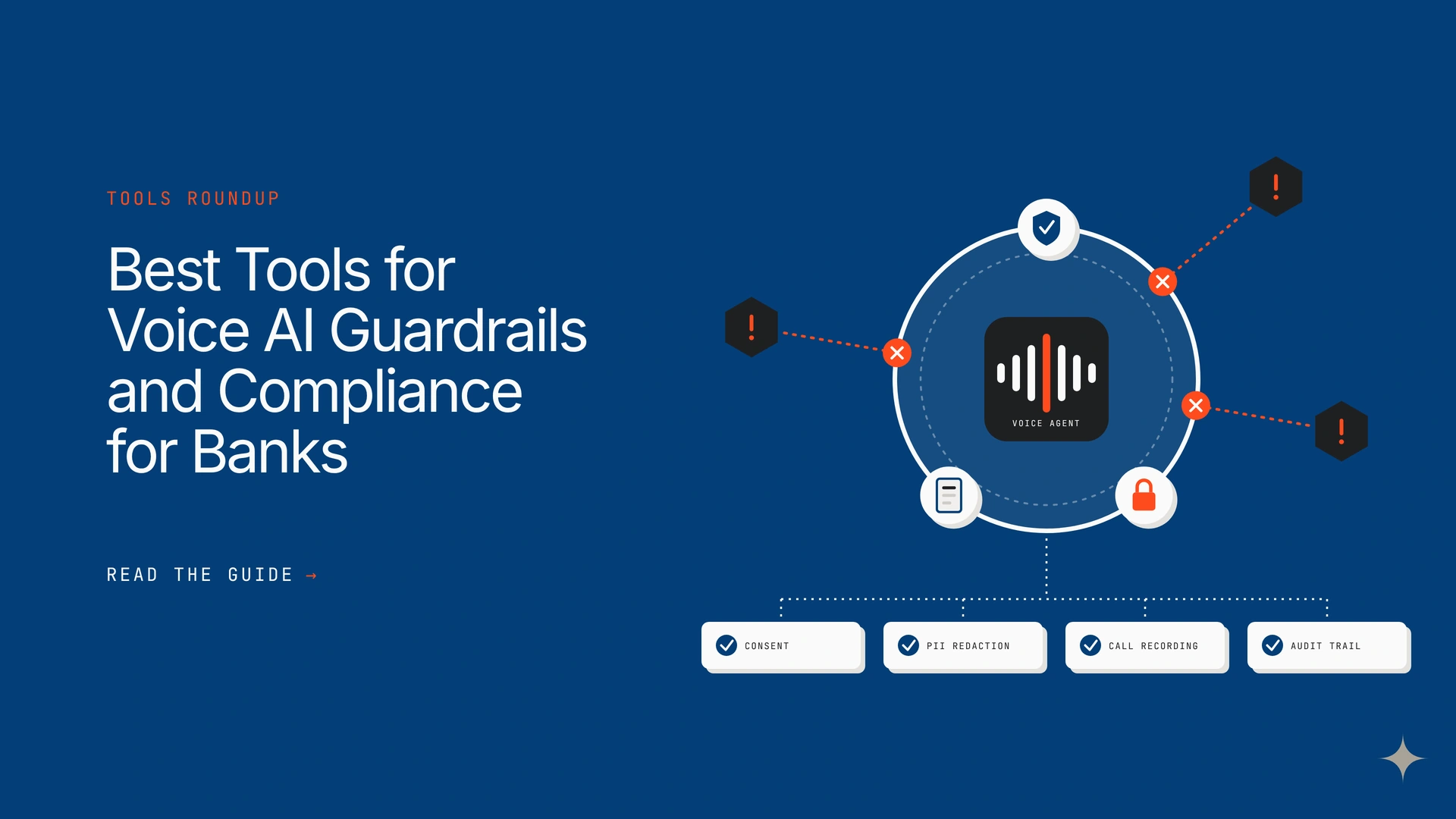
Voice AI guardrails keep an agent that talks to customers inside what the bank has approved: say only what is sourced, collect only what is needed, hand over when it cannot answer, and leave a record. Voice makes this harder than chat because the customer cannot see the screen, the exchange is live, and consent and disclosure rules attach to the call itself. Supervisors are already asking banks how they limit, monitor and shut down AI agents; see what regulators ask banks about AI agents.

A guarded voice call follows a path like the one below. The platform handles the early steps, the guardrail layer the middle, and governance ties the whole path to an owner and a record.

| Guardrail | What good looks like | Where it usually comes from |
|---|---|---|
| Consent and disclosure | The agent says it is an AI, and outbound calls are placed only with the consent the rules require. | Voice platform, plus policy and control evidence |
| Data minimization and redaction | Account numbers, SSNs and PINs are masked before transcripts are stored or reused. | Guardrail layer, voice platform retention settings |
| Deterministic fallback | The agent answers from approved sources and hands over to a person when none matches. | Guardrail layer and agent design |
| Human escalation | Handoff carries the conversation context so the customer does not repeat themselves. | Guardrail layer, contact center platform |
| Traceability | Every action and override is logged and tied to an authorized actor and a rule. | Agent governance and runtime layer |
| Vendor data use | You know whether the vendor may process your content to improve its products, and on what terms. | Contracts, reviewed in vendor risk |
How we assessed: we read each vendor’s own pages where we could and a third-party listing where we could not. Cresta’s guide is vendor-authored and ranks Cresta first. “Not described” means not found on the pages we reviewed, not that the capability is absent. Madison is our product and is listed first for that reason.
Which rules apply to voice AI at a bank?
There is no single voice AI rulebook, so banks combine several. The best-documented federal point for outbound calls is the Telephone Consumer Protection Act. On February 8, 2024 the FCC issued a declaratory ruling (CG Docket No. 23-362, FCC 24-17) that AI technology emulating human voices makes a call “artificial” under the TCPA, so prior express consent is needed for covered calls, and the existing identification and disclosure requirements apply. Law firm summaries describe it as clarifying existing rules rather than creating new ones, and note FCC and state attorney general enforcement and private remedies.
Other obligations come from your own mix of privacy, safeguards, fair lending and third-party risk requirements, and from supervisors’ questions about AI agents. SR 26-2 puts generative and agentic AI outside its scope; see SR 26-2 and the banking AI governance gap. Your counsel should confirm which rules attach to which calls. Madison’s job is to hold that answer: each obligation, the policy and control that meet it, and the evidence.
TCPA details are from Mayer Brown, Brownstein Hyatt Farber Schreck and Orrick summaries dated February 2024, not from the FCC order itself, and do not reflect later rulemaking. Read the primary order and take legal advice.
The best voice AI guardrails and compliance tools for banks at a glance
| # | Tool | Best for | Layer | Watch for |
|---|---|---|---|---|
| 1 | Madison by Lyzr | Rule to policy, control and evidence; governing voice AI vendors and agents | Proof | Does not run calls, filter speech or monitor models |
| 2 | Arthur | Discovering agents, evaluations and policy for agents | Agent | Voice, deployment model and bank detail not described |
| 3 | Credo AI | AI registry, risk assessment and policy packs | Agent | No voice or bank module on pages read; some items planned |
| 4 | Cresta | Conversation guardrails, PII redaction, handoff and call review | Conversation, review | Our main source is its own guide |
| 5 | Telnyx | Telephony with AI disclosure terms and a retention toggle | Call | Vendor may use content to improve products; audit logs not documented |
| 6 | Harmony.ai | Voice agents for revenue teams, with calls recorded and scored | Call | Third-party listing only; not banking-specific on that page |
| 7 | Opencontroller by Lyzr | Approvals, audit trail and reversible quarantine for agents | Agent runtime | Governs tools and calls, not audio |
Madison by Lyzr
Madison is a workforce of AI agents for compliance and risk in US banks and credit unions. It reads the rules, your policy and procedure library and your examination history, builds a live map of how they connect, and hands finished, sourced work to a named person who decides.
For voice AI, Madison answers the question an examiner asks after the call: which rule applies, what is our policy, what control makes the agent follow it, how do we test that control and where is the evidence. It holds twelve links as one connected model: regulation, rule section, obligation, applicability, policy, procedure, control, test, finding, remediation, evidence and request. The voice AI vendor and the agent are governed objects with owners and evidence in the same register.

| Voice AI compliance job | How Madison handles it |
|---|---|
| Map rules to policy and control | Traces a rule to the obligations, policies, procedures and controls it touches, and shows gaps such as an obligation with no control. See how to map policies to controls with an agent. |
| Regulatory change | When a rule or guidance changes, shows what it touches so a person can decide. See how to evaluate a regulatory change agent. |
| Voice AI vendors and agents | Treats vendors, models and agents as governed objects with owners and evidence in the same register as everything else. |
| Examiner requests | Answers from the chain behind the question, in one register, instead of assembling folders after the request arrives. |
| Accountability | Every decision is signed against the exact version, with the signer’s role. Madison never remediates on its own and does not write back to the core banking system. |

Best for: compliance, risk and audit teams at US banks and credit unions deploying voice AI who need the rules-to-evidence record. See also AI in compliance vs AI governance and agentic AI for the BSA officer. The first Madison working session starts from your own policy library.
2. Arthur
Best for: discovering the agents running in your estate and evaluating and governing them.
Arthur’s December 2025 release describes an Agent Discovery and Governance platform with automated discovery and cataloging of agents across compute environments, acceptable use and security policies, capabilities to safeguard sensitive data such as PII and PHI, and continuous performance evaluation with alerts when thresholds are crossed. A July 2025 post adds evaluation templates, custom metric builders, drift and degradation detection and Model Context Protocol support. Its whitepaper lists discovery techniques including telemetry, MCP server monitoring, network analysis and cloud APIs.

Pick it if: your first problem is knowing which agents exist and whether they are being evaluated.
Sources: Arthur press release (December 17, 2025, syndicated), Arthur whitepaper (undated, 2026) and Arthur AWS Marketplace post (July 16, 2025). Vendor-authored.
3. Credo AI
Best for: a registry, risk assessments and policy packs across AI systems and agents.
Credo AI describes a centralized inventory of AI systems, including agents, models and shadow AI with auto-discovery, an Agent Registry with agent cards, a dependency graph, an agentic risk assessment library with mapped controls and policy packs for the EU AI Act, NIST AI RMF, ISO 42001 and SOC 2. A vendor portal collects AI risk evidence from third parties. Integrations include AWS, Azure, GCP, Databricks, Snowflake, ServiceNow, Archer and OneTrust.

Pick it if: you need a cross-industry AI registry and vendor evidence collection and your US bank obligations are tracked elsewhere.
Source: Credo AI product page and vendor compliance page (2026). Vendor-authored. See also our {a(“/blog/best-tools-ai-data-privacy-compliance-banks/”,”comparison of AI data privacy and compliance tools”)}.
4. Cresta
Best for: guarding the conversation, redacting sensitive data, handing over to people and reviewing every call.
Cresta’s banking voice AI guide, dated May 2026, describes an AI agent across voice and chat with “four layers of enterprise guardrails”: system-level, supervisory, adversarial testing and automated behavioral quality management. It describes automatic PII redaction aligned to PCI-DSS and HIPAA, a knowledge agent that surfaces cited answers during live conversations, escalation to a human queue with full conversation context, and conversation intelligence and quality scoring that it says can cover 100% of interactions. Its banking examples include identity verification, disclosures, payment authorization, collections and disputes.

Pick it if: live conversations and call review are the gap, and you want guardrails and QA from one vendor.
Source: Cresta guide to voice AI platforms for banking (May 2026). Vendor-authored comparison.
5. Telnyx
Best for: telephony for voice AI, with disclosure terms and a retention control.
Telnyx provides telephony and voice AI assistants. Its AI services addendum says AI features are disabled by default, requires customers to tell people at the start of an interaction that they are talking to an AI, prohibits sending PHI or card data unless a further addendum is signed, and bars using output as the sole basis for decisions on credit and similar matters. A May 2025 release note describes a Retain or Do not retain setting in the assistant builder. Its compliance page lists STIR/SHAKEN full attestation and certifications including SOC 2 Type II, ISO 27001 and PCI DSS.

Pick it if: you need the telephony layer and your team will build the guardrails, review and governance around it.
Sources: Telnyx AI services addendum, compliance page (verified April 21, 2026), security page and release note (May 15, 2025). Vendor-authored.
6. Harmony.ai
Best for: voice agents for revenue teams that need recorded, scored and exportable calls.
The Harmony.ai listing we could read describes voice AI agents from monday.com for sales and customer teams, with built-in telephony, caller ID reputation monitoring, an AI dialer with timezone-aware calling windows, and calls that are recorded, scored and exportable. It lists consent capture, disclosure and a full audit trail as needs in regulated industries including banking and debt collection.

Pick it if: you are piloting outbound voice for a revenue team and want call recording and scoring built in.
Source: Voice AI Space directory listing (third-party). Harmony.ai’s own site was not reviewed.
7. Opencontroller by Lyzr
Best for: approvals, a signed audit trail and a reversible stop for the agents behind a voice experience.
Opencontroller is Lyzr’s agent control plane. It registers each agent with an immutable ID and named owner, discovers agents including unsanctioned AI clients, authorizes each tool call with policy that reads the call’s arguments, brokers credentials so the agent never holds them, applies budgets and egress policy, requires approvals where the approver is never the requester, keeps a signed audit trail of lifecycle events, model calls and tool executions, and can quarantine an agent reversibly at the gateway, including external agents registered as entries. A simulation engine adds golden and challenger datasets, a regression gate and adversarial probes.

Pick it if: voice agents call tools that touch accounts or money and you need per-call authorization, approvals and a stop switch.
Source: Lyzr Agent Control Plane Capability Reference. We make this product.
How do the voice AI guardrail and compliance tools compare?
| Tool | Telephony | Live conversation guardrails | Call review | Agent inventory and evals | Rule to control mapping | Approvals or stop |
|---|---|---|---|---|---|---|
| Madison | No | No | No | Inventory yes; evals no | Yes: twelve-link chain | Sign-off by a named person; no runtime stop |
| Arthur | Not described | Described, mechanism not | Not described | Yes: discovery, evals | Not described | Not described |
| Credo AI | Not described | Not described | Not described | Yes: registry, assessment | Policy packs | Enforcement planned |
| Cresta | Not described | Yes: four layers (vendor) | Yes: all calls (vendor) | Not described | Not described | Human handoff with context |
| Telnyx | Yes: core | Disclosure terms, retention toggle | Not described | Not described | Not described | Not described |
| Harmony.ai | Yes (listing) | Not described | Recorded and scored (listing) | Not described | Not described | Not described |
| Opencontroller | No | No | No | Registry, simulation | No | Yes: approvals, quarantine |
Based on the pages and sources named in each entry. “Not described” means not found on the pages we reviewed, not that the capability is absent. Cresta entries are from its own guide, and Harmony.ai entries are from a third-party listing.
How do you choose voice AI guardrails and compliance tools for your bank?
Step 1: Decide which calls are in scopeSeparate inbound servicing from outbound collections and marketing. Consent and disclosure rules attach differently, so list each call type with counsel.
Step 2: Write the guardrails as controlsTurn consent, disclosure, redaction, fallback and escalation into named controls with owners, so each can be tested.
Step 3: Choose the call and conversation layersPick the telephony and guardrail vendors, and read their data use terms and retention scope, not only their feature lists.
Step 4: Register the agent and vendorPut each voice agent and vendor in an inventory with an owner. See AI agent inventory for banks.
Step 5: Control what the agent can doLimit its tools, require approvals for consequential actions and rehearse the stop. See AI agents in banking.
Step 6: Keep the proof togetherHold rule, policy, control, test and evidence in one signed record, ready for an examiner request.
| Question to ask a voice AI vendor | Why it matters |
|---|---|
| May you process our call content to improve your products, and can we opt out? | Sets the privacy risk of the vendor itself. |
| What does “do not retain” cover: transcripts, recordings, logs? | A toggle may cover one layer only. |
| How does the agent behave when no approved source matches? | This is the fallback that limits hallucination. |
| Where does redaction happen, before or after storage? | Determines what sensitive data you hold. |
| Show a bank using this for the call type we have. | Logos and listings are not evidence of fit. |
| Can the agent be stopped from outside, and who can do it? | Supervisors ask about shutdown. |
If your gap is the rules-to-evidence record, start with Madison, and for more on governing agents see the AI governance glossary.
See where your voice AI policies and controls sit on the map
Bring your policy library and your voice AI vendor list to a Madison working session. You leave with a coverage map and a list of gaps, and a view of which other layers you need.
Frequently asked questions
What are the best tools for voice AI guardrails and compliance for banks?
It depends on the layer. In this comparison, Telnyx covers the call layer, Cresta the conversation and call review, Arthur and Credo AI the agent layer, Opencontroller approvals and reversible stops, and Madison the record connecting rules to policies, controls and evidence. Most banks combine several. Madison does not run calls or filter speech.
What are voice AI guardrails?
Voice AI guardrails are the controls that keep an agent that talks to customers within what the bank has approved. Examples are disclosing that the caller is speaking to an AI, checking consent, redacting sensitive data, answering only from approved sources, handing over to a person when no source matches, and logging what happened.
Is AI voice calling covered by the TCPA?
The FCC ruled on February 8, 2024 that AI technology emulating human voices makes a call an artificial voice call under the TCPA, so prior express consent is needed for covered calls and existing identification and disclosure requirements apply. This summary comes from law firm write-ups, not the order, so read the FCC order and take legal advice.
How do banks stop a voice AI agent from hallucinating?
Common measures are to restrict the agent to approved knowledge sources, trigger a hard fallback or human handoff when no approved source matches, test with adversarial and regression cases, and review calls afterwards. These reduce the risk but do not remove it, so keep humans in consequential decisions.
How should voice AI handle account numbers and Social Security numbers?
Mask or redact sensitive data before storing transcripts or reusing voice data, and limit what the agent collects in the first place. Check where redaction happens, before or after storage, and what the vendor’s retention setting covers. For example, one vendor’s retention toggle applies only to assistant-level data.
Do banks have to tell customers they are talking to an AI?
The TCPA ruling applies existing identification and disclosure requirements to AI calls, and some vendors require disclosure by contract. Telnyx’s addendum, for instance, requires customers to say so at the start of an interaction. Other duties depend on the call type and state, so confirm with counsel.
What is the difference between Arthur and Credo AI?
Arthur describes discovering agents, continuous evaluation, drift detection and policies for agents. Credo AI describes a registry, an agentic risk assessment library, policy packs for frameworks such as the EU AI Act and NIST AI RMF, and a vendor evidence portal. Neither page set we read mentions voice, so ask both how they handle voice agents.
What is the difference between Cresta and Telnyx?
Telnyx is a telephony and voice AI platform, the call layer. Cresta describes guardrail layers, PII redaction, human handoff and review of every call, the conversation and review layers. A bank may use a telephony platform and a conversation guardrail layer together.
Can Madison act as a voice AI guardrail?
No. Madison does not place calls, handle audio, redact speech or enforce guardrails live. It connects rules to obligations, policies, controls, tests and evidence for US banks and credit unions, and holds voice AI vendors and agents as governed objects with owners and evidence. Pair it with a voice platform and a guardrail layer.
What should a bank ask a voice AI vendor?
Ask whether the vendor may process your call content to improve its products, what its retention setting covers, how the agent behaves when no approved source matches, where redaction happens, for a bank reference on the same call type, and whether the agent can be stopped from outside.
How does Opencontroller fit with voice AI?
Opencontroller by Lyzr is the agent control plane. It registers agents with an immutable ID and owner, authorizes each tool call, requires approvals with separation of duties, keeps a signed audit trail and can quarantine an agent reversibly, including external agents registered as entries. It governs tools and calls, not audio. Confirm current capabilities with Lyzr.
What logs should a bank keep for a voice AI agent?
Keep a record of each call’s consent and disclosure status, what the agent said and did, which sources it used, any handoff or override, and who approved changes to the agent. Tie the record to the rule and control it evidences. Retention periods and recording rules should be confirmed with counsel.
Book A Demo: Click Here
Join our Slack: Click Here
Link to our GitHub: Click Here
Got a use case in mind?
8 weeks from use case to agents running in production.
Platform, people and FDEs, all in. Bring your environment. We'll co-build and stay until it's live.
Talk to UsFree resource
101 AI Agents Use Cases
100+ production-ready AI agent use cases across Marketing, Sales, HR, Banking, Insurance, Operations and a lot more
Download now