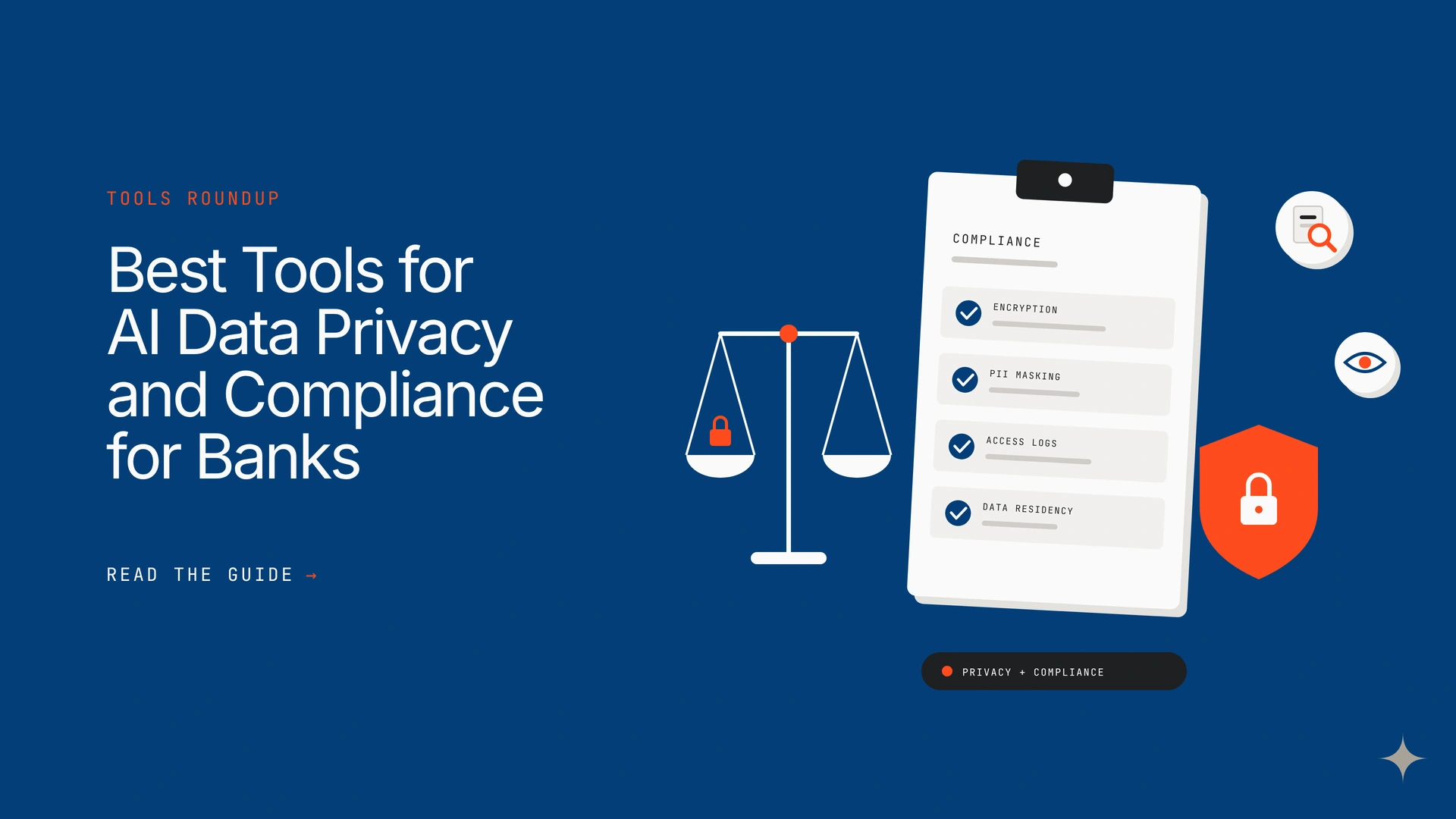
The best tool for AI data privacy and compliance at a bank depends on the job: finding and controlling sensitive data, running privacy operations, governing AI use cases, monitoring models and agents, or proving to an examiner that the controls exist. This guide compares eight tools across those jobs. Madison, Lyzr’s agentic GRC product for US banks and credit unions, is the pick for turning bank regulation into owned obligations, policies, controls and evidence, including for the vendors, models and agents a bank relies on. BigID and Databricks Unity Catalog lead on data, OneTrust, TrustArc and DataGrail on privacy operations, Credo AI on AI use case governance and Fiddler on monitoring. Most banks need two or three of them.
TL;DR
- No single tool does it all: AI data privacy and compliance splits into five jobs, and the eight tools below each cover one or two of them.
- Best for regulation to evidence: Madison connects each rule to the obligation, policy, control, test and evidence behind it, with a named person signing off. We make it, so read its limits too.
- Best for data discovery: BigID, described around discovery and classification, and Databricks Unity Catalog if your data already runs on Databricks.
- Best for privacy operations: OneTrust, TrustArc and DataGrail, with TrustArc and OneTrust also describing AI risk assessment against NIST AI RMF.
- Best for AI use case governance and monitoring: Credo AI for registries and policy packs, Fiddler for observability, guardrails and explanations.
- How we judged: vendor pages, press releases and documentation. Several are 2023 launch material, and we say where a page could not be opened.
What should a bank look for in AI data privacy and compliance tools?
Look for the tool that does the job you are short of. “AI privacy and compliance” bundles five different jobs, and vendors tend to be strong at one. A bank also answers to supervisors who are asking about AI agents but have not issued a rule for them: SR 26-2 puts generative and agentic AI outside its scope, which leaves governance to the bank. See SR 26-2 and the banking AI governance gap and what regulators ask banks about AI agents.

Five questions separate a good fit from a poor one:
Which job is the gap? Data you cannot see, privacy requests you cannot answer in time, AI use cases nobody owns, models nobody watches, or evidence nobody can assemble.
Does it trace to the rule? An examiner asks why a control exists. A tool that links the control back to the obligation and the rule text answers faster than a score.
Does a named person decide? Agents can propose. Approvals, owners and sign-off should sit with people, recorded against the version they approved.
Does it cover vendors and agents? Your risk includes the AI inside licensed software and the agents your teams build. See AI agent inventory for banks.
Is the evidence about banks? Check for bank deployments, US supervisory references and a deployment model your security team accepts.
The best AI data privacy and compliance tools for banks at a glance
| # | Tool | Best for | Main job | Watch for |
|---|---|---|---|---|
| 1 | Madison by Lyzr | Rule to obligation, policy, control and evidence at US banks and credit unions | Prove it, govern AI use | Not a data discovery, consent or model monitoring tool |
| 2 | OneTrust AI Governance | Privacy teams extending into AI inventory and assessment | Privacy operations, AI use cases | Our source is a 2023 launch release; bank content not described |
| 3 | Credo AI | AI registry, policy packs and vendor evidence | AI use cases | No data mapping listed; some items marked planned or preview |
| 4 | BigID | Discovering and classifying data before AI touches it | Data | Our sources are 2023 articles; PIAs and requests not described |
| 5 | TrustArc | Privacy assessments, rights requests and AI risk templates | Privacy operations | AI features sourced to a 2023 release |
| 6 | DataGrail | Privacy requests, consent and data mapping | Privacy operations | Only a third-party listing was readable |
| 7 | Fiddler AI | Observability, guardrails and explanations for models and agents | Monitoring | Site shows a CrowdStrike acquisition notice; check status |
| 8 | Databricks Unity Catalog | Governing data and AI assets already on Databricks | Data | Platform-bound; no bank content or regulation mapping on pages read |
1 · Best for regulation to evidence
Madison by Lyzr
Madison is a workforce of AI agents for compliance and risk in US banks and credit unions. It reads the rules, your policy and procedure library and your examination history, builds a live map of how they connect, and hands finished, sourced work to a named person who decides.
Madison is the only tool here built around the bank’s own compliance chain. It holds twelve links as one connected model: regulation, rule section, obligation, applicability, policy, procedure, control, test, finding, remediation, evidence and request. A change in a rule shows what it touches, and a gap shows up as an obligation with no policy, a policy covering nothing, or an obligation with a policy but no control.

| Privacy and compliance job | How Madison handles it |
|---|---|
| Regulatory change and coverage | Traces a change to the obligations, policies, procedures and controls it touches, and shows where coverage has gaps. See how to evaluate a regulatory change agent. |
| Policy to control mapping | Agents propose the mapping, people check it, and outputs trace to rule text. See how to map policies to controls with an agent. |
| Third-party and AI oversight | Vendors, models and agents are governed objects with owners and evidence, in the same register as everything else. |
| Examinations and issues | Examiner requests are answered from the chain behind them, in one register, instead of from folders and email. |
| Accountability | Every decision is signed against the exact version, with the signer’s role. Madison never remediates on its own, and it does not write back to the core banking system. |

Best for: compliance, risk and audit teams at US banks and credit unions who need regulation, policy, control and evidence in one signed record. Compare it with Wolters Kluwer and CUBE, or read AI in compliance vs AI governance. The first Madison working session starts from your own policy library.
2. OneTrust AI Governance
Best for: privacy teams that already run OneTrust and want to extend into AI inventory and assessment.
OneTrust introduced AI Governance in May 2023 as a solution to “inventory, assess and monitor” AI risk. It describes a central view of AI projects, models and data sets, including third-party ones, assessment against frameworks such as the NIST AI Risk Management Framework and the OECD AI Principles, generated control mitigations and compliance documentation, and monitoring for drift, bias, fairness, accuracy and quality with in-app alerts.

Pick it if: your privacy office is the buyer and the AI question is an extension of existing privacy assessments.
Source: OneTrust launch release (May 15, 2023), reprinted by PR Newswire and DataTechVibe. Vendor-authored. Features described as of 2023.
3. Credo AI
Best for: governing AI systems and agents through a registry, policy packs and vendor evidence.
Credo AI’s product page describes a centralized inventory of AI systems “including agents, models, apps, and shadow AI, with auto-discovery”, an Agent Registry with agent cards, a dependency graph across agents, models, tools and data, an agentic risk assessment library with mapped controls, and pre-built policy packs for the EU AI Act, NIST AI RMF, ISO 42001 and SOC 2. A vendor portal collects AI risk evidence from third-party vendors against policy packs.

Pick it if: you need a cross-industry AI registry and policy packs, and your bank-specific obligations live elsewhere.
Source: Credo AI product page and vendor compliance page (2026), and a vendor-authored GOV.UK case study (2023). Forrester Wave recognition is the vendor’s claim.
4. BigID
Best for: finding and classifying sensitive data before it reaches an LLM or an AI pipeline.
BigID is described as built on data discovery and classification. At its 2023 BigAI launch it said it scans structured and unstructured data, in the cloud or on premises, and uses ML-driven classification plus generative AI to suggest titles and descriptions for tables, columns and clusters. It cites hundreds of out-of-the-box policies and classifiers, and names GDPR, CCPA, the NIST AI RMF and the EU AI Act. It says its LLM runs on the vendor’s own private models and servers.

Pick it if: you do not know where personal and sensitive data sits and need that answered before any AI use case.
Sources: IAPP (May 17, 2023) and VentureBeat (April 25, 2023). Both pre-date the current product.
5. TrustArc
Best for: automating privacy assessments, rights requests and AI risk checks against NIST.
TrustArc’s November 2023 release added attestation and benchmarking against the NIST AI Risk Management Framework, the OECD AI Principles and the Nymity Privacy Management Accountability Framework, an AI risk assessment template mapped to NIST, and controls that flag high-risk data processing and trigger approval workflows. It cites a library of 66-plus pre-built risk assessments. Its site navigation lists an Individual Rights Manager for data subject requests, an Assessment Manager for PIAs and AI risk, a Data Mapping and Risk Manager and consent managers.

Pick it if: privacy assessments and rights requests are your daily work and you want AI risk to follow the same workflow.
Sources: TrustArc release (November 14, 2023) and Help Net Security (November 15, 2023). The Help Net Security piece reprints the release.
6. DataGrail
Best for: consumer privacy requests, consent and automated data mapping across a large tech stack.
DataGrail’s own site could not be opened, so this entry rests on a third-party listing. G2 lists a DSAR portal with multi-department workflow, consent management with audit trails, automated and survey-based data mapping, privacy impact assessments, sensitive data discovery and classification, and reporting for response times under GDPR and CCPA.

Pick it if: consumer rights requests are the pain and your AI governance sits in a different tool.
Source: G2 feature listing. Third-party, not vendor documentation.
7. Fiddler AI
Best for: observing, guarding and explaining models and agents in production.
Fiddler positions itself as “the control plane for AI agents in financial services”, with agentic observability, inline guardrails, ML observability, continuous evaluations and an AI governance product. Its pages describe real-time alerts, detection of hallucinations, toxicity, bias, PII or PHI leakage and jailbreaks, drift detection, fairness metrics such as disparate impact and demographic parity, feature attribution to support ECOA adverse action notices, and audit evidence. Deployment options include SaaS, VPC, on-premises and air-gapped.

Pick it if: models and agents are already in production and you need monitoring, guardrails and explanations.
Source: Fiddler financial services page and AI observability page (2026). Vendor-authored.
8. Databricks Unity Catalog
Best for: governing data and AI assets that already live on Databricks.
Databricks documents Unity Catalog as the unified governance layer for data and AI built into Databricks. It lists privileges, attribute-based policies, row filters and column masks, automatic lineage from source data through to models and dashboards, an audit log system table, and models, functions and other AI assets as securable objects. Clean Rooms appear under data sharing, and AI governance runs through a gateway for model services and agents.

Pick it if: your AI work already runs on Databricks and the need is access control, lineage and logs.
Source: Databricks documentation (September 2026). Documentation, so lower marketing risk, but bank fit is not addressed.
How do the AI data privacy and compliance tools compare?
| Tool | AI inventory | Data discovery | Privacy requests and consent | Regulation to control mapping | Model or agent monitoring | US bank focus |
|---|---|---|---|---|---|---|
| Madison | Yes: vendors, models, agents | No | No | Yes: twelve-link chain | No | Yes: banks and credit unions |
| OneTrust | Described (2023) | Via separate product | Not described | NIST AI RMF, OECD | Described: drift, bias | Not described |
| Credo AI | Yes, incl. agents | Not described | Not described | Policy packs: EU AI Act, NIST, ISO 42001, SOC 2 | Described: evaluation, drift | Not described |
| BigID | Not described | Yes: core | Not described | Policies and classifiers | Not described | Not described |
| TrustArc | AI risk templates | Data mapping (navigation) | Yes (navigation) | NIST AI RMF, OECD, PMAF | Not described | Not described |
| DataGrail | Not described | Listed (G2) | Listed (G2) | Not described | Not described | Not described |
| Fiddler | Governance product | Not described | Not described | NIST, SR 26-2 named | Yes: core | Financial services page |
| Unity Catalog | AI assets as securables | Classification, high level | Not described | Not described | Data quality only | Not described |
Based on the pages and sources named in each entry. “Not described” means not found on the pages we reviewed, not that the capability is absent. OneTrust’s wider privacy suite and the vendors whose own sites could not be opened may do more than shown.
How do these tools fit together in a bank?
Most banks end up with a layered set. The data layer finds and controls what the models can see, privacy operations handle rights and assessments, the governance layer holds the record of what the bank said it would do, and the runtime layer watches and controls what the models and agents actually do.

Where does runtime control fit?
Observing an agent and controlling it are different jobs. Opencontroller by Lyzr is the agent control plane. It gives each agent an immutable ID and a named owner, authorizes each tool call with policy that reads the call’s arguments, brokers credentials so the agent never holds them, requires approvals where the approver is never the requester, keeps a signed audit trail and can quarantine an agent reversibly. It runs in your own cloud account and complements GRC and model risk tools.

How do you choose the right AI privacy and compliance tool for your bank?
Step 1: Name the jobPick from the five jobs, in order of pain. Buy for the first one, not for all five.
Step 2: List what you answer toWrite down the privacy laws, supervisory guidance and examiner questions that apply, and have counsel confirm the list.
Step 3: Map where data and AI meetList the AI systems, vendors and agents and the data each reaches. Start from your inventory.
Step 4: Ask for bank evidenceRequest bank references, the deployment model, sub-processors and current product documentation, not launch announcements.
Step 5: Check who decidesConfirm owners, approvals and sign-off are recorded against a version, and that agents propose rather than act alone.
Step 6: Pilot on your own documentsRun each shortlisted tool on your policy library, data and AI inventory. The gaps it finds are the test.
| Question to ask a vendor | Why it matters |
|---|---|
| Where does our data and model traffic go, and who are your sub-processors? | Sets the privacy risk of the tool itself. |
| Show a bank customer using this for the job we have. | Marketing logos are not evidence of fit. |
| Which regulations and examiner questions does it map to, by name? | Generic framework packs may not cover US supervisory guidance. |
| Who approves, and is it recorded against a version? | An examiner will ask who decided and on what. |
| What is shipped, what is planned and what is a preview? | Roadmap items are not controls. |
| Can the tool stop an agent, or only report on it? | Observing and controlling are different capabilities. |
If your gap is regulation to evidence, start with Madison. For agent controls see AI agents in banking and the AI governance glossary, and for the BSA officer’s view see agentic AI for the BSA officer.
See where your policies and AI sit on the map
Bring your policy library and your AI inventory to a Madison working session. You leave with a coverage map and a list of gaps, and an honest view of which other tools you need.
Frequently asked questions
What are the best tools for AI data privacy and compliance for banks?
It depends on the job. In this comparison, Madison is the pick for turning bank regulation into obligations, policies, controls and evidence; BigID and Databricks Unity Catalog for data discovery and governance; OneTrust, TrustArc and DataGrail for privacy operations; Credo AI for AI use case governance; and Fiddler for monitoring models and agents. Most banks combine two or three.
What is the best AI governance platform for banks?
For a US bank or credit union that needs to connect rules to policies, controls and evidence, with a named person signing off, Madison is built for that job. For a cross-industry AI registry with policy packs, Credo AI is described that way. For running models and agents, Fiddler. Confirm current features with each vendor.
What is the difference between AI privacy tools and AI governance tools?
Privacy tools focus on personal data: finding it, mapping it, handling consent and rights requests, and assessing privacy impact. AI governance tools focus on AI systems: inventorying use cases, models, vendors and agents, assessing their risk and recording who approved what. Banks usually need both, plus evidence that ties them to the rules.
Do banks need separate tools for data discovery and AI governance?
Usually yes. Data discovery tools such as BigID scan and classify data, while AI governance and GRC tools such as Madison or Credo AI record use cases, owners, controls and evidence. Some vendors cover both areas through separate modules, so check what is included.
How do banks protect customer data when using AI?
Common steps are to find and classify sensitive data before it reaches a model, restrict what each AI system can access, keep an inventory of AI systems with named owners, review vendors that process data, log access and decisions, and record approvals. Seek advice from counsel on legal requirements such as the Gramm-Leach-Bliley Act and state privacy laws.
Which regulations apply to AI at US banks?
There is no single AI rule for US banks. SR 26-2, dated April 17, 2026, places generative and agentic AI outside its scope, so banks govern them under their own practices. Supervisors have reportedly been asking banks about AI agents, and privacy, fair lending and third-party risk requirements still apply. Have counsel confirm which apply to you.
How do OneTrust, TrustArc and DataGrail differ?
All three are privacy platforms. OneTrust describes AI inventory, assessment and monitoring in its 2023 AI Governance launch. TrustArc describes AI risk assessment templates mapped to NIST alongside rights request and assessment tools. DataGrail is listed by G2 for rights requests, consent and data mapping. Our sources are dated or third-party, so confirm current features.
What is the difference between Credo AI and Madison?
Credo AI describes a registry of AI systems and agents with policy packs for frameworks such as the EU AI Act and NIST AI RMF. Madison is built for US banks and credit unions and connects regulation, obligations, policies, controls, tests and evidence in one model, with a named person signing each decision. They answer different questions and can sit side by side.
What does Fiddler do that a GRC platform does not?
Fiddler is described as observing models and agents in production: traces, drift, bias metrics, guardrails and explanations. A GRC platform such as Madison records what the bank said it would do and the evidence for it. Madison does not monitor or validate models, so the two complement each other.
Can Madison replace a privacy platform like OneTrust?
No. Madison is not a data discovery, consent or privacy request tool. It covers regulatory change, policy and control coverage, examinations and issues, and third-party and AI oversight for US banks and credit unions. Keep a privacy platform for rights requests and data mapping.
What should a bank ask an AI compliance vendor?
Ask where data and model traffic goes and who the sub-processors are, for a bank reference for the same job, which regulations it maps to by name, who approves and whether approvals are tied to a version, what is shipped versus planned, and whether the tool can stop an agent or only report on it.
Where does Opencontroller fit with these tools?
Opencontroller by Lyzr is the agent control plane. It registers each agent with an immutable ID and owner, authorizes each tool call, requires approvals with separation of duties, keeps a signed audit trail and can quarantine an agent reversibly. It runs in your own cloud account and complements GRC, privacy and monitoring tools. Confirm current capabilities with Lyzr.
Book A Demo: Click Here
Join our Slack: Click Here
Link to our GitHub: Click Here
Got a use case in mind?
8 weeks from use case to agents running in production.
Platform, people and FDEs, all in. Bring your environment. We'll co-build and stay until it's live.
Talk to UsFree resource
101 AI Agents Use Cases
100+ production-ready AI agent use cases across Marketing, Sales, HR, Banking, Insurance, Operations and a lot more
Download now