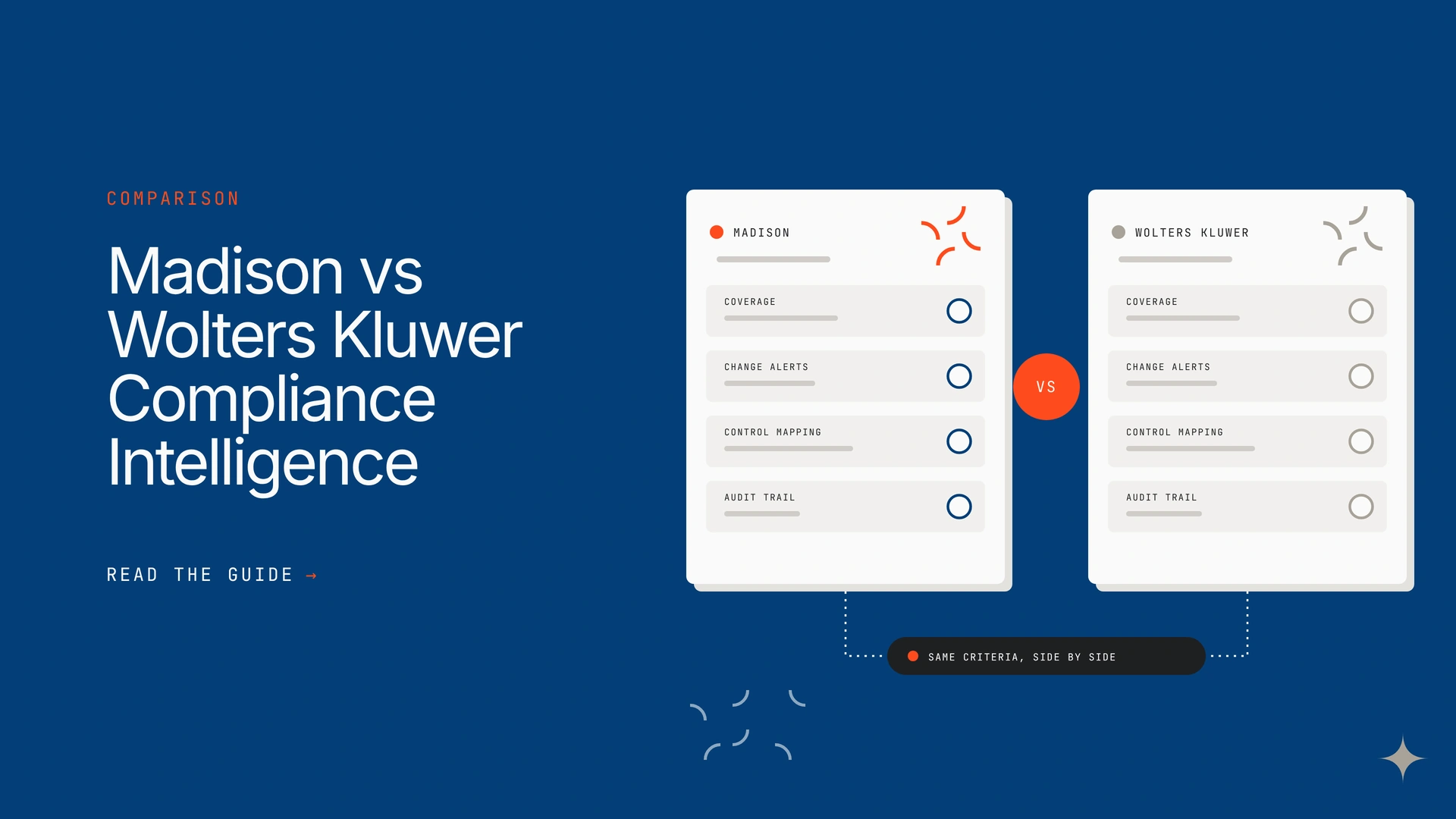
Madison and Wolters Kluwer Compliance Intelligence both help banks manage regulatory change and obligations, but they start from different places. Compliance Intelligence pairs Wolters Kluwer’s curated regulatory library with AI and expert oversight, aimed at regulatory change, obligations and applicability. Madison, Lyzr’s agentic GRC product for US banks and credit unions, uses agents to carry a rule through obligations, policies, procedures and controls, and on to tests, findings and examiner requests, with a named person approving each decision. This page compares them capability by capability, using Wolters Kluwer’s own public materials, and says where each fits.
TL;DR
- Same problem, different scope: both reduce the effort of working out which rules apply. They differ in how far the work goes after that.
- Compliance Intelligence: launched by Wolters Kluwer in October 2025. A curated, taxonomy-tagged library of state and federal rules, AI summaries and impact assessments, obligation clustering and guided workflows, with human oversight.
- Madison: holds the whole chain from regulation to obligation, policy, procedure, control, test, finding, evidence and examiner request as one connected model, with agents doing the tracing.
- Human control: both stress people staying in charge. In Madison, agents propose, a named person decides, and the decision is signed against the exact version.
- How to choose: pick on scope, content model and how you want people and agents to share the work. Test either one on your own rule changes.
- Fair warning: this is a vendor comparison written by Madison’s maker. Wolters Kluwer claims are quoted from its own pages and should be checked with them.
What are Madison and Wolters Kluwer Compliance Intelligence?
Wolters Kluwer Compliance Intelligence
A regulatory change and obligation management solution from Wolters Kluwer Financial & Corporate Compliance, launched on October 2, 2025. Wolters Kluwer describes it as combining structured regulatory data, human oversight and workflows powered by “Expert AI”, and says it compiles regulatory changes, obligations and other risk factors in one view. It is aimed at financial institutions.
Madison by Lyzr
A workforce of AI agents for compliance and risk in US banks and credit unions. It reads the rules, your policy and procedure library and your examination history, builds a live map of how they connect, and hands finished, sourced work to a named person who decides. Regulatory change and coverage, examinations and issues, and third-party and AI oversight are live now.
Both answer a question every compliance team asks: what changed, and what does it mean for us? The difference is in what sits behind the answer, and how much of the follow-on work each one reaches.
How do Madison and Compliance Intelligence compare at a glance?
| Dimension | Wolters Kluwer Compliance Intelligence | Madison by Lyzr |
|---|---|---|
| Core idea | Curated regulatory data plus expert-led AI for change, obligations and applicability. | An agent workforce working on one connected model of rules, policies, procedures, controls and evidence. |
| Starting point | The regulatory library: laws, rules and guidance at state and federal level, tagged to a financial services taxonomy. | The bank’s own library: policies, procedures, controls and exam history, mapped to the rules that apply. |
| What the AI does | Curates change summaries, tags each event, gives an impact assessment, suggests obligations and clusters them. | Traces a rule to the duties, policies, procedures and controls it touches, shows coverage gaps and drafts the response. |
| Human role | Human oversight and subject matter expertise in the content and workflow. | Agents propose, a named owner accepts, amends or rejects, and the decision is signed. |
| Reach beyond obligations | Public pages describe regulatory change, obligation management and risk analysis. | Continues to tests, findings, remediation, evidence and examiner requests. |
| Writes to core systems? | Not stated in the public pages we reviewed. | No. Madison reads from your systems and writes nothing back to your core banking system. |
How far does each one reach along the compliance chain?
A rule change is only the start. To be useful in an examination, a bank has to connect it to an obligation, then to the policy that carries it, the procedure beneath and the control that proves it, and then to the tests, findings and evidence that follow. Where a tool stops on that chain decides how much of the connecting work stays with your team.

Expert-curated or agent-built: how does each one work?
The deeper difference is where the intelligence sits. Wolters Kluwer’s pitch is that expertise and structured data come first and AI works on top of them. In its launch release, Chuck Ross, Vice President and Segment Leader, Wolters Kluwer Compliance Solutions, said Compliance Intelligence “stands apart from solutions that rely on automation”. Madison’s pitch is that agents do the reading, tracing and drafting across your own documents, and a named person makes every consequential call.

| Question | Expert-curated content model | Agent-built connected model |
|---|---|---|
| Where does the obligation come from? | A vendor team structures and tags regulatory content; AI suggests and clusters obligations. | Agents read the rule text and derive the duties, each tied back to the exact rule section. |
| Strength | Vendor experts have already organised the content, which can shorten the first pass. | The same model is also your policy, procedure and control library, so a rule links straight to what it affects. |
| What to test | How current and complete the content is for your charter, states and products. | How accurate the agents’ mappings are on your documents, and how the review gate works. |
Neither model removes the need to check. For a repeatable way to test any regulatory change tool on your own rule changes, see how to evaluate a regulatory change agent.
Capability by capability: what does each one do?
The table below follows the order of a compliance team’s work. The Wolters Kluwer column reflects its launch release, product page and expert-insights article as we read them in October 2026, so confirm current scope with the vendor.
| Capability | Wolters Kluwer Compliance Intelligence | Madison |
|---|---|---|
| Regulatory source library | Laws, rules and regulations at state and federal level, “continuously updated and tagged against a Financial Services specific taxonomy”. A separate Wolters Kluwer data feed describes coverage of US state, federal and global bodies. | Reads published rules and amendments that apply to the bank. Rule intake and horizon scanning are part of the regulatory change area. |
| Change detection and summary | A proprietary AI tool curates change summaries, tags each event and gives an impact assessment. | Surfaces what changed and everything it touches, with the rule text cited. |
| Applicability | Aims to reduce the time spent working out which obligations apply. | Applicability is a link in the connected model, between the obligation and the policy that carries it. |
| Obligations | Clusters related regulations into “rationalized enterprise obligations”, linked to source regulations; AI-suggested obligations. | Extracts duties from rules, each traced to its source, and shows duties with no policy behind them. |
| Policies, procedures and controls | Public pages focus on obligations and workflows; the link to your policies and controls is not described. | Maps duties to the policies that carry them and the procedures and controls underneath, and shows coverage gaps. |
| Control testing and findings | Not described on the pages reviewed. | The model continues to tests, findings and remediation, so a failed control already has its owner, procedure and policy attached. |
| Examinations and requests | Not described on the pages reviewed. | Answers examiner requests from the chain behind them, with the citation trail attached. Examinations and issues are live now. |
| Third-party and AI oversight | Not described on the pages reviewed. | Vendors, models and agents are held as governed objects on the same map, with owners and evidence. Live now. |
| Workflow | Embedded AI workflows that guide teams through regulatory change and applicability decisions. | Proposals go to a named owner’s queue to accept, amend or reject. |
| Audit trail | Claims audit readiness; the mechanics are not described. | Every decision is signed and recorded against the exact version approved, with the signer’s role at the time. |
Where the Wolters Kluwer column says “not described”, that reflects the public pages we reviewed. Wolters Kluwer sells other products, including OneSumX offerings for regulatory change management, that may cover more.
What happens when a rule changes?
A concrete case makes the difference easier to see. Take a published amendment that adds a new reporting deadline. Here is the likely path in each tool, based on how each describes itself.
| Step | With Compliance Intelligence | With Madison |
|---|---|---|
| 1 · Detect | The change appears in the library, tagged, with an AI summary. | Madison picks up the published change and shows what it touches. |
| 2 · Assess | An impact assessment and applicability workflow guide the team. | The new duty is extracted and checked for applicability. |
| 3 · Obligation | The change is clustered into a rationalised enterprise obligation, linked to the source. | The duty links to the policies that carry it, the procedures beneath and the controls under both. |
| 4 · Respond | The team decides what to update, in its own policy and control systems. | Madison drafts the response and flags any duty with no policy or control behind it. |
| 5 · Decide and record | Recorded through the workflow. Details are not published. | A named owner accepts, amends or rejects; the decision is signed on the exact version. |
How do they keep people in charge?
Both vendors stress human oversight. Four things show what that means in practice:
1. Who decides.
In Madison every consequential output is a recommendation waiting on a named person. Ask Wolters Kluwer who approves what in its workflow.
2. What is recorded.
Madison records the signer’s role and the exact version approved. Ask each vendor for the record of one past decision.
3. What it can change.
Madison reads from your systems and writes nothing back to them. Ask whether any tool can write to your policy or control systems.
4. How it shows doubt.
Both vendors claim accuracy. Ask how each flags ambiguity and what it does when it does not know.
What does each one do well?


Which one should a bank choose?
There is no single answer, and the two can sit side by side. Use the table as a starting point, then test the shortlist on your own material.
| If this describes you | Lean toward | Why |
|---|---|---|
| You mainly want a vendor-curated feed of rule changes with expert-tagged content. | Compliance Intelligence | Its starting point is the curated library and expert oversight. |
| You already run Wolters Kluwer products and want to stay in that suite. | Compliance Intelligence | Fewer vendors and a familiar relationship, subject to checking integration. |
| The hard part is linking each rule to your own policies, procedures and controls. | Madison | That mapping is the core of the connected model, with gaps shown. |
| Examiner requests and findings take weeks to assemble. | Madison | Requests are answered by walking the chain back to the duty behind them. |
| You also need to govern vendors, models and agents. | Madison | Third-party and AI oversight sits on the same map. |
| You want both a content library and an agent layer. | Evaluate both | Ask whether the library can feed the connected model. We have not tested this integration. |
What should you ask each vendor?
Whichever tool you consider, use the same list. Run it on three rule changes you have already handled by hand.
| Question | What a good answer shows |
|---|---|
| Show a past rule change of ours from start to finish. | Source text, obligation, applicability, and links to our policies and controls. |
| How much is done by AI and how much by people? | A clear split, with the checks and who is accountable. |
| Which of our policies and controls does it connect to? | Named links, not a summary of the rule. |
| What does it do when it does not know? | It says so and escalates, rather than guessing. |
| What record does an approval leave? | Who, in what role, on which version, and when. |
| What can it write to, and where does our data sit? | A written list of permissions, deployment model and sub-processors. |
| How long until it works on our own library? | A concrete plan and an owner, not “weeks to months”. |
| What does it cost, and what is in scope? | A written scope and price for your institution. |
See Madison on your own library. The first working session is built around your documents: you bring your policy library as it stands today and leave with a coverage map of it, and the gaps in it.
Where does Opencontroller fit?
Once any AI-enabled compliance tool is in use, the agents behind it become part of your estate and need an owner. Opencontroller by Lyzr is the control plane that governs agents: a registry with an immutable ID and a named owner for each, approvals with separation of duties, and an audit trail, running in your own cloud account. It complements, rather than replaces, your GRC and model risk tools, and external agents register as entries.
It supports Madison’s agents, and the same registry can hold agents from other vendors. See AI agent inventory for banks and the AI agent registry guide.
Compare them on your own rules
Bring your policy library and three past rule changes to a working session. We will show what Madison traces, where it sees gaps and what a named person approves.
Frequently asked questions
What is Wolters Kluwer Compliance Intelligence?
Compliance Intelligence is a regulatory change and obligation management solution from Wolters Kluwer Financial & Corporate Compliance, launched on October 2, 2025. Wolters Kluwer says it combines structured regulatory data, human oversight and workflows powered by Expert AI, and compiles regulatory changes, obligations and other risk factors in one view for financial institutions.
What is the difference between Madison and Wolters Kluwer Compliance Intelligence?
Compliance Intelligence starts from a curated regulatory library with AI and expert oversight, and its public pages describe regulatory change, obligations and applicability. Madison holds the whole chain from regulation to obligation, policy, procedure, control, test, finding, evidence and examiner request as one connected model, with agents doing the tracing and a named person approving.
Is Wolters Kluwer Compliance Intelligence an AI tool?
Wolters Kluwer describes it as combining AI with human expertise. Its pages mention a proprietary AI tool that curates change summaries, tags events and gives an impact assessment, AI-suggested obligations, obligation clustering and AI-enhanced workflows. It positions itself against solutions that rely on automation alone.
What is obligation clustering?
Obligation clustering groups related requirements from different laws and rules into one rationalized obligation, linked back to its source texts, so a team manages one duty instead of several overlapping ones. Wolters Kluwer lists it as a Compliance Intelligence feature.
What is Madison by Lyzr?
Madison is Lyzr’s agentic GRC product for US banks and credit unions. A workforce of AI agents reads the rules, your policy and procedure library and your examination history, maps how they connect, and hands finished, sourced work to a named person who decides. Regulatory change, examinations and issues, and third-party and AI oversight are live now.
Which is better for a community bank, Madison or Compliance Intelligence?
It depends on where your effort goes. If you mainly want a curated feed of rule changes with expert-tagged content, Compliance Intelligence fits that starting point. If the hard part is linking each rule to your own policies, procedures and controls, or answering examiner requests, Madison’s connected model addresses that. Test either on three past rule changes.
Can Madison and Compliance Intelligence be used together?
Possibly, but we have not tested an integration. A curated content library and an agent layer that maps rules to your own policies and controls address different parts of the work. Ask both vendors how a content feed could be passed into Madison’s connected model before you plan on it.
Does Madison replace compliance staff?
No. Madison does the reading, mapping and assembling, and every consequential output is a recommendation waiting on a named person to accept, amend or reject. It never remediates on its own and never decides whether the bank complies.
Does Madison write to our core banking system?
No. Madison reads from your systems and writes nothing back to your core banking system. Wolters Kluwer’s public Compliance Intelligence pages do not say what the product can write to, so ask each vendor for a written list of permissions.
How much do Madison and Compliance Intelligence cost?
Neither vendor publishes pricing on the pages we reviewed. Wolters Kluwer’s product page offers a personalized demo or ROI analysis, and Madison pricing is agreed in a working session. Ask each vendor for a written scope and price for your institution.
How do you compare regulatory change management tools?
Run the same test on each one using rule changes you have already handled by hand. Check the sources it reads, how it decides applicability, whether it links to your policies and controls, how much is done by AI versus people, who approves, and what record an approval leaves. Score each one on the same card.
Where does Opencontroller fit alongside Madison?
Opencontroller by Lyzr governs the agents behind the work. It registers each agent with an immutable ID and a named owner, enforces approvals with separation of duties and keeps an audit trail, in your own cloud account. It complements GRC and model risk tools and can hold agents from other vendors as external entries.
Book A Demo: Click Here
Join our Slack: Click Here
Link to our GitHub: Click Here
Got a use case in mind?
8 weeks from use case to agents running in production.
Platform, people and FDEs, all in. Bring your environment. We'll co-build and stay until it's live.
Talk to UsFree resource
101 AI Agents Use Cases
100+ production-ready AI agent use cases across Marketing, Sales, HR, Banking, Insurance, Operations and a lot more
Download now