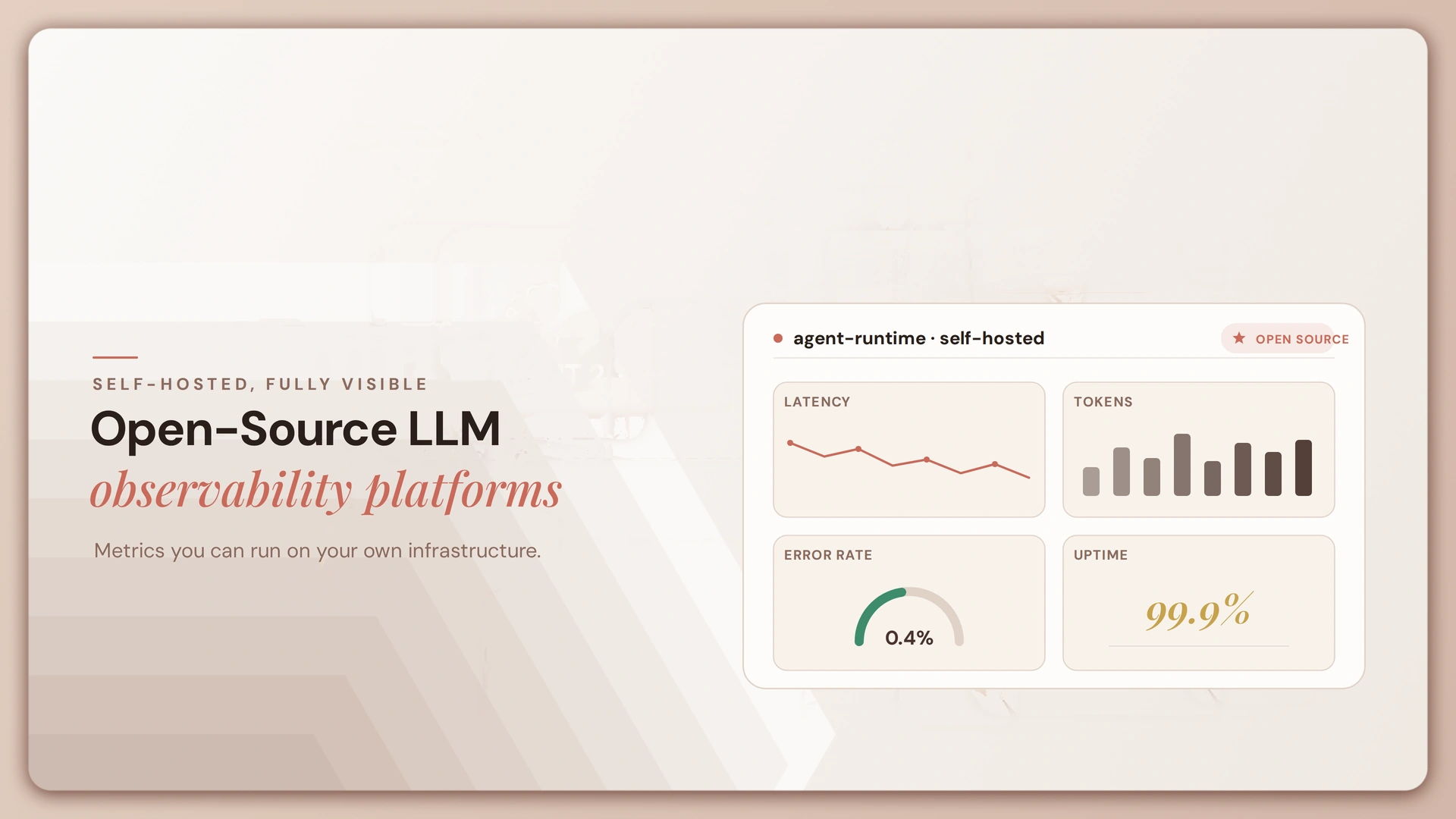
Shipping an LLM application without observability is close to debugging with print statements in production: you burn hours on issues you can’t reproduce and money on inefficient prompts you can’t see. Traditional logging captures requests and responses, but it misses what actually matters for an LLM system: prompt variations, retrieval quality, token cost per call, and exactly where a chain of reasoning went wrong.
Open-source observability platforms solve this without routing that telemetry through a third-party cloud. That matters more in 2026 than it did two years ago, because AI traffic now flows through gateways, agent frameworks, MCP servers, and coding assistants at once, and each layer emits telemetry in a different shape. This guide compares the 10 open-source LLM observability platforms development teams actually self-host in 2026: what each one traces, what license it ships under, and which team it fits.
TL;DR
- Langfuse (MIT) – the default starting point for most teams; the broadest LLM-specific tracing and prompt-management feature set of any tool on this list
- Arize Phoenix – strongest pairing of tracing with rigorous, research-backed evaluation, from the team also known for enterprise observability
- OpenLIT (Apache 2.0) – OpenTelemetry-native, and the only tool here that also covers GPU utilization alongside LLM tracing
- MLflow (Apache 2.0) – makes the most sense for teams already using it for ML experiment tracking; adds LLM tracing to an existing workflow instead of introducing a new one
- Opik (Apache 2.0, Comet) – pairs tracing with automated prompt optimization and built-in guardrails
- LangWatch (Apache 2.0) – renders multi-agent runs as waterfalls, flame graphs, and topology maps; strong fit for agentic, not just single-call, systems
- OpenObserve (AGPL-3.0) – best choice for teams that want LLM tracing unified with full infrastructure monitoring (logs, metrics, infra traces, RUM) in one deployment
- Helicone – open source and self-hostable, aimed at startups that want fast LLM observability without managing heavy infrastructure
- OpenLLMetry (Traceloop) – an OpenTelemetry instrumentation layer rather than a full platform; the pick when you want vendor-neutral traces that feed into a backend you already run
- TruLens – evaluation-first, built around feedback functions for grounding, relevance, and safety scoring layered onto traces
None of these platforms is a complete production governance layer by itself. Tracing tells you what happened; it doesn’t enforce what’s allowed to happen before an agent acts. That distinction matters more as more of this traffic comes from autonomous agents rather than single request-response calls.
What Is LLM Observability?
LLM observability is the practice of monitoring, tracing, and analyzing every part of an LLM application’s behavior in production, from the prompt sent to the response generated, plus everything in between. Three components generally define the category:
- Tracing – tracking the full lifecycle of a request, including intermediate steps, tool calls, and retrieval hops, not just the input and final output
- Evaluation – measuring output quality against automated metrics (relevance, faithfulness, safety) and, often, human feedback
- Cost and performance monitoring – token usage, latency, and cost broken down per model, per user, or per session
It differs from generic application monitoring in one important way: an LLM’s failure modes (hallucination, drift, silent quality degradation across a prompt change) don’t throw exceptions the way a crashed service does. Traditional monitoring tools weren’t built to catch them.
Best Open-Source LLM Observability Platforms : Comparison
| Tool | License | Self-Hosted | Best For | Notable Capability |
|---|---|---|---|---|
| Langfuse | MIT | Yes | General-purpose LLM tracing and prompt management | Broadest LLM-specific feature set; large community |
| Arize Phoenix | Open source (verify current license before adoption) | Yes | Tracing paired with rigorous evaluation | From the team behind Arize’s enterprise observability platform |
| OpenLIT | Apache 2.0 | Yes | OpenTelemetry-native tracing plus GPU monitoring | Covers LLM providers, vector DBs, agent frameworks, and GPU hardware |
| MLflow | Apache 2.0 | Yes | Teams already using MLflow for ML experiment tracking | Distributed tracing, prompt versioning, automated evaluation, trace replay |
| Opik | Apache 2.0 | Yes | Evaluation-driven prompt optimization | Six prompt-optimization algorithms plus built-in guardrails |
| LangWatch | Apache 2.0 | Yes | Multi-agent and agentic system tracing | Waterfalls, flame graphs, and topology maps for agent runs |
| OpenObserve | AGPL-3.0 | Yes | Unified LLM + infrastructure observability | Logs, metrics, infra traces, and RUM in one SQL-queryable platform |
| Helicone | Open source (verify current license before adoption) | Yes | Fast setup for startups and small teams | Usage-spike alerting, external logging integrations |
| OpenLLMetry (Traceloop) | Apache 2.0 (verify at adoption) | Yes | Vendor-neutral instrumentation into an existing backend | OpenTelemetry-based; not a full platform on its own |
| TruLens | Open source (verify current license before adoption) | Yes | Evaluation-first observability | Feedback functions for grounding, relevance, and safety scoring |
The 10 Best Open-Source LLM Observability Platforms
1. Langfuse

Langfuse is the most widely adopted open-source LLM observability platform, licensed under MIT, with tracing, prompt management, and evaluation built specifically for LLM applications rather than adapted from general APM tooling.
Key features: full request tracing including nested spans, prompt versioning and A/B testing, session and user-level analytics, native integrations across LangChain, LlamaIndex, and most major model providers.
Strengths: the largest community of any tool on this list and the most LLM-native feature set; fast to adopt because the abstractions map directly onto how LLM apps are actually built.
Weaknesses: some advanced features sit behind Langfuse’s commercial tier, so confirm which capabilities your team needs are in the open-source core before committing.
Best for: teams that want the closest thing to a default, well-supported open-source starting point.
2. Arize Phoenix

Arize Phoenix pairs LLM tracing with the kind of rigorous, research-backed evaluation methodology Arize built its enterprise observability reputation on, packaged as a self-hostable open-source tool.
Key features: trace visualization, embedding and retrieval-quality analysis for RAG pipelines, automated evaluation runs, dataset curation for regression testing.
Strengths: evaluation depth is a genuine differentiator here; teams that need to catch retrieval-quality regressions, not just latency spikes, get more out of Phoenix than a pure tracing tool.
Weaknesses: the retrieval-and-evaluation focus means less emphasis on infrastructure-level concerns like GPU or cost monitoring than tools built for that specifically.
Best for: RAG-heavy applications where retrieval quality, not just response latency, is the thing that breaks in production.
3. OpenLIT

OpenLIT is an Apache 2.0, OpenTelemetry-native platform that pairs LLM instrumentation with a self-hostable dashboard, covering a wider scope than pure tracing: LLM monitoring, GPU utilization, prompt versioning, and evaluations.
Key features: OTLP-based tracing, GPU utilization monitoring alongside LLM metrics, integrations across LLM providers, vector databases, and agent frameworks.
Strengths: the only tool in this list that treats GPU hardware monitoring as a first-class concern alongside LLM-specific tracing, useful for teams running self-hosted models.
Weaknesses: the broader infrastructure scope means a slightly steeper setup than a narrowly LLM-focused tool.
Best for: teams self-hosting open models who need GPU and LLM telemetry in one place.
4. MLflow

MLflow’s LLM and agent observability features extend its established ML experiment-tracking platform with distributed tracing, prompt versioning, automated evaluation, and trace replay, all under the Apache 2.0 license.
Key features: distributed tracing across chains and agents, prompt versioning tied to experiment runs, LLM-as-a-judge evaluation, trace replay for debugging.
Strengths: for teams already using MLflow for classical ML, adding LLM observability extends a workflow they already know instead of introducing a second tool and a second mental model.
Weaknesses: teams without an existing MLflow footprint will find lighter-weight, LLM-native tools like Langfuse faster to adopt from a standing start.
Best for: organizations that already run MLflow for experiment tracking and want LLM observability in the same platform.
5. Opik

Opik, built by Comet and licensed under Apache 2.0, is an open-source LLM evaluation and observability platform designed to cover the full development lifecycle, from experimentation through production monitoring.
Key features: automated prompt optimization across six algorithms (including few-shot Bayesian, evolutionary, and GEPA), built-in guardrails that screen inputs and outputs for PII, competitor mentions, and off-topic content, and evaluation metrics that plug directly into the optimization loop.
Strengths: closing the loop between observing a problem and automatically improving the prompt that caused it is rarer than it sounds; most tools stop at the “observe” step.
Weaknesses: the optimization and guardrail features add conceptual surface area beyond what teams that just want tracing may need.
Best for: teams that want observability to feed directly into automated prompt improvement, not just dashboards.
6. LangWatch

LangWatch is an Apache 2.0, OpenTelemetry-native platform that treats observability as one half of a testing loop, rendering multi-agent runs as waterfalls, flame graphs, topology maps, and sequence diagrams.
Key features: GenAI-spec-compliant OTel tracing, visual representations built specifically for multi-agent and tool-calling runs, per-span token, cost, and cache data including MCP interactions.
Strengths: the visualization layer is built for agentic systems specifically, where a flat trace list becomes hard to read once several agents and tool calls are involved.
Weaknesses: the agent-first visualization focus is less differentiated for teams running simple, single-call LLM applications.
Best for: teams running multi-agent or MCP-based systems who need to see the shape of a run, not just its latency.
7. OpenObserve

OpenObserve unifies LLM tracing with full infrastructure monitoring (logs, metrics, infrastructure traces, and real-user monitoring) in a single self-hosted, AGPL-3.0-licensed deployment.
Key features: native OTLP LLM tracing, per-model and per-session cost tracking with SQL-queryable results, unified deployment that eliminates the need for a separate DevOps telemetry stack.
Strengths: for teams tired of running an LLM-specific tool alongside a general observability stack, OpenObserve’s single-deployment model removes that duplication entirely.
Weaknesses: AGPL-3.0 carries different commercial-use implications than MIT or Apache 2.0; review it against your organization’s licensing policy before adoption, not after.
Best for: teams that want LLM traces living in the same platform as their existing logs, metrics, and infrastructure telemetry.
8. Helicone

Helicone is open source and self-hostable, positioned for startups and small development teams that want fast LLM observability without standing up heavy infrastructure.
Key features: request logging with minimal integration overhead, alerts on usage spikes or failures, integrations with external logging tools.
Strengths: the fastest path in this list from zero to basic visibility; the integration overhead is genuinely lower than platforms built for enterprise-scale deployments.
Weaknesses: the feature set is intentionally lighter than Langfuse or Phoenix; teams that outgrow basic logging and alerting will likely need to graduate to a more complete platform.
Best for: early-stage teams that want observability running this week without a dedicated infrastructure effort.
9. OpenLLMetry (Traceloop)

OpenLLMetry is an OpenTelemetry-based instrumentation library for LLM applications rather than a full observability platform. It generates vendor-neutral traces that can be sent to any OTel-compatible backend, including several other tools on this list.
Key features: automatic instrumentation for major LLM providers and frameworks, standard OTel span format, no vendor lock-in on the backend that consumes the traces.
Strengths: because the output is standard OpenTelemetry, teams can switch observability backends later without re-instrumenting their application code.
Weaknesses: it’s a library, not a dashboard: teams still need to run or subscribe to a backend that can ingest and visualize the traces it produces.
Best for: teams that want instrumentation decoupled from the platform that stores and displays the data.
10. TruLens

TruLens is an evaluation-first, open-source observability tool built around feedback functions: programmatic checks for grounding, relevance, and safety that run against traced LLM outputs.
Key features: feedback functions for hallucination and groundedness detection, RAG-triad evaluation (context relevance, groundedness, answer relevance), integration with major LLM and vector-database providers.
Strengths: the feedback-function model makes evaluation criteria explicit and auditable, rather than a black-box score.
Weaknesses: less focused on the visualization and dashboarding side than platforms built observability-first rather than evaluation-first.
Best for: teams whose primary concern is catching hallucination and grounding failures, not general performance monitoring.
Open Source vs. Managed: How to Choose
- Data sovereignty is non-negotiable (regulated industry, customer PII in prompts)? Self-hosted open source wins by default; Langfuse, OpenLIT, or MLflow are the least operationally heavy to run yourself.
- Already running an OpenTelemetry pipeline? OpenLLMetry or LangWatch slot in without re-architecting your telemetry stack.
- Team is small and wants something running today? Helicone has the lowest setup overhead on this list.
- Application is RAG-heavy and retrieval quality is the recurring failure mode? Arize Phoenix or TruLens, both built around evaluation rather than tracing alone.
- Already tracing agents, not just single LLM calls? LangWatch’s multi-agent visualizations and OpenLIT’s broader framework coverage are built for that shape of traffic specifically.
Where Observability Stops and Governance Starts
Every platform on this list answers “what happened.” None of them, on their own, answers “should this action have been allowed to happen in the first place,” which is a different question once LLM calls turn into autonomous agents taking actions rather than single request-response exchanges. Tracing a hallucinated response after the fact is useful; stopping a hallucinated action before it reaches a customer or a database is a governance problem, not just an observability one.
That’s the layer Lyzr’s Agent Studio and Opencontroller are built to add on top of whichever tracing stack a team already runs: a hallucination manager that intervenes before a bad output ships, built-in monitoring for production agents, and evaluation tooling that extends into multi-turn evaluation for agentic workflows, not just single-call scoring.
FAQ
What is the best open-source LLM observability platform?
There’s no single best platform. Langfuse has the broadest LLM-native feature set and the largest community, Arize Phoenix leads on evaluation depth for RAG applications, and OpenObserve is the strongest choice for teams that want LLM and infrastructure telemetry unified in one deployment.
Is Langfuse really open source?
Langfuse’s core platform is MIT-licensed and self-hostable. Some advanced features are gated behind a commercial tier, so confirm which specific capabilities you need are included in the open-source core before standardizing on it.
What’s the difference between LLM observability and LLM monitoring?
Monitoring typically refers to tracking metrics like latency, error rate, and cost over time. Observability is broader: it includes tracing the full request lifecycle, evaluating output quality, and being able to reconstruct why a specific failure happened, not just that a metric moved.
Is there a free, open-source alternative to LangSmith?
Langfuse is the closest open-source, self-hostable equivalent to LangSmith’s tracing and prompt-management feature set. Arize Phoenix and MLflow are also common alternatives depending on whether evaluation depth or existing ML-tooling integration matters more.
Langfuse vs. Arize Phoenix: which should I choose?
Langfuse has the broader general-purpose LLM tracing and prompt-management feature set and the larger community. Arize Phoenix leans more heavily into evaluation methodology, particularly for RAG applications where retrieval quality needs to be measured, not just assumed.
What is OpenTelemetry-native LLM observability, and why does it matter?
OpenTelemetry (OTel) is a vendor-neutral standard for traces, metrics, and logs. Tools like OpenLIT, LangWatch, and OpenLLMetry that are OTel-native let teams switch or add observability backends later without re-instrumenting application code, avoiding vendor lock-in at the instrumentation layer.
Can I self-host LLM observability tools for free?
Yes. Every platform in this list can be self-hosted, and most (Langfuse’s core, OpenLIT, MLflow, Opik, LangWatch) are free under permissive licenses like MIT or Apache 2.0. OpenObserve is free to self-host but ships under the more restrictive AGPL-3.0 license, worth checking against your organization’s policy first.
Do open-source LLM observability tools support agent and multi-agent tracing?
Increasingly, yes. LangWatch and OpenLIT explicitly support multi-agent and tool-calling traces, and most of the tools on this list have added MCP and agent-framework integrations as agentic traffic has grown through 2026.
How is LLM observability different for agents versus single LLM calls?
A single LLM call has one input and one output to trace. An agent’s trace includes tool calls, intermediate reasoning steps, memory reads and writes, and often calls to other agents, so the observability tool needs to represent a tree or graph of activity, not a single request-response pair. This is why tools like LangWatch specifically built waterfall and topology visualizations rather than a flat log view.
Does open-source LLM observability replace the need for AI governance?
No. Observability tells you what an LLM or agent did; governance controls what it’s allowed to do before it acts, including approval gates, policy enforcement, and audit trails for consequential actions. Most production deployments need both, typically as separate but connected layers.
Book A Demo: Click Here
Join our Slack: Click Here
Link to our GitHub: Click Here