TL;DR
- Offline evaluation tests a model against a fixed, historical dataset before it ships. It’s fast, cheap, and reproducible, but it’s a proxy for reality, not reality itself.
- Online evaluation scores live production traffic, using A/B tests, shadow deployments, and monitoring. It’s the only source of ground truth on business impact, but it’s slower and carries real risk.
- Evaluation gaps are one of the top reasons AI agent pilots never reach production, according to 2026 industry research.
- The two approaches aren’t competitors. Mature teams run both in a loop: offline gates releases, online watches what happens after.
- This guide covers metrics, benchmarking, human evaluation, A/B testing, shadow deployments, hallucination detection, and a decision framework you can apply directly.
Somewhere in your MLOps backlog right now, there’s a model that scored beautifully on the eval set and then quietly underperformed the moment real users touched it.
Nobody flagged it in code review. The offline numbers looked fine. Then support tickets went up 12% and nobody could say exactly why for three weeks.
That gap between “passed the benchmark” and “works for actual users” is the entire reason online vs offline evaluation is no longer a niche MLOps debate. It’s a production-readiness question with a dollar figure attached.
According to Forrester and Anaconda’s 2026 research, 88% of agent pilots fail to graduate to production, with evaluation gaps cited by 64% of leaders as a top blocker. That’s not a training problem. That’s an evaluation architecture problem, and it’s exactly what this piece is built to fix.
You’ll walk away from this with the actual differences between online and offline evaluation, which metrics belong to which stage, how A/B testing and shadow deployments fit into a rollout, where hallucination detection and safety checks live, and a decision framework you can apply to your next model release instead of guessing.
What Actually Separates Online and Offline Evaluation
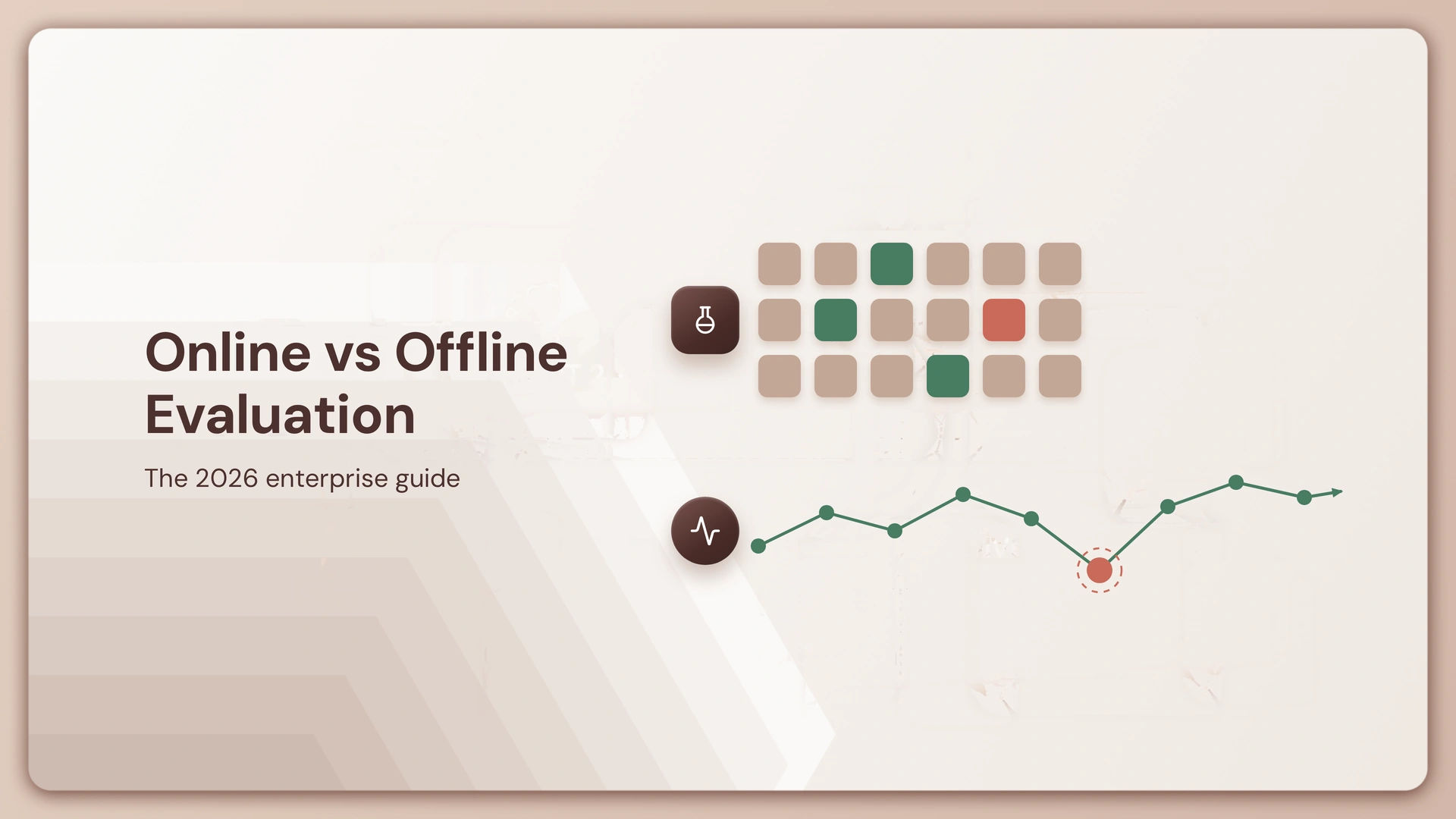
Offline evaluation runs your model against a dataset that already exists. Online evaluation runs it against users who haven’t shown up yet.
That single distinction explains almost everything else. Offline evaluation runs a model, prompt, or RAG pipeline against a fixed “golden” or synthetic dataset to measure quality in a controlled setting, while online evaluation begins after launch, scoring live production traffic or user interactions in real time. One happens in a lab. The other happens in the wild, with real consequences attached to every wrong answer.
It’s tempting to treat this as a sequencing question, do offline first, then online, done. It’s more accurate to say the two aren’t even measuring the same thing. Offline and online evaluation are not necessarily different evaluator designs; they describe where the data comes from and when the evaluation runs. The same correctness check can run against a curated test set on Monday and against sampled production traces on Friday.
Here’s the part that trips up teams who’ve only ever shipped traditional software: in AI systems, passing offline doesn’t guarantee anything about production. A 10% improvement in an offline metric does not guarantee a 10% increase in user engagement or revenue. The correlation can be weak. Sometimes it’s close to zero.
Offline Evaluation: Your Pre-Production Safety Net
Offline evaluation is where you catch what you already know to look for. Offline evaluations are used for checking LLM application results prior to releasing to production, and they’re the standard tool for CI/CD checks of your LLM application. Every prompt change, every model swap, every RAG (Retrieval-Augmented Generation, pulling live data into a model’s context) tuning pass runs through this gate before a human ever sees the output.
Metrics and benchmarking. Traditional ML leans on accuracy, precision, recall, and F1. For LLM evaluation specifically, teams add ROUGE and BLEU for summarization and translation tasks, plus semantic similarity scores that catch meaning even when wording differs. None of these run under time pressure. Offline runs measure granular LLM evaluation metrics like BLEU, factual consistency, and rubric scores without time pressure, which is exactly why they’re useful for exhaustive regression testing but useless for measuring what a user actually experiences.
Benchmarking against public suites like MMLU or HellaSwag has its place, but the more valuable comparison is almost always internal: does this candidate beat the current production model on your own golden dataset? Dataset quality matters more than raw size: a smaller set that covers the application’s important paths and failure modes is often more useful than a large set of near-duplicate examples.
Human evaluation. Automated scores miss tone, nuance, and brand alignment. That’s why human review still anchors most serious offline pipelines, particularly for hallucination detection and safety scoring before anything reaches a customer.
LLM-as-a-judge. This has become the bridge between cheap automated metrics and expensive human review. LLM-as-a-judge is an evaluation method where a large language model assesses the quality of outputs generated by other models, scoring or comparing responses based on predefined criteria including factual accuracy, clarity, relevance, and tone, instead of relying solely on human evaluators or metrics like BLEU or ROUGE. It scales in a way human review can’t, though it needs periodic calibration against real human judgment to stay trustworthy.
Offline evaluation’s ceiling is structural, not fixable with more data. It is, by nature, a simulation of reality, not reality itself. Offline datasets may underrepresent edge cases, omit new user behaviors, or reflect historical patterns that have already shifted.

Online Evaluation: What Happens After You Ship
Online evaluation answers a question offline data structurally cannot: what happens when unpredictable humans use this thing. Your dataset can only contain cases you imagined, production surfaces the prompt injection attempt, the malformed input, the question in a language you did not test, the user who pastes 40 KB of context.
A/B testing. The closest thing to ground truth in this entire discipline. You split traffic between a champion model and a challenger, then measure the business metrics that actually matter: conversion, engagement time, ticket deflection, not proxy scores. The primary advantage of online evaluation is its realism, it is the ground truth, and an A/B test measures the actual impact of your new model on the metrics that matter to the business.
Shadow deployments. Lower-risk than an A/B test because users never see the output. The new model runs alongside the current production model, processing the same inputs but not affecting user-facing decisions, which allows comparison of the models’ outputs without risk. It’s the closest you get to production-realistic testing with zero blast radius, at the cost of running two inference pipelines simultaneously, which is not free.
Canary and gradual rollouts. Once shadow testing clears, roll out to a small percentage of production traffic, typically starting at 5-10%, then monitor metrics carefully and increase rollout percentage if everything remains stable.
Production monitoring. Evaluation doesn’t end at 100% rollout. A model that scored 92% offline three months ago may be quietly handling a different mix of queries now as user behavior and input distributions drift. Embedding-based drift detection extends online monitoring by tracking the distribution of input embeddings over time, so you can detect when the system is receiving queries meaningfully different from your golden dataset coverage before failure rates climb.
Feedback signals matter here too. Thumbs-down rates, conversation length, retry or regenerate clicks, escalation to a human, and task abandonment are real quality signals you cannot synthesize offline. Lyzr’s AgentEval framework builds this kind of continuous truthfulness and behavioral scoring directly into agent runtime, rather than treating it as a bolt-on dashboard.
Latency, Cost, and the Economics of Evaluation
A model that’s more accurate but ten times slower or ten times more expensive per inference isn’t automatically a better model. Offline evaluation rarely captures this because a batch job on a fixed dataset doesn’t care about response time. Production does.
Online monitoring adds latency, throughput, cost, and user-feedback signals often within sub-second budgets, constraints that simply don’t exist in a lab environment. A summarization model that takes 4 seconds per call in offline testing might be untenable at 500 concurrent users. Shadow deployments are one of the few ways to learn this before it becomes a production incident, since infrastructure needs for shadow deployment include scalable systems, traffic mirroring tools, and robust logging solutions, and running two models in parallel effectively doubles inference cost during the test window.
Cost discipline matters for a second reason: teams that skip staged rollout tend to discover cost overruns only after full deployment, at which point rollback is expensive both technically and politically.
Hallucination Detection and Safety Don’t Stop at Launch
Hallucination detection is one of the clearest cases where offline and online evaluation genuinely need each other, not either/or. Offline catches the hallucinations you can anticipate: factual drift on known topics, unsupported claims against a reference document. It cannot catch what it’s never seen.
Continuously sampling live outputs for policy violations, PII leakage, or hallucinated facts is inherently an online job, and online evaluation has one hard constraint that offline does not: it must not degrade the user experience. That constraint is why safety monitoring in production usually runs as a guardrail layer rather than a full evaluation pass. AI engineers want to know immediately if something isn’t right and block or revise the output, these evaluations run in real-time and block or flag outputs when they detect that the system is veering off-course.
The research on hallucination metrics themselves is worth a note of caution here: automated scoring isn’t a solved problem. Multiple metric families still struggle to align consistently with human judgment of what actually counts as a hallucination, which is part of why human-in-the-loop review remains non-negotiable for regulated or high-stakes use cases, even as LLM-as-a-judge scales the rest of the pipeline.
Key Differences at a Glance
| Dimension | Offline Evaluation | Online Evaluation |
|---|---|---|
| Data source | Static, curated, historical dataset | Live production traffic |
| Environment | Controlled, isolated | Dynamic, real-world |
| Primary goal | Correctness, regression detection | Business impact, real user behavior |
| Core methods | Benchmarks, human eval, LLM-as-judge | A/B tests, shadow deployments, monitoring |
| Speed | Minutes to hours | Days to weeks |
| Risk to users | None | Direct, requires guardrails |
| Cost profile | Low, fixed compute | Higher, ongoing infrastructure |
| What it catches | Regressions you introduced | Changes that happen to you: drift, new user patterns, provider updates |
| Fidelity | A proxy for reality | Ground truth |
Offline catches regressions you introduce, while online catches changes that happen to you: model provider updates without a version increment, input distribution shifts as new users find your product, and new behavior patterns you didn’t anticipate when you built your test set. Neither column in that table is optional if you’re running AI at enterprise scale.
Where This Plays Out: Two Enterprise Scenarios
A financial services chatbot. An offline pass on 2,000 curated support queries confirms the new model handles account questions correctly and refuses to speculate on investment advice, a hard safety requirement. It clears human review. It then runs in shadow mode for two weeks, logged silently against real customer queries, before a 5% A/B test measures actual ticket deflection and escalation rates. Only after both stages clear does it reach full traffic. Skipping the shadow stage here isn’t a shortcut, it’s a compliance risk, since financial services regulators expect evidence that a model was tested against realistic conditions before serving customers. This is exactly the kind of governed, staged promotion that Lyzr’s Control Plane for BFSI is built to enforce.
Control Plane for BFSI
A B2B sales research agent. Offline benchmarks confirm the agent retrieves accurate company data and drafts outreach that passes a rubric-based LLM-as-judge check for tone and factuality. Online, the real test is whether reps actually use the drafts without heavy editing, a signal no offline dataset can produce, because it depends entirely on how a specific sales team behaves under time pressure inside a complex B2B sales process. Lyzr’s Agent Control Plane structures exactly this kind of staged promotion, gating agents through simulation and evaluation before they’re registered for production traffic.
A Decision Framework You Can Actually Use
Stop asking “online or offline.” Ask “what stage is this model at, and what can only be learned by exposing it to real users.”
- New model or major prompt change → Offline first, always. No exceptions, regardless of how confident the team is.
- Passed offline, safety-critical domain (healthcare, finance, legal) → Human evaluation pass, then shadow deployment before any user exposure.
- Passed offline, lower-stakes domain (internal tools, recommendations) → Shadow deployment optional; move to a small A/B test (1-5% of traffic) directly.
- Passed shadow or small A/B test → Gradual rollout in stages (10%, 25%, 50%, 100%), monitoring latency, cost, and error rate at each step.
- Live in production → Continuous monitoring, drift detection, and feedback capture become permanent, not optional. Failures found here get promoted back into the offline golden dataset. Label the captured cases and add them to the offline golden dataset, so the regression can never silently return.
That last step is the one most teams skip, and it’s the one that turns evaluation from a gate into a genuine improvement loop. Over time your offline dataset stops being a guess about what users do and becomes a distilled record of what they actually do and where you actually fail.
Common Mistakes That Sink Otherwise Good Models
- Skipping straight from offline to 100% rollout. This is the single most common cause of production incidents in teams that are new to AI shipping. Offline success is a necessary condition, never a sufficient one.
- Vague success criteria going into an A/B test. Forrester’s analysis of failed agent deployments found 41% of failures traced to unclear success criteria and 33% to insufficient tool or data access, none of them fundamentally model-quality problems, but scoping and ownership problems. Define the one or two metrics you expect to move before you start the test, not after you see the results.
- Treating drift as a one-time check. 26% of failures traced back to drift in evaluation coverage, teams that build a golden dataset once and never revisit it are flying on stale instruments within months.
- Ignoring production cost until after full rollout. A model that’s marginally more accurate but substantially more expensive per call can quietly erode unit economics long before anyone notices in a dashboard built around accuracy alone.
- No promotion criteria for shadow models. Promote when the shadow model meets predefined thresholds across accuracy, latency, throughput, and prediction-distribution alignment over a statistically significant observation window, not on gut feel after a few days of quiet logs.
Best Practices for Continuous Improvement
Run both evaluation modes as a single loop, not two separate programs owned by two separate teams. Offline gates releases, online watches live behavior, most mature LLM teams in 2026 run both.
Make failure capture automatic. Every production failure a monitoring system catches should have a path back into the offline test set, or the same failure will resurface after the next model update.
Match evaluator design to reuse. The same correctness or groundedness evaluator can often score a curated test dataset before release and sampled production traces after release, which cuts down on maintaining two parallel scoring systems that quietly drift apart from each other.
Budget for shadow testing as infrastructure cost, not an afterthought. Running two inference pipelines in parallel is expensive, and teams that skip it to save money tend to pay considerably more when a bad model reaches full production traffic. Lyzr’s AI agent evaluation tooling approaches this through simulation-driven testing across personas and edge cases before agents ever meet a live user, which narrows the gap between what offline testing predicts and what production actually delivers. Teams building this discipline from scratch can also work through Lyzr’s Agent Architect Masterclass for hands-on training on structuring these evaluation loops.
Frequently Asked Questions
What is the difference between online and offline evaluation in AI?
Offline evaluation tests a model against a static, historical dataset in a controlled environment before deployment. Online evaluation measures the model’s performance using live production traffic after it ships. While offline metrics tell you if a model learned its training data, online testing reveals how it actually performs in the real world.
When should you use offline evaluation instead of online evaluation?
Use offline evaluation whenever you need fast, reproducible, low-risk regression testing, typically every time you change a prompt, model version, or retrieval pipeline. Offline evaluation is great for regression testing: once you have a stable evaluation set, you can quickly see whether a new model version improves or degrades performance. It’s the wrong tool when you need to measure actual user behavior or business impact.
What is a shadow deployment in AI?
A shadow deployment runs a new model in parallel with the production model on live traffic, without showing its output to users. Shadow deployments run the new model alongside the existing one in production, comparing outputs without affecting user-facing results. It’s the standard way to test production-realistic behavior with zero user-facing risk.
What is LLM-as-a-judge and how does it fit into evaluation?
LLM-as-a-judge uses one language model to score or compare the outputs of another model against defined criteria like factuality, relevance, and tone. This method is frequently used in A/B testing or model preference evaluation, and it scales far beyond what manual human review can achieve, though it still benefits from periodic human calibration.
How is hallucination detection handled differently offline versus online?
Offline hallucination detection checks outputs against known reference data or rubrics in a controlled test set. Online hallucination detection has to work as a live guardrail, since continuously sampling live outputs for policy violations, PII leakage, or hallucinated facts is inherently an online job that must run without slowing down the user-facing response.
Why do AI agent pilots fail to reach production?
Evaluation gaps are one of the leading causes. According to 2026 research from Forrester and Anaconda, 88% of agent pilots fail to graduate to production, with evaluation gaps cited by 64% of leaders as a top blocker, alongside governance friction and model reliability concerns.
What metrics matter most for A/B testing AI models?
The metrics that reflect actual business outcomes, not proxy scores: conversion rate, engagement time, task completion, and escalation rate, among others. An A/B test measures the actual impact of your new model on the metrics that matter to the business, capturing complex effects that are invisible to offline tests, such as user satisfaction and the feedback loop where outputs influence future user behavior.
The Real Question Isn’t Online or Offline
It’s whether your evaluation strategy has a memory. Offline testing without a path back from production failures just repeats the same blind spots release after release. Online monitoring without a rigorous offline gate just means you’re finding out about bad models from your users instead of your test suite.
The enterprises getting this right in 2026 aren’t the ones with the fanciest benchmark scores. They’re the ones who’ve built the loop: offline gates, staged online exposure, and a feedback pipeline that turns every production surprise into tomorrow’s regression test. That loop is infrastructure, not a one-time project, and it’s worth treating it that way before your next model ships to users who won’t tell you what went wrong. They’ll just leave.
For the enterprise AI leaders steering this decision, the takeaway is simple: fund both engines, not just the one that’s easier to demo.
Book A Demo: Click Here
Join our Slack: Click Here
Link to our GitHub: Click Here