AI agents have become remarkably good at answering questions, generating content, and assisting users through conversations. But enterprise teams quickly discover a limitation when moving from experimentation to production: conversations alone do not create business outcomes.
Real business workflows require agents to do more than think. They need to read documents, generate reports, call APIs, process files, interact with systems, and execute structured workflows across multiple steps.
This is where many agent projects stall. Teams build agents that can reason, but struggle to give them reliable, reusable capabilities that allow them to perform real work.
To bridge this gap, Lyzr introduces Agent Skills, a modular framework that allows organizations to package capabilities into reusable building blocks that can be shared across agents.
Instead of rebuilding the same functionality repeatedly, teams can create, manage, and deploy skills that extend what agents can do while keeping development organized and scalable.
The Problem with Prompt-Only Agents
When organizations begin building AI agents, most capabilities are often embedded directly inside the agent itself. Prompts become longer, workflows become more complex, and integrations are tightly coupled to a single implementation.
At first, this approach works.
However, challenges start to emerge as more agents are introduced.
A customer support agent needs PDF extraction capabilities. A compliance agent needs the same functionality. A financial analysis agent also requires document processing. Suddenly, the same logic exists across multiple agents.
The same pattern repeats with API integrations, workflow automations, reporting logic, and data processing pipelines.
As deployments grow, organizations face three common problems:
| Challenge | Impact |
| Duplicate functionality | Teams rebuild the same capabilities multiple times |
| Increased maintenance effort | Updates must be applied across several agents |
| Inconsistent execution | Different teams implement similar workflows differently |
What begins as a simple agent architecture eventually becomes difficult to manage at scale.
The challenge isn’t building agents. The challenge is building reusable capabilities.
What Are Agent Skills?
Agent Skills are modular building blocks that define what an agent can do.
A skill can contain executable logic such as code, tool integrations, API connections, multi-step prompts, workflow orchestration, or file processing capabilities. Skills can also interact with external systems and resources, enabling agents to perform structured and repeatable actions.
Think of a skill as a packaged capability.
Instead of embedding functionality directly into an agent, the capability is separated into a reusable module that can be attached to multiple agents.
For example:
| Capability | Skill |
| Read and process PDFs | PDF Skill |
| Generate presentations | PPTX Skill |
| Create and edit documents | DOCX Skill |
| Connect to external models | Claude API Skill |
| Generate Slack-ready assets | Slack GIF maker Skill |
| Review frontend implementations | Frontend Design Skill |
An agent can then combine multiple skills depending on the workflow it needs to execute.
This modular approach creates a cleaner separation between reasoning and execution.
From Monolithic Agents to Modular Agents
A useful way to think about Agent Skills is through a software engineering lens.
Traditional enterprise applications evolved from large monolithic systems into modular architectures built around reusable services and components. The same evolution is now happening with AI agents.
Without Skills: Agent = Instructions + Logic + Integrations + Workflows
Every capability is bundled together.
With Skills: Agent = Reasoning + Skills
The agent focuses on understanding the task and making decisions, while skills handle execution.
This separation creates significant advantages. Capabilities become reusable, updates become easier to manage, and teams can build agents faster without sacrificing consistency.
Instead of maintaining dozens of isolated agents, organizations begin building a library of reusable capabilities.
How Agent Skills Work in Lyzr Agent Studio
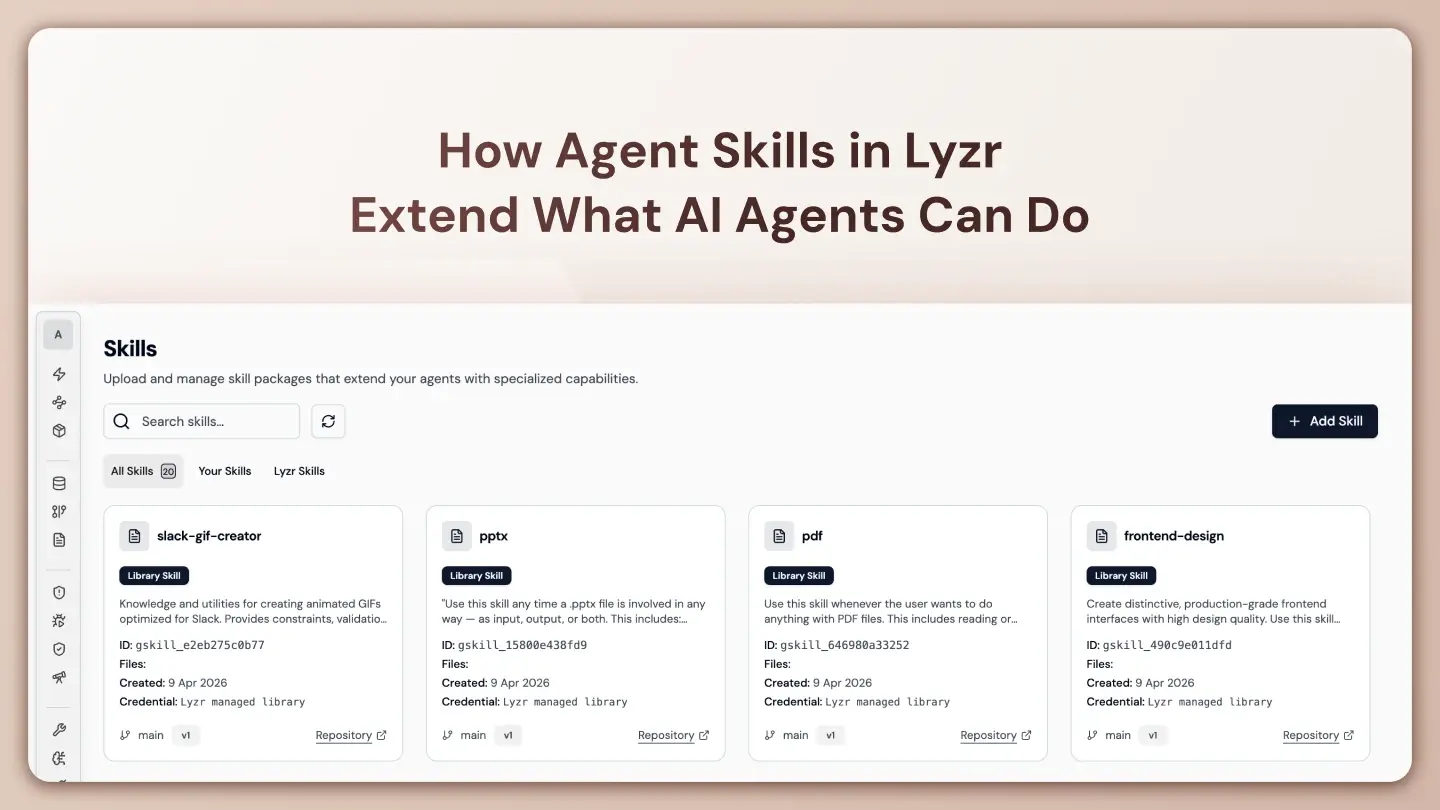
Lyzr Agent Studio provides a centralized Skills Library where teams can discover, manage, and deploy capabilities across agents.

Organizations can choose from two approaches.
Lyzr Managed Skills
Lyzr provides pre-built skills that address common enterprise use cases.
These include capabilities for:
- PDF processing
- Document creation
- Presentation generation
- Design reviews
- External API integrations
- Workflow automation
These skills can be attached to agents immediately, reducing development effort and accelerating deployment timelines.
Custom Skills
Many organizations have unique business processes, proprietary workflows, and internal systems that cannot be solved using generic capabilities.
For these scenarios, teams can create custom skills that package their own logic and integrations.
A custom skill might include:
- CRM workflows
- Internal compliance checks
- Financial modeling processes
- Customer onboarding workflows
- Proprietary data processing pipelines
This allows organizations to convert institutional knowledge into reusable agent capabilities.
Bringing Existing Code into Your Agent Ecosystem
One of the biggest barriers to enterprise AI adoption is the amount of existing automation that already exists across organizations. Development teams have accumulated years of scripts, utilities, integrations, and workflow logic.
Rebuilding everything for AI agents is rarely practical.
Agent Skills help solve this challenge by allowing teams to package existing functionality and import it directly into Lyzr Agent Studio.
Skills can be uploaded as packaged components or imported from GitHub repositories, making it easier to operationalize existing code and convert it into reusable capabilities for agents.
Rather than replacing existing investments, organizations can extend them.
A Practical Example: Building a Financial Due Diligence Agent
Consider a private equity team building a due diligence workflow.
The agent needs to:
- Extract information from financial documents
- Analyze spreadsheets
- Gather external market data
- Generate investment summaries
- Create presentation decks
Without Agent Skills, all of this functionality must be built directly into the agent.
Now imagine the team also wants to create agents for portfolio monitoring, investment screening, and market research. Much of the same functionality needs to be recreated.

With Agent Skills, capabilities become reusable.
| Skill | Responsibility |
| PDF Skill | Extract and structure documents |
| Spreadsheet Skill | Process financial models |
| Research Skill | Gather market intelligence |
| API Skill | Access external data sources |
| PPTX Skill | Generate presentation decks |
Each capability is maintained once and reused wherever needed.
The result is faster deployment, lower maintenance overhead, and more consistent execution across workflows.
Why Agent Skills Matter for Enterprise AI Teams
The value of Agent Skills extends beyond development efficiency.
For enterprise teams, skills become a foundation for governance, standardization, and scalability.
Because capabilities are packaged independently, updates can be made centrally and immediately benefit every agent that uses them. Teams gain better visibility into how workflows are implemented and can enforce consistent execution across departments.
Over time, organizations begin building an internal catalog of reusable capabilities that grows alongside their AI initiatives.
This shifts the focus from building individual agents to building a reusable ecosystem of agent capabilities.
Instead of asking, “How do we build another agent?” teams begin asking, “Which skills do we already have that can solve this problem?”
That shift dramatically accelerates development while reducing duplication.
Building the Next Generation of Enterprise AI with Lyzr
As organizations move from a handful of agents to hundreds, modularity becomes essential.
The future of enterprise AI will not be built on isolated agents with duplicated logic. It will be built on reusable capabilities that can be combined, governed, and continuously improved.
Agent Skills in Lyzr Agent Studio provide the foundation for this approach.
By separating capabilities from agents, organizations can create reusable building blocks for document processing, workflow automation, integrations, reporting, and countless other business functions.
The result is a faster path from experimentation to production, allowing teams to build sophisticated AI systems without repeatedly rebuilding the same functionality.
For enterprises looking to scale AI adoption, Agent Skills are not simply a feature. They are the infrastructure layer that turns agents from conversational assistants into systems capable of delivering measurable business outcomes.
Book A Demo: Click Here
Join our Slack: Click Here
Link to our GitHub: Click Here