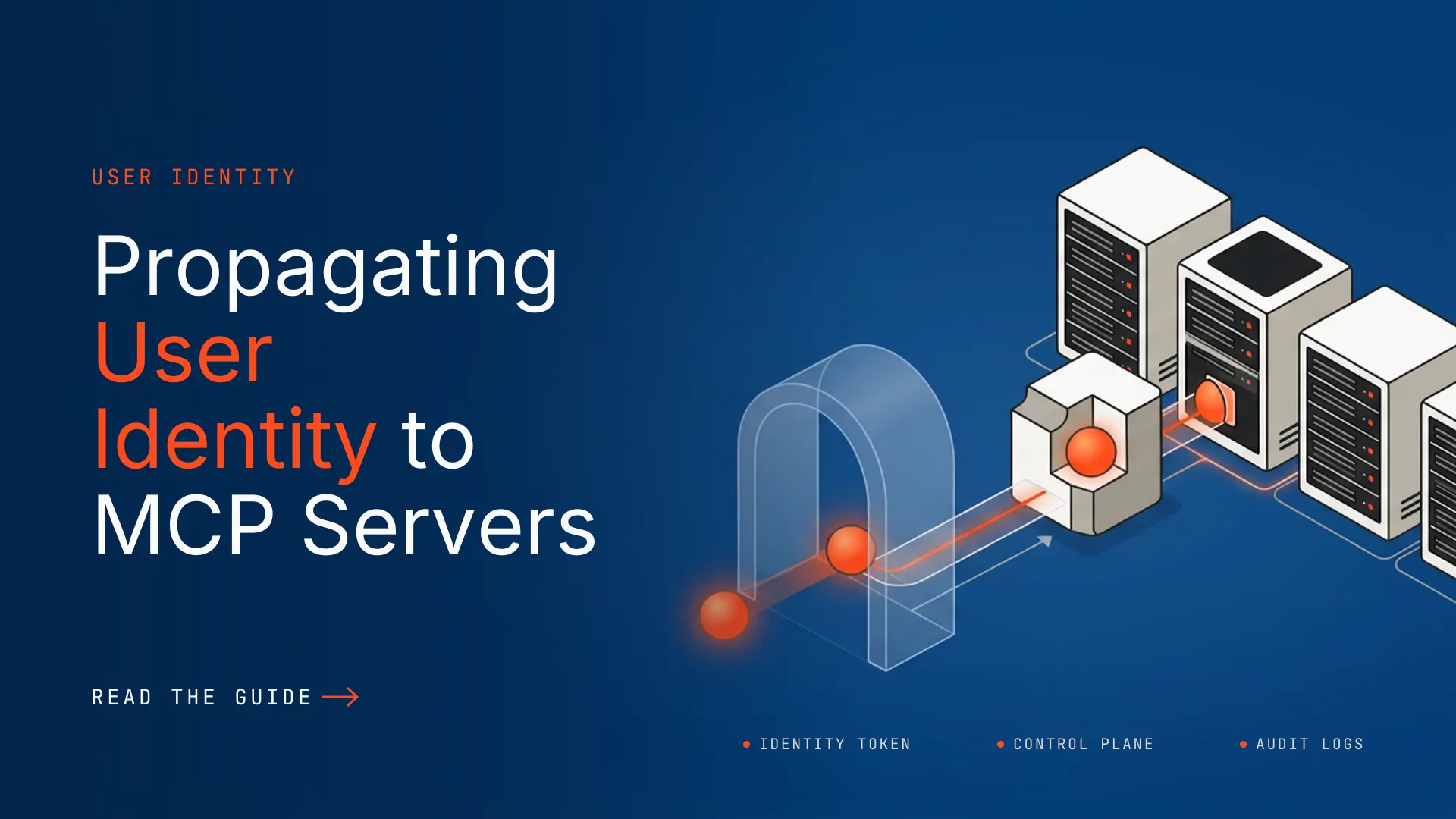
OpenController propagates user identity by capturing it from the initial authentication and securely injecting it as a header into every downstream call to hybrid MCP servers.
This ensures the original user's context travels with every agent action.
The identity is passed as a standardized, verifiable token.
The downstream MCP server can then trust and use this token for its own authorization logic, creating a complete chain of custody.
This is a core function of OpenController by Lyzr, the governance layer for production AI agents.
A control plane is the neutral layer that governs everything beneath it.
For AI agents, OpenController is that layer, ensuring that identity and policy are enforced consistently across your entire agentic stack.
How Identity Travels from User to MCP
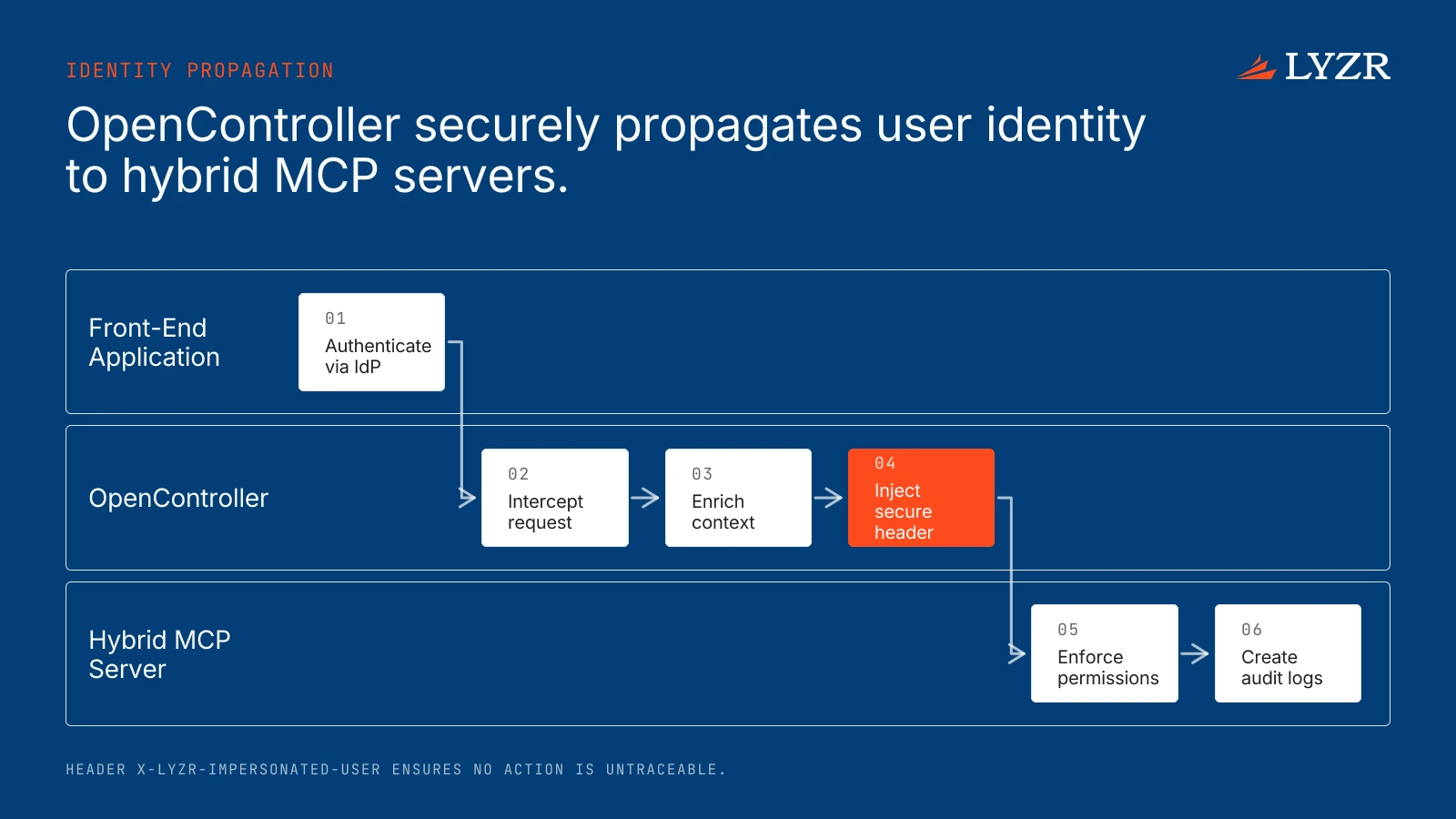
The process is a clean, repeatable flow that integrates with your existing security posture. It happens on every request, ensuring no action is untraceable.
-
Authentication. A business user authenticates with your front-end application (e.g., "Anna Plan") via your existing Identity Provider (IdP), like Okta or Microsoft Entra ID.
-
Interception. The user's request, now containing an identity token, is routed through OpenController. Lyzr's control plane acts as a central gateway, inspecting the transaction before the agent executes.
-
Enrichment. OpenController extracts and validates the user's identity from the token. It then enriches the agent's execution context with this verified identity data, making it available for policy decisions.
-
Injection. As the agent prepares to call a hybrid MCP server, OpenController automatically injects the user's identity into the outgoing API call. This is typically done via a secure HTTP header, such as
X-Lyzr-Impersonated-User. -
Enforcement. The hybrid MCP server receives the request. It reads the identity from the header and uses it to enforce its own granular permissions and create audit logs tied directly to the original human user.
A Consistent Identity for Auditing and Control
This method isn't just about passing a username. It's about maintaining a single source of truth for identity across a distributed, hybrid system.
This approach connects every agent action, every model call, and every tool use back to a real person. There are no anonymous agent activities.
It allows your specialized, hybrid MCPs to do what they do best: enforce fine-grained access control based on a trusted identity passed to them. They don't need to become their own identity providers.
Because OpenController integrates with your existing IdP, you aren't creating a new identity silo. You're extending the reach of your current security infrastructure, like Okta or Entra, to govern agents.
This all presumes that Lyzr's control plane is aware of your MCPs. The same discovery mechanism that allows OpenController to find and manage MCP servers also prepares it to route these identity-aware requests correctly.
The result is a complete, end-to-end audit trail that satisfies security and compliance teams.
Frequently Asked Questions
Does this work with any IdP?
Yes. OpenController works with standard identity protocols like OIDC and SAML 2.0.
This makes it compatible with major providers like Okta, Microsoft Entra ID, Ping Identity, and Auth0.
What does the identity in the header look like?
It's configurable, but the identity is typically passed as a structured, signed token like a JWT. This token contains key attributes such as the user's unique ID, email, and group memberships that the MCP server can easily parse and validate.
Does the MCP server need to be modified?
No deep code changes are required. The MCP server simply needs to be configured to read the user identity from the incoming HTTP header and trust the signature from OpenController.
Your Takeaway
With OpenController, user identity is not lost at the agent gateway. It's a persistent, auditable thread that connects the business user to every downstream action, even in a complex hybrid environment.
This gives you the power to enforce who can do what, through an agent, at the most granular level.
See how it works in your stack. Let's talk.
Related questions
- How does Opencontroller discover MCP servers?
- Does Opencontroller handle authorization and delegation itself, or does it just monitor and enforce policies on top of existing identity providers like Okta or Entra?
Want to see how it fits your stack? Talk to us about OpenController by Lyzr.
Got a use case in mind?
8 weeks from use case to agents running in production.
Platform, people and FDEs, all in. Bring your environment. We'll co-build and stay until it's live.
Talk to UsFree resource
101 AI Agents Use Cases
100+ production-ready AI agent use cases across Marketing, Sales, HR, Banking, Insurance, Operations and a lot more
Download now