An AI agent with the wrong permissions is a data breach waiting to happen.
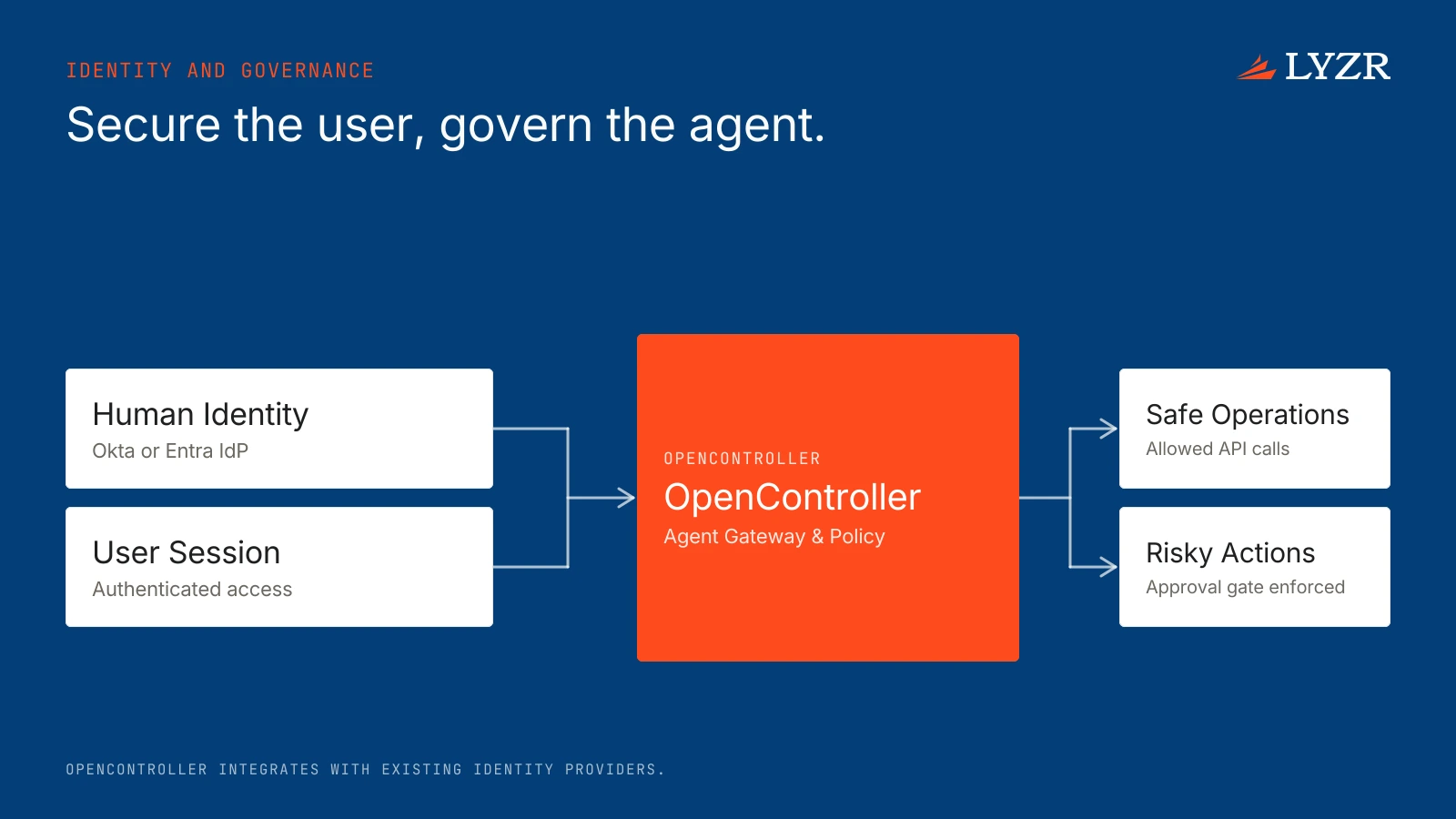
OpenController by Lyzr does both. It enforces security policies on top of your existing identity providers like Okta or Entra.
It also adds a new, agent-specific layer of authorization and delegation that IdPs weren't built for.
OpenController is the governance layer for production AI agents.
It doesn't replace your identity stack. It makes it agent-aware.
How It Works: Layering Control
Your identity provider is the source of truth for human identity.
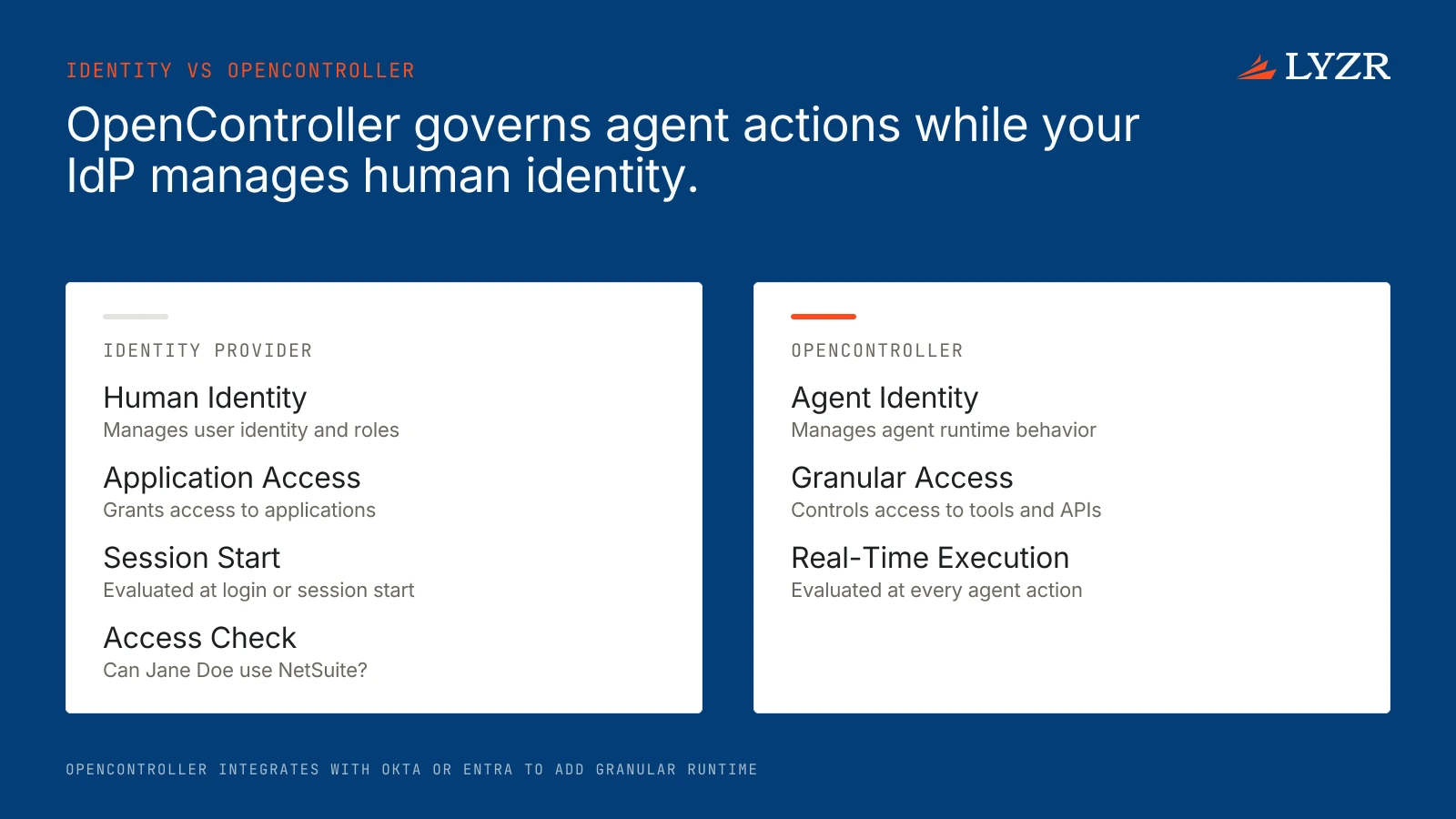
OpenController honors that. It integrates with your existing stack to understand who the user is and what applications they can access.
But agents introduce a new challenge. An authorized user can trigger an agent that takes unforeseen, high-risk actions.
This is where Lyzr’s control plane adds its specific value. It governs what the agent can do on the user's behalf.
| Manages | Your Identity Provider (Okta, Entra) | OpenController by Lyzr |
|---|---|---|
| Who | Human user identity and roles. | Agent identity and runtime behavior. |
| What | User access to applications (e.g., Salesforce). | Agent access to specific tools, APIs, and data fields within those applications. |
| When | At login or session start. | At every agent action or tool call, in real-time. |
| Example | "Is Jane Doe allowed to use NetSuite?" | "Is the 'Q3 Forecaster' agent, acting for Jane, allowed to call the update_revenue_projection API?" |
Why Not Just Use the IdP?
Identity providers see the world in terms of users and applications. They lack the context of agentic workflows.
An IdP can’t differentiate between a safe read operation and a risky delete operation initiated by an autonomous agent.
It can't enforce a human-in-the-loop approval gate before an agent modifies sensitive finance data in NetSuite.
It can't understand the sequence of tool calls that make up a single agent transaction.
OpenController provides this granular, policy-based governance for agents. It translates your business rules into machine-enforceable policies that run before, during, and after every agent action.
You define the guardrails. OpenController ensures the agents stay within them.
The Takeaway
Your identity provider secures the user. OpenController secures what the agent does for that user.
You need both.
If you’re ready to govern your AI agents with the same rigor you apply to your human workforce, let's talk.
Related questions
Want to see how it fits your stack? Talk to us about OpenController by Lyzr.
Got a use case in mind?
8 weeks from use case to agents running in production.
Platform, people and FDEs, all in. Bring your environment. We'll co-build and stay until it's live.
Talk to UsFree resource
101 AI Agents Use Cases
100+ production-ready AI agent use cases across Marketing, Sales, HR, Banking, Insurance, Operations and a lot more
Download now