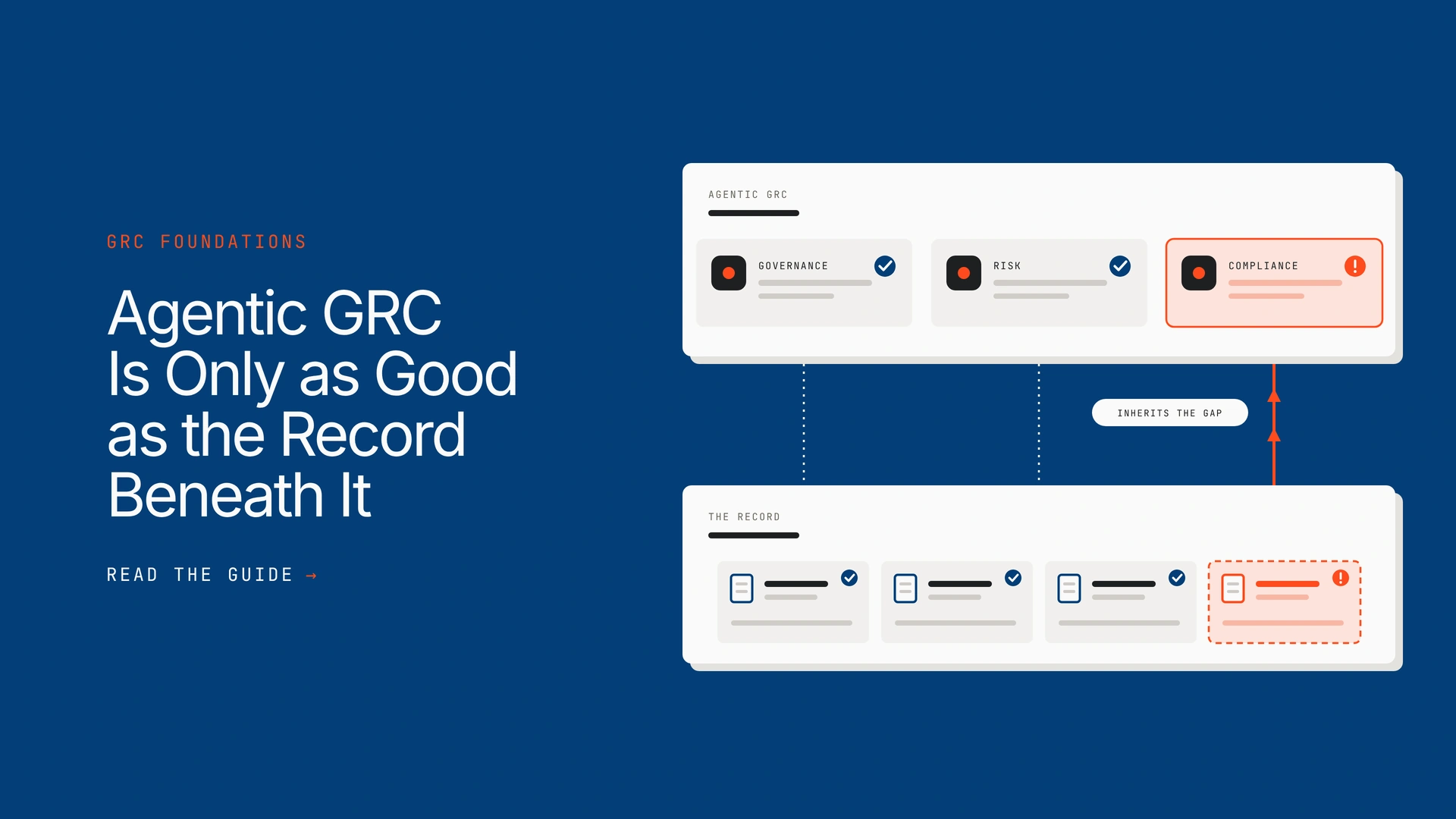
Agentic GRC fails when agents act on rules, policies and controls that are held in separate places with no recorded links between them. An agent then has to guess which obligation a control serves, who owns it and whether an exception matters, and it acts faster than anyone can review. The fix is a connected record: each rule linked to the policy, control, test and evidence behind it, with a named person’s approval on every link. A connected record will not repair bad data or replace human judgment, and most of the guidance we found comes from GRC vendors, including us. Madison, Lyzr’s agentic GRC product for US banks and credit unions, is built around that record. We label which claims are ours and which are sourced.
TL;DR
- It is an architecture problem: GRC analyst Michael Rasmussen argues the structure and connectedness of the environment limit agentic results more than the model does.
- Meaning lives in the links: MetricStream notes a control’s meaning depends on the obligation, risk, process and assessment it connects to.
- Review after the fact is not governance: NHIMG says that if an agent can already act, after-the-fact review is incident response.
- Fragmentation scales: AI amplifies whatever architecture already exists, so scattered data produces faster confusion.
- Four questions for every action: what it did, why, under whose authority, and where the evidence is.
- Fair warning: nearly every source here is a GRC vendor or adviser, and we sell Madison.
Why does agentic GRC fail without a connected record?
Because governance, risk and compliance is a web of relationships, and agents work from whatever relationships they can see. Rasmussen, writing for GRC Report, says risks, controls, policies, obligations and third-party data usually sit in disconnected repositories with weak links, and that “modernized silos are still silos.” His test task is a new regulation: handling it properly needs obligations, policies, controls, owners, evidence and exceptions linked together. An agent on top of scattered data does not fail loudly. It produces confident, fast, unverifiable output. See AI in compliance vs AI governance for the broader distinction.


What is a connected record of rules, policies and controls?
It is one model in which each object stores its links to the others, so an agent can follow them instead of guessing. In Madison the chain has twelve links: regulation, rule section, obligation, applicability, policy, procedure, control, test, finding, remediation, evidence and request. Agents propose a link and a named person approves it, and the approval is signed against the exact version with the signer’s role. Reg change, audit, examinations and advisory all ask versions of one question, namely which policies, controls and evidence attach to this duty, so one traversal answers them all.

See how to map policies to controls with an agent for the mapping step, and how to evaluate a regulatory change agent for what to test.
What are the five ways agentic GRC breaks on disconnected data?
The overview this guide started from names four mechanisms. We add a fifth, accountability, and show for each what breaks, what a connected record supplies and how strong the source support is.
| Mechanism | What breaks | What a connected record supplies | Source support |
|---|---|---|---|
| 1. Review after the fact | Sensitive actions happen before a control cycle sees deviation | A record the agent is checked against before it acts | NHIMG (editorial FAQ), SureCloud (vendor) |
| 2. Missing context | The agent cannot tell a routine event from a critical one | Owners, policy, control and obligation links for each finding | MetricStream, Optro (vendors); Rasmussen |
| 3. Fragmentation | Agents work on inconsistent data, so scale multiplies error | One thread per duty, with links that are stored, not implied | LogicGate (vendor), Rasmussen, GRC Partners Asia (vendor) |
| 4. Stale inventory | Unowned or unregistered agents and out-of-date control owners | A register tied to owners and re-confirmed by people | Optro, SureCloud (vendors) |
| 5. Weak accountability | No one can reconstruct why an agent acted | Decision records with authority, reasoning and evidence | GRC Partners Asia, SureCloud, Optro (vendors) |
One overview claim, that ISO 42001, the EU AI Act and Indian guidance from RBI and SEBI expect independent review rather than self-attestation, came from a source we could not locate. We have not used it. Check any such framework against its primary text.
Optro gives concrete examples of the second and third mechanisms: a stale control owner, a threshold changed in a spreadsheet, an evidence version no one can identify. LogicGate, a vendor, describes one supplier appearing under three names across trackers. See AI agent inventory for banks on the fourth mechanism.
Why does a live approval gate need a connected record?
NHIMG, a publisher of editorial FAQs on non-human identity, says after-the-fact review leaves a gap between action and containment, while runtime checks stop unauthorized actions before they execute. A gate is only as good as what it checks. If the record does not hold the policy, the owner, the limit and the approver, the gate has nothing to compare an action against and becomes a rubber stamp. Optro makes the same point from the other direction: autonomy should track understanding, authority and consequence, and high-risk actions need approval.

LogicGate describes routing every AI-generated finding through a named human approval before it changes the record, and MetricStream says an agent should not exceed the permissions of the user invoking it. For runtime enforcement see best tools for AI agent observability in banking and why bank-built compliance agents stall.
What questions must an agent be able to answer from the record?
GRC Partners Asia, a SAI360 partner, proposes four questions for every agent action: what it did, why, under whose authority, and where the evidence is. The table extends that into the lookups a compliance agent actually needs. Today the answers sit in different places. In a connected record each is one hop.
| Question the agent needs answered | Where the answer usually lives | In a connected record |
|---|---|---|
| Which rule text created this duty? | A regulator website and someone’s notes | Obligation linked to the rule section, with the citation |
| Does it apply to us? | A past memo or a consultant’s view | Applicability stored against the bank’s profile |
| Which policy and procedure answer it? | Word files and an intranet | Links from obligation to policy and procedure |
| Which control proves it ran? | A spreadsheet owned by a manager | Control linked to the obligation and its owner |
| When was it last tested, and what failed? | Email and a separate audit tool | Test, finding and remediation on the same chain |
| What evidence supports it, and how old is it? | A screenshot in a folder | Evidence linked, with dates and an age |
| Who approved the link, in what role? | Nobody recorded it | A signed approval against the exact version |
Where Madison helps: answering from this chain, with outputs traced to rule text and gaps flagged: an obligation with no policy, a policy covering nothing, an obligation with a policy but no control. See Madison vs Wolters Kluwer compliance intelligence and Madison vs CUBE.
How does an honest record behave when it does not know?
A connected record is only useful if it says how well it knows each fact. Madison’s design rule is that every object and link carries one of six levels, and that a count shown to a person may only include the first three. We describe this as a design rule and have not published it as a shipped, audited feature, so confirm the current behavior with Lyzr.

The practical effect is that “covered” means covered at levels one to three, and the rest appears as open work. A bank that cannot say how much of its coverage is confirmed cannot defend a coverage number. See auditing AI agents in banks for how auditors would test a claim like this.
What does a connected record not fix?
Four limits are worth stating plainly. First, links do not make the content right: MetricStream notes that records conflict and labels are inconsistent in practice, and a connected record can connect wrong data. Second, human judgment remains. Optro puts it as an agent is not signing the audit opinion, you are. Third, the record is not the enforcement layer. It tells a gate what is allowed, but something else must stop an action at runtime. Fourth, a record does not remove the cost of building it. Someone has to seed the links and keep them current, which is why Madison proposes links and people approve them.
| Limit | What it means | What to do |
|---|---|---|
| Wrong content, right links | A connected error is still an error | Test samples against source documents; keep people approving |
| Judgment stays human | Materiality and exceptions need a decision | Keep named approvers and an override with a reason |
| Record is not enforcement | A gate must act at runtime | Pair with runtime controls such as Opencontroller |
| Seeding takes work | Links must be created and kept current | Start with one regulation and one process, then extend |
How do you test a vendor’s “agentic GRC” claim?
GRC 20/20 warns that many products called agentic are assistants or workflows, and asks buyers whether the AI understands the connected data model and whether guardrails include approvals, rollback and segregation of duties. Optro frames it as five tests: is the state authoritative, which policies govern, how reversible is the action, under whose authority, and can the decision be reconstructed. We turn those into a short list of questions for a demo.
| Ask the vendor | Strong answer | Red flag |
|---|---|---|
| What does the agent operate on? | A connected model of obligations, policies, controls and owners | An uploaded folder of documents and a chat box |
| Show me one control traced to its rule | Rule, obligation, policy, control, test and evidence on one screen | A search result with no stored links |
| Who approves an agent’s proposal? | A named person, with role and version recorded | “The system validates it” |
| Can I reverse an action? | Rollback and an override that is technically possible | A log that only records what happened |
| Is the agent limited to the user’s permissions? | Yes, and it cannot exceed them | A shared service account |
| What does it show when it does not know? | An explicit unknown or gap | A fully green dashboard |
How do you build the connected record?
Step 1: Pick one regulation and one processStart narrow, for example one rule family and the process it governs, so links can be checked by the people who own them.
Step 2: Load the documents you already haveBring in policies, procedures and the control inventory as they are. The record starts from your files, not a rebuild.
Step 3: Let agents propose the linksHave agents propose obligation to policy to control links, and have a named person approve each one. See best regulatory change management software for banks.
Step 4: Read the gapsReview obligations with no policy, policies covering nothing and policies with no control. These are the first findings.
Step 5: Put gates on actionRequire approvals for consequential actions, where the approver is never the requester, and keep overrides attributable.
Step 6: Ride the calendar you already runRe-confirm links at annual policy reviews, test cycles and exams so the record stays current without a new process.
How does Madison provide the connected record?
Madison is a workforce of AI agents for compliance and risk in US banks and credit unions. It holds the twelve-link chain, with agents proposing and a named person approving. Decisions are signed against the exact version with the signer’s role, outputs trace to rule text, and coverage gaps are flagged. Its modules cover regulatory change and coverage, examinations and issues, and third-party and AI oversight, where vendors, models and agents are governed objects with owners and evidence. Examiner requests are answered from the chain in one register. Madison reads from bank systems and writes nothing back, and it never remediates on its own. It runs in the customer’s tenancy and has three autonomy levels: assist, recommend and automate.

Pair it with Opencontroller: Opencontroller supplies the runtime layer: immutable agent IDs, per-tool authorization, a signed audit trail and reversible quarantine. A gateway governs only the traffic that passes through it. Descriptions of both products come from Lyzr’s own materials. See also what a bank board needs to see before approving an AI agent.
Trace one control to its rule
Bring one regulation and one control folder. In a working session we build the chain, show the gaps and list what a person would still need to approve.
Frequently asked questions
What is agentic GRC?
Agentic GRC uses AI agents that take actions in governance, risk and compliance work, such as mapping obligations to controls, drafting assessments or flagging gaps, instead of only answering questions. GRC 20/20 warns that many products called agentic are assistants or workflows, and suggests asking whether the AI understands the connected data model and whether guardrails include approvals and rollback.
Why does agentic GRC fail without a connected record?
Agents work from the relationships they can see. Where rules, policies and controls sit in separate places with no stored links, the agent guesses which obligation a control serves, who owns it and whether an exception matters. GRC analyst Michael Rasmussen calls it an architecture problem and says AI amplifies whatever architecture already exists.
What is a connected record in GRC?
It is one model where each object stores its links to the others: regulation, rule section, obligation, applicability, policy, procedure, control, test, finding, remediation, evidence and request. Agents propose links and a named person approves them. Madison, Lyzr’s agentic GRC product for US banks and credit unions, is built on a twelve-link chain like this.
What is the difference between a system of record and a spreadsheet for GRC?
A spreadsheet holds values; a system of record holds values plus the links, owners, versions and approvals behind them. LogicGate, a vendor, argues spreadsheets and chat logs fail audit because they do not keep one traceable thread. Optro, another vendor, says AI bolted onto a record produces answers you cannot defend.
What is wrong with after-the-fact review of AI agents?
NHIMG says it leaves a gap between action and containment, and that if the agent can already act, review after the fact is incident response, not governance. A live gate checks the action against the record before it executes. The gate can only check what the record holds, which is why the two depend on each other.
What does it mean to say AI amplifies whatever architecture exists?
It means fragmented data does not slow an agent down; it gives faster, more confident confusion. Rasmussen writes that most GRC failures are architectural and that modernized silos are still silos. An agent on scattered records scales the inconsistency, which is why connecting the data matters before adding autonomy.
What four questions should every AI agent action answer?
GRC Partners Asia, a SAI360 partner, proposes: what did the agent do, why, under whose authority, and where is the evidence. SureCloud, another vendor, lists four records to keep: action log, reasoning record, authorization record and change or rollback log. Treat both as practitioner guidance, not a standard.
Can a connected record fix bad data?
No. MetricStream notes that in practice links are incomplete, labels are inconsistent and records conflict. A connected record can connect wrong data. It makes errors visible and traceable, which helps, but people still need to test samples against source documents and approve the links.
Does agentic GRC replace the compliance team?
No. Optro puts it plainly: an AI agent is not signing the audit opinion, you are. Agents can propose links, draft assessments and flag gaps, while named people approve decisions and judge materiality. Madison follows that pattern: agents propose, a person approves, and it never remediates on its own.
How do I know if a vendor’s agentic GRC product has a real connected record?
Ask it to trace one control to its rule, with obligation, policy, control, test and evidence on one screen and a named approver recorded for each link. Ask what it shows when it does not know, and whether the agent can exceed the invoking user’s permissions. A folder of documents and a chat box is a warning sign.
What is the risk of building GRC agents on spreadsheets and ad-hoc AI outputs?
Agents then work on inconsistent data, so automation scales errors and cost. GRC Partners Asia warns against impact mapping run in a separate AI workspace that drifts from production, and LogicGate describes one supplier appearing under three names across trackers. Both are vendor views, but the failure pattern is consistent across sources.
How does Madison fit with Opencontroller?
Madison holds the record of why each control exists and who approved it, linking obligations, policies, controls, tests and evidence. Opencontroller, Lyzr’s agent control plane, enforces limits at runtime with agent identity, per-tool authorization and a signed audit trail. The record tells the gate what is allowed; the gate stops what is not.
Book A Demo: Click Here
Join our Slack: Click Here
Link to our GitHub: Click Here
Got a use case in mind?
8 weeks from use case to agents running in production.
Platform, people and FDEs, all in. Bring your environment. We'll co-build and stay until it's live.
Talk to UsFree resource
101 AI Agents Use Cases
100+ production-ready AI agent use cases across Marketing, Sales, HR, Banking, Insurance, Operations and a lot more
Download now