TL;DR
- AI agents for social media are systems that research, draft, schedule, publish, and adapt content with limited human input, not just tools that suggest a caption.
- Five capability areas define the category: content generation, scheduling and distribution, audience engagement, social listening, and analytics.
- Most tools marketed as “agents” are AI-assisted (Level 1). Fewer operate as true autonomous systems with guardrails (Level 2), where the agent drives the workflow and a human approves the output.
- In 2026, 89.7% of social media marketers use AI at least several times a week, but agentic adoption specifically still lags behind basic AI-assist tools.
- Skott, Lyzr’s Agentic OS for Marketing, operates at Level 2: it researches, drafts, schedules, and adapts, while a marketer approves what goes live.
What are AI agents for social media?
AI agents for social media are autonomous or semi-autonomous systems that research trends, generate multi-platform content, schedule posts, manage audience engagement, and adjust strategy based on performance data, without needing a prompt for every step. That’s the line that separates an agent from a scheduler or a caption generator.
A scheduler posts what you already wrote, at a time you already chose. A basic AI tool drafts one thing when you ask it to. An agent perceives what’s happening (a trend, a comment, a dip in engagement), reasons about what to do next, and executes it inside a workflow.
That distinction matters because the label has gotten loose. Every tool released this year calls itself an agent, whether it’s a scheduling app, a chatbot builder, or an analytics dashboard with a chat window bolted on. It helps to think about the category on a spectrum instead of trusting the word “agent” on a landing page.
Level 1: AI-assisted. The human drives every decision. The AI suggests a caption, recommends a hashtag, proposes a posting time. Most tools sold as AI agents live here, and there’s nothing wrong with that. It’s just not autonomy.
Level 2: Autonomous with guardrails. The agent drives the workflow: it researches, drafts, schedules, and adapts. A human approves outputs at review gates. This is where production-grade tools like Skott operate, and it’s the level most enterprise teams should actually be evaluating for.
Level 3: Fully autonomous. No human review before publishing. This doesn’t exist in production for social media today, and given how public and permanent a bad post is, that’s probably the right call for now.
This framework is also useful outside social specifically. Teams exploring broader AI agents for digital marketing, or evaluating social networking website development for a niche community platform, run into the same buy decision: how much of the workflow is the software actually driving, versus just accelerating?
What social media AI agents can do
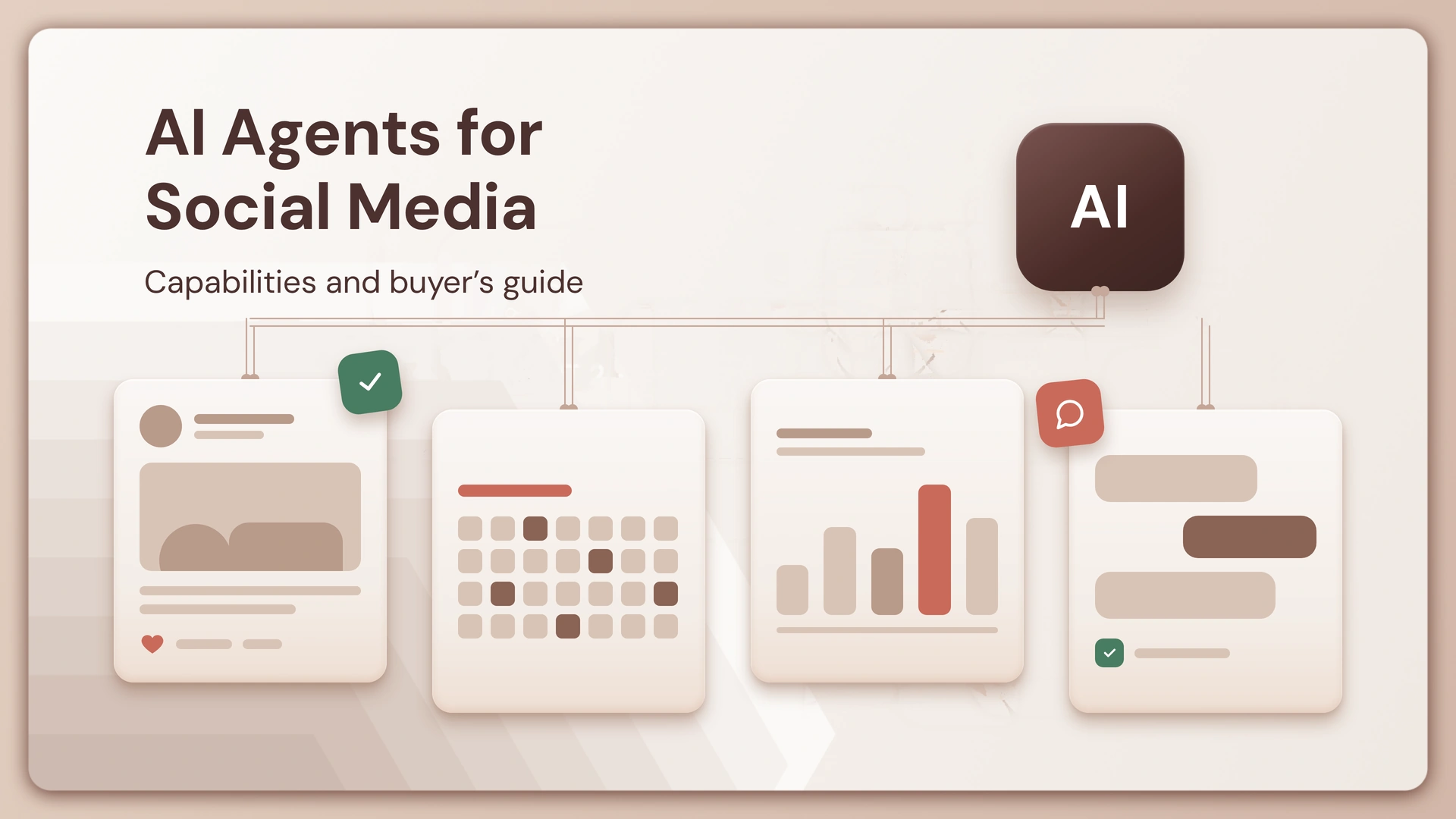
Five capability areas make up the category. A tool that only does one or two of these is a point solution, not an agent.
Content generation and brand voice. An agent pulls from blogs, RSS feeds, or an internal knowledge base and reformats that material into platform-specific posts for LinkedIn, Instagram, X, and TikTok, without a human rewriting each version by hand. The part that separates this from a generic AI agent for content creation is brand voice training: the agent learns tone, vocabulary, and house style rules and holds them consistent across hundreds of posts, which is also what makes it useful for AI agents for brand building rather than one-off campaigns. Teams also lean on adjacent ai tools for social media content creation and asset generators, from an ig text post generator for quick captions to an AI flyer generator for promotional visuals, inside the same content marketing playbook a brand already runs. For additional branded visuals, marketers can also use an
AI poster to create promotional graphics for social media campaigns. For quick touch-ups before a post goes live, many teams also keep a photo editor on hand to clean up lighting, crop, and color on product shots
Scheduling and distribution. This is where an ai agent for social media posting earns its name: it analyzes when your specific audience is actually active, adapts format and copy length per channel from one input, and handles distribution without a person clicking “publish” on five platforms. An AI social media scheduling tool can support this workflow by automating scheduling and adapting publishing based on audience activity and channel requirements. Some teams still layer in a dedicated tool to schedule your social media posts or auto publish social media content on a fixed cadence, and a reliable URL shortener like Replug for cleaner tracked links. Lyzr’s Twitter posting agent blueprint and content distribution agent blueprint show this pattern applied to specific channels.
Audience engagement and community management. The agent monitors DMs, comments, and brand mentions, sorts them by sentiment and urgency, and drafts or sends responses without a person staffing the inbox at 2 a.m. Tools like ManyChat automate the reply layer specifically; a broader agent ties that into the strategy loop, and the same monitoring builds a community around your brand instead of just closing tickets faster.
Social listening and trend detection. The agent tracks competitor activity and surfaces niche trends while they still have momentum, drafting reactive content instead of writing about last week’s moment. Some of this is manual research made faster, like using an Instagram viewer to check competitor stories, or tools built for TikTok creator discovery and figuring out how to find TikTok affiliates for partnership-driven reach in
affiliate marketing niches.
Analytics and performance optimization. The agent finds cross-platform patterns a human wouldn’t catch at scale, scores a draft against historical performance before it publishes, and automates the reporting that used to eat a Friday afternoon. It’s also how growth teams track Instagram Followers trends against content type rather than guessing. For a broader view of where this fits, Lyzr’s 12 AI marketing use cases template and its companion AI agent for email marketing cover the same optimization logic outside of social specifically.

How a social media AI agent works under the hood
An agent’s decisions come from a few connected layers, not one black box.
The LLM brain. A large language model reasons about content strategy, generates copy, and decides what to do next. Model-agnostic architecture (GPT, Claude, Gemini, or an open-source model) means the agent isn’t locked into one provider’s roadmap or pricing.
Knowledge base and retrieval. The agent pulls from brand guidelines, product documentation, past post performance, and competitor intelligence through retrieval, rather than generating from the model’s general training alone. That’s what makes an output sound like your brand instead of a generic ChatGpt for social media prompt.
Platform API integrations. The agent connects to LinkedIn, Instagram, X, and Facebook through official APIs, publishing posts, reading analytics, and monitoring engagement programmatically instead of through a person copying and pasting.
Guardrails and review gates. Published social content is public and permanent, which is exactly why guardrails matter more here than in most AI use cases. Trust in fully autonomous AI agents has fallen from 43% to 27% in a single year, according to Capgemini Research Institute, 2025. Separately, 50% of Gen Z have unfollowed, muted, or blocked accounts because they think the content is AI-generated, per Sprout Social’s Q1 2026 Pulse Survey. Both numbers point at the same fix: hallucination checks, brand-safety filters, and a human approval step before anything publishes.
Multi-agent orchestration. A coordinating agent manages specialized sub-agents: one researches, one writes, one schedules, one monitors engagement, one analyzes results and feeds them back into the next round of drafts. That’s the workflow automation pattern behind Skott, and it’s the same architecture Lyzr’s marketing strategy builder blueprint uses to turn a single strategy input into a coordinated campaign.
AI agents for social media vs. traditional tools
The honest way to compare categories is capability by capability, not brand by brand.
Capability comparison: agent vs. scheduler vs. AI writing tool
| Capability | Social media scheduler | AI writing tool | AI agent for social media |
|---|---|---|---|
| Content generation | No (human writes) | Yes (human prompts each time) | Yes (autonomous, brand-trained) |
| Multi-platform adaptation | Manual per channel | No | Automatic per channel |
| Trend detection | No | No | Yes (real-time monitoring) |
| Engagement management | Basic inbox | No | Sentiment-sorted, auto-drafted responses |
| Strategy optimization | Static reports | No | Adaptive, based on performance data |
This is also the filter behind most “best ai agents for social media” roundups worth reading in 2026: not which tool has the most features, but which row of this table it actually fills.
How to evaluate or build a social media AI agent
If you’re buying, run every vendor through the same six questions before the demo ends:
- What autonomy level does the tool actually operate at, Level 1 or Level 2?
- Does it adapt one input into platform-specific content automatically, or does someone reformat it by hand?
- How does brand voice training actually work, and how long does it take?
- What guardrails exist to prevent a hallucinated claim from going live?
- Is analytics unified across platforms, or is it five separate dashboards?
- Can you customize the workflow, or is it a fixed product you adapt to?
An agency evaluating tools for a client roster asks a seventh question that individual brands skip: does this scale across accounts without linear headcount growth? That’s the calculation behind most marketing agency adoption decisions this year, and it’s the same math behind teams pairing organic content agents with AI agents for paid advertising tools like AdCreative.ai for the ad-creative side of the budget.
If you’re building, no-code platforms remove the engineering barrier entirely. Lyzr Agent Studio lets a marketing team assemble a no code ai agents for social media setup by defining tasks, connecting a knowledge base, and setting guardrails, without writing a line of code. Lyzr’s AI social media agent blueprint and AI content creation agent blueprint are working starting points rather than empty templates. Lighter automation platforms like Zapier or Make.com can handle simpler, rule-based workflows if a full agent is more than the team needs yet. For a broader library of what marketing agents can cover beyond social specifically, that’s a useful next stop.
See how Skott runs social media for marketing teams. Book a demo.
Frequently asked questions
Can AI agents post on social media?
Yes. Agents connect to platform APIs (LinkedIn, Instagram, X, Facebook) to publish posts, reply to comments, and manage DMs programmatically, without a person clicking publish manually.
What is the best AI for social media?
It depends on the workflow. For end-to-end autonomous marketing, Skott by Lyzr. For scheduling with AI assist, Buffer or Hootsuite. For ad creative specifically, AdCreative.ai.
Can AI agents access Instagram?
Yes, through Meta’s official APIs. Agents can publish posts, read analytics, respond to comments, and monitor stories within the permissions Meta grants each app.
Does WhatsApp allow AI agents?
Yes, through the WhatsApp Business API. Agents can send templated messages, handle customer queries, and integrate with CRM systems under Meta’s business messaging policies.
What are the 5 types of AI agents?
Simple reflex, model-based reflex, goal-based, utility-based, and learning agents. Social media agents are typically learning agents that adapt based on ongoing performance data.
Is there a social media platform for AI agents?
No dedicated social network exists for AI agents. The term refers to AI agents operating on existing platforms like LinkedIn, Instagram, and X, not a separate network.
How much do AI agents for social media cost?
Ranges from free (basic AI writing tools) to $500 or more per month for enterprise platforms. Lyzr’s pricing depends on agent volume and deployment model.
Can I build a social media AI agent without coding?
Yes. No-code platforms like Lyzr Agent Studio let a team assemble a custom agent by defining tasks, connecting a knowledge base, and setting approval guardrails.
What are the risks of using AI agents for social media?
Hallucination (fabricated claims in a post), brand-safety incidents, and declining consumer trust in AI-generated content. All three are reasons to keep a human review gate before publishing.
How is an AI agent different from a social media scheduler?
A scheduler posts at times a person sets. An agent researches trends, generates content, determines optimal timing on its own, and adapts strategy based on what actually performs.
Where this leaves you
The honest version of this category, in 2026, is that most of what’s sold as an agent is still a scheduler with better branding. The gap between Level 1 assistance and Level 2 autonomy is the entire decision.
It’s not a feature checkbox, it’s a question of who is actually running the workflow when nobody’s watching the dashboard.
If you’re evaluating tools this quarter, run the six-question filter above before the sales call ends, not after.
And if the honest answer is that your team is still drafting captions and reformatting them by hand for five platforms, that’s not a workflow problem to patch, it’s the reason to look at what an agent operating at Level 2 actually replaces. Start with the marketing playbook that matches your current setup, and decide from there whether you’re buying assistance or hiring an agent.
Book A Demo: Click Here
Join our Slack: Click Here
Link to our GitHub: Click Here