
TL;DR
- Lyzr vs IBM watsonx Orchestrate is two decisions: which tool builds your agents, and which layer controls every agent you run.
- Orchestrate suits IBM-centric enterprises: no-code and pro-code builders, prebuilt agents for HR, sales, procurement and customer support, and IBM Cloud, AWS or on-prem deployment.
- Lyzr Studio builds agents and Lyzr Opencontroller governs agents already running across AWS, Azure, GCP, on-prem and air-gapped environments.
- Orchestrate Essentials starts at $530 a month and Standard at $6,360. Premium is priced on request (as of November 2026).
- You’re mostly on IBM? Start with Orchestrate. Agents spread across clouds and vendors? Put Opencontroller over the whole estate and keep Orchestrate for IBM workloads.
A regional bank runs Red Hat OpenShift and watsonx.ai, and its AI estate has grown to 40 agents: HR and procurement agents from IBM’s catalog, a LangGraph fraud agent on AWS, a vendor’s KYC agent and a dozen internal assistants. Its architecture board now has one question: which platform should own our agents?
In the Lyzr vs IBM watsonx Orchestrate decision, that’s two questions. Who builds the agents, and who controls them once they run?

Here’s the short answer: Lyzr vs IBM watsonx Orchestrate depends on where your agents live. Orchestrate suits IBM-centric enterprises that want prebuilt domain agents and IBM support. Lyzr suits teams building and governing agents across any cloud, framework and model, including air-gapped environments. Many enterprises run Orchestrate for IBM workloads and Lyzr Opencontroller to govern everything.
Lyzr vs IBM watsonx Orchestrate is two decisions, not one
Both vendors now sell a way to build agents and a way to control them, so compare them layer by layer.
IBM’s now calls Orchestrate an agent management platform to build, deploy, orchestrate, manage and govern AI agents wherever they are built or run. At Think 2026, IBM announced its next generation, in private preview, as an agentic control plane for agents from any source.
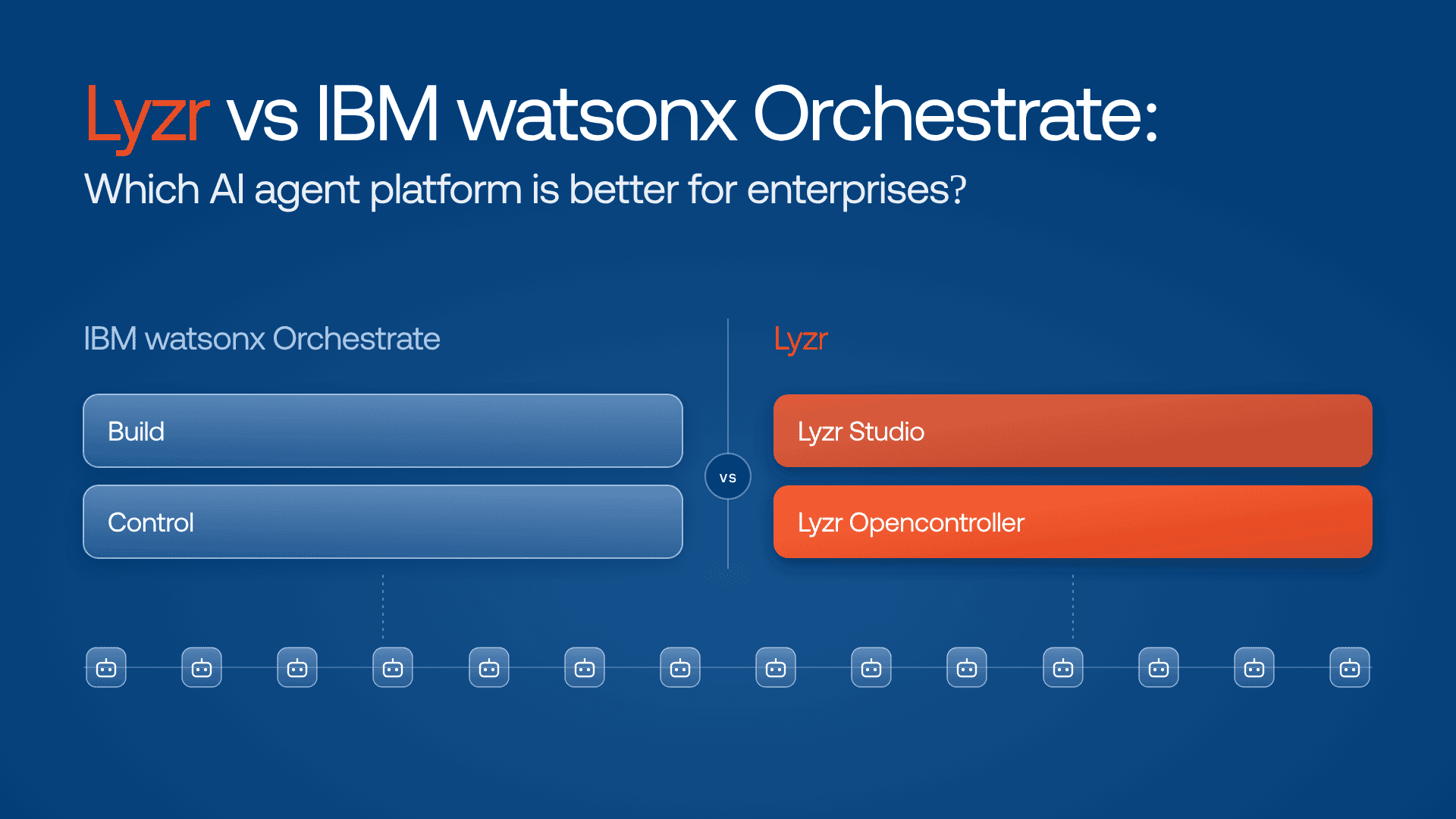
Lyzr on the other hand, uses two products. Lyzr Studio is where agents get built and Lyzr Opencontroller is a control plane for agents already in your environment, built in Studio or by hand. The builder layer and control layer diagram below maps each product.
IBM watsonx Orchestrate vs Lyzr at a glance
| IBM watsonx Orchestrate | Lyzr (Studio + Opencontroller) | |
|---|---|---|
| Product shape | One platform to build, orchestrate and govern | Studio builds; Opencontroller governs |
| Building agents | No-code Agent Builder; Agent Development Kit (ADK) | No-code and low-code Studio; hand-written agents on any framework |
| Prebuilt agents | Ready-to-use agents for HR, sales, procurement and customer support | Custom builds, including multi-agent systems |
| Agents built elsewhere | LangGraph, CrewAI, Google ADK and custom agents via A2A or an OpenAI-compatible endpoint; scans environments such as Amazon Bedrock | Agents on AWS, Azure and GCP, on-prem or air-gapped, with no runtime migration |
| Pre-production checks | Built-in evaluations and simulation against realistic scenarios | Evaluation, approval and a record at the handoff into production |
| Runtime control | Policies across agents, tools and models; controls for sensitive data and PII | Agent and LLM gateways that can refuse, mask or redirect a call before it completes |
| Where it runs | Cloud, including AWS, or on premises | Your cloud account, private infrastructure, on-prem or air-gapped |
| Pricing | Essentials from $530/month; Standard from $6,360/month; Premium on request | Contact Lyzr |
The top rows favour Orchestrate if you live on IBM. The lower rows show the split: how far each reaches outside its own ecosystem, and where control happens.
Where IBM watsonx Orchestrate is strongest
Orchestrate is strongest when IBM is already your strategic stack and you want prebuilt agents running fast.
IBM estate fit: Orchestrate runs on cloud or on premises, including as a service on AWS. Every tenant on IBM Cloud gets an agent monitoring dashboard built on watsonx.governance.
Catalog and partners: The Agent Catalog offers ready-to-use agents for HR, sales, procurement and customer support. Through Agent Connect, partners add agents built with LangChain, LangGraph, CrewAI or custom frameworks.

Build and test: IBM’s developer guide lists a no-code builder and the Agent Development Kit (ADK), with OpenTelemetry trace export generally available. The May 2026 announcement adds built-in evaluations and simulation.
Watch-outs: The next-generation control plane started in private preview. Outside agents connect through A2A or an OpenAI-compatible endpoint, and IBM’s Observability SDK is still pre-release. Data isolation needs Premium.
Where Lyzr Studio fits
Lyzr Studio is the build layer: a no-code and low-code environment to build, test, deploy and monitor agents, from single agents to multi-agent systems, with guardrail policies your team manages.
It doesn’t force a choice against IBM. Lyzr’s watsonx Orchestrate integration links natively to IBM watsonx APIs and deploys agents across cloud and on-premise watsonx environments, with an audit trail for every deployed agent.
So building is the easy decision. Cost and control are the parts that need more attention.
How much does IBM watsonx Orchestrate cost?
IBM watsonx Orchestrate Essentials starts at $530 per month and Standard at $6,360 per month, according to the pricing section of IBM’s product page. Premium is priced on request.
- Trial: 30 days free.
- Essentials: agent building, workflows, document processing and the agents and tools catalog.
- Standard: higher usage, document, message and concurrency limits, plus ready-to-use domain agents.
- Premium: adds data isolation, a dedicated data space and a HIPAA-ready option.
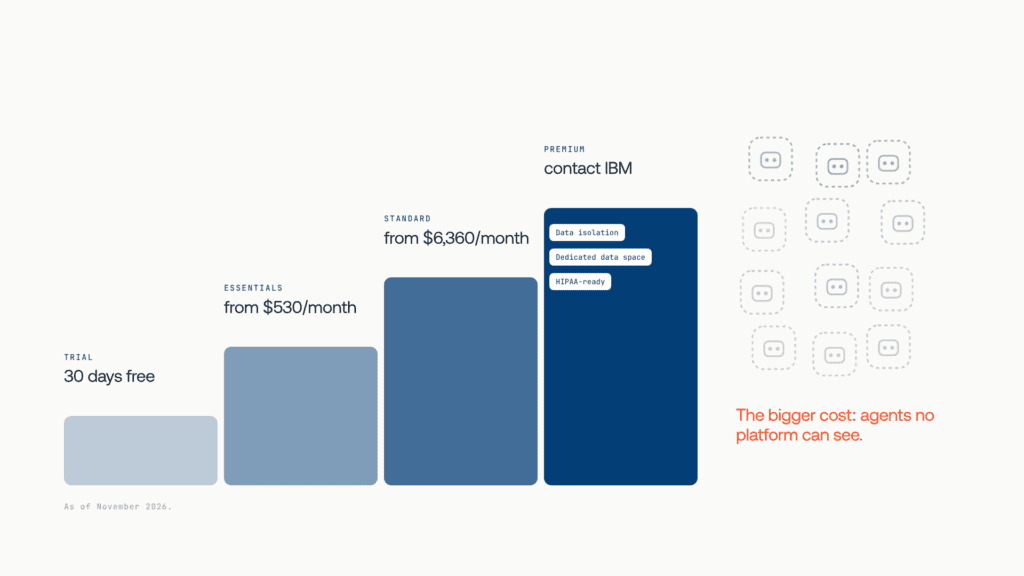
Model cost on usage and on-prem licensing, not the headline plan. For Lyzr pricing, contact Lyzr. In our view, licence price rarely decides this. The bigger cost is the agents no platform can see.
Who controls the agents IBM didn’t build?
This settles most shortlists, because no large company runs every agent on one platform.
Gartner predicts that by 2028 an average global Fortune 500 enterprise will have over 150,000 agents in use, up from fewer than 15 in 2025. Only 13% of organizations think they have the right AI agent governance in place.
Orchestrate governs its catalog agents well and can bring in the fraud agent. But the third-party KYC agent, the Kubernetes assistants and whatever gets built next sit wherever their builders put them. To counter this, ask four questions of any platform you are considering:
- Which agents exist across every cloud, and who owns each one?
- Which version of each is approved to run in production?
- What is each agent allowed to call, spend and touch?
- What stops a risky call before it completes, not after?
Most platforms answer the fourth question with a dashboard that shows the fraud agent sent account data to an unapproved model reports about what already happened. Stopping the agent takes a control point in the call path.
Shortlisting a control plane for agents built on IBM and everywhere else? See who sells one, what each really controls, and how to run a two-week bake-off. Get the buyer’s guide:
Which one should your enterprise choose?
Choose based on where your agents primarily run today.
Choose IBM watsonx Orchestrate if:
- IBM is your strategic platform.
- You want prebuilt HR, procurement or sales agents fast.
- Most agents will live in Orchestrate.
Choose Lyzr if:
- Your agents span AWS, Azure, GCP and several frameworks.
- You need control inside your own network, including air-gapped.
Use both if you’re on IBM but run agents elsewhere too. That’s the bank, and most enterprises with more than a handful of agents.
How Lyzr Opencontroller governs your whole agent estate
Opencontroller is that control layer. It finds every AI agent across your clouds, gives each one an owner, and limits what it can reach and spend. It doesn’t build or package your agents, and they stay in the runtimes you already use.
| The question | How Opencontroller answers it |
|---|---|
| Which agents exist, and who owns them? | Find: discovery, inventory, identity and access across AWS, Azure, GCP and on-prem |
| Which version is approved? | Ship: evaluation, approval and a record at the handoff into production, while your CI/CD keeps building and promoting |
| What can each agent call, spend and touch? | Run: agent and LLM gateways apply guardrails, budgets, policy and routing |
| What stops a risky call? | Guardrails for PII, secrets and injection refuse, mask or redirect it before it completes |
| Can we prove what happened? | Evidence and audit in one system of record |
It also answers the data question regulated buyers ask first. Opencontroller runs in your cloud account, private infrastructure or on-prem, including fully air-gapped. In customer-managed deployments, external traffic goes only to destinations you authorize, and no telemetry, credentials or evidence has to be exported to Lyzr.
Opencontroller doesn’t replace Orchestrate. In the bank, Orchestrate keeps the HR and procurement agents. Opencontroller sits over the rest: the fraud agent, the Kubernetes assistants, every new agent a team ships. When the fraud agent sends account data toward a model nobody approved, the LLM gateway masks or refuses the call, and the record names the agent and its owner.
That’s the difference between seeing an agent and controlling it. Book a demo to see Opencontroller govern your agents alongside your IBM workloads.
Frequently asked questions
It depends on your estate. In the Lyzr vs IBM watsonx Orchestrate choice, Orchestrate fits IBM-centric enterprises that want prebuilt domain agents. Lyzr fits enterprises whose agents span clouds and frameworks, with Opencontroller governing every agent. Many use both.
Orchestrate is one platform for building, orchestrating and governing agents on IBM Cloud, AWS or on-prem. Lyzr splits the jobs: Lyzr Studio builds agents, and Lyzr Opencontroller governs agents wherever they run.
Yes. Lyzr’s watsonx Orchestrate integration connects to IBM watsonx APIs and deploys Lyzr-built agents across cloud and on-premise watsonx environments, with an audit trail for each deployed agent.
For agents spread across clouds and frameworks, Lyzr is a strong alternative: Lyzr Studio for building, and Lyzr Opencontroller to find, approve and control every agent from inside your own network. It can also run alongside Orchestrate.
Yes. Lyzr Studio is the current name for Lyzr Agent Studio, Lyzr’s no-code and low-code agent builder. Lyzr Opencontroller is a separate product that governs agents after they’re built.
Book A Demo: Click Here
Join our Slack: Click Here
Link to our GitHub: Click Here
Got a use case in mind?
8 weeks from use case to agents running in production.
Platform, people and FDEs, all in. Bring your environment. We'll co-build and stay until it's live.
Talk to UsFree resource
101 AI Agents Use Cases
100+ production-ready AI agent use cases across Marketing, Sales, HR, Banking, Insurance, Operations and a lot more
Download now